国家开发银行

Search documents
哪家政策行薪酬最高?国开行2024年人均薪酬50.2万
Xin Lang Cai Jing· 2026-01-09 01:15
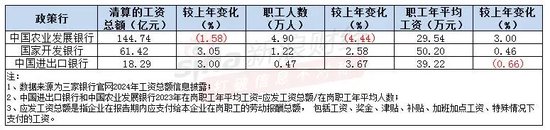
近期,多家银行披露了2024年度职工工资情况。 从薪酬表现看,三家政策性银行年度人均薪酬分化明显。其中,国家开发银行职工年平均工 资最高,为50.2万元;中国进出口银行较上年微降,为39.22万元;中国农业发展银行2024年 清算的工资总额及职工人数均有下降,但人均薪酬逆势上涨,增至29.54万元。此外,国有 大行中的工行、农行、中行、建行、交行也披露了2024工资分配信息,人均薪酬均超23万 元,交行在五大行中排名首位,达31.64万元。 此外,上述银行的职工队伍普遍呈现扩张之势,2024年仅中国农业发展银行和工商银行职工 人数缩减,其他均较上年增加,整体来看,中国进出口银行涨幅超3.6%;国家开发银行和 交通银行均超2.5%。 国开行2024人均薪酬超50万, 进出口银行微降 | 政策行 | 清算的工资 | 较上年变化 | 职工人数 | 较上年变化 | In REFER | 技 上年变化 | | --- | --- | --- | --- | --- | --- | --- | | 总额(亿元) | | %) | (万人) | (%) | 工资(万元) | (%) | | 中国农业发展银行 | 144.7 ...




【早知道】中国石化与中国航油实施重组;OpenAI进军医疗健康领域
Sou Hu Cai Jing· 2026-01-09 00:27
Group 1 - The Ministry of Commerce responded to the review of Meta's acquisition of Manus, stating that enterprises engaging in foreign investment activities must comply with Chinese laws and regulations [1] - The Ministry of Industry and Information Technology warned against irrational competition in the lithium battery industry, with participation from over ten leading companies [1] - China National Petroleum Corporation and China Aviation Oil Group Company are implementing a restructuring [1] Group 2 - Guangzhou is promoting the construction of the liquid rocket assembly testing base of CASIC in Nansha and the rapid establishment of the assembly base for Huangpu Xinghe Power Rocket [1] - OpenAI is entering the healthcare sector, with multiple companies targeting the AI healthcare market [1] - The China Development Bank plans to support nearly 20 billion yuan in funding for the elderly care sector by 2025 [1] Group 3 - Jiangxi is advancing the "Ying Shan Hong Action" upgrade project to support technology-based companies in formulating listing plans [1]

金融机构“追”着要AI应用方案 行业数字化改造向核心环节渗透
Shang Hai Zheng Quan Bao· 2026-01-08 16:49
Group 1 - Digital finance is a crucial part of the financial sector, linking technological innovation, business upgrades, and national strategy through bidding processes, reshaping service systems, business models, and competitive landscapes [2][5] - The shift in financial institutions' outsourcing bids from merely "finding people to work" to "ecosystem co-construction" reflects a transition from "heavy construction" to "heavy operation" in digital transformation [6][2] - The demand for AI applications is surging, leading to increased computing power needs, particularly for distributed and cloud-native core system upgrades [3][5] Group 2 - Huakun Zhenyu, a core hardware supplier for state-owned banks, expects its financial sector revenue to exceed 6 billion yuan in 2025, with a year-on-year growth rate of over 50% [4] - Recent bidding projects from major banks indicate a trend towards long-term, value-focused technology procurement, emphasizing "technology empowering business" rather than just hardware and software purchases [5][4] - The competitive landscape is intensifying as financial institutions increasingly seek to collaborate on digital finance initiatives, with a notable rise in project bids and the need for targeted solutions [7][8] Group 3 - The financial industry is experiencing a shift towards distributed core systems, with significant projects being launched by various banks, indicating a rapid upgrade cycle in the asset management sector [4][5] - AI technology is becoming a core component in various financial IT solutions, with smaller institutions also beginning to adopt AI applications, reflecting a trend of scaling up from larger institutions [5][4] - The financial sector's technology investments are expected to peak and slightly decline by 2026, amidst a complex landscape of overheating computing investments and the absence of standout AI applications [8][7]

货币市场日报:1月8日
Xin Lang Cai Jing· 2026-01-08 12:49
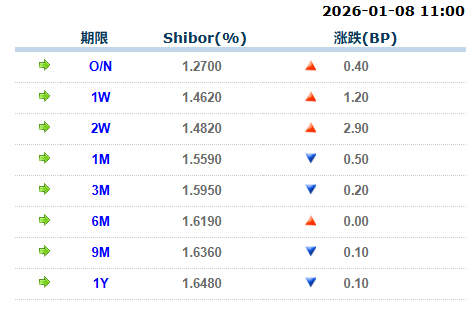
Group 1: Monetary Policy and Market Operations - The People's Bank of China conducted a 99 billion yuan reverse repurchase operation with a rate of 1.40%, maintaining the previous level, resulting in a net injection of 99 billion yuan into the market as there were no reverse repos maturing on that day [1] - The Shanghai Interbank Offered Rate (Shibor) for short-term instruments saw a slight increase, with overnight Shibor rising by 0.40 basis points to 1.2700%, 7-day Shibor up by 1.20 basis points to 1.4620%, and 14-day Shibor increasing by 2.90 basis points to 1.4820% [1] Group 2: Interbank Repo Market - In the interbank pledged repo market, short-term funding rates continued to fluctuate within a narrow range, with overnight rates increasing in both volume and price. The weighted average rates for DR001 and R001 rose by 0.2 basis points and 0.6 basis points, respectively, to 1.2695% and 1.3424%, with transaction volumes increasing by 3,121 billion yuan and 1,455 billion yuan [4] - The weighted average rates for DR007 and R007 showed mixed movements, with DR007 rising by 1.2 basis points to 1.474% while R007 fell by 0.6 basis points to 1.5261%, with transaction volumes decreasing by 176 billion yuan and 648 billion yuan, respectively [4] Group 3: Market Sentiment and Trading Activity - Overall, the funding environment on January 8 was balanced, with major banks lending out funds and non-bank overnight transactions occurring at rates around 1.45%. The market maintained stability post-open market operations, with overnight rates fluctuating between 1.30% and 1.42% [9] - In the secondary market for negotiable certificates of deposit, trading sentiment was generally moderate, with 1-month, 3-month, and 6-month maturities experiencing active trading. The 1-month national bank rate closed at approximately 1.54%, unchanged from the previous day, while the 3-month rate decreased by about 1 basis point to 1.60% [10]
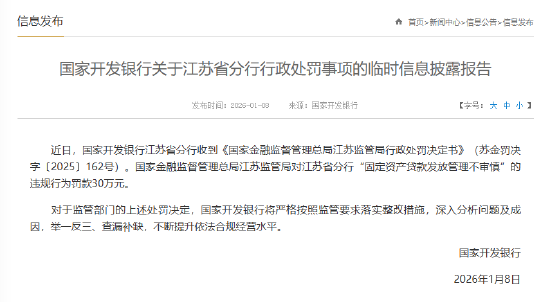
国家开发银行回应江苏省分行被罚:将举一反三、查漏补缺,不断提升依法合规经营水平
Xin Lang Cai Jing· 2026-01-08 11:02
1月8日金融一线消息,近日,国家开发银行江苏省分行因"固定资产贷款发放管理不审慎"被罚款30万 元。 对于监管部门的上述处罚决定,国家开发银行回应:将严格按照监管要求落实整改措施,深入分析问题 及成因,举一反三、查漏补缺,不断提升依法合规经营水平。 责任编辑:秦艺 1月8日金融一线消息,近日,国家开发银行江苏省分行因"固定资产贷款发放管理不审慎"被罚款30万 元。 对于监管部门的上述处罚决定,国家开发银行回应:将严格按照监管要求落实整改措施,深入分析问题 及成因,举一反三、查漏补缺,不断提升依法合规经营水平。 责任编辑:秦艺 ...
国开行:2025年支持养老领域投放资金近200亿元
Yang Shi Xin Wen· 2026-01-08 10:43
Core Insights - The National Development Bank plans to invest nearly 20 billion yuan in 2025 to support the development of China's elderly care industry and the silver economy [1] Investment Focus - The funding will prioritize the construction of community-based elderly care service networks and the enhancement of elderly care institutions [1] - The aim is to establish a three-tier elderly care service network covering urban and rural areas, promoting coordination among various forms of elderly care services [1] - The bank will also support the integration of elderly finance and technology finance, focusing on potential industries and exploring support for smart hardware, digital health monitoring, home automation, rehabilitation aids, elderly care robots, brain-computer interfaces, and artificial intelligence [1] Regional Development - The National Development Bank supports the development of silver economy industrial clusters in regions such as Beijing-Tianjin-Hebei, the Yangtze River Delta, the Guangdong-Hong Kong-Macao Greater Bay Area, and Chengdu-Chongqing [1] Future Plans - In 2026, the bank will leverage its policy-based financial functions to accelerate the implementation of benchmark projects in elderly care and the silver economy, aiming to create models and lead initiatives [1]
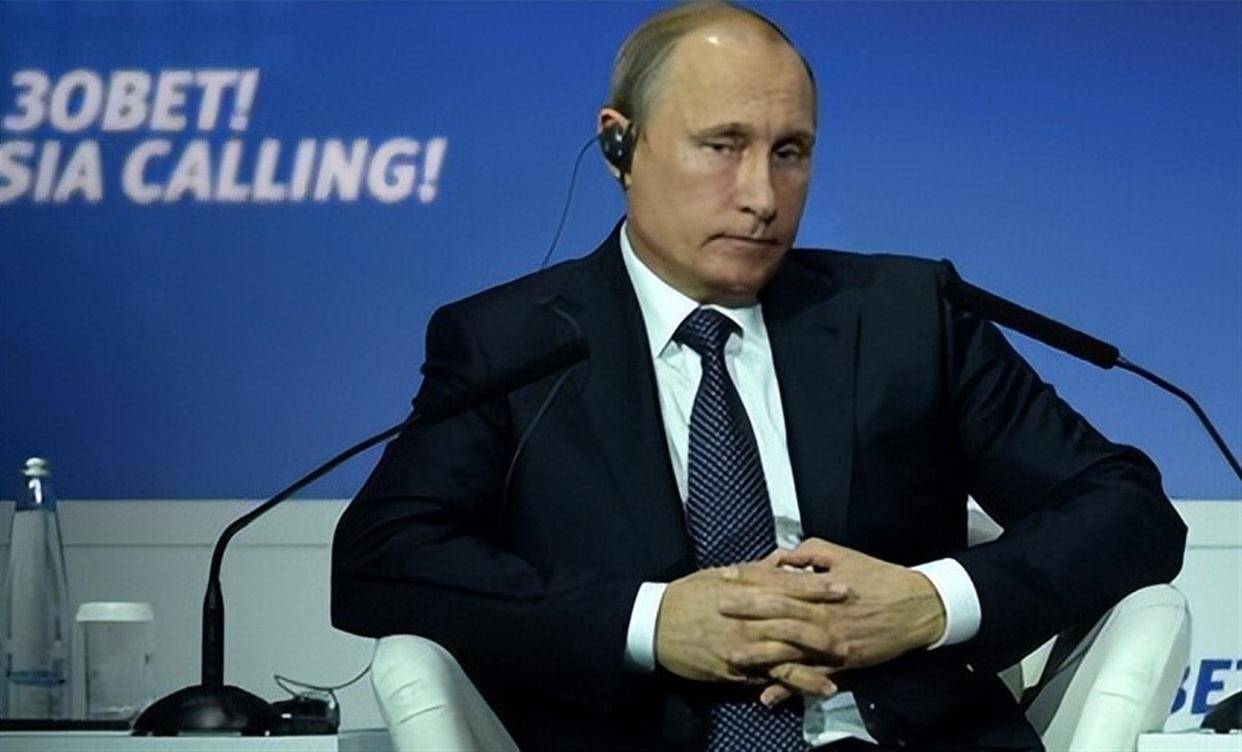
是机遇还是深坑?普京突然对中国掏出家底:边境划五大特区,10年免税
Sou Hu Cai Jing· 2026-01-06 07:51
Core Viewpoint - Russia aims to attract Chinese capital, technology, and enterprises to develop its vast but underpopulated Far East regions through significant tax incentives and policy stability [1][3]. Group 1: Policy and Economic Environment - Five regions in Russia have been designated as "International Advanced Development Zones," offering up to 10 years of tax exemptions and a 15-year policy stability guarantee [1]. - The Russian government is eager to exchange its natural resources for Chinese investments and infrastructure capabilities, reflecting a "resources for development" strategy [3]. - The rapid implementation of this policy has been described as "shock-style investment promotion" [3]. Group 2: Challenges and Risks - The Russian economy is currently under severe Western sanctions, leading to the exit of over 1,000 foreign companies since the escalation of the Ukraine conflict in 2022 [3]. - Legal and business environments in Russia are fraught with uncertainty, with laws allowing for the nationalization of foreign assets and the ambiguity of contract sanctity under "force majeure" claims [4]. - Chinese companies have faced payment delays and issues with fund repatriation, complicating their operations in Russia [6][7]. Group 3: Local Requirements and Constraints - The new special zone policies include localization requirements, mandating companies to register locally, hire local employees, and source materials locally, which can create a "soft lock-in" effect for businesses [7]. - Currency risk is significant, with the ruble experiencing extreme volatility, impacting the profitability of investments when converting revenues back to dollars or yuan [9]. - Infrastructure deficiencies in the Far East, such as sparse transportation networks and unstable power supply, hinder project execution and development [10]. Group 4: Historical Context and Trust Issues - Russia's attempts to develop the Far East are not new, with previous initiatives yielding limited success, as evidenced by a declining population and underutilized land [12]. - There exists a "trust deficit" in Sino-Russian relations, with Russian policymakers expressing caution about over-reliance on Chinese investments, leading to potential investment barriers [14]. Group 5: Strategic Recommendations for Chinese Enterprises - Chinese companies are advised to adopt light-asset, quick-turnaround investment models, focusing on cross-border trade and logistics rather than heavy manufacturing [16]. - Utilizing policy financial tools from Chinese banks can help mitigate risks associated with investments in Russia [16]. - Building reliable local partnerships and alliances is essential for navigating the complex regulatory landscape and reducing risks [18]. - Clear exit strategies must be included in investment agreements to address potential legal and political uncertainties [20].
西部陆海新通道建设不断提速
Jin Rong Shi Bao· 2026-01-06 01:25
Core Viewpoint - The construction of the Western Land-Sea New Corridor is a clear requirement outlined in the "14th Five-Year Plan," with the People's Bank of China and other departments issuing guidelines to enhance financial support for this initiative [1] Group 1: Financial Support Measures - The guidelines propose 21 key measures across six areas to improve financial services for the corridor, including enhancing organizational collaboration, strengthening financial support, optimizing cross-border settlement, and improving financial risk prevention [1] - The banking sector is identified as a primary financial force in supporting the corridor's development, with experts indicating that the guidelines clarify the direction and focus for banks in this initiative [1][2] Group 2: Cross-Regional Collaboration - The guidelines emphasize the establishment of cross-regional financial collaboration mechanisms to address existing coordination issues among banks, governments, and logistics entities [2] - The People's Bank of China aims to promote coordinated financial development across provinces and with countries along the corridor, facilitating a dual circulation economic model [2] Group 3: Digital Financial Services - The guidelines encourage the banking sector to innovate in digital financial services, with a focus on integrating blockchain technology and enhancing logistics financing services [4] - Digital financial services are highlighted for their advantages in risk identification, service efficiency, cost control, and product innovation, which are crucial for supporting the corridor's development [4] Group 4: Innovative Financing Models - The National Development Bank's Guangxi branch has adopted innovative financing models, providing significant funding for infrastructure projects to enhance the region's connectivity and trade with ASEAN countries [6] - The corridor serves as a key node in the Belt and Road Initiative, necessitating expanded financial cooperation and a clear financial collaboration network with relevant countries [6] Group 5: Responsibilities of the Banking Sector - The guidelines call for the banking sector to take on greater responsibilities in establishing financial cooperation mechanisms and exploring international financial collaboration [7] - Banks are encouraged to work with regulatory bodies and international organizations to develop financial solutions tailored to regional trade characteristics [7]
市场避险情绪未见明显增强
工银国际· 2026-01-05 13:46
Report Summary 1. Investment Rating The report does not mention the investment rating of the industry. 2. Core Views - The market's risk - aversion sentiment has not significantly increased. The new issuance of Chinese offshore bonds was sluggish last week due to the holiday, with basically no new issuance. The yields of US Treasury bonds showed differentiation, with the 10 - year and 2 - year US Treasury bond yields rising by 6 and falling by 1 basis point respectively last week to 4.19% and 3.47% [1][2]. - The minutes of the December FOMC meeting showed that most participants supported the December rate cut. Most participants believed that if inflation declines gradually as expected, further rate cuts might be appropriate. Although inflation is still above the Fed's policy target, in the absence of a further upward trend, most Fed officials tend to cut rates to support the job market [2]. - The situation in Venezuela over the weekend did not significantly boost the market's risk - aversion sentiment. The oil price remained generally stable, and the US Treasury bond yields in the Asian session on Monday did not change much. The Bloomberg Barclays China US - dollar bond total return index remained flat last week [1][3]. - After the New Year's Day holiday, funds flowed back to the banking system, and inter - bank funding rates dropped significantly. The yields of 3 - year and 10 - year Chinese government bonds remained unchanged and fell by 1 basis point respectively to 1.38% and 1.85%. The long - term Chinese interest rates have basically entered a volatile market since the end of August 2025, and their subsequent trends may depend on the implementation of further loose monetary policies [1][4]. 3. Summary by Related Catalogs Offshore Market - **New Issuance**: Affected by the holiday, the new issuance of Chinese offshore bonds was sluggish last week, with basically no new issuance [1][2]. - **US Treasury Bond Yields**: The 10 - year and 2 - year US Treasury bond yields showed differentiation, rising by 6 and falling by 1 basis point respectively last week to 4.19% and 3.47% [1][2]. - **Market Sentiment and Bond Index**: The situation in Venezuela over the weekend did not significantly push up the market's risk - aversion sentiment. The oil price was generally stable. The US Treasury bond yields in the Asian session on Monday did not change much. The Bloomberg Barclays China US - dollar bond total return index remained flat, with the high - rating index falling slightly by 0.1% and the high - yield index rising slightly by 0.1% [1][3]. Onshore Market - **Funding Rates**: After the New Year's Day holiday, funds flowed back to the banking system, and inter - bank funding rates dropped significantly. The 7 - day deposit - type institutional pledged - repo weighted - average rate and the 7 - day inter - bank pledged - repo weighted - average rate dropped by 17 and 48 basis points respectively to 1.43% and 1.45% [4]. - **Government Bond Yields**: The yields of 3 - year and 10 - year Chinese government bonds remained unchanged and fell by 1 basis point respectively to 1.38% and 1.85%. The long - term Chinese interest rates have basically entered a volatile market since the end of August 2025, and their subsequent trends may depend on the implementation of further loose monetary policies [1][4]. Appendix: List of Chinese US - dollar Bonds The appendix lists a large number of Chinese US - dollar bonds, including information such as the issuer, guarantor, coupon rate, issuance amount, maturity date, and ratings from Moody's, S&P, and Fitch [19][20][21].
2025,银行大罚单明显变多了
Xin Lang Cai Jing· 2026-01-04 12:48
Core Insights - A significant trend observed in 2025 is the increase in large fines imposed on banks, reflecting compliance shortcomings and risk points during the transition to high-quality development in the banking industry [2][16] - In 2025, regulatory authorities issued a total of 454 fines exceeding one million yuan to banking institutions and personnel, an increase of 58 from the previous year, with the total amount of fines nearly doubling [2][16] - The main areas of violations in 2025 were concentrated in credit business, anti-money laundering, and internal control systems, with anti-money laundering violations seeing the most notable increase, reaching 894 fines, a rise of 185.09% compared to the previous year [2][16] Summary of Fines Over 20 Million Yuan - In 2025, there were 12 fines disclosed with amounts exceeding 20 million yuan, primarily related to compliance management issues in traditional business areas such as loans and bills, indicating deficiencies in basic business risk control and regulatory cooperation [4][17] - Common violations included issues with account management and anti-money laundering, highlighting flaws in customer identity verification and transaction monitoring processes [3][17] Summary of Fines Between 10 Million and 20 Million Yuan - This category of fines predominantly involved joint-stock banks, reflecting a conflict between business innovation and compliance management [6] - Violations were mainly related to compliance operations (account and anti-money laundering) and business management (internet loans and agency sales), with cross-border foreign exchange violations being a secondary concern [7] Summary of Fines Between 5 Million and 10 Million Yuan - Fines in this range were primarily concentrated among city commercial banks, joint-stock banks, and rural commercial banks [10] - The most common violations included anti-money laundering and customer identity verification issues, alongside traditional problems related to credit "three checks" failures [10]