联电

Search documents
被逼转型的晶圆代工巨头
半导体行业观察· 2025-07-03 01:13
Core Viewpoint - The shift of mature foundries like UMC and GlobalFoundries towards advanced processes is driven by market pressures, including fierce competition from Chinese foundries and a significant decline in the profitability of mature processes [2][10]. Group 1: Strategic Shifts of Mature Foundries - UMC is evaluating the feasibility of developing a 6nm process to support high-complexity applications, marking a significant strategic shift for a company that previously focused on mature processes [4]. - GlobalFoundries, which had previously abandoned advanced process development, is also showing renewed interest in advanced nodes due to changing customer demands [4][10]. - UMC and GlobalFoundries are exploring potential collaboration, which could lead to the formation of a new foundry giant that poses a structural threat to TSMC in the mature process segment [5][6]. Group 2: Market Dynamics and Competitive Pressures - The rapid rise of domestic foundries in China, particularly SMIC, is reshaping the competitive landscape, with SMIC projected to surpass UMC in market capitalization by 2024 [8]. - The utilization rate of global mature process capacity has dropped from over 90% in 2022 to below 70% in 2024, leading to increased pricing pressures and reduced profit margins for mature foundries [9]. - UMC has reduced its capital expenditure budget to $1.8 billion for 2024, while SMIC continues to invest over $7 billion to expand its capacity [9]. Group 3: Challenges in Re-entering Advanced Processes - The estimated initial investment for a 6nm process is around $5 billion, which poses a significant financial challenge for companies transitioning from mature to advanced processes [11]. - The reliance on EUV technology for advanced nodes creates additional barriers, as the equipment is expensive and has limited availability, complicating the transition for companies like UMC and GlobalFoundries [11][12]. - The need to rebuild technical capabilities and attract talent in advanced processes presents a daunting challenge, as many skilled professionals have moved to leading players like TSMC and Samsung [13]. Group 4: Alternative Strategies from Other Foundries - Other foundries, such as VIS and PSMC, are focusing on niche markets and specialized processes, such as SiC and GaN, to differentiate themselves from competitors [15][16]. - Tower Semiconductor and X-FAB are also pursuing unique technological paths, emphasizing non-standard markets and regional manufacturing to avoid direct competition with Chinese foundries [17][18]. Group 5: The Landscape of Leading Foundries - Intel is facing challenges with its 18A process, considering significant strategic adjustments to attract key customers, while also dealing with delays in production timelines [20][21]. - Samsung has postponed its 1.4nm process launch to 2029, opting instead to enhance the efficiency of its existing processes to maintain profitability [25][26]. - TSMC continues to dominate the foundry market, with its market share increasing from 29.4% in Q1 2024 to 35.3% in Q1 2025, driven by strong demand for AI and HPC chips [28].


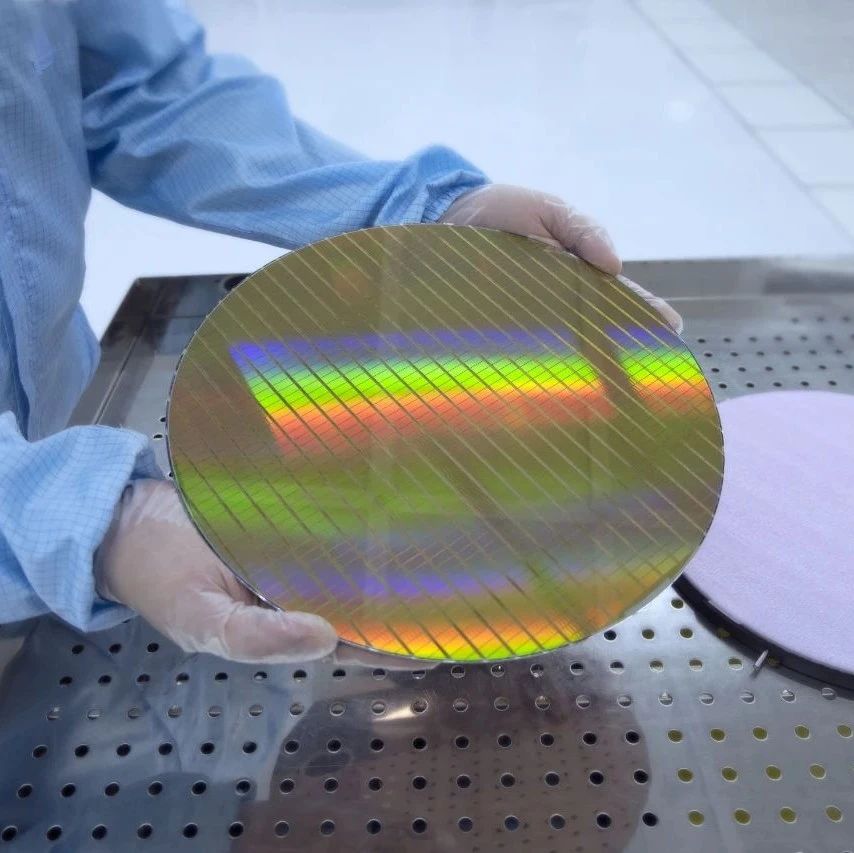
中国台湾成熟制程 不跟着拼量
Jing Ji Ri Bao· 2025-07-01 23:16
Group 1 - The core viewpoint highlights that while Chinese mainland wafer foundries are aggressively expanding capacity, Taiwanese manufacturers like TSMC are focusing on advanced processes and maintaining dominance in the global market by securing orders from major clients such as Apple, AMD, NVIDIA, and Qualcomm [1] - TSMC continues to lead in advanced process technology, while other Taiwanese foundries like UMC, GlobalFoundries, and Powerchip are forming alliances with international companies or enhancing niche products to avoid direct price competition with Chinese counterparts [1] - UMC is collaborating with Intel to develop 12nm technology in the U.S. and is considering entering advanced processes with a focus on 6nm technology for producing advanced WiFi, wireless RF, Bluetooth components, AI accelerators, and core processing chips for automotive applications [1] Group 2 - GlobalFoundries has been developing special process applications, focusing on silicon carbide (SiC) and gallium nitride (GaN) technologies, with plans to start mass production of 8-inch SiC wafers by the second half of 2026, targeting industrial control and consumer products initially, and later expanding into electric vehicles, AI data centers, and green energy applications [1] - Powerchip is gradually moving away from low-margin processes and seeking high-value product lines, having initiated the Wafer-on-Wafer (WoW) 3D stacking technology since 2019, particularly suitable for edge AI, automotive electronics, and high-performance computing (HPC) [2] - Motech is clearly positioning itself in the niche application market, focusing on high flexibility and customized orders, thereby strengthening its relationships with automotive and industrial control clients [2]
这种AI芯片材料,被垄断!
半导体芯闻· 2025-06-25 10:24
Core Viewpoint - The article highlights the critical supply constraints of T glass, a specialized material essential for high-performance AI servers, driven by the surging demand from major tech companies like Nvidia, AMD, and Microsoft [1][5][8]. Group 1: Supply Chain Dynamics - Major tech executives have been visiting Nitto Boseki, the sole high-end glass cloth supplier, to secure T glass for AI data centers, indicating a strategic move to ensure material availability [1][5]. - The demand for T glass is surging due to its rigidity, which prevents substrate bending during advanced chip packaging, crucial for AI chip production yield [2][5]. - Nitto Boseki has committed to investing 80 billion yen (approximately 550 million USD) to expand semiconductor material production, including T glass, aiming to double its capacity in Taiwan by March 2028 [5][8]. Group 2: Market Competition and Challenges - The supply of T glass has been particularly tight since the second half of last year, with many companies unable to secure additional capacity despite increased cash offers [5][12]. - Competitors like Taiwan Glass are looking to enter the T glass market, with plans to ramp up production by the end of 2025, potentially altering the market dynamics if they succeed in certification processes [10][11]. - The article notes that while new entrants are emerging, the production of high-end T glass requires significant time and expertise, suggesting that Nitto Boseki may maintain its critical position in the supply chain for the foreseeable future [12]. Group 3: Financial Performance - Nitto Boseki reported sales of 109 billion yen in the last fiscal year, a 17% increase year-on-year, with profit margins rising from 9% to 15.1%, largely driven by AI application demand [8].


联电要在台湾扩产?
半导体行业观察· 2025-06-21 03:05
Core Viewpoint - The article discusses UMC's potential acquisition of a factory from Han Yu Crystal in Tainan Science Park, emphasizing the company's strategic focus on expanding advanced packaging capabilities in Taiwan and Singapore [1][3]. Group 1: Company Strategy - UMC is exploring opportunities for operational and profit enhancement, including factory acquisitions, technology collaborations, and new investments, with Taiwan remaining a key expansion option [3][5]. - The company plans to integrate wafer fabrication with advanced packaging solutions, moving beyond traditional foundry services to high-value areas [4][5]. Group 2: Technological Development - UMC has established 2.5D advanced packaging capabilities in Singapore and is leveraging wafer-to-wafer bonding technology, which is crucial for 3D IC manufacturing [4][5]. - The company is currently focused on 12nm process technology in collaboration with Intel, while also looking to diversify into compound semiconductors and specialized materials [4][5]. Group 3: Production Capacity - UMC's interposer production currently stands at approximately 6,000 units per month, with no immediate plans for capacity expansion [5]. - Future efforts will concentrate on developing integrated technologies with higher added value, providing comprehensive system-level solutions for clients [5].
另类视角看中芯:港 A 价差背后,信仰鸿沟多大?
海豚投研· 2025-06-20 11:46
Core Viewpoint - The article discusses the valuation discrepancies between SMIC's A-shares and H-shares, highlighting the contrasting perspectives of domestic and foreign investors regarding the company's potential and investment returns [1][39]. Group 1: Investment Characteristics - SMIC is viewed as a critical asset in China's semiconductor industry, with significant production capacity and a leading position in mature process technology [5][40]. - The company has experienced substantial revenue growth, with a projected revenue of $8 billion in 2024, reflecting a compound annual growth rate of 16% over six years [9]. - However, capital expenditures have also surged, reaching $7.3 billion in 2024, indicating that over 90% of revenue is reinvested into capital [10][19]. Group 2: Financing and Cash Flow - SMIC's financing sources include equity financing, debt financing, and non-controlling shareholder investments, with each contributing approximately equally over the past six years [21]. - The company raised $7.5 billion through its IPO in 2020 and has accumulated $9.4 billion in net borrowings over seven years [23][24]. - Recent trends show a decline in state-owned capital injections, with only $280 million received in 2024, significantly lower than previous years [30]. Group 3: Valuation Discrepancies - The valuation gap between SMIC's A-shares and H-shares is attributed to differing investment philosophies, with domestic investors viewing it as a strategic asset while foreign investors see it as less unique compared to competitors like TSMC [39][41]. - Domestic investors are more likely to adopt a long-term perspective, while foreign investors focus on short-term returns and may not be willing to endure the associated risks [41][42]. - The article suggests that SMIC's valuation is likely to remain structurally different due to these contrasting views, making it challenging to reconcile the price differences in the market [43]. Group 4: Investment Opportunities - SMIC is characterized as a heavy asset business with cyclical performance, and its valuation is expected to fluctuate between 1-2 times price-to-book (PB) ratio based on market conditions [50]. - The company is positioned as a "growth reserve," with potential for higher PB elasticity when trading below 1 PB, but risks of significant declines when trading above 2 PB without fundamental breakthroughs [54]. - Investors are encouraged to consider their investment horizon and the nature of returns they seek, especially given the cyclical nature of the semiconductor industry [55].


2025Q1全球晶圆代工市场:中芯国际份额升至6%,排名第三!
Sou Hu Cai Jing· 2025-06-09 15:55
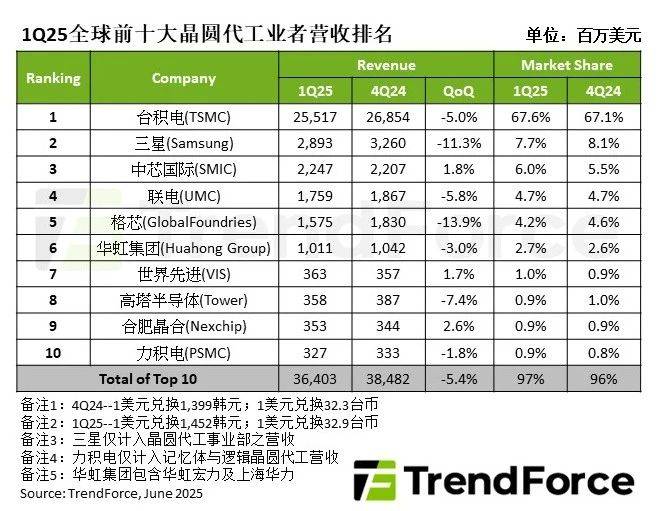
Core Viewpoint - The global wafer foundry market revenue is expected to decline by approximately 5.4% quarter-on-quarter to $36.4 billion in Q1 2025, influenced by international market conditions and preemptive inventory stocking by various manufacturers [1] Group 1: Market Overview - The overall wafer foundry market revenue for Q1 2025 is projected to be $36.4 billion, down from $38.5 billion in Q4 2024 [2] - TSMC remains the market leader with a revenue of $25.5 billion and a market share of 67.6%, despite a 5% decline from the previous quarter [2][4] - Samsung's foundry revenue decreased by 11.3% to $2.89 billion, resulting in a market share drop to 7.7% [4] - SMIC's revenue increased by 1.8% to $2.25 billion, with a market share rise to 6% [4] - UMC's revenue fell by 5.8% to $1.76 billion, maintaining a market share of 4.7% [4] - GlobalFoundries experienced a significant revenue drop of 13.9% to $1.58 billion, with a market share of 4.2% [4] Group 2: Company Performance - Huahong Group's revenue decreased by 3% to $1.01 billion, with a market share of 2.7% [5] - VIS saw a revenue increase of 1.7% to $363 million, achieving a market share of 1% [5] - Tower Semiconductor's revenue declined by 7.4% to $358 million, with a market share of 0.9% [5] - Nexchip's revenue grew by 2.6% to $353 million, maintaining a market share of 0.9% [5] - PSMC's revenue decreased by 1.8% to $327 million, with a market share of 0.9% [5] Group 3: Future Outlook - The second quarter is expected to see a slowdown in momentum as the preemptive inventory stocking due to tariffs concludes, but the continuation of China's trade-in subsidy policy and upcoming smartphone launches are anticipated to drive demand [5]
全球晶圆代工TOP10,最新出炉!
Sou Hu Cai Jing· 2025-06-09 14:32
Core Insights - The global wafer foundry industry is expected to see a revenue decline of approximately 5.4% in Q1 2025, totaling $36.4 billion, influenced by international market conditions and seasonal factors [2][3] - The second quarter is anticipated to show revenue growth for the top ten foundries, driven by China's old-for-new subsidy policy, pre-launch inventory for new smartphone models, and stable demand for AI HPC [2] Company Performance - TSMC remains the market leader with a revenue of $25.5 billion in Q1 2025, a decrease of 5% quarter-over-quarter, holding a market share of 67.6% [3][4] - Samsung's foundry revenue fell by 11.3% to $2.89 billion, with a market share of 7.7%, primarily due to weak mobile chip demand and ongoing inventory adjustments [5] - SMIC reported a revenue increase of 1.8% to $2.25 billion, benefiting from customer pre-orders and domestic consumption subsidies, ranking third in the industry [6] - UMC's revenue decreased by 5.8% to $1.76 billion, maintaining its fourth position, with stable wafer shipments offsetting seasonal impacts [6] - GlobalFoundries experienced a revenue decline of 13.9% to $1.58 billion, while HuaHong Group ranked sixth with stable performance [7] - Vanguard's revenue increased by 1.7% to $363 million, moving up to seventh place, while Tower's revenue decreased by 7.4% to $358 million [7] - Nexchip's revenue grew by 2.6% to $353 million, ranking ninth, while PSMC's revenue slightly decreased by 1.8% to $327 million, placing it tenth [8] Market Trends - TSMC's advanced process technologies, particularly in AI and HPC, are driving revenue growth, with 3nm, 5nm, and 7nm processes contributing 73% of wafer sales [4] - AI chip demand is projected to be a significant growth driver for TSMC, with a forecasted 100% increase in AI accelerator chip sales in 2025 [4] - SMIC anticipates a revenue decline of 4% to 6% in Q2 2025, indicating a challenging market environment ahead [6]
台积电市占,创历史新高
半导体芯闻· 2025-06-09 10:34
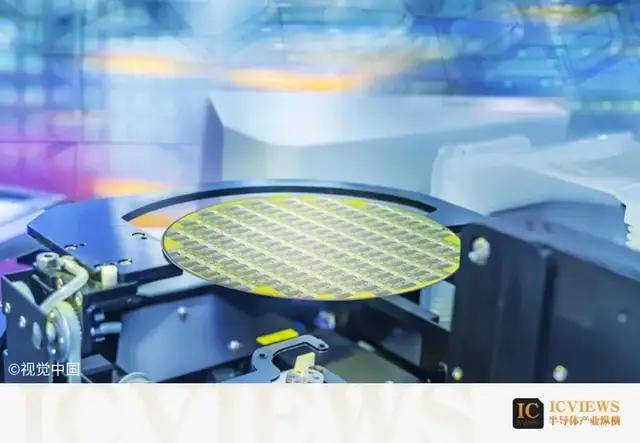
如果您希望可以时常见面,欢迎标星收藏哦~ 来源:内容来自联合报 。 集邦科技今日发布首季晶圆代工市占调查,美国新关税政府引发的提前备货及中国旧换新补贴影 响,急单涌进,抵销淡季效应,首季营收季减5.4%,优于预期,台积电也挟AI及HPC订单需求稳 定,首季全球市占再向上推升,达到67.6%,稳坐全球第一。 集邦调查,第1季主要晶圆代工厂营收合计仅季减约5.4%,为364亿美元,优于预期。展望第2季营 收表现,随着关税引发的提前备货告一段落,整体动能逐步放缓,唯中国旧换新的补贴政策拉货潮 有望延续,加上下半年智慧手机新品上市前备货陆续启动,以及AI HPC需求稳定,将成为带动第 2季产能利用率和出货的关键,预期前十大晶圆代工厂营收将呈现季增。 集邦指出,第1季各晶圆代工业厂仍由台积电以67.6%市占率稳居第一,虽其晶圆出货虽因智慧手 机备货淡季而下滑,但因AI及HPC需求和电视的关税避险急单仍然强劲,抵销手机端需求下滑不 利因素,营收255亿美元,季减5%。 第二名的三星代工部门因美国先进制程禁令限制中国客户投产,以及其客户组成关系,获得中国消 费补贴的红利有限,第1季营收季减11.3%,为28.9亿美元,市占 ...

【太平洋科技-每日观点&资讯】(2025-06-03)
远峰电子· 2025-06-02 09:23
Market Overview - The main board saw significant gains with notable stocks such as Yuyin Co. (+10.07%), Times Publishing (+10.02%), and Hengbao Co. (+10.00%) leading the charge [1] - The ChiNext board also performed well, highlighted by Xiongdi Technology (+13.22%) and Shangluo Electronics (+12.74%) [1] - The Sci-Tech Innovation board was led by Lais Information (+4.55%) and Gai Lun Electronics (+4.25%) [1] - The SW Education Publishing sector showed a slight increase of 0.64% [1] Domestic News - TSMC's subsidiary, Caiyu, is aggressively developing super-surface technology to enter the AR glasses market, aiming to expand its consumer product offerings and explore silicon photonics opportunities [1] - Unisoc launched a fully domestically produced enterprise-level PCIe 5.0 SSD, the Unisoc Flash E5200, featuring domestic main control chips and 3D TLC storage particles [1] - UMC announced its collaboration with Intel on a 12nm process, which is a key development plan expected to achieve mass production by 2027 [1] - ASE introduced a new chip-on-wafer bridge technology utilizing TSV to enhance I/O density and thermal performance, addressing increasing bandwidth demands [1] Company Announcements - Kangxi Communication reported a reduction in shareholding by a major shareholder, Pan Bin, who decreased his stake to below 5% by selling 2,293,073 shares [3] - Airong Software announced a cash dividend distribution of 1.50 yuan per 10 shares, totaling 31,332,495 yuan [3] - Huashi Technology received five invention patents for its independently developed products, with a patent term of 20 years [3] - Runze Technology disclosed a reduction in shareholding by major shareholders, who sold 2,457,300 shares, representing 0.1427% of the total share capital [3] Overseas News - New思科技 reported receiving a letter from the U.S. Department of Commerce regarding new export restrictions to China, prohibiting sales and access to certain services [4] - DRAMeXchange reported a significant increase in the average trading price of PC DRAM products, which rose by 27.27% in May [4] - TrendForce indicated that NAND Flash suppliers faced a 15% decline in average selling prices in Q1 2025, with total revenue for the top five brands dropping nearly 24% [4] - AMD plans to launch a new AI chip tailored for the Chinese market, based on the RDNA4 architecture, following Nvidia's similar move [4]