
雀巢

Search documents
3 Wealth-Building Vanguard ETFs to Buy Hand Over Fist in 2026
Yahoo Finance· 2026-01-29 13:36
Core Insights - The article emphasizes that extraordinary investment results can be achieved without extraordinary efforts, highlighting the effectiveness of low-cost index funds, particularly those from Vanguard [1][2]. Investment Opportunities - Vanguard offers several ETFs that are considered excellent for wealth-building: - **Vanguard Total Stock Market ETF (VTI)**: This ETF tracks the overall stock market and has an expense ratio of 0.03%. It has an annualized return of 9.21% since May 2001 [3]. - **Vanguard Dividend Appreciation ETF (VIG)**: Focused on stocks with strong dividend growth, this ETF has an expense ratio of 0.05% and an annualized return of 9.99% since April 2006. Notable investments include Broadcom and Microsoft [3]. - **Vanguard International High Dividend Yield ETF (VYMI)**: This ETF provides international stock exposure with a current yield of approximately 3%. It has an annualized return of 10.61% since February 2016, featuring well-known companies like Nestle and Toyota [3].
冻干食品行业深度:内需释放新动能,供应链创新驱动未来
NORTHEAST SECURITIES· 2026-01-29 08:25
Investment Rating - The report rates the industry as "Buy" based on the growth potential and market dynamics observed in the freeze-dried food sector [3]. Core Insights - The freeze-dried food industry in China is entering a high-growth phase, with the market size expected to grow from 0.848 billion RMB in 2014 to 3.8 billion RMB by 2024, reflecting a compound annual growth rate (CAGR) of 16.1% [2][26]. - The global freeze-dried food market is projected to reach USD 30.43 billion by 2024 and USD 56.27 billion by 2034, indicating a robust growth trajectory driven by health-conscious consumer trends and the rise of outdoor activities [2][12]. - China's freeze-dried food consumption is significantly lower than that of developed countries, indicating substantial growth potential as domestic demand is expected to be a key driver for the industry [2][27]. Summary by Sections 1. Industry Development and Market Dynamics - The freeze-dried food market has evolved through three stages: initial exploration, export-driven growth, and recent domestic demand-driven expansion [21][23]. - The technology behind freeze-drying preserves over 95% of nutrients, making it a preferred choice for health-conscious consumers [15][18]. - The industry is characterized by low penetration rates in China compared to developed markets, suggesting a significant opportunity for growth as consumer awareness and demand increase [27][32]. 2. Global Market Trends - The global freeze-dried food market is expanding, with Asia as a major supplier and Europe and North America as key consumers [2][12]. - Freeze-dried fruits hold the largest market share, followed by meat, seafood, and vegetables, indicating diverse product opportunities [2][12]. 3. Competitive Landscape - The competitive landscape is shifting from a focus on single product categories to multi-scenario applications, with companies diversifying their offerings to include ready-to-eat meals and snacks [38][44]. - Major players in the industry include both international brands like Nestlé and domestic leaders such as Three Squirrels and Good Products, reflecting a fragmented market structure [46]. 4. Policy and Regulatory Environment - The industry is supported by a robust policy framework aimed at ensuring food safety and promoting technological advancements, which are crucial for high-quality development [49][50]. - Recent regulations encourage the use of freeze-drying technology in high-end food products, particularly for infant nutrition, highlighting the government's support for this sector [49].
FDA合成色素禁令后,哪些生物合成色素企业在涌入赛道?
合成生物学与绿色生物制造· 2026-01-29 06:36
Core Viewpoint - The article discusses the increasing demand for natural food colorants driven by regulatory changes and consumer preferences, particularly in light of the FDA's plan to phase out certain synthetic colorants by the end of 2026, creating a significant market opportunity for natural alternatives [2][5]. Group 1: Regulatory Changes and Market Impact - The FDA plans to eliminate eight synthetic colorants, including Tartrazine (E102), by the end of 2026, prompting major food and beverage companies to reformulate their products [2][4]. - This regulatory shift is expected to accelerate the transition towards natural colorants, with the global natural food colorant market projected to grow from approximately $2 billion in 2025 to over $4 billion by 2030 [5]. Group 2: Challenges and Technological Innovations - Key challenges in adopting natural colorants include stability, cost, and supply chain issues, with technologies such as microencapsulation, fermentation engineering, and plant cell culture being explored to address these challenges [6][8]. - Various natural colorant alternatives are being developed, including Lutein, Curcumin, Safflower Yellow, and Beet Red, which have shown progress in application within food products [6]. Group 3: Industry Players and Developments - Several companies are entering the natural colorant space, including Michroma, which uses filamentous fungi for fermentation to produce heat-stable red colorants, and Chromologics, focusing on natural red colorants through fungal fermentation [9][10]. - In China, companies like ZhiNuo Technology and DaoSheng Bio are making strides in microbial colorants, with ZhiNuo achieving significant growth in fermentation capacity and DaoSheng's blue colorant receiving FDA registration [12][13]. Group 4: Future Outlook and Competitive Landscape - The dual drivers of policy and consumer demand are pushing the industry towards natural colorant solutions, with companies needing to establish supply chains and participate in international standard-setting to remain competitive [13]. - The competition in the natural colorant market will not only focus on replacing synthetic options but also on technology, sustainability, and brand trust [13].



贝因美:应对行业挑战,书写价值竞争新篇章
Jin Tou Wang· 2026-01-28 08:27
Core Viewpoint - The article discusses the challenges and strategies of Beingmate, a prominent Chinese infant formula brand, in the context of a shrinking market and increasing competition, emphasizing its commitment to quality and fair pricing. Group 1: Industry Context - The Chinese infant formula market is experiencing a significant decline, with the number of newborns dropping below 10 million and the market size shrinking from nearly 2000 billion yuan in 2019 to 1635 billion yuan in 2024 [5] - The industry is undergoing a transformation due to stricter regulations and changing consumer preferences, leading to a shift from growth to competition in a saturated market [4][5] - Beingmate's market share has decreased to approximately 1.7%, falling out of the top ten brands in the industry [5] Group 2: Company Strategy - Beingmate has adopted a "genuine and reasonable" strategy, focusing on product quality and fair pricing, with a commitment to only earning a 5% profit margin [10][12] - The company aims to enhance its supply chain management and product quality, as demonstrated by its response to a recent ARA ingredient recall incident [7][18] - Beingmate is diversifying its product offerings beyond infant formula to include organic A2 milk powder, adult nutrition products, and other family health products, aiming to create a comprehensive ecosystem for family health [8][9][10] Group 3: Financial Performance - In 2024, Beingmate reported a revenue increase of 9.7% to 2.773 billion yuan and a net profit growth of 116.92%, indicating a positive turnaround after years of losses [14] - The company has improved its operational efficiency, with a 7.51% decrease in sales expenses while increasing targeted advertising on platforms like Xiaohongshu and Douyin [12][14] - Beingmate's financial stability is reflected in its cash reserves of 1.543 billion yuan and manageable short-term debt of 1.123 billion yuan as of the first quarter of 2025 [14] Group 4: Market Positioning - Beingmate ranks among the top four domestic infant formula brands, indicating a solid brand foundation and market recognition despite recent challenges [14] - The company's focus on quality and consumer trust is crucial in a market where consumers are increasingly discerning about product safety and nutritional value [15][18] - The "genuine and reasonable" approach is seen as a potential way to rebuild consumer trust and differentiate itself in a highly competitive market [19][22]

嘉必优陷雀巢奶粉召回风波,外媒指原料污染源头为中国供应商
Guan Cha Zhe Wang· 2026-01-27 10:41
(文/解红娟 编辑/张广凯) "该辟谣的都辟谣了。" 在业内人士看来,尽管目前尚未有官方明确通知,但瑞士联邦食品安全局(BLV)的相关结论,已然变 相坐实了此次涉事ARA(花生四烯酸)原料的供应商正是嘉必优。 近日,瑞士《每日广讯报》(Tages-Anzeiger)报道,瑞士联邦食品安全局(BLV)表示,受污染的微 量原料花生四烯酸(ARA)来自中国供应商,该公司是全球三大ARA生产商之一。 此消息一出,作为国内ARA行业龙头企业的嘉必优,瞬间被推至舆论风口浪尖。 观察者网了解到,全球ARA市场的三大核心生产商分别为荷兰帝斯曼-芬美意、中国嘉必优以及中国润 科生物。在污染事件爆发后,帝斯曼-芬美意、中国润科生物均迅速发声撇清关联,唯有嘉必优始终没 有正面回应。 具体来看,帝斯曼-芬美意明确表示"涉事问题ARA原料并非由其供应",并称作为全球ARA营养原料的 长期可靠供应商,始终将产品质量与安全置于首位,其生产的life's ARA完全按照全球最高婴配级标准 生产,确保每一步都可控、可溯、可靠。 同时,帝斯曼-芬美意还透露,受此次事件影响,其ARA原料需求激增,公司将全力协调产能以满足市 场需求。 润科生物则发 ...

全球大公司要闻 | 千问最强模型发布,紫金矿业扫货金矿
Wind万得· 2026-01-27 02:03
Group 1 - Alibaba officially released the Qwen3-Max-Thinking flagship reasoning model with over 1 trillion parameters, achieving significant performance improvements and surpassing top models like GPT-5.2 and Claude Opus4.5 in key benchmarks [2] - Zijin Mining announced plans to acquire 100% of United Gold for 28 billion yuan, which includes gold resources in Mali, Côte d'Ivoire, and Ethiopia, enhancing the company's gold resource portfolio [2] - Nvidia announced a $2 billion investment in CoreWeave to strengthen collaboration in AI computing infrastructure and accelerate AI factory construction, aiming to deploy over 5 GW of computing power by 2030 [2] Group 2 - Tencent held its 2025 employee conference, with CEO Ma Huateng stating that TEG and CSIG will lead Tencent's AI initiatives, focusing on an integrated approach to large models and AI products while maintaining user privacy [4] - TSMC's earnings report and guidance led Goldman Sachs to raise its 12-month target for Taiwan's weighted index from 32,400 to 34,600, reflecting recognition of TSMC's leadership in AI and HPC [4] - Foxconn's stock surged due to supply disruptions from a winter storm in North America and China's proposed "anti-involution" policy, which is expected to support Taiwan's petrochemical exports and margins in the long term [4] Group 3 - The U.S. Rare Earth Company received a $1.6 billion investment from the Trump administration for developing Texas rare earth mines and an Oklahoma magnet factory, with total funding reaching $3.1 billion [6] - Microsoft launched the new AI chip Maia 200, built on TSMC's 3nm process, aimed at reducing dependency on Nvidia, while also addressing issues with Windows 11 updates causing device startup failures [6] - Apple released the second-generation AirTag with a 50% increase in range and larger volume, while Q1 earnings are expected to show steady growth [6] Group 4 - Samsung Electronics reported a 3-4 times increase in consumer-grade DDR5 memory prices over the past two months and announced a stock reward program for employees [10] - Toyota began production of the 2026 hybrid RAV4 in Canada and recalled 162,000 Tundra models in the U.S., with sales in China showing signs of recovery despite a 3.6% drop in stock price due to yen appreciation [10] - LG Group's LG Display is collaborating with Korean companies to develop glass interlayers for expanding semiconductor packaging business [10]

婴儿配方奶粉危机蔓延,达能股价暴跌
Xin Lang Cai Jing· 2026-01-26 12:03
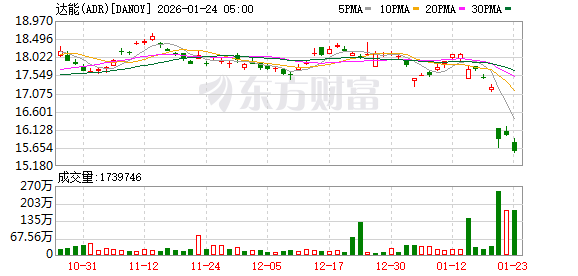
Core Viewpoint - Danone and Nestlé are recalling multiple batches of infant formula due to concerns about potential contamination with a dangerous toxin, leading to a significant drop in Danone's stock price [1][2]. Group 1: Stock Performance - Danone's stock fell by 5.9% on Monday, continuing a decline of over 10% from the previous week [2][7]. - The current stock price is €64, marking a one-year low, down from €80 in November of the previous year [8]. Group 2: Recall Details - The recall involves a "very small number of specific batches" of infant formula, initiated after similar actions by Nestlé and Lactalis [1][6]. - The products are being recalled in Singapore and Europe due to potential contamination with Bacillus cereus toxin, which can cause nausea and vomiting [2][7]. - The Irish Food Safety Authority has requested Danone to recall certain batches produced at its Irish facility, which supplies multiple European countries [8]. Group 3: Financial Impact - Jefferies analyst David Hayes noted that the sales from the recalled products are estimated to be less than €40 million [8]. - Bernstein analyst Callum Elliott estimated that the direct impact on Danone's revenue from the recall will be less than €50 million [9]. - If Danone's core brand, Aptamil, which contributes 30% of the company's profits, is affected, it could lead to reputational damage [9]. Group 4: Industry Context - The recall is part of a broader issue affecting the industry, with Nestlé's global recall potentially costing up to €1.6 billion, equivalent to 1.7% of its sales [3][4]. - Nestlé has apologized for the recall and stated that it does not expect a significant financial impact [4].

达能在欧采取预防性召回措施,回应称不涉及中国市场在售产品
Nan Fang Du Shi Bao· 2026-01-26 10:24
总部位于法国巴黎的跨国食品巨头达能(Danone)日前发布召回信息,称遵循欧洲主管部门最新指导意见,在部分市场召回数量极为有限的特定批次婴幼 儿配方产品。 达能在公告中强调,此次召回是预防性措施,表示无论是日常监控措施,还是基于当前行业特殊情况而开展的额外专项分析,均确认达能的产品是安全的, 且完全符合相关法规要求。1月26日,达能中国向南都湾财社记者表示,此次在部分市场启动的预防性召回产品数量极为有限,相关产业也未通过官方渠道 进入中国市场。 达能发布的召回公告 公司表示中国市场不受召回事件影响 欧洲主管部门指导意见调整触发召回 根据爱尔兰食品安全局1月23日发布的公告,达能正在召回特定批次的婴儿配方奶粉和后续配方奶粉,相关产品在爱尔兰生产,并出口到多个欧盟国家、英 国和其他国家,但未在爱尔兰分销。南都湾财社记者发现,西班牙、以色列、英国、法国等几个国家已发布召回通知,据悉,特定批次产品涉及Gallia、 Blédilait、ALMIRON PROFUTURA等品 爱尔兰食品安全局官网截图 1月26日,达能中国相关负责人向南都湾财社记者表示,近日,欧洲主管部门指导意见调整触发产品召回,该行为是预防性措施,仅 ...
东鹏饮料:复盘日本咖啡发展,现制咖啡为即饮咖啡起到带动作用-20260126
ZHONGTAI SECURITIES· 2026-01-26 07:35
Investment Rating - The report maintains a "Buy" rating for the company [4][23][27] Core Insights - The Japanese coffee market has evolved through four stages, leading to a complementary relationship between freshly brewed and ready-to-drink coffee, creating a full consumption loop [6][9][20] - The ready-to-drink coffee market in Japan reached a size of approximately 930 billion yen in 2023, with a stable competitive landscape dominated by Suntory's BOSS and Coca-Cola's GEORGIA [6][20] - The Chinese coffee market is experiencing rapid growth, with ready-to-drink coffee benefiting from the consumer base cultivated by freshly brewed coffee, leading to a significant increase in per capita coffee consumption [18][19][21] Financial Projections - The company is projected to achieve revenues of 11,263 million yuan in 2023, growing to 34,006 million yuan by 2027, with a compound annual growth rate (CAGR) of 32% [4][23] - The net profit attributable to the parent company is expected to rise from 2,040 million yuan in 2023 to 7,764 million yuan in 2027, reflecting a CAGR of 35% [4][23] - Earnings per share (EPS) is forecasted to increase from 5.10 yuan in 2023 to 14.93 yuan in 2027 [4][23] Market Dynamics - The competition in the ready-to-drink coffee segment has shifted from foreign dominance to a three-way competition among Nestlé, Starbucks, and local brand Dongpeng Beverage, which is expected to capture nearly 14% market share by late 2025 [21][23] - The report highlights that the ready-to-drink coffee segment is expected to grow rapidly, driven by the increasing consumer education and habits established by freshly brewed coffee [21][23] - The pricing strategy in the freshly brewed coffee market has led to a significant increase in the proportion of coffee priced below 15 yuan, enhancing market accessibility [20][21]

东鹏饮料(605499):复盘日本咖啡发展 现制咖啡为即饮咖啡起到带动作用
Xin Lang Cai Jing· 2026-01-26 06:35
Group 1: Japan Coffee Market Insights - Japan's coffee market has evolved through four iterations, starting from traditional coffee shops to convenience store coffee revolutionizing the market [1] - Key milestones include the introduction of canned coffee by UCC in 1969 and Starbucks' "third place" concept in 1996, which transformed coffee consumption from a functional beverage to a lifestyle choice [1] - As of 2023, the ready-to-drink coffee market in Japan reached 930 billion yen, dominated by Suntory's BOSS and Coca-Cola's GEORGIA, indicating a stable industry development [1] Group 2: China Coffee Market Dynamics - The Chinese coffee market is experiencing rapid growth, with ready-to-drink coffee emerging as a core driver, led by local brands like Luckin and Kudi optimizing efficiency through "delivery + digitalization" [2][3] - By 2024, per capita coffee consumption in China is projected to reach 22.24 cups, a significant increase from 16.74 cups in 2023, marking the first time per capita consumption exceeds 20 cups [2] - The competition landscape for ready-to-drink coffee is shifting from foreign dominance to a triopoly among Nestlé, Starbucks, and local brand Dongpeng Beverage, with Dongpeng's market share approaching 14% by November 2025 [4] Group 3: Investment Recommendations - The ongoing expansion of the coffee industry and the differentiation between ready-to-drink and freshly brewed coffee are expected to drive rapid growth in the ready-to-drink segment [4] - Dongpeng Beverage is highlighted as a top player in the ready-to-drink coffee market, with projected revenues of 209.15 billion, 271.77 billion, and 340.06 billion yuan from 2025 to 2027, reflecting year-on-year growth rates of 32%, 30%, and 25% respectively [4] - The expected net profit for Dongpeng Beverage is forecasted to be 45.06 billion, 59.46 billion, and 77.64 billion yuan for the same period, with corresponding growth rates of 35%, 32%, and 31% [4]