长安汽车

Search documents
国企改革成绩单发布,央企重组仍是新一轮改革重点
Di Yi Cai Jing· 2026-01-13 12:33
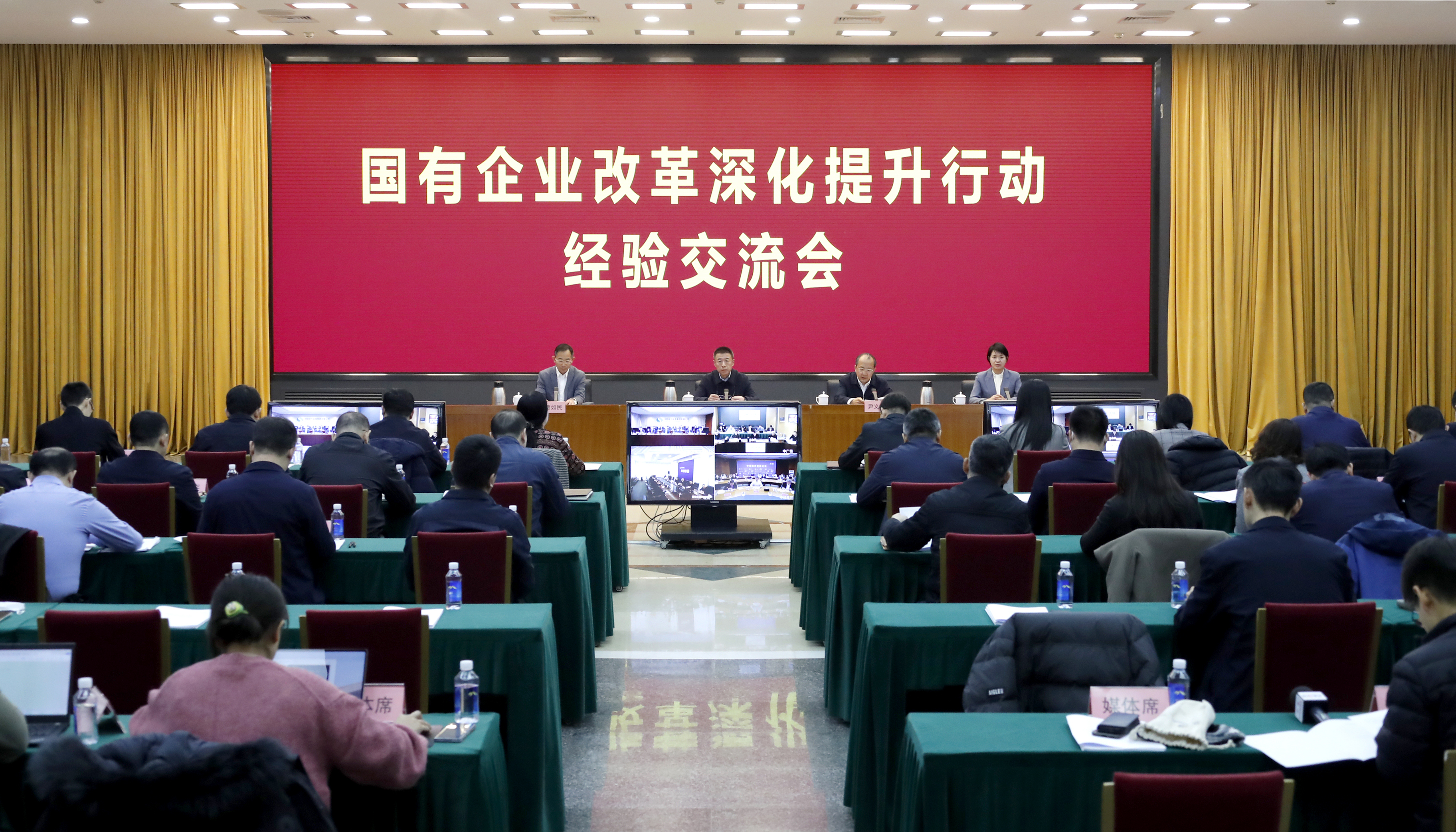
Core Insights - The three-year action plan for deepening state-owned enterprise (SOE) reform has been largely completed, with significant achievements in areas such as structural layout, technological innovation, corporate governance, and regulatory mechanisms [1][2] Group 1: Reform Achievements - The latest round of SOE reform has shown fundamental changes in the overall landscape of state-owned enterprises, contributing significantly to economic and social development, although challenges remain in original innovation capabilities and safety support in key areas [3] - Central enterprises have established 97 original technology sources and led the construction of 23 innovation consortia, promoting collaborative research and development [3] - In the strategic emerging industries, central enterprises achieved revenue exceeding 11 trillion yuan from January to November 2025, with significant investments in biopharmaceuticals and low-altitude economy sectors [4] Group 2: Strategic Restructuring and Integration - The State-owned Assets Supervision and Administration Commission (SASAC) has promoted the restructuring and integration of state-owned enterprises to enhance efficiency and focus on core competencies, resulting in the formation of new central enterprises and significant asset consolidations [5] - Strategic restructuring efforts have involved 116 groups across various regions, enhancing the core competitiveness of enterprises [5] Group 3: Future Reform Directions - The "14th Five-Year Plan" and subsequent actions have transitioned SOE reform from institutional construction to efficiency enhancement, laying a foundation for deeper changes in the "15th Five-Year Plan" period [8] - Future reforms will focus on improving the modern enterprise system with an emphasis on integrating party leadership into corporate governance and enhancing the effectiveness of state asset supervision [9] - The ongoing restructuring of central enterprises, such as the merger between China Petroleum and Chemical Corporation and China Aviation Oil, is seen as a significant step towards optimizing the layout and responding to international competition and green transformation [10]

崔东树:2025年全国乘用车批发增速9% 新能源乘用车批发增速25%
智通财经网· 2026-01-13 11:42
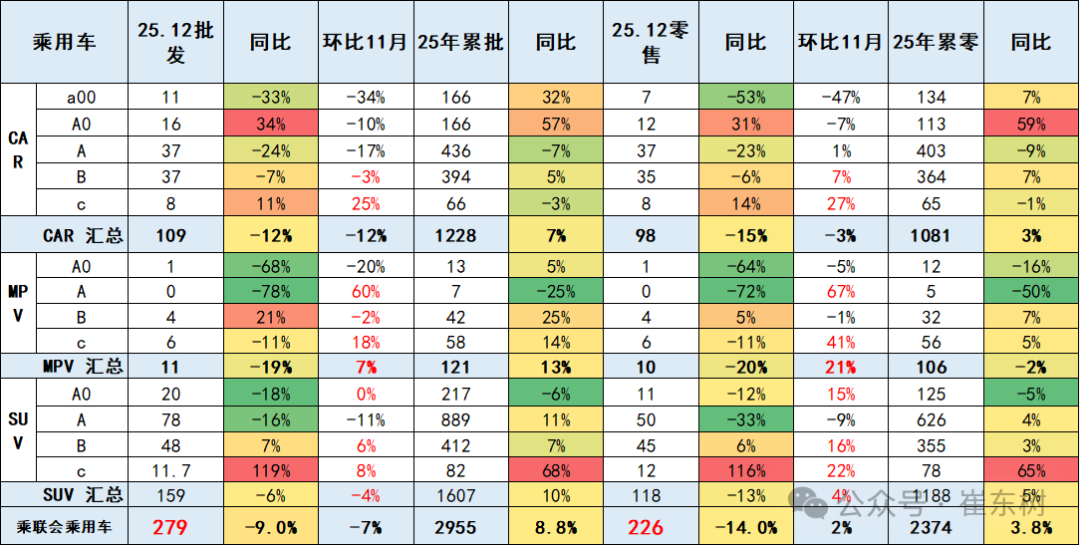
Core Insights - The wholesale growth rate for passenger cars in China is projected to be 9% in 2025, while the growth rate for new energy passenger cars is expected to reach 25%, aligning with the growth expectations set for the "14th Five-Year Plan" [1] - The end of the tax exemption policy for new energy vehicle purchases has led to a significant market shift, with many provinces experiencing a depletion of funds for trade-in subsidies, resulting in a mixed market performance [1] Passenger Car Market Overview - In December 2025, the retail sales of passenger cars decreased by 14%, which is significantly lower than the 9% decline in wholesale sales [2] - The A00 class cars saw a wholesale decline of 33% year-on-year and a 34% month-on-month drop in December 2025, with retail sales down 53% year-on-year [5] - The A0 class cars experienced a 34% increase in wholesale sales year-on-year, but a 10% decrease month-on-month in December 2025, with retail sales up 31% year-on-year [7] - A0 class SUVs had a wholesale decline of 18% year-on-year in December 2025, while retail sales decreased by 12% year-on-year [9] A-Class Passenger Car Trends - A-class sedans saw a wholesale decline of 24% year-on-year in December 2025, with retail sales down 23% year-on-year [11] - A-class SUVs experienced a 16% year-on-year decline in wholesale sales in December 2025, with retail sales down 33% year-on-year [13] B-Class Passenger Car Trends - B-class sedans had a wholesale decline of 7% year-on-year in December 2025, with retail sales down 6% year-on-year [15] - B-class SUVs saw a 7% increase in wholesale sales year-on-year in December 2025, with retail sales up 6% year-on-year [17] - B-class MPVs experienced a 21% increase in wholesale sales year-on-year in December 2025, with retail sales up 5% year-on-year [19]
新能源汽车2026前瞻,“量变”到“质变”的分水岭
3 6 Ke· 2026-01-13 11:31
Core Insights - The Chinese electric vehicle (EV) industry is set to become mainstream by 2025, with retail penetration rates expected to exceed 60% by year-end, marking a significant shift from being an alternative option to a market leader [2][4] - Domestic brands like BYD and Geely are solidifying their positions, while new entrants are facing intense competition and differentiation [2][6] - The focus for 2026 will shift from market share expansion to value redefinition within the industry [3] Market Penetration - In the first eleven months of 2025, the production and sales of new energy vehicles (NEVs) in China saw a year-on-year increase of over 30%, with NEV sales accounting for 47.5% of total vehicle sales [4] - December is projected to see NEV retail sales reach 1.38 million units, with penetration rates likely to surpass 60% for the first time [4] - Domestic brands dominate the market, with a retail penetration rate of 79.6% for NEVs in November, far outpacing mainstream joint venture brands at 6.8% [4] Company Strategies and Challenges - BYD aims to expand its "smart driving equality" initiative, while facing challenges in balancing scale expansion with profit and quality [5] - Geely's strategy is showing results with a 60.5% NEV penetration rate, but it needs to build a "second growth curve" for overseas market presence [5] - Chery leads in overseas markets but must accelerate its domestic NEV transformation and smart technology integration [5] - New forces like Leap Motor are experiencing rapid growth, while Li Auto faces challenges due to product controversies and performance declines [6] Technological Advancements and Globalization - The "universal smart driving" concept is becoming a reality, with BYD's advanced driving assistance systems becoming more affordable [8] - The global expansion of Chinese EVs is evolving from simple product exports to establishing local manufacturing and supply chains in markets like Thailand [9] - The industry is witnessing a shift towards integrating technology and manufacturing, with companies like Chery and Seres successfully navigating the capital markets [10] Industry Restructuring and Future Directions - The industry is transitioning from a financing and expansion model to one focused on technology depth, profitability, and ecological value [10] - State-owned capital is evolving from a supportive role to an active industry integrator, aiming to stabilize the market and promote long-term R&D [11] - The automotive value chain is shifting towards a focus on electronic architecture, software, and services, with tech giants redefining the automotive experience [11] Challenges and Future Outlook - Structural challenges in the supply chain are emerging, with cost pressures affecting relationships with suppliers, particularly smaller firms [12] - Marketing practices that mislead consumers could damage long-term brand trust, highlighting the need for integrity in communications [12] - The industry must build resilient supply chains, drive technological innovation, and transition to localized ecosystems to sustain growth [13][14] - The competition is entering a new phase where success will depend on defining next-generation technology standards and achieving sustainable business models [15]





华纬科技:2026年1月13日投资者关系活动记录表
Xin Lang Zheng Quan· 2026-01-13 10:01
Core Viewpoint - The company is expanding its production capacity and diversifying its product offerings, particularly in the automotive and non-automotive sectors, while maintaining a focus on profitability and market share growth. Group 1: Main Product Pricing and Profitability - The company's core products, including suspension springs and stabilizer bars, have a unit price range of 120-200 yuan per vehicle, with an overall gross margin of 27% [1] - The gross margin for suspension components is relatively stable due to minimal impact from raw material price fluctuations, while the stabilizer bar's margin is closely linked to client demand due to high fixed costs associated with custom tooling [1] Group 2: Production Capacity Layout - The company's Chongqing production base is expected to commence operations in the first half of this year, with ongoing ramp-up throughout the year [2] - The production lines for stabilizer bars and springs are currently in the equipment installation and debugging phase, primarily serving key clients in the southwest region, such as Seres and Changan [2] Group 3: Non-Automotive Sector Expansion - The non-automotive business is a significant growth driver, with a strong focus on industrial robots, rail transportation, and construction machinery, particularly emphasizing industrial robots [3] - The company has entered the humanoid robot sector, supplying small springs for hand joints, leveraging its established design and manufacturing capabilities in valve and specialty springs [3] Group 4: Future Growth Path - The company aims to enhance its market share in the domestic stabilizer bar market, which still has considerable room for growth, especially as production capacity is released [4] - The overseas suspension system components market is identified as a blue ocean opportunity, with low participation from Chinese enterprises, prompting the company to actively pursue international business expansion [4] - The company is also focusing on upstream and downstream collaboration, exploring non-metal and new materials to mitigate downstream volatility risks and secure long-term growth [4]
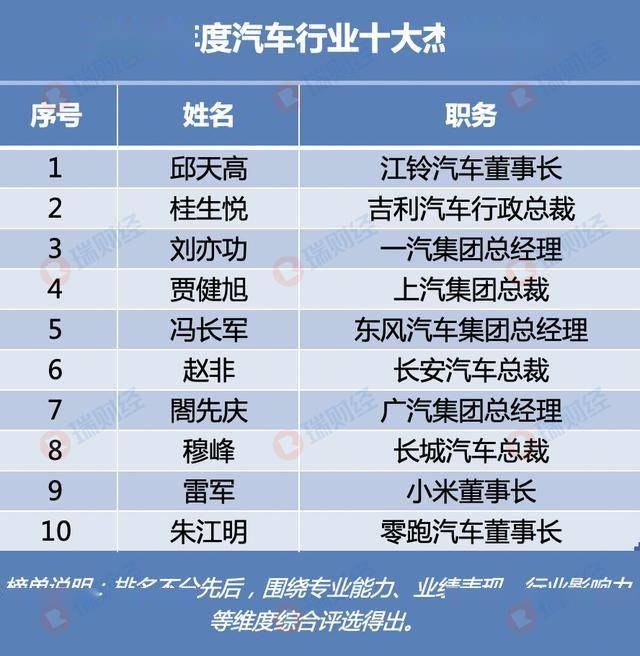
小米董事长雷军入选“2025年度汽车行业十大杰出人物”
Sou Hu Cai Jing· 2026-01-13 09:57
瑞财经1月13日,由瑞财经推出的"2025年度汽车行业十大杰出人物"榜单揭晓,小米董事长雷军入选。 "2025年度汽车行业十大杰出人物"榜单围绕专业能力、业绩表现、行业影响力等维度综合评选得出。 雷军,55岁,小米集团执行董事、创始人、董事长及首席执行官、以及智能电动汽车业务的首席执行 官,亦为薪酬委员会成员。雷军全面负责公司策略、公司文化及关键产品,并监管高级管理团队。雷军 现任集团多家附属公司、合并联属实体及经营实体的董事。雷军在2000年创办了在线零售平台卓越网并 在2004年将其出售给亚马逊。同时,雷军曾作为天使投资人,投资了JoYY Inc. 及UCWeb等多家创新型 企业。雷军更是知名的科技创业者。雷军于1992年加入金山软件有限公司并担任金山软件多个高级职 位,包括自2011年7月起担任董事长,自2008年8月起担任非执行董事,自1998年至2007年12月担任首席 执行官。自2011年12月起,雷军担任北京金山办公软件股份有限公司董事。自2012年1月起,雷军担任 金山云控股有限公司的非执行董事并在2015年4月起担任该公司的董事长。雷军于1991年7月自武汉大学 计算机科学系毕业,获得理学学 ...

四大板块齐头并进——车企2025产销快报解析
Zhong Guo Qi Che Bao Wang· 2026-01-13 09:43
Core Insights - The Chinese passenger car market is projected to retail 23.78 million units in 2025, reflecting a 4% year-on-year growth, supported by policies like "trade-in" [2] - Major domestic automakers such as BYD, Geely, Changan, and Leap Motor have achieved significant progress, while several joint venture companies are showing signs of recovery in China [2] Domestic Automakers Performance - BYD achieved a record annual sales of 4.60 million units in 2025, a 7.73% increase, with pure electric vehicle sales reaching 2.25 million units, up 27.85%, surpassing Tesla in global sales [3] - SAIC Group sold 4.51 million vehicles in 2025, a 12.3% increase, with its new energy vehicle sales growing by 33.1% to 1.64 million units [3] - China FAW's total vehicle sales reached 3.30 million units, a 3.2% increase, with its new energy vehicle sales soaring by 71% to 366,000 units [4] - Geely's total sales reached 3.02 million units, a 39% increase, with new energy vehicle sales hitting 1.69 million units, up 90% [4] - Changan's sales reached 2.91 million units, an 8.5% increase, with new energy vehicle sales growing by 51% to 1.11 million units [5] - Chery Group achieved a record high of 2.81 million units sold, with new energy vehicle sales increasing by 54.9% to 903,800 units [5] Joint Venture Automakers Performance - Joint venture automakers are under pressure but some have found ways to adapt, with FAW-Volkswagen leading in sales with 1.59 million units sold [7] - SAIC Volkswagen achieved sales of 1.06 million units, maintaining a strong position in the market [8] - Toyota's joint ventures in China reported positive growth, with FAW Toyota selling 805,500 units, a 3-year consecutive growth [8] New Energy Vehicle Market - New energy vehicles are a common highlight across major domestic automakers, with significant growth in sales and market penetration [3][4][5] - New entrants like Leap Motor and NIO are also showing strong growth, with Leap Motor achieving 596,600 units sold, a 103% increase [10] - Xpeng Motors delivered 429,400 units, a 126% increase, while NIO delivered 326,000 units, a 46.9% increase [11] Export Growth - China's automobile exports are expected to exceed 7 million units in 2025, marking a historic high [13] - Chery led the export of Chinese passenger cars with 1.34 million units, a 17.4% increase [13] - BYD's overseas sales surpassed 1 million units, a 145% increase, with significant growth in Europe [14] - New energy vehicle exports are also on the rise, with companies like Leap and Xpeng expanding their international presence [16]



华纬科技(001380) - 2026年1月13日投资者关系活动记录表
2026-01-13 09:26
Group 1: Product Pricing and Profitability - The main products of the company are suspension springs and stabilizer bars, with unit prices ranging from 120 to 200 RMB [2] - The comprehensive gross margin for suspension system components is approximately 27%, with stable margins expected for suspension springs if raw material prices remain stable [2][3] - The profitability of stabilizer bars is linked to client demand due to high fixed costs associated with developing individual tooling for each product [2] Group 2: Production Capacity and Clientele - The Chongqing factory is expected to start production in the first half of 2026, with ongoing production ramp-up throughout the year [3] - Key clients for the Chongqing factory include Seres and Changan Automobile, primarily serving the southwestern region [3] Group 3: Non-Automotive Applications - The non-automotive sector includes industrial robots, rail transportation, and construction machinery, with industrial robots having a relatively high market share [3] - The company focuses on top-tier clients in the non-automotive sector, aligning with its market expansion strategy [3] Group 4: Future Development Directions - Future growth paths include increasing market share for domestic stabilizer products and expanding into the overseas suspension system components market, which is currently underrepresented by Chinese enterprises [4] - The company is also considering upstream and downstream industry collaboration and is exploring materials close to the raw material sector to mitigate operational risks [4]
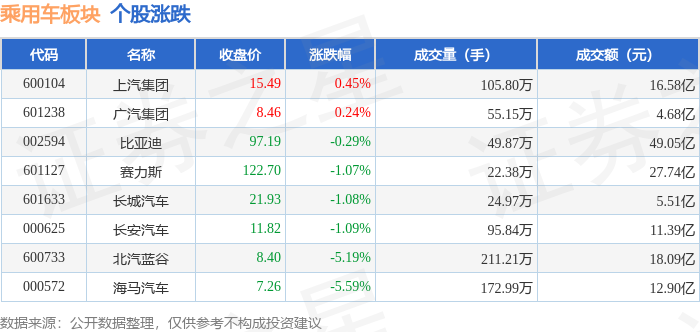
乘用车板块1月13日跌0.71%,海马汽车领跌,主力资金净流出6.24亿元
Zheng Xing Xing Ye Ri Bao· 2026-01-13 08:56
Market Overview - The passenger car sector experienced a decline of 0.71% on January 13, with Haima Automobile leading the drop [1] - The Shanghai Composite Index closed at 4138.76, down 0.64%, while the Shenzhen Component Index closed at 14169.4, down 1.37% [1] Individual Stock Performance - SAIC Motor Corporation (600104) closed at 15.49, up 0.45% with a trading volume of 1.058 million shares and a turnover of 1.658 billion yuan [1] - GAC Group (601238) closed at 8.46, up 0.24% with a trading volume of 551,500 shares and a turnover of 468 million yuan [1] - BYD (002594) closed at 97.19, down 0.29% with a trading volume of 498,700 shares and a turnover of 4.905 billion yuan [1] - Seres (601127) closed at 122.70, down 1.07% with a trading volume of 223,800 shares and a turnover of 2.774 billion yuan [1] - Great Wall Motors (601633) closed at 21.93, down 1.08% with a trading volume of 249,700 shares and a turnover of 551 million yuan [1] - Changan Automobile (000625) closed at 11.82, down 1.09% with a trading volume of 958,400 shares and a turnover of 1.139 billion yuan [1] - BAIC BluePark (600733) closed at 8.40, down 5.19% with a trading volume of 2.112 million shares and a turnover of 1.809 billion yuan [1] - Haima Automobile (000572) closed at 7.26, down 5.59% with a trading volume of 1.729 million shares and a turnover of 1.290 billion yuan [1] Fund Flow Analysis - The passenger car sector saw a net outflow of 624 million yuan from main funds, while retail investors contributed a net inflow of 451 million yuan [1] - The detailed fund flow for individual stocks shows: - SAIC Motor had a net inflow of 1.5 billion yuan from main funds, but a net outflow of 1.01 billion yuan from retail investors [2] - Great Wall Motors had a net inflow of 11.625 million yuan from main funds, with a net outflow of 9.9974 million yuan from retail investors [2] - GAC Group experienced a net outflow of 8.916 million yuan from main funds, with a net inflow of 440,000 yuan from retail investors [2] - BYD had a significant net outflow of 92.804 million yuan from main funds, but a net inflow of 10.8052 million yuan from retail investors [2] - Changan Automobile faced a net outflow of 1.15 billion yuan from main funds, while retail investors contributed a net inflow of 94.9543 million yuan [2] - Haima Automobile had a net outflow of 162 million yuan from main funds, but a net inflow of 143 million yuan from retail investors [2] - Seres had a net outflow of 2.02 billion yuan from main funds, with a net inflow of 178 million yuan from retail investors [2] - BAIC BluePark had a net outflow of 206 million yuan from main funds, while retail investors contributed a net inflow of 135 million yuan [2]




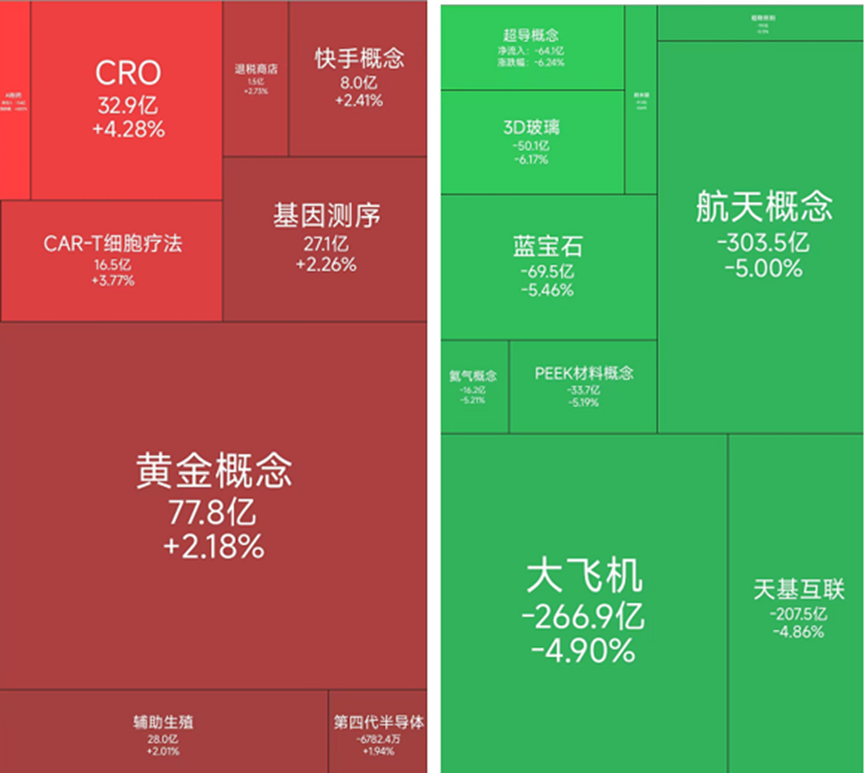
CRO概念涨幅居前,19位基金经理发生任职变动
Jin Rong Jie· 2026-01-13 07:44
Market Performance - On January 13, all three major A-share indices fell, with the Shanghai Composite Index down 0.64% to 4138.76 points, the Shenzhen Component Index down 1.37% to 14169.4 points, and the ChiNext Index down 1.96% to 3321.89 points [1] Fund Manager Changes - On January 13, there were 19 fund manager changes, with 547 fund products experiencing manager departures in the past 30 days (December 14 to January 13) [3] - Among the changes on January 13, 10 fund products announced manager departures involving 5 managers, with 4 leaving due to job changes and 1 due to the end of an agency role [3] Fund Manager Performance - Lei Wenyu, a fund manager at Huatai-PB, manages assets totaling 2.687 billion yuan, with the highest return product being Huatai-PB CSI 2000 Index Enhanced A, which achieved a 94.28% return over 2 years and 2 days [5] - Zhao Jian from Guotou Ruijin manages assets of 8.506 billion yuan, with the highest return product being Guotou Ruijin CSI Consumer Services Index, which achieved a 168.17% return over 7 years and 265 days [5] Fund Manager Appointments - On January 13, 26 fund products announced new fund manager appointments involving 14 managers [5][6] - Notable new appointments include Zhao Jian for Guotou Ruijin CSI All-Share Public Utilities ETF and Zhang Ziyan for Fortune Hengxin 3-Month Holding Period Mixed (ETF-FOF) A [6] Fund Research Activity - In the past month, Huaxia Fund conducted the most company research, engaging with 43 listed companies, followed by Bosera Fund with 38 and E Fund with 31 [7] - The automotive parts industry was the most researched sector, with 125 instances, followed by communication equipment with 119 [7] Recent Research Focus - In the last week (January 6 to January 13), Chaojie Co. was the most researched company, receiving attention from 53 fund institutions, followed by Guanglian Aviation with 36 [8] - In the past month, Chang'an Automobile was the most popular among public funds, with 75 fund management companies participating in its research [9]

全国多个城市汽车产量超百万辆,谁在领跑?
Ren Min Ri Bao Hai Wai Ban· 2026-01-13 03:57
在全国各大城市中,汽车产量如何?2025年前11个月,重庆汽车产量近250万辆。北京和上海的汽车产 量超过了百万辆,郑州、青岛等城市的产量也接近百万辆。新能源汽车方面,2025年前11个月,合肥新 能源汽车产量超120万辆,居全国城市第一。 还有政策扶持。"十四五"以来,重庆市将建设"智能网联新能源汽车之都"作为推动制造业高质量发展的 核心战略,着力打造世界级智能网联新能源汽车产业集群。安徽省明确,支持合肥打造具有全球影响力 的新能源汽车之都和智能网联新能源汽车创新高地;支持芜湖建设自主品牌集聚区。 统计方式调整引发格局变化 北京、上海、柳州等城市也在百万级别。2025年前11个月,上海整车产量为160.11万辆,其中新能源汽 车产量104.2万辆。北京2025年前11个月全市生产汽车133.5万辆,比上年同期增长27.6%。值得关注的 是,柳州2025年前9个月的整车产量已经完成133.1万辆,同比增长37.8%,全年"成绩单"可期。 郑州、青岛、长沙、武汉等城市正稳步接近"百万辆"门槛。2025年前10个月,郑州全市整车产量95.63 万辆,同比增长16.52%,年产量突破百万大关几无悬念。青岛2025年 ...