洋河股份

Search documents
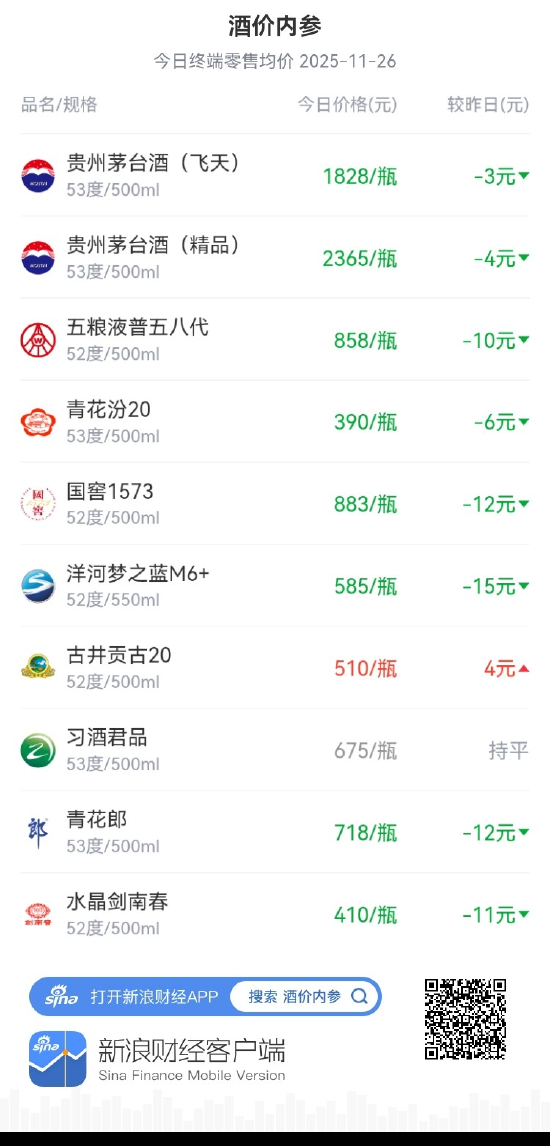
酒价内参11月26日价格发布:洋河梦之蓝M6+价格下跌15元/瓶,跌幅居前
Xin Lang Cai Jing· 2025-11-26 01:44
Group 1 - The core viewpoint of the article highlights a significant price adjustment in the Chinese liquor market, particularly among the top ten products, with an overall retail price drop of 69 yuan, totaling 9222 yuan, ending a four-day upward trend [1] - Among the products, Gujinggong Gu20 saw a price increase of 4 yuan per bottle, while the majority experienced price declines, with Yanghe Dream Blue M6+ dropping by 15 yuan per bottle, marking the largest decrease [1][4] - The article notes that prior to this price adjustment, there was a period of price stabilization and increase in the white liquor market, indicating accumulated pressure for a correction [1] Group 2 - Liu Feng, Chief Economist at the International Research Institute of Green Finance, emphasized the resilience of the liquor industry in China, despite challenges such as declining production and market segmentation, due to its essential role in social and emotional contexts [2] - Looking ahead to the 14th Five-Year Plan, Liu pointed out trends driven by consumer rationality and health consciousness, with a focus on quality and cultural value as key purchasing motivations [2] - Liu suggested that liquor companies should adopt a "1+N" product strategy, maintaining core flagship products while introducing a variety of lower-alcohol and fruit wines to meet changing consumer demands [2]





市值蒸发2000亿,洋河却藏3张王牌!
Xin Lang Cai Jing· 2025-11-25 13:34
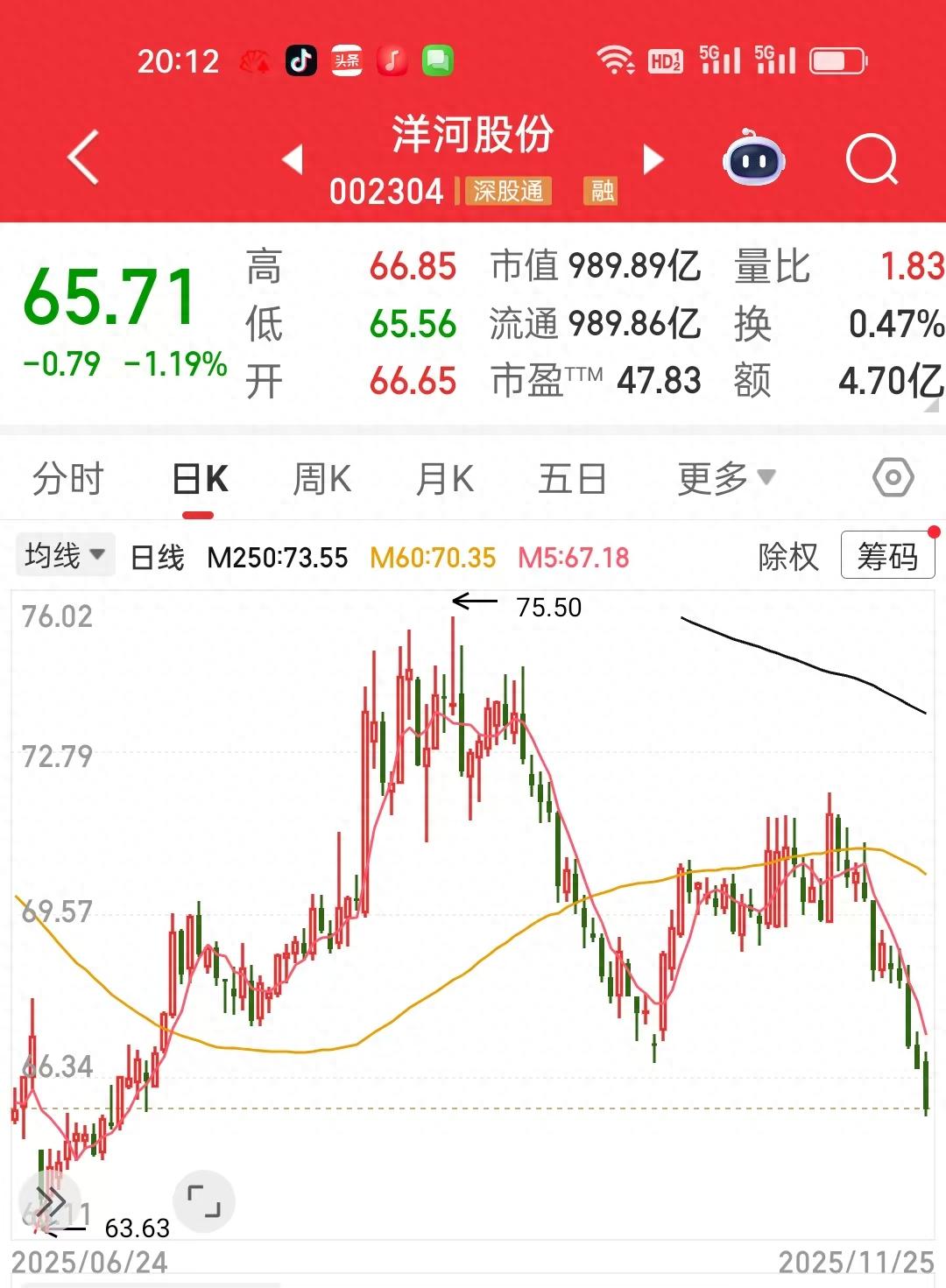
Core Viewpoint - The company Yanghe has experienced a significant decline in stock price and market value, attributed to a challenging economic environment and a downturn in the liquor industry, particularly affecting its sales and profitability [3][4][10]. Financial Performance - Yanghe's stock closed at 65.71 yuan, down 1.19% from the previous day, with over 50 million in main capital quietly flowing out [1]. - The company's market value has dropped from a high of 268 yuan to below 70 yuan, resulting in a loss of over 200 billion yuan in market capitalization [3]. - In 2024, Yanghe's revenue is projected to decline by 12.83% to 28.876 billion yuan, with net profit expected to decrease by 30%, marking the first quarterly loss since its listing [3][4]. Market Dynamics - Despite the overall market downturn, Yanghe has seen some positive sales trends in key provinces, with sales in Jiangsu increasing by 8% and supermarket sales rising by 12% [7][8][9]. - The company has managed to reduce inventory levels from 4.5 months to 3.5 months, indicating a more cautious production strategy [4]. Strategic Adjustments - Yanghe has cut production by over 50% to clear inventory and stabilize prices, focusing on producing only what is sold [4]. - The company is beginning to invest more in product development and digital channels, aiming to improve its market position and regain lost market share [10][16]. Challenges and Opportunities - Yanghe faces challenges such as slow product updates and a lack of high-end offerings compared to competitors, with R&D expenses significantly reduced [10][11]. - The company has a strong foundation with 70,000 premium cellars and 1 million tons of stored liquor, providing resilience during tough market conditions [9][13]. Future Outlook - Yanghe has the potential to recover by implementing strategic changes, including leadership adjustments, increased investment in high-end product development, and enhancing digital sales channels [14][15]. - The company is already seeing signs of recovery, with improved sales and a willingness from distributors to invest, indicating a positive shift in market sentiment [16][18].
11月25日深证国企股东回报(970064)指数涨0.73%,成份股中材科技(002080)领涨
Sou Hu Cai Jing· 2025-11-25 11:01
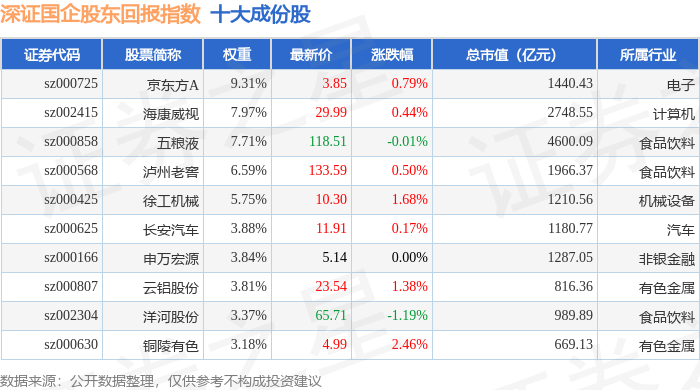
Core Points - The Shenzhen State-Owned Enterprises Shareholder Return Index (970064) closed at 1612.77 points, up 0.73%, with a trading volume of 20.124 billion yuan and a turnover rate of 0.78% [1] - Among the index constituents, 33 stocks rose, with China National Materials Technology leading at a 10.01% increase, while 12 stocks fell, with CITIC Special Steel leading the decline at 2.97% [1] Index Constituents Summary - The top ten constituents of the Shenzhen State-Owned Enterprises Shareholder Return Index include: - BOE Technology Group (sz000725) with a weight of 9.31%, latest price at 3.85, and a market cap of 144.043 billion yuan [1] - Hikvision (sz002415) with a weight of 7.97%, latest price at 29.99, and a market cap of 274.855 billion yuan [1] - Wuliangye Yibin (sz000858) with a weight of 7.71%, latest price at 118.51, and a market cap of 460.009 billion yuan [1] - Luzhou Laojiao (sz000568) with a weight of 6.59%, latest price at 133.59, and a market cap of 196.637 billion yuan [1] - XCMG Machinery (sz000425) with a weight of 5.75%, latest price at 10.30, and a market cap of 121.056 billion yuan [1] - Changan Automobile (sz000625) with a weight of 3.88%, latest price at 11.91, and a market cap of 118.077 billion yuan [1] - Shenwan Hongyuan (sz000166) with a weight of 3.84%, latest price at 5.14, and a market cap of 128.705 billion yuan [1] - Yunnan Aluminum (sz000807) with a weight of 3.81%, latest price at 23.54, and a market cap of 81.636 billion yuan [1] - Yanghe Brewery (sz002304) with a weight of 3.37%, latest price at 65.71, and a market cap of 68.686 billion yuan [1] - Tongling Nonferrous Metals (sz000630) with a weight of 3.18%, latest price at 6.67, and a market cap of 66.913 billion yuan [1] Capital Flow Summary - The net inflow of main funds into the index constituents totaled 425 million yuan, while retail funds saw a net outflow of 319 million yuan [3] - Key stocks with significant capital flow include: - China National Materials Technology with a net inflow of 210 million yuan from main funds [3] - Luzhou Laojiao with a net inflow of 91.542 million yuan from main funds [3] - Tongling Nonferrous Metals with a net inflow of 60.685 million yuan from main funds [3]



12只白酒股上涨 贵州茅台1444.65元/股收盘
Bei Jing Shang Bao· 2025-11-25 08:34
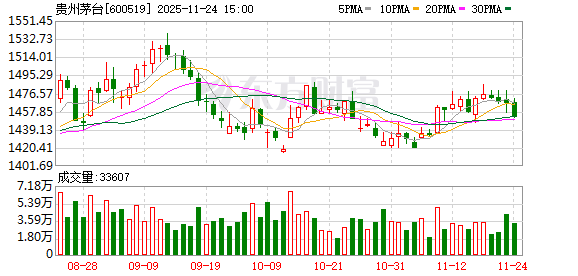
Core Viewpoint - The liquor industry, particularly the baijiu sector, is undergoing a significant adjustment, with expectations of a gradual bottoming phase by 2026 despite current challenges [1]. Industry Summary - The Shanghai Composite Index closed at 3870.02 points, up 0.87%, while the baijiu sector index closed at 2254.47 points, up 0.28% [1]. - A total of 12 baijiu stocks saw gains, with the leading stock, Jiu Gui Jiu, increasing by 1.73% [1]. - The report from Galaxy Securities indicates that the baijiu industry has been in deep adjustment this year, with a notable acceleration in supply-side clearing since the third quarter [1]. - The industry is expected to remain in an adjustment phase until 2026, but signs of a bottoming phase are anticipated, characterized by narrowing declines in sales and prices, along with continued clearing in financial statements [1]. Company Summary - Kweichow Moutai's stock closed at 1444.65 yuan per share, down 0.51% [1]. - Wuliangye's stock closed at 118.51 yuan per share, down 0.01% [1]. - Shanxi Fenjiu's stock closed at 192.99 yuan per share, up 0.31% [1]. - Luzhou Laojiao's stock closed at 133.59 yuan per share, up 0.50% [1]. - Yanghe's stock closed at 65.71 yuan per share, down 1.19% [1].

酒价内参11月25日价格发布 市场整体续涨青花郎五连阳
Xin Lang Cai Jing· 2025-11-25 01:57
Core Insights - The retail prices of the top ten liquor products in the white liquor market have continued to rise, with an overall price of 9,291 yuan for a bundled sale, marking an increase of 8 yuan from the previous day, achieving four consecutive days of price increases [1] Price Movements - Yanghe Dream Blue M6+ saw a strong performance with a daily price increase of 8 yuan per bottle [1] - Guojiao 1573's price increased by 6 yuan per bottle [1] - Qinghualang's price rose by 5 yuan per bottle, marking five consecutive days of increases [1] - Prices for Shuijing Jian'nan Chun and Xijiu Junpin increased by 3 yuan and 2 yuan per bottle, respectively, showing stable trends [1] - Qinghualan 20's price rose by 2 yuan per bottle, while Wuliangye Pu 58's price also increased by 2 yuan per bottle [1] - In contrast, the prices of some products decreased, with the boutique Moutai and Gujing Gong Gu 20 dropping by 9 yuan and 7 yuan per bottle, respectively [1] - Feitian Moutai's price fell by 4 yuan per bottle [1] Specific Product Prices - Feitian Moutai: 1,831 yuan per bottle, down 470 yuan [3] - Boutique Moutai: 2,369 yuan per bottle, down 9 yuan [3] - Wuliangye Pu 58: 868 yuan per bottle, up 2 yuan [3] - Qinghualan 20: 396 yuan per bottle, up 2 yuan [3] - Guojiao 1573: 895 yuan per bottle, up 670 yuan [3] - Yanghe Dream Blue M6+: 600 yuan per bottle [3] - Gujing Gong Gu 20: 506 yuan per bottle, down 7 yuan [3] - Qinghualang: 730 yuan per bottle, down 570 yuan [4] - Shuijing Jian'nan Chun: 421 yuan per bottle, up 3 yuan [4] - Xijiu Junpin: 675 yuan per bottle, up 2 yuan [4]
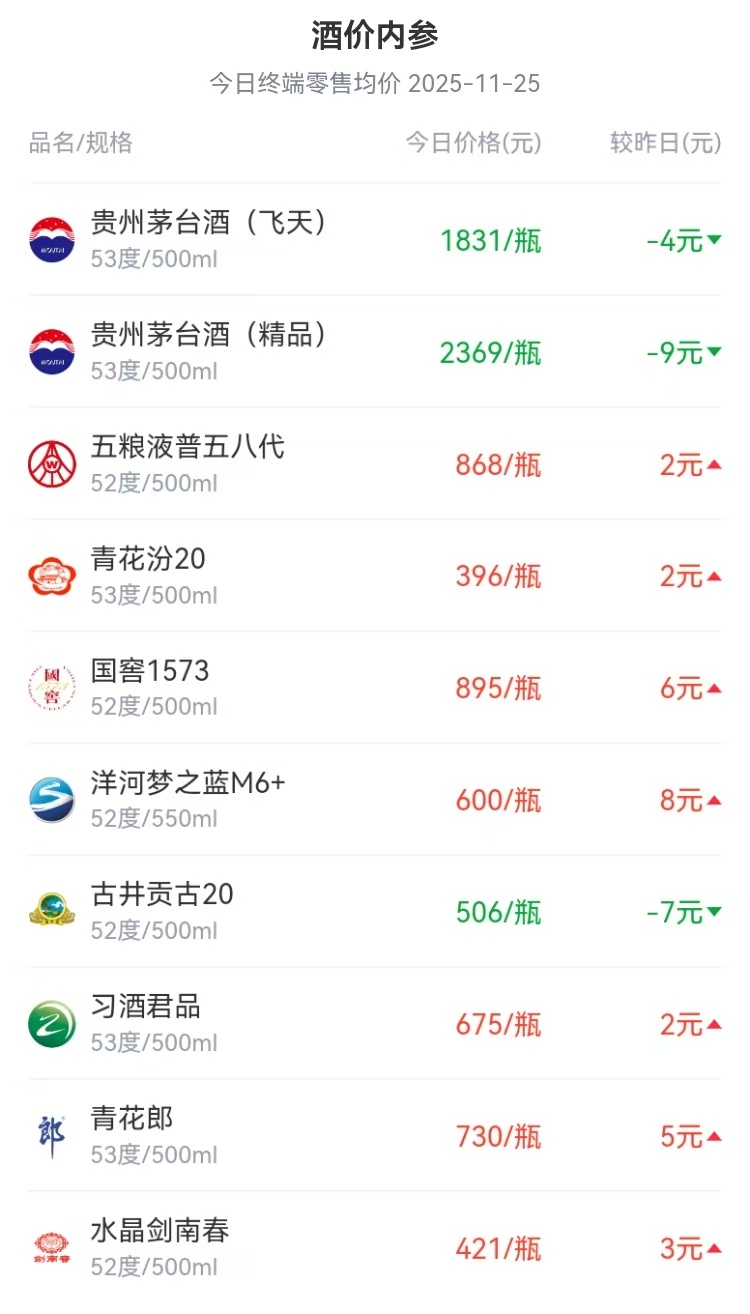
今日白酒市场整体续涨 青花郎五连阳
Ge Long Hui· 2025-11-25 01:21
Core Insights - The retail average price of the top ten liquor products in the white liquor market continues to rise, reaching 9,291 yuan, an increase of 8 yuan from the previous day, marking four consecutive days of price increases [1] Price Movements - Yanghe Dream Blue M6+ shows strong performance with a daily price increase of 8 yuan per bottle [1] - Guojiao 1573 price increased by 6 yuan per bottle [1] - Qinghua Lang price rose by 5 yuan per bottle, achieving five consecutive days of increases, leading the market [1] - Crystal Jian Nan Chun and Xijiu Junpin prices increased by 3 yuan and 2 yuan per bottle, respectively, showing stable trends [1] - Qinghua Fen 20 price increased by 2 yuan per bottle [1] - Wuliangye Pu 58 price also rose by 2 yuan per bottle [1] Price Declines - Premium Moutai and Gujing Gong Gu 20 experienced significant declines, with prices dropping by 9 yuan and 7 yuan per bottle, respectively [1] - Feitian Moutai price decreased by 4 yuan per bottle [1]
中国必选消费品11月价格报告:白酒批价多数下跌,方便食品与调味品价格回升
Haitong Securities International· 2025-11-24 13:11
Investment Rating - The report assigns an "Outperform" rating to multiple companies in the essential consumer goods sector, including Guizhou Moutai, Wuliangye, and others [1]. Core Insights - The wholesale prices of Baijiu have mostly declined, while prices for instant foods and condiments have rebounded [1][10]. - Discounts for convenience foods and seasonings have narrowed compared to the end of October, indicating a potential recovery in consumer spending [19][38]. - The report highlights the stability of discounts for infant formula and beer, while discounts for liquid milk and soft drinks have increased [21][38]. Summary by Sections Baijiu Pricing - The wholesale prices for various Baijiu brands, such as Moutai and Wuliangye, have shown significant declines compared to previous months and year-to-date figures [9][40]. - For instance, the price of Feitian Moutai (case) is 1650 yuan, down by 110 yuan from last month, and down 590 yuan year-to-date [40]. Consumer Goods Discounts - Convenience foods have seen an increase in average and median discount rates, moving from 93.2%/95.9% at the end of October to 95.8%/97.0% [19][38]. - Seasonings also experienced a rise in discount rates, from 83.7%/84.9% to 85.9%/88.9% [19][38]. - In contrast, liquid milk discounts have widened, with average rates dropping from 69.6% to 66.0% [21][38]. Company Ratings - The report lists several companies with an "Outperform" rating, including: - Guizhou Moutai - Wuliangye - Luzhou Laojiao - Shanxi Fenjiu - Yanghe - Others [1].
“上平台有些销量,但我还是主动撤下了!”一位烟酒店老板的自白:赚不到钱,还要和顾客扯皮售后
Mei Ri Jing Ji Xin Wen· 2025-11-24 10:29
Core Viewpoint - The annual "Double 11" shopping festival highlights the contrasting experiences of retailers in the liquor industry, with some embracing instant retail while others, like a store owner named Li Mu, have opted to withdraw due to low profitability despite high sales volumes [1][2][3]. Group 1: Instant Retail Growth - Instant retail in the liquor sector is recognized as a new consumption trend, with significant sales growth reported during promotional events, such as a 612% increase in transaction volume for Moutai during "Double 11" [1][2]. - Major platforms like Meituan and JD.com are experiencing explosive growth in liquor sales, with predictions indicating that the market size for liquor instant retail could exceed 100 billion yuan by 2027 [11][12]. Group 2: Challenges Faced by Retailers - Many liquor retailers are cautious about instant retail, with over 40% reporting cash flow pressures and difficulties due to high inventory and price discrepancies [3][4]. - Retailers like Li Mu have found that despite some sales, the costs associated with instant retail, including platform commissions and customer service issues, have led to minimal profits [4][7]. Group 3: Pricing and Competition - The pricing strategies of instant retail platforms often disrupt traditional pricing structures, leading to conflicts with distributors and retailers who struggle to maintain profitability [15][16]. - Price comparisons show that many premium liquors are sold at lower prices on instant retail platforms compared to official brand stores, creating a challenging environment for traditional retailers [5][6]. Group 4: Consumer Behavior and Market Dynamics - The convenience of instant retail is appealing to younger consumers, with many preferring the quick delivery of liquor for social occasions [9][10]. - The industry is witnessing a shift towards digitalization and the need for brands to adapt to changing consumer preferences, emphasizing the importance of maintaining brand integrity while exploring new sales channels [17][18].

白酒行业即时零售“热赛道”难解渠道“冷难题”?
Mei Ri Jing Ji Xin Wen· 2025-11-24 09:00
Core Insights - The annual "Double 11" shopping festival has highlighted the contrasting experiences of retailers in the liquor industry, with some like Li Mu opting to withdraw from instant retail platforms due to low profitability despite high sales volumes [1][2][4] - The liquor instant retail market is recognized as a new consumption trend, but many retailers remain cautious and hesitant to fully engage due to profitability concerns and operational challenges [2][4][16] Group 1: Market Dynamics - Instant retail platforms have reported explosive growth in sales during promotional periods, with significant year-on-year increases in transaction volumes for premium liquor brands [1][10] - The market for liquor instant retail is projected to grow substantially, with estimates suggesting a penetration rate increase from 1% in 2023 to 6% by 2027, potentially exceeding a market size of 100 billion [10][11] Group 2: Retailer Challenges - Many liquor retailers, especially smaller ones, are struggling with cash flow pressures and high inventory levels, leading to a situation where over 40% of distributors report financial strain [4][8] - Retailers face difficulties in maintaining profitability due to high logistics costs and platform commission fees, which can significantly erode margins [16][18] Group 3: Consumer Behavior - The rise of instant retail is driven by changing consumer habits, with younger consumers seeking convenience and quick delivery options for liquor purchases [9][13] - Instant retail has become a preferred choice for many consumers, with the ability to receive orders within 30 minutes enhancing the appeal of this shopping method [9][10] Group 4: Industry Perspectives - Industry experts acknowledge the potential of instant retail but caution that the current price competition and low-margin environment could disrupt traditional distribution channels and pricing structures [16][18] - There is a growing consensus that the future of instant retail in the liquor sector will require a shift from price competition to value creation, emphasizing the need for a sustainable business model that balances consumer demand with brand integrity [18][19]

11只白酒股上涨 贵州茅台1452元/股收盘
Bei Jing Shang Bao· 2025-11-24 08:05
Core Viewpoint - The liquor sector, particularly the baijiu industry, is experiencing a market correction with valuations at relatively low historical levels, while market expectations remain weak [2] Group 1: Market Performance - On November 24, the Shanghai Composite Index closed at 3836.77 points, up 0.05% [2] - The baijiu sector closed at 2248.25 points, increasing by 0.17%, with 11 baijiu stocks rising [2] Group 2: Individual Stock Performance - Kweichow Moutai closed at 1452.00 CNY per share, down 1.00% [2] - Wuliangye closed at 118.52 CNY per share, down 0.97% [2] - Shanxi Fenjiu closed at 192.40 CNY per share, down 0.31% [2] - Luzhou Laojiao closed at 132.92 CNY per share, down 0.95% [2] - Yanghe Brewery closed at 66.50 CNY per share, down 0.67% [2] Group 3: Industry Insights - CITIC Securities noted that the baijiu industry is currently in a phase of bottoming out, with ongoing sales struggles [2] - Moutai is addressing e-commerce chaos to stabilize price expectations, supported by performance-driven strategies and strong brand influence [2] - The industry is exploring new marketing models while leveraging strong operational capabilities to enhance channel performance [2]