晶澳科技

Search documents
上游现减产预期,多晶硅成交价重心继续上移
Xuan Gu Bao· 2025-09-23 23:17
Industry Insights - The price of multi-crystalline silicon N-type raw materials is quoted at 50.3-55 CNY/kg, while granular silicon is priced at 49-50 CNY/kg, with an overall multi-crystalline silicon price index at 52.44 CNY/kg, indicating a slight upward shift in transaction prices [1] - The market for multi-crystalline silicon is experiencing polarization, with resources priced at 52 CNY/kg and below being more popular, leading to some crystal pulling enterprises facing supply shortages [1] - In September, multi-crystalline silicon production saw mixed changes, with an overall expected slight decline. In October, a reduction in production is anticipated in the Sichuan region due to the approaching dry season [1] - The photovoltaic industry is advancing its "anti-involution" strategy, with significant effects from price control measures, suggesting that industry chain prices may gradually cover full costs [1] - Strict new energy consumption standards for multi-crystalline silicon are expected to accelerate the elimination of outdated production capacity [1] - The photovoltaic sector is likely to achieve supply-side improvements through a combination of top-level support, market-driven elimination, and technological iteration, with policies related to capacity and product quality expected to be implemented soon [1] Company Developments - TBEA (特变电工) claims that its multi-crystalline silicon cost and quality are among the best in China, with cash costs around 30,000 CNY/ton and comprehensive costs approximately 35,000 CNY/ton by July 2025 [2] - Daqo New Energy (大全能源), a leading domestic high-purity multi-crystalline silicon producer, has established partnerships with major photovoltaic companies such as Longi Green Energy, JA Solar, Trina Solar, and TCL Zhonghuan, with a production guidance of 110,000 to 140,000 tons for the entire year of 2025 [2]


晶科与隆基握手言和 但光伏“专利战”远未终结
2 1 Shi Ji Jing Ji Bao Dao· 2025-09-23 23:10
Core Viewpoint - The recent settlement between leading photovoltaic companies Longi Green Energy and JinkoSolar regarding patent disputes marks a significant development in the solar industry, potentially reducing conflicts over technology dominance between TOPCon and BC cell technologies [1][3][7]. Group 1: Patent Dispute Resolution - Longi Green Energy and JinkoSolar have reached a settlement to end all ongoing patent litigation globally and have agreed on cross-licensing arrangements for their core patents [1][5]. - The resolution of the patent disputes may lead to a decrease in public arguments regarding which technology, TOPCon or BC, is superior [1][3]. - The settlement is seen as a potential technology alliance, which could help both companies navigate the current oversupply situation in the market [7][8]. Group 2: Technology Competition - The competition between TOPCon and BC technologies has intensified since 2023, with TOPCon capturing approximately 23% of the market share in 2023, up from less than 10% the previous year [3][4]. - Both companies have been involved in developing technologies outside their primary focus, with Longi having some TOPCon capacity and Jinko reportedly working on BC production lines [4][6]. - The ongoing technology and patent disputes reflect a broader market share competition rather than purely technical disagreements [6][8]. Group 3: Industry Implications - The resolution of the patent disputes is viewed as a landmark event for intellectual property protection in the photovoltaic industry, where many leading manufacturers have been embroiled in similar disputes [8][9]. - The complexity of patent litigation in the solar sector is attributed to high technical barriers and the involvement of multiple scientific disciplines, which complicates the litigation process [9][10]. - The Ministry of Industry and Information Technology has emphasized the importance of intellectual property in the solar manufacturing sector, aiming to curb vicious competition and promote industry transformation [9][10].



工业产品碳足迹平台正式上线
Zheng Quan Ri Bao Zhi Sheng· 2025-09-23 11:45
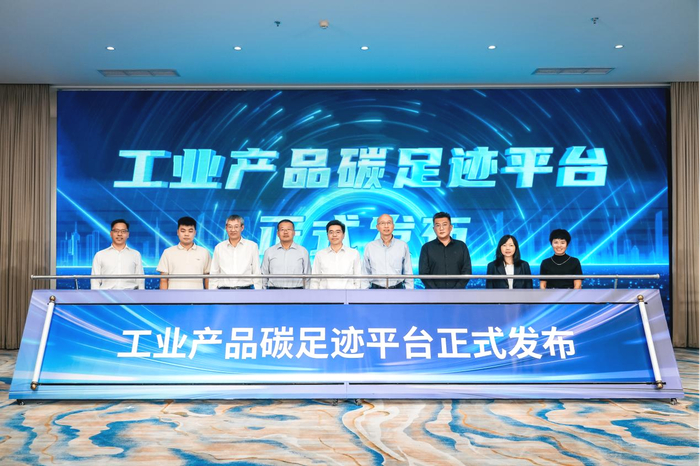
Core Viewpoint - The establishment of the "Industrial Product Carbon Footprint Platform" marks a significant step in China's efforts to manage carbon emissions in industrial products, providing a comprehensive service for carbon footprint certification and green supply chain management [1][4]. Group 1: Platform Overview - The platform is based on real, large-scale enterprise measurement data and aims to enhance the green competitiveness of key industrial products in China [1][4]. - It serves as a strategic infrastructure for carbon footprint management, integrating data capability building, enterprise certification services, international mutual recognition cooperation, and policy decision support [4][6]. - The platform has already provided carbon footprint accounting and certification services to companies like BYD and JA Solar, achieving both domestic and international dual certification [6]. Group 2: Expert Contributions and Discussions - Experts from various fields discussed the challenges and strategies for building a product carbon footprint management system, emphasizing the importance of local databases in calculating carbon footprints [3]. - The platform is described as not just a calculation tool but an open, evolving ecosystem that supports green design, low-carbon supply chain management, and green finance services [3]. - The platform's local database calculated the carbon footprint of photovoltaic components to be about half of that found in international databases, highlighting its significance in enhancing green competitiveness [3].
晶科能源多股东套现20亿背后:巨亏29亿业绩仍存"水份"现金流逆势净流出接连变卖资产
Xin Lang Cai Jing· 2025-09-23 10:43
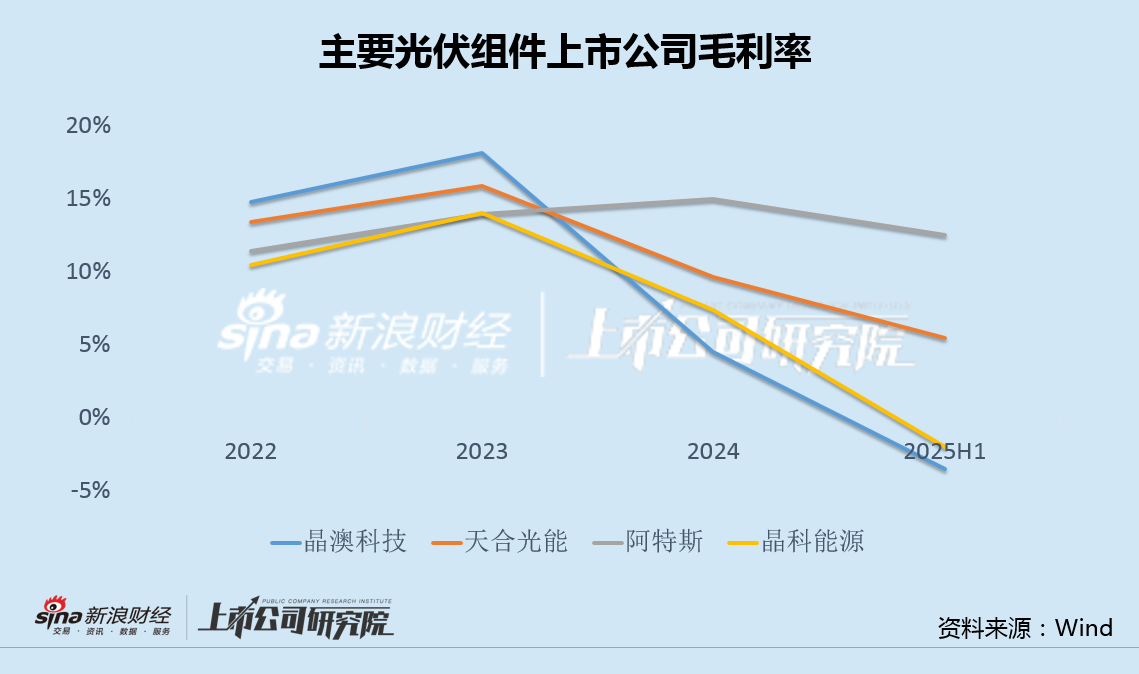
Core Viewpoint - JinkoSolar is facing significant financial challenges, including a substantial loss in the first half of the year and declining profit margins, leading to asset sales and shareholder cash-outs, which further undermine market confidence in the company's future [1][12]. Financial Performance - In the first half of the year, JinkoSolar reported a revenue of 31.8 billion yuan, a year-on-year decrease of 32.6%, and a net loss of 2.91 billion yuan compared to a profit of 1.2 billion yuan in the same period last year [3]. - The company's gross profit margin fell to -2.0%, a decline of 10.6 percentage points year-on-year, marking a rare entry into negative territory [3][5]. - In Q2, JinkoSolar's revenue was 17.99 billion yuan, down 25.6% year-on-year, with a net loss of 1.52 billion yuan, indicating a continued downward trend in performance [4]. Product Performance - JinkoSolar's component revenue decreased by 33.7% to 30.124 billion yuan, with a corresponding gross margin of -0.98%. The gross margin for battery cells plummeted by 27.18 percentage points to -29.95%, while silicon wafer margins fell by 25.92 percentage points to -27.29% [5]. - The company's overseas revenue also declined by 38.93% to 20.535 billion yuan, with a gross margin dropping to -0.05%, marking the first time in five years it has entered negative territory [5]. R&D and Competitive Position - Despite early investments in N-type components and a significant output of over 48 GW in 2023, JinkoSolar is losing its competitive edge as other companies rapidly increase their TOPCon production capacity, leading to intensified price competition [6]. Cash Flow and Debt Situation - JinkoSolar's operating cash flow showed a net outflow of 3.81 billion yuan in the first half of 2025, doubling year-on-year, primarily due to reduced receivables [6][8]. - The company's debt ratio reached 74.07% by mid-2025, an increase of 2.08 percentage points from the end of 2024, indicating a growing debt burden [8]. - Interest-bearing debt surged by 5.92 percentage points to 32.47%, with total interest-bearing liabilities nearing 30 billion yuan, including short-term and long-term borrowings [9]. Asset Sales and Strategic Moves - To alleviate financial pressure, JinkoSolar has opted to sell assets, including the 100% stake in Xinjiang Jinko for 4.3 billion yuan, which had shown promising profits [10]. - The company also plans to sell 80% of its subsidiary Zhejiang Jinko New Materials for 8 million yuan, despite the subsidiary's ongoing losses, which will provide a significant investment gain relative to its audited net profit [11]. Market Sentiment - The ongoing asset sales and the significant cash-outs by major shareholders amid declining stock prices have raised concerns about JinkoSolar's future prospects in the market [12].
晶科能源多股东套现20亿背后:巨亏29亿业绩仍存"水份" 现金流逆势净流出接连变卖资产
Xin Lang Zheng Quan· 2025-09-23 09:47
Core Viewpoint - JinkoSolar is facing significant financial challenges, including a substantial loss in the first half of the year and declining profit margins, leading to asset sales to alleviate debt pressures [1][2][9][14]. Financial Performance - In the first half of the year, JinkoSolar reported a revenue of 31.8 billion yuan, a year-on-year decrease of 32.6%, and a net loss of 2.91 billion yuan compared to a profit of 1.2 billion yuan in the same period last year [2][5]. - The company's gross margin fell to -2.0%, a decline of 10.6 percentage points year-on-year, marking a rare instance of negative gross margin [2][3]. - In Q2, revenue was 17.99 billion yuan, down 25.6% year-on-year, with a net loss of 1.52 billion yuan, indicating a continued downward trend in performance [2]. Product Segment Performance - JinkoSolar's component revenue decreased by 33.7% to 30.124 billion yuan, with a gross margin of -0.98% [5]. - The gross margin for battery cells plummeted by 27.18 percentage points to -29.95%, while the gross margin for silicon wafers dropped by 25.92 percentage points to -27.29% [5]. - International revenue fell by 38.93% to 20.535 billion yuan, with a gross margin of -0.05%, marking the first time in five years that it has entered negative territory [5]. R&D and Competitive Position - JinkoSolar has heavily capitalized its R&D investments, with a cost capitalization rate of only about 20%, indicating potential overstatement of performance [5][8]. - Although JinkoSolar initially led in the adoption of TOPCon technology, increased competition has eroded its first-mover advantage, resulting in a rapid expansion of TOPCon capacity across the industry [8]. Cash Flow and Debt Situation - The company reported a negative operating cash flow of -3.81 billion yuan in the first half of 2025, with a year-on-year increase in cash outflow [9][11]. - As of June 2025, JinkoSolar's debt ratio reached 74.07%, an increase of 2.08 percentage points from the end of 2024, with interest-bearing debt rising significantly [11]. - The company has been selling assets to manage its financial strain, including the sale of its subsidiary Xinjiang Jinko for 4.3 billion yuan, despite the subsidiary's strong performance [11][12]. Asset Sales and Market Confidence - JinkoSolar's asset sales, while providing short-term relief, are unlikely to resolve underlying performance and debt issues [14]. - The stock price decline has led to significant shareholder sell-offs, further diminishing market confidence in the company's future prospects [14].
广发行业严选基金3年亏80多亿,为何刘格菘亏那么多,谁是真凶?
Sou Hu Cai Jing· 2025-09-23 08:54
Core Viewpoint - The article discusses the downfall of Liu Gesong, a once-celebrated fund manager at GF Fund, highlighting the significant losses faced by investors despite the company profiting from management fees. It raises questions about accountability in the investment landscape and the consequences of over-reliance on star fund managers [1][3][26]. Group 1: Rise of Liu Gesong - Liu Gesong's rise began in 2019 when he capitalized on the semiconductor and renewable energy trends, leading to a peak management scale of 843 billion yuan, which accounted for over 30% of GF Fund's total stock product scale [3][7]. - The marketing strategies employed by GF Fund transformed Liu into a personal brand, attracting over 148.7 billion yuan from more than 240,000 investors during the launch of the "GF Industry Select Three-Year Holding Period Mixed Fund" [5][7]. Group 2: Risks and Downfall - The initial success was attributed to market conditions and not solely Liu's abilities, which masked the underlying risks associated with high management scale and market volatility [8][10]. - Liu's heavy investments in stocks like Yiwei Lithium and Jing'ao Technology resulted in significant losses, with Yiwei's stock price dropping by 70% and Jing'ao's by 80% from their peaks [12][14]. Group 3: Systemic Issues - The concentration of risk due to similar holdings among multiple fund managers at GF Fund led to a systemic decline in net values when the renewable energy sector faced downturns [14][16]. - The talent pool at GF Fund is reportedly shallow, with nearly 80% of fund managers having less than 10 years of experience, raising concerns about their ability to navigate market cycles [18][22]. Group 4: Investor Sentiment and Regulatory Changes - Investor sentiment has shifted from blind faith in star managers to a more cautious approach, with significant net redemptions occurring, such as a 1 billion yuan redemption from a fund managed by Zheng Chengran [26][28]. - Regulatory changes are being implemented to align fund managers' interests with those of investors, including a floating management fee system that penalizes underperformance [28][30].
光伏电池组件逆变器出口月报(25年8月)-20250923
Great Wall Securities· 2025-09-23 08:16
Investment Rating - The report rates the industry as "Outperforming the Market" [1] Core Insights - In August 2025, China's solar cell module exports reached $2.921 billion, a year-on-year increase of 19.8% and a month-on-month increase of 31.4%, with an estimated export volume of 40.42 GW. The focus of domestic manufacturers has shifted to overseas markets due to domestic policy changes and a surge in demand [2] - The inverter exports totaled $878 million in August 2025, showing a year-on-year increase of 1.93% but a month-on-month decrease of 3.63%. The export volume reached 3.8461 million units, down 27.26% year-on-year and 16.39% month-on-month. The European market is stabilizing, while demand in Asia continues to adjust [2] - The solar storage industry has seen a decline in market conditions over the past year, but 2024-2025 may represent a bottoming period for industry profits. The balance of supply and demand is expected to improve, particularly for inverters, which have higher competitive barriers [3] Summary by Sections Export Data - In August 2025, the export volume of solar cell modules to Europe was 11.61 GW, with year-on-year growth of 39.41% and month-on-month growth of 23.84%. Emerging markets are showing significant growth, with exports outside Europe reaching 28.81 GW, a year-on-year increase of 67.77% and a month-on-month increase of 36.54% [2] - Specific provincial data shows that Zhejiang exported 1.4482 million inverters in August, a month-on-month decrease of 24.1%, while Jiangsu and Guangdong also reported declines in export volumes [2][3]
晶澳科技股价连续4天下跌累计跌幅11.37%,招商基金旗下1只基金持128.79万股,浮亏损失200.91万元
Xin Lang Cai Jing· 2025-09-23 07:18
Core Viewpoint - JinkoSolar Technology Co., Ltd. has experienced a decline in stock price, with a cumulative drop of 11.37% over the past four days, closing at 12.16 CNY per share on September 23, 2023, with a total market capitalization of 40.246 billion CNY [1] Company Overview - JinkoSolar was established on October 20, 2000, and went public on August 10, 2010. The company is primarily engaged in the research, production, and sales of silicon wafers, solar cells, and solar modules, as well as the development, construction, and operation of solar photovoltaic power plants [1] - The revenue composition of JinkoSolar is as follows: photovoltaic modules account for 91.10%, other businesses 5.85%, and photovoltaic power plant operations 3.05% [1] Fund Holdings - According to data, one fund under China Merchants Fund has a significant holding in JinkoSolar. The China Merchants CSI Photovoltaic Industry Index A Fund (011966) increased its holdings by 111,700 shares in the second quarter, bringing the total to 1.2879 million shares, which represents 2.2% of the fund's net value [2] - The fund has incurred a floating loss of approximately 296,200 CNY today, with a total floating loss of 2.0091 million CNY during the four-day decline [2] Fund Manager Performance - The fund manager Wang Ping has a tenure of 15 years and 98 days, with the fund's total asset size at 16.687 billion CNY. The best return during his tenure is 272.34%, while the worst return is -70.61% [3] - Co-manager Xu Rongman has a tenure of 4 years and 184 days, with the fund's total asset size at 27.361 billion CNY. The best return during his tenure is 62.99%, while the worst return is -59.08% [3]

中国-清洁能源_太阳能产品价格追踪 -China – Clean Energy_ Solar Products Price Tracker – Week 38
2025-09-23 02:34
Summary of Key Points from the Conference Call Industry Overview - **Industry**: Clean Energy, specifically focusing on solar products in China and the Asia Pacific region [1][4] Core Insights and Arguments - **Polysilicon Prices**: - Average price for chunk polysilicon reached Rmb51/kg, reflecting a 2.0% increase week-over-week (WoW) [3][7] - Granular polysilicon prices remained stable at Rmb49/kg [7] - **Wafer and Cell Prices**: - Domestic wafer prices increased by 0-3.8% WoW, with prices ranging from Rmb1.35 to Rmb1.70 per piece [7] - Domestic cell prices remained flat WoW, priced between Rmb0.285 and Rmb0.31 per watt [7] - **Module Prices**: - TOPCon module prices for ground-mounted and distributed projects were stable at Rmb0.67/W and Rmb0.70/W, respectively [7] - Prices for TOPCon modules in the US, EU, and India also remained unchanged, with US prices at US$0.30/W [7] - **Solar Film and Resin Prices**: - Prices for solar films increased by 0-8.1% WoW, while EVA resin prices rose by 0.9-3.5% WoW [7] - POE resin prices remained stable [7] Year-over-Year and Month-over-Month Changes - **Year-over-Year (YoY) Changes**: - Polysilicon prices increased by 27.5% YoY, while wafer prices rose by 25.0% YoY [2] - Cell prices saw a 10.7% increase YoY [2] - TOPCon bifacial module prices decreased by 8.0% YoY [2] - **Month-over-Month (MoM) Changes**: - Polysilicon prices increased by 15.9% MoM, while wafer prices rose by 12.5% MoM [2] - Cell prices increased by 6.9% MoM [2] Additional Important Information - **Market Sentiment**: The clean energy sector, particularly solar products, is viewed as attractive for investment [4] - **Analyst Contacts**: Key analysts involved in the report include Eva Hou, Albert Li, and Estelle Wang, providing insights into the clean energy market [3] Conclusion The clean energy sector, particularly solar products in China, is experiencing price increases across various components, indicating a robust market environment. The stability in module prices and the increase in polysilicon and wafer prices suggest a positive outlook for the industry moving forward.

涨超1.1%,光伏ETF基金(516180)近1月涨幅排名可比基金头部
Sou Hu Cai Jing· 2025-09-23 02:02
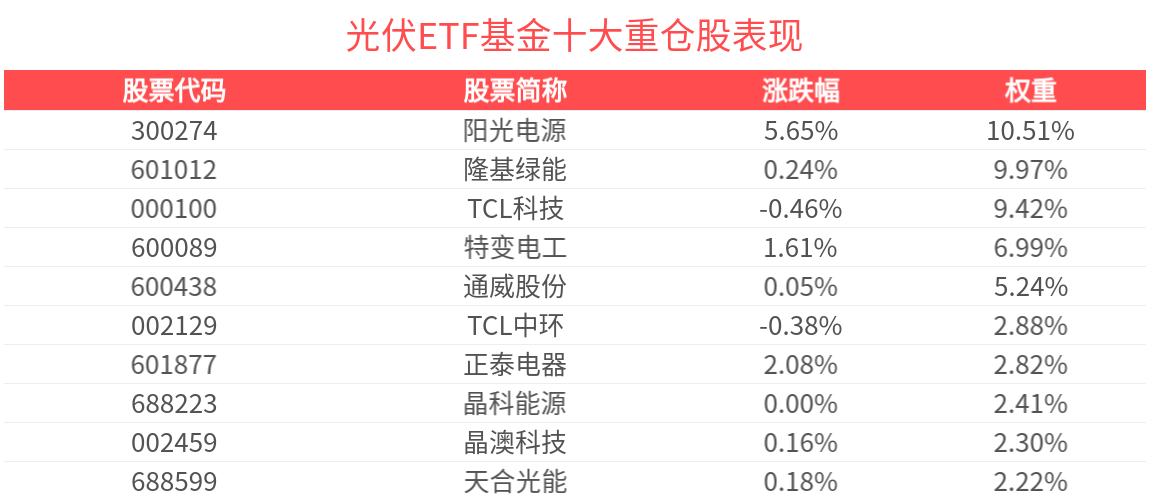
Group 1 - The Zhongzheng Photovoltaic Industry Index (931151) has shown a strong increase of 1.38% as of September 23, 2025, with notable gains in constituent stocks such as Sunshine Power (300274) up by 5.65% and Arctech (688472) up by 5.50% [1] - The Photovoltaic ETF Fund (516180) has risen by 1.10%, with a latest price of 0.74 yuan, and has accumulated a 9.32% increase over the past month, ranking 3rd out of 10 comparable funds [1] - The Zhongzheng Photovoltaic Industry Index is composed of no more than 50 representative listed companies from the photovoltaic industry chain, reflecting the overall performance of these securities [1] Group 2 - As of August 29, 2025, the top ten weighted stocks in the Zhongzheng Photovoltaic Industry Index include Sunshine Power (300274), Longi Green Energy (601012), and TCL Technology (000100), with the top ten accounting for 56.14% of the index [2] - The weight and performance of the top stocks are as follows: Sunshine Power (5.65%, 10.51%), Longi Green Energy (0.24%, 9.97%), and TCL Technology (-0.46%, 9.42%) [4]