泸州老窖

Search documents
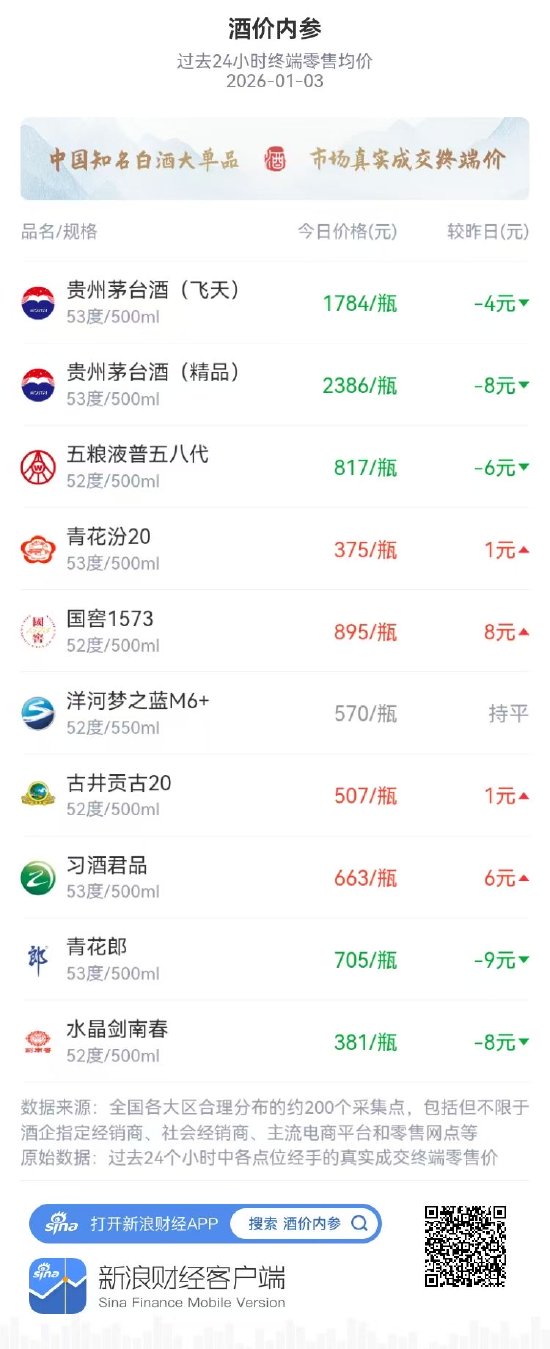
酒价内参1月3日价格发布 市场延续下行整体价格再创近期新低
Xin Lang Cai Jing· 2026-01-03 01:06
新浪财经"酒价内参"重磅上线 知名白酒真实市场价尽在掌握 新浪财经"酒价内参"过去24小时中收集的数据显示,中国白酒市场十大单品的终端零售均价在新年第三 天继续下行,整体价格进一步下探。如果十大单品各取一瓶整体打包售卖,今日总售价为9083元,较昨 日回落19元,创下近11日以来新低。市场在新年伊始连续回调,整体价格中枢持续下移。 今日市场呈现涨跌互现的分化格局。上涨产品中,国窖1573表现强势,环比上涨8元/瓶,领涨全场。习 酒君品价格上涨6元/瓶。古井贡古20与青花汾20价格分别微涨1元/瓶。洋河梦之蓝M6+价格则与昨日持 平。下跌产品方面,青花郎价格回调幅度居前,下跌9元/瓶。精品茅台与水晶剑南春价格均下跌8元/ 瓶,后者价格创下近期新低。五粮液普五八代价格下跌6元/瓶。飞天茅台价格下跌4元/瓶。尽管部分品 牌实现低点反弹,但市场整体仍被观望情绪主导,多数核心产品价格承压。 "酒价内参"的每日数据源自全国各大区均有合理分布的约200个采集点,包括但不限于酒企的指定经销 商、社会经销商、主流电商平台和零售网点等,原始取样数据为过去24个小时中各点位经手的真实成交 终端零售价格,力求为社会各界提供一份关于知 ...



食品饮料2026年投资策略报告:曙光渐显,在分化中前行-华源证券
Sou Hu Cai Jing· 2026-01-02 10:33
Group 1 - The report focuses on the food and beverage industry, highlighting the performance in 2025 and investment opportunities in 2026, with ROA (Return on Assets) as a key indicator for recovery [1][2] - The industry is currently in a differentiated recovery phase, with varying recovery paces across segments; soft drinks and snacks are leading, while liquor is still in the destocking phase [1][2] - The experience from Japan's consumption differentiation in the 1990s serves as a reference, emphasizing the importance of meeting consumer needs for cost-effectiveness and health [1][10] Group 2 - Investment strategies for 2026 focus on two main lines: "price" and "volume," with rising CPI expected to drive valuation recovery in traditional high-penetration sectors like liquor and dairy [2][3] - Key investment targets include leading brands in liquor (e.g., Kweichow Moutai, Luzhou Laojiao), dairy (e.g., Yurun Dairy, China Shengmu), and beer (e.g., Tsingtao Brewery) [2][3] - The report identifies three directions for volume growth: cost-effective consumption, low-penetration segments benefiting from health trends, and overseas market expansion [2][3] Group 3 - The industry is expected to progress through differentiation, with segments showing potential for valuation recovery as ROA stabilizes, while segments aligned with cost-effectiveness and health trends will continue to grow [3][10] - The report suggests that companies with efficiency and innovation advantages will further solidify their competitive positions [3][10]

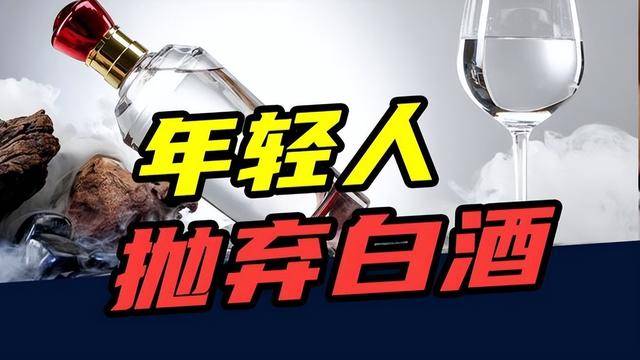
现在的年轻人,基本上已远离了白酒,2个根本原因,其他都是借口
Sou Hu Cai Jing· 2026-01-02 08:43
Core Viewpoint - The decline in liquor consumption, particularly in the high-end segment, is primarily attributed to economic conditions and policy changes rather than a shift in young people's drinking habits [1][31]. Economic Environment - The liquor industry, especially high-end liquor, is categorized as an "elastic consumption" good, meaning it is not a necessity and is more likely to be cut from budgets during economic downturns [14][18]. - The turning point for the liquor industry occurred in 2020, with stocks of major brands like Moutai and Wuliangye reaching historical peaks in early 2020 but subsequently declining for over five years [3][5]. - By the third quarter of 2025, even industry giants like Wuliangye reported significant profit declines, a scenario previously unimaginable [5]. - Economic pressures have led to reduced consumer spending, with a notable decrease in the business liquor market, which dropped by 32% year-on-year in 2024 [18][20]. Consumer Demographics - The primary consumer base for liquor has historically been middle-aged individuals, with those under 30 accounting for less than 15% of total consumption, while those over 35 represent 72.8% [9][12]. - The notion that young people are the cause of declining sales overlooks the fact that the main consumer group is facing economic challenges, leading to reduced spending [12][31]. Policy Impact - Recent policy changes, such as the revised regulations on government consumption of alcohol, have significantly altered the consumption landscape, particularly in the business sector [20][22]. - The 2025 revision of the "Regulations on Saving and Opposing Waste in Party and Government Agencies" expanded restrictions on all alcoholic beverages, contributing to a short-term decline of 2%-3% in the liquor sector [22][28]. - Local policies, like those from Guizhou province aimed at transforming the liquor industry, indicate a need for adaptation in response to changing market conditions [24][28]. Market Dynamics - The inventory levels of liquor companies have surged, with 20 listed liquor firms reporting stock levels of 168.39 billion yuan, an increase of 19.29 billion yuan year-on-year [26]. - Many distributors are experiencing price inversions, where the selling price is lower than the manufacturer's suggested price, further dampening market enthusiasm [26][28]. - The combination of economic pressures and policy regulations has compressed the consumption space for high-end liquor, which previously relied heavily on government and corporate events [30][31]. Conclusion - The decline in liquor consumption is fundamentally linked to economic conditions and regulatory changes rather than a simple shift in consumer preferences among younger demographics [31][37]. - The industry must adapt to these economic and policy shifts to meet evolving consumer demands, rather than attributing the decline to younger consumers [35][37].


罗振宇2026跨年演讲:1000天后的世界,当AI连接万物,我们如何连接彼此?
Quan Jing Wang· 2026-01-02 02:36
Core Insights - The future world in 2025 will see AI deeply integrated into daily life, optimizing decision-making and serving as a new foundation for societal operations, while raising questions about maintaining meaningful human connections in a technology-driven era [1] - AI is not about replacement but rather about restructuring human roles, emphasizing that certain fields requiring emotional connection and personalized care will always remain uniquely human [1] Group 1: Long-term Perspective - The discussion highlights the long-term commitment of Luzhou Laojiao, a brand with over 700 years of craftsmanship and continuous production for 450 years, showcasing the value of time in creating quality products [2] - The process of making fine liquor is portrayed as a slow, time-dependent transformation that cannot be expedited by algorithms, paralleling the importance of time in building genuine human relationships [2] Group 2: Emotional Connection - While AI can efficiently transmit information, true emotional connections between people often require a medium that fosters openness, such as sharing a drink, which allows for genuine conversation and connection [3] - The narrative emphasizes that despite the advancements in AI, the act of sharing a drink remains a vital way to connect with others, reinforcing trust and intimacy that cannot be replicated by digital communication [3]

白酒行业游戏规则会被重塑吗
Qi Lu Wan Bao· 2026-01-01 16:27
Core Viewpoint - Guizhou Moutai will completely eliminate the distribution model by 2026, reducing the burden on distributors and regaining pricing control over its products, particularly the core product, Feitian Moutai, which is now available at a suggested retail price of 1499 yuan, down from previous highs of around 3000 yuan [1][2]. Group 1: Changes in Distribution and Pricing - The decision to stop the distribution model is a significant move to alleviate the financial pressure on distributors, who previously had to purchase non-standard products at high prices, leading to hidden losses due to price discrepancies [2]. - The previous practice of selling Moutai products at 90% of the market suggested retail price has contributed to the financial strain on distributors, making the new direct sales approach a necessary reform [2]. Group 2: Market Challenges and Consumer Behavior - The transformation of Guizhou Moutai reflects the determination of leading liquor companies to adapt, but it also introduces new challenges, particularly regarding whether consumers, especially younger demographics, will continue to purchase high-end liquor at the new price point [3]. - The trend towards lower alcohol content and younger consumer preferences is becoming prominent in the industry, with other companies like Wuliangye and Luzhou Laojiao launching lower-alcohol products to attract younger buyers [3]. Group 3: Industry Impact and Competition - Moutai's market reform is expected to create a new wave of disruption in the liquor industry, potentially expanding its consumer base as prices stabilize, which may impact competitors like Wuliangye and Guojiao 1573 [4]. - The ongoing "Matthew effect" in the liquor industry is leading to resource concentration among top companies, suggesting that smaller enterprises may face significant challenges and potential market exit [4]. Group 4: Financial Attributes and Market Dynamics - The gradual removal of Moutai's financial attributes raises concerns in the capital market, as easier access to reasonably priced Moutai could slow down inventory turnover and affect the market dynamics for high-priced stockholders [5]. - The competitive advantage of the iMoutai platform in offering genuine products at fair prices may further disrupt traditional sales channels, leading to potential price volatility in the Moutai market [5].
首发 | 酒业新论:牛恩坤谈“好好卖酒”的四大学习技巧与要求!
Sou Hu Cai Jing· 2026-01-01 08:37
Core Insights - The article emphasizes the challenges faced by salespeople in the liquor industry, particularly in the context of a rapidly changing market environment. It highlights the need for continuous learning and adaptation in sales techniques to succeed in selling liquor effectively [2][4][15]. Group 1: Selling Challenges - The inability to sell liquor effectively is a significant issue, often unrecognized by those who struggle with it. This lack of awareness can lead to missed opportunities and misunderstandings in professional relationships [4][5][6]. - Many salespeople experience subtle setbacks in their careers, such as losing business relationships or facing unexpected rejections, without realizing the underlying reasons for these changes [5][6][7]. Group 2: Learning to Sell Effectively - The traditional approach of learning to sell through personal development is insufficient in today's competitive and fast-paced environment. A more strategic and analytical approach is necessary to master the art of selling liquor [8][9]. - Learning from mistakes is crucial. Salespeople must recognize and reflect on their errors to improve their selling techniques and adapt to changing market conditions [10][11]. - Practical learning in specific scenarios is essential. Sales techniques should be applied in real-life situations to ensure they are effective and adaptable to various contexts [11][12]. Group 3: Evolving Market Dynamics - The modern liquor market is characterized by a contract-based society where personal branding and communication skills are paramount. Salespeople must demonstrate their value through their actions and words [15][16]. - Standardization in the industry has made it challenging for individuals to stand out, increasing the importance of personal charisma and communication abilities in sales roles [16][17]. - The information overload in today's society has made it harder to capture attention, necessitating creativity and uniqueness in selling strategies to succeed [17][18].
“i茅台”开售1499元茅台!业内人士:更以消费者为中心了
新浪财经· 2026-01-01 07:42
Core Viewpoint - Guizhou Moutai has launched the sale of its Feitian 53% vol 500ml liquor on the iMoutai App starting January 1, 2026, allowing consumers to purchase directly, indicating a strong demand for Moutai and a shift towards consumer-centric strategies [3][10]. Group 1: Sales and Consumer Response - The Feitian Moutai sold out quickly after its launch at 9:00 AM, with consumers expressing excitement on platforms like Xiaohongshu, referring to it as their "dream liquor" [4][7]. - The iMoutai App will continue to offer the Feitian Moutai daily at 9:00 AM, allowing consumers who missed out to try again the next day [5][10]. Group 2: Market Strategy and Consumer Engagement - Moutai's pricing strategy has returned to 1499 yuan, which is expected to stabilize the market and enhance user experience, making it more accessible to a broader audience [7][9]. - The launch of the iMoutai App is part of Moutai's digital transformation, aiming to connect directly with consumers and ensure authenticity in purchases [10][11]. Group 3: Industry Impact - The return of Moutai to a lower price point is anticipated to increase its consumer base and drinking scenarios, potentially impacting competitors like Wuliangye and Guojiao 1573 [9][11]. - Experts believe that the fixed pricing on the iMoutai platform will discourage speculative pricing behaviors, reinforcing Moutai's position as a consumer product rather than an investment asset [11].
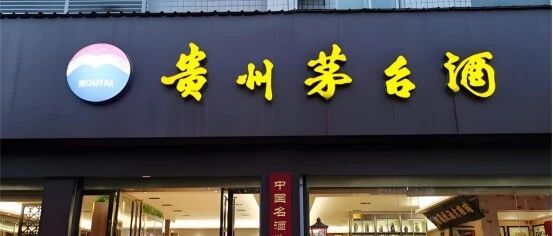
“i茅台”开售1499元茅台!业内人士:更以消费者为中心
Xin Lang Cai Jing· 2026-01-01 07:21
Core Viewpoint - Guizhou Moutai has launched the sale of its Feitian 53% vol 500ml liquor on the iMoutai App starting January 1, 2026, allowing consumers to purchase directly, indicating a shift towards consumer-centric strategies and improved user experience [2][6][15]. Group 1: Sales and Consumer Response - The Feitian Moutai sold out quickly after its launch at 9:00 AM, with consumers expressing excitement on social media platforms like Xiaohongshu, referring to it as their "dream liquor" [3][5][10]. - The iMoutai App will continue to offer the Feitian Moutai daily at 9:00 AM, with a purchase limit of 12 bottles per person, ensuring ongoing availability for consumers [3][11][13]. Group 2: Market Strategy and Pricing - The price of the Feitian Moutai is set at 1499 yuan, with sales following a first-come, first-served basis, and daily supply adjusted based on market conditions [5][13]. - The launch of the Feitian Moutai on the iMoutai App is part of Moutai's broader strategy to enhance market stability, improve channel activity, and provide better service to consumers [6][15]. Group 3: Industry Impact - The return to a more accessible price point for Moutai is expected to expand its consumer base, attracting middle-class families and small business owners, thereby increasing the consumption scenarios for Moutai [6][15]. - The competitive landscape may shift, as the lower price of Moutai could pressure other premium liquor brands like Wuliangye and Guojiao 1573, which previously benefited from Moutai's higher pricing [6][15].
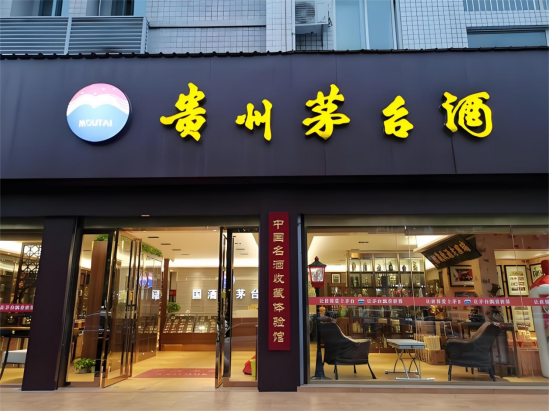
2025年A股“燃爆了”!创近6年最大涨幅,540股股价翻倍!融资客年度“采购清单”出炉
Zheng Quan Shi Bao Wang· 2026-01-01 02:00
Market Performance - In 2025, the A-share market showed strong performance, with the Shanghai Composite Index closing at 3968.84 points, marking an annual increase of 18.41%, the largest since 2020 [2] - The Shenzhen Component Index surged by 29.87%, while the ChiNext Index saw a remarkable rise of 49.57% [2] - The Hong Kong market also performed well, with the Hang Seng Index increasing by 27.77% and the Hang Seng Tech Index rising by 23.45% [3] Sector Performance - The non-ferrous metals sector led the annual gains with a staggering increase of 94.73%, driven by soaring precious metal prices and rare earth export restrictions [4] - The communication sector followed with an 84.75% increase, while electronics, comprehensive, power equipment, and machinery sectors all saw gains exceeding 40% [4] - Conversely, the coal and food & beverage sectors were among the few to record declines, with decreases of 5.27% and 9.69%, respectively [4] Stock Performance - A total of 540 stocks in the A-share market doubled in price in 2025, with the top performers being Upway New Materials and Tianpu Co., with increases of 1820.29% and 1645.35%, respectively [5] - Notable stocks with significant annual gains exceeding 500% included *ST Yushun, *ST Yazhen, and Shenghong Technology, among others [5] - On the downside, 25 stocks experienced annual declines of over 40%, with Shijin Technology leading with a drop of 50.99% [5] Financing Trends - As of December 30, 2025, the A-share financing balance reached a record high of 25,385.25 billion yuan, maintaining above 25 trillion yuan for six consecutive days [9] - The financing balance increased by 6,843.8 billion yuan compared to the end of 2024, representing a year-on-year growth of 36.91% [10] - The electronics and power equipment sectors saw net inflows exceeding 1,000 billion yuan, while communication, machinery, and non-ferrous metals sectors also attracted significant investments [10] Notable Stocks in Financing - A total of 133 stocks had net financing purchases exceeding 10 billion yuan, with New Yisheng, Ningde Times, and Shenghong Technology among the top [12] - The "three swordsmen" of optical modules, New Yisheng and Zhongji Xuchuang, received substantial financing support, with net purchases exceeding 100 billion yuan [13] - Conversely, stocks like Muyuan Foods and Oriental Fortune faced significant net financing repayments, exceeding 10 billion yuan [11][13]


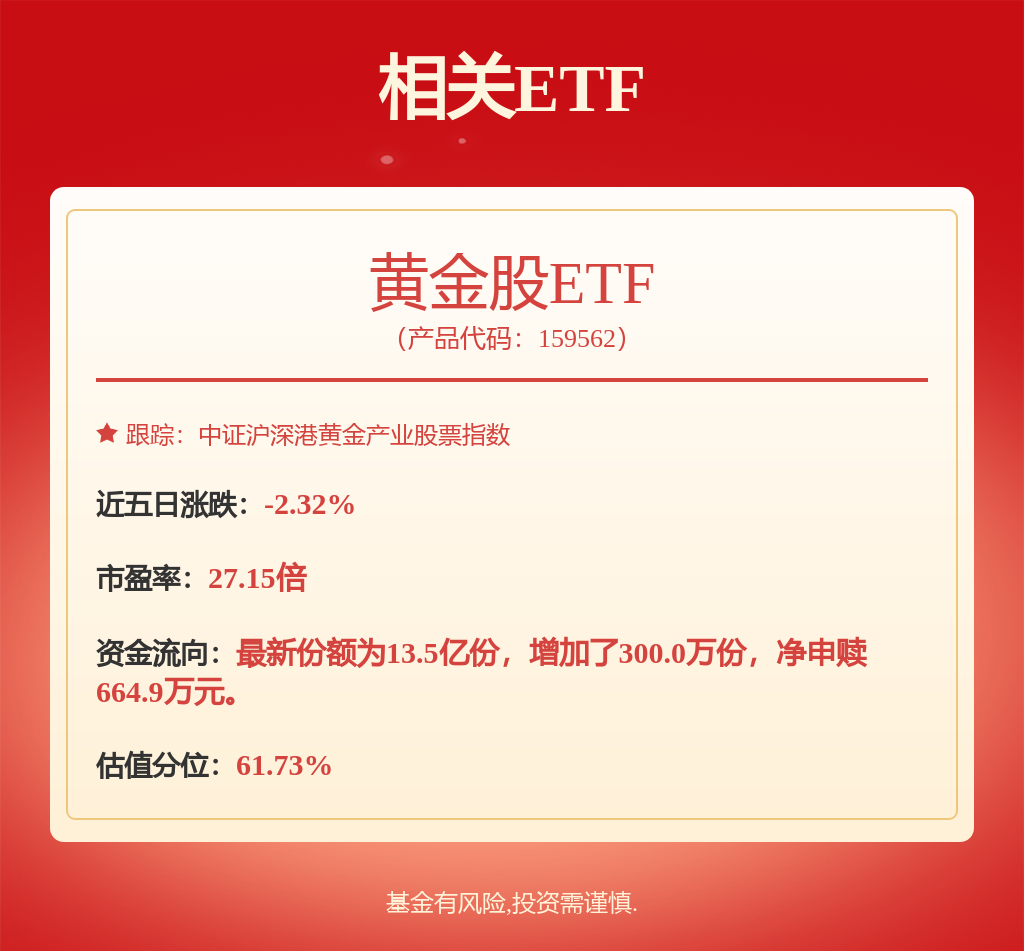
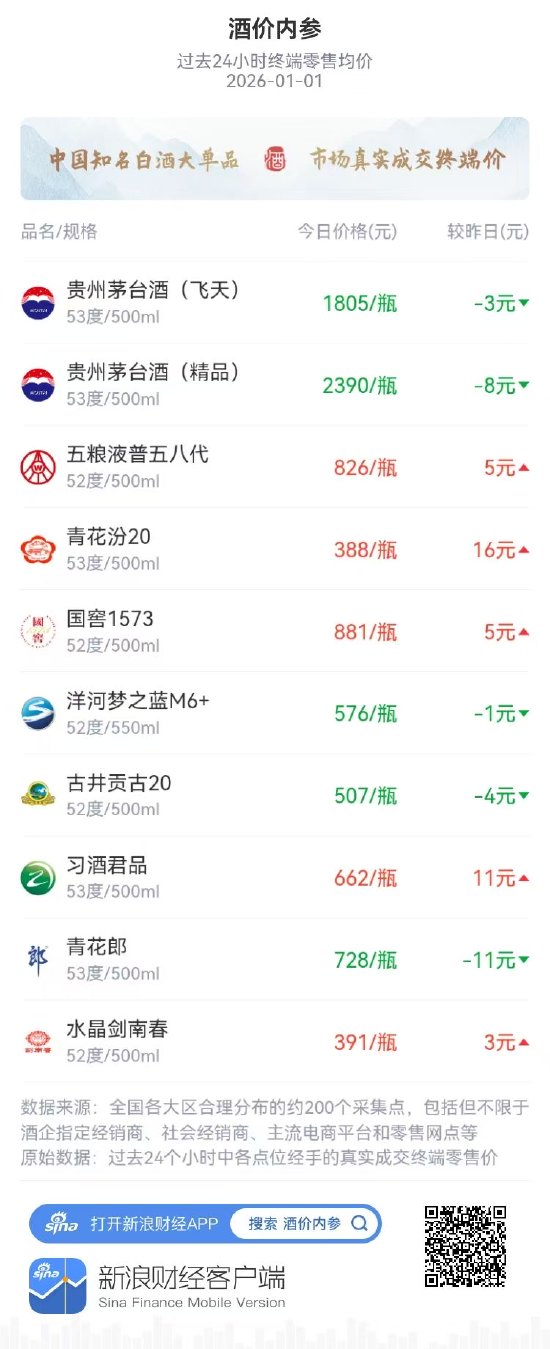
酒价内参1月1日价格发布 市场新年企稳青花汾20领涨
Xin Lang Cai Jing· 2026-01-01 01:00
Core Viewpoint - The Chinese liquor market shows signs of stabilization and slight price rebound as the new year begins, following a period of deep adjustment at the end of the previous year [1][4]. Price Trends - The average retail price of the top ten liquor products reached 9,154 yuan, an increase of 13 yuan from the previous day [1][4]. - The market exhibited a mixed rebound, with five products increasing in price and five decreasing [7]. Specific Product Price Changes - Significant price increases were observed for: - Qinghua Fen 20, up 16 yuan per bottle [7]. - Xijiu Junpin, up 11 yuan per bottle [7]. - Guojiao 1573 and Wuliangye Pu 58, both up 5 yuan per bottle [7]. - Shuijing Jian'nanchun, up 3 yuan per bottle [7]. - Notable price decreases included: - Qinghua Lang, down 11 yuan per bottle [7]. - Boutique Moutai, down 8 yuan per bottle [7]. - Guqingong Gu 20, down 4 yuan per bottle [7]. - Flying Moutai, down 3 yuan per bottle [7]. - Yanghe Dream Blue M6+, down 1 yuan per bottle [7]. Market Data Collection - The data for "Liquor Price Reference" is sourced from approximately 200 collection points across various regions, including designated distributors, social distributors, major e-commerce platforms, and retail outlets [3][7]. Industry Developments - Moutai's market transformation took a significant step with the announcement of the sale of Flying Moutai (53% vol, 500ml) starting January 1, 2026, with a limit of 12 bottles per user per day [3][7]. - This initiative aims to create a more consumer-centric market environment and stabilize market order through enhanced direct channel management and product matrix optimization [3][7].