
海康威视

Search documents
美联邦通信委员会又发作了,“中国老想打击美国弱点”
Guan Cha Zhe Wang· 2025-10-29 03:39
Core Viewpoint - The U.S. Federal Communications Commission (FCC) continues to implement measures against Chinese electronic products under the guise of national security, including banning new licenses for devices containing components from a "covered list" and disabling previously approved devices [1][3]. Group 1: FCC Actions - On October 28, the FCC voted 3-0 to prohibit new licenses for devices with components from the "covered list" and to disable previously approved devices in certain cases [1][3]. - Earlier in October, the FCC announced further tightening of restrictions on telecommunications equipment manufactured by Chinese companies deemed to pose national security risks [3]. - The FCC has previously mandated major e-commerce platforms to remove millions of "prohibited" Chinese electronic products, including home security cameras and smartwatches [3][4]. Group 2: Responses from Chinese Companies - Hikvision opposed the FCC's actions, arguing that the restrictions extend beyond its authority and lack evidence against specific products, which could harm U.S. communities and small businesses relying on compliant security systems [3][5]. - The Chinese government has repeatedly criticized the U.S. for politicizing and weaponizing national security, claiming it undermines market rules and international trade order, and has vowed to protect the legitimate rights of Chinese enterprises [5]. Group 3: Historical Context - The FCC has a history of actions against Chinese technology firms, including the 2019 legislation requiring U.S. telecom operators to remove Chinese equipment from their networks and the 2020 identification of Huawei and ZTE as national security threats [4]. - In 2021, the Biden administration signed the Secure Equipment Act, which further restricted the FCC from reviewing or issuing new equipment licenses for companies like Huawei and ZTE [4].



黄仁勋口中的“中国硅谷”,正在批量生产AI独角兽
创业邦· 2025-10-29 03:27
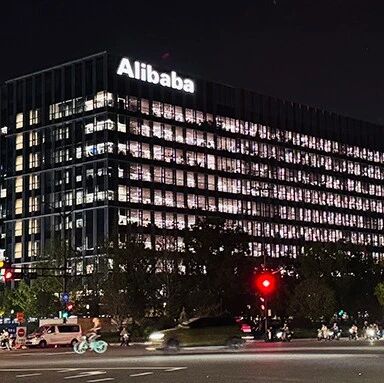
Core Viewpoint - Hangzhou is emerging as a competitive technology innovation hub in China, often referred to as "China's Silicon Valley," driven by AI and supported by a robust ecosystem of companies, policies, and talent [6][51]. Group 1: Overview of Hangzhou's Tech Ecosystem - Recent stock price surges of Alibaba and the IPO launches of local companies like Yushutech and Qunhe Technology highlight the city's growing prominence in the tech sector [6]. - Hangzhou's tech ecosystem is characterized by top universities, a vibrant entrepreneurial culture, active private capital, and a complete technology enterprise hierarchy from giants to startups [7]. Group 2: Key Companies and Innovations - Alibaba's global headquarters in Hangzhou serves as a core hub for AI talent and innovation, with plans for a 380 billion yuan investment in AI infrastructure over three years [11]. - Numerous "Alibaba-affiliated" AI startups are emerging, such as: - BetterYeah AI, focusing on enterprise-level AI agents, has raised over 100 million yuan in its latest funding round [15]. - Half Universe, aiming to create a personal AI computer, is led by former Alibaba Cloud chief security scientist [15]. - Rokid, specializing in AR technology, has gained international recognition for its smart glasses [15]. - The establishment of the Zhijiang Laboratory, focusing on intelligent perception and AI, showcases the city's commitment to cutting-edge research [17]. Group 3: Policy Support and Talent Attraction - The "Future Science City" in Yuhang District has implemented generous talent policies, including up to 12 million yuan in research subsidies and 3 million yuan in housing subsidies to attract high-level talent [22]. - The city government has set ambitious goals for the AI industry, aiming for over 390 billion yuan in core AI industry revenue and more than 700 AI enterprises by the end of 2025 [52]. Group 4: Competitive Landscape - Hangzhou faces competition from other major cities like Beijing, Shenzhen, and Shanghai, but it is carving out a niche in AI application transformation [51]. - The city is developing a unique "Silicon Alley" model, with tech companies like DeepSeek and Qunhe Technology establishing themselves in urban centers rather than traditional tech parks [36]. Group 5: Future Prospects - The integration of Alibaba's ecosystem, Zhejiang University's talent pool, and the capital from Ant Group positions Hangzhou favorably for future growth in the AI sector [51]. - The city's cultural inclusivity and willingness to embrace new talent contribute to its attractiveness as a tech hub, fostering a diverse and innovative environment [53].




七台AI超算引爆全球!全市场最大的计算机ETF(159998)强势四连涨,美国能源部联手英伟达、甲骨文,打造历史级别计算机
Sou Hu Cai Jing· 2025-10-29 01:38
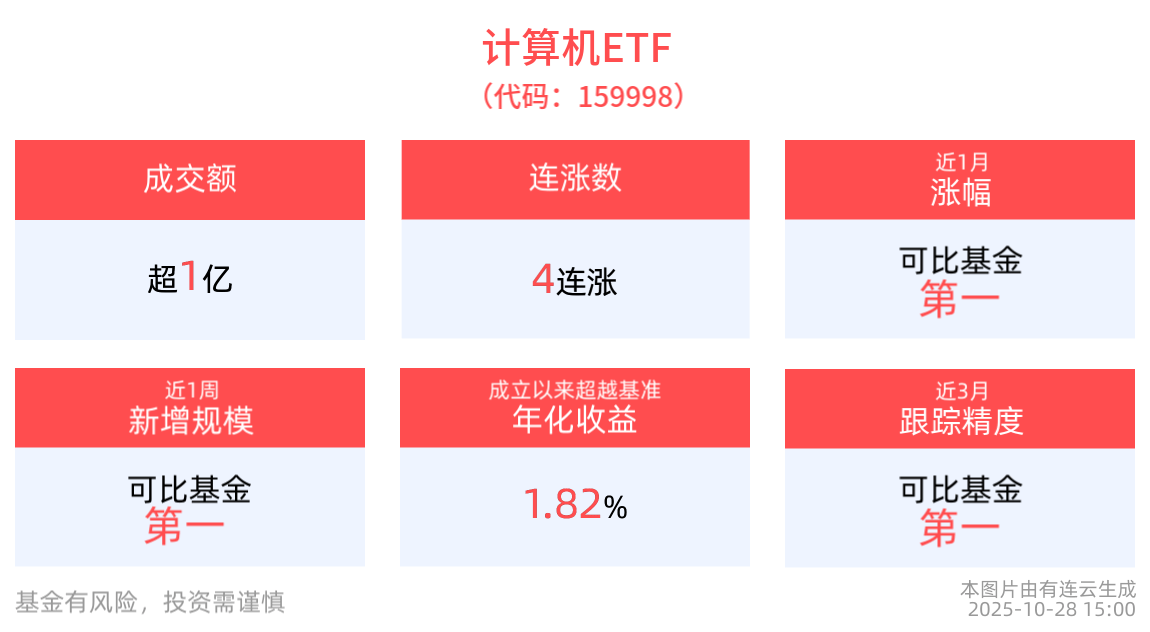
Group 1 - The Computer ETF (159998) has risen by 0.28% as of October 28, 2025, marking its fourth consecutive increase, with a turnover rate of 4.25% and a transaction volume of 121 million yuan [3] - The Computer ETF (159998) has seen a cumulative increase of 3.82% over the past week, ranking first among comparable funds, with a significant growth in scale of 8.639 million yuan [3] - The Tianhong Sci-Tech Index ETF (589860) has a turnover rate of 11.44% and a transaction volume of 40.4241 million yuan, indicating active market trading [3] Group 2 - The Computer ETF (159998) covers a wide range of sectors including information technology services, application software, and communication equipment, featuring leaders in AI applications and hardware manufacturing [4] - The Tianhong Sci-Tech Index ETF (589860) covers 97% of the market capitalization of the Sci-Tech board, with a balanced allocation in strategic emerging industries such as semiconductors and artificial intelligence [4] - The U.S. Department of Energy has announced a collaboration with NVIDIA and Oracle to build seven new AI supercomputers, emphasizing the importance of AI in scientific research [5] Group 3 - The quantum technology market is expected to exceed $6.1 billion globally by 2025, with China's market projected to reach 11.56 billion yuan, reflecting a compound annual growth rate of over 30% [6] - CITIC Securities highlights the need to accelerate innovation in AI and digital technologies, predicting significant growth in capital expenditure related to AI model development [7]


趋势研判!2025年中国智慧安检行业发展历程、产业链、市场规模、竞争格局及发展趋势:公共安全需求持续升级,智慧安检市场规模将超350亿元[图]
Chan Ye Xin Xi Wang· 2025-10-29 01:24
Core Insights - The article emphasizes the importance of smart security checks as a technological innovation that enhances public safety by integrating advanced technologies like AI, big data, and IoT to improve efficiency and accuracy in security processes [1][10]. Industry Overview - Smart security checks represent a comprehensive upgrade of traditional security methods, significantly improving detection efficiency and accuracy while enabling real-time monitoring and analysis of potential threats [3][10]. - The market size of China's smart security check industry is projected to grow from 8.93 billion yuan in 2014 to 27.81 billion yuan in 2024, with a compound annual growth rate (CAGR) of 12.03% [1][11]. Industry Development History - The development of smart security checks began in the 1980s with the introduction of X-ray machines in airports, evolving rapidly in the 21st century with advancements in internet and AI technologies [5][10]. - A notable milestone occurred in 2007 when Phoenix, Arizona, introduced a full-body scanning device, marking the global adoption of similar technologies in airports [5]. Industry Chain - The upstream of the smart security check industry includes manufacturers of security equipment, AI technology providers, and big data processing companies, while the downstream applications are concentrated in transportation, industrial safety, and healthcare sectors [6][10]. Market Dynamics - The smart security check industry is experiencing robust growth driven by continuous policy support and technological advancements, with expectations to exceed 35 billion yuan by 2026 [1][11]. - In 2024, China's transportation sector is expected to see 64.592 billion passenger trips, indicating a growing demand for efficient security measures [8][9]. Competitive Landscape - The global smart security check industry features a tiered competitive structure, with international giants like Arsenal and Garrett leading the high-end market, while Chinese companies like Hikvision and Dahua are prominent in the second tier [12][13]. Future Trends - Key future trends in smart security checks include the realization of "seamless passage" experiences, proactive risk identification through digital profiling, and the establishment of a data trust chain using blockchain technology [16][17][18].


【点金互动易】存储芯片+汽车芯片,公司自主研发PCIe5.0 SSD主控芯片,已切入海康存储、致态等头部供应链
财联社· 2025-10-29 00:20
Group 1 - The article emphasizes the importance of timely and professional information interpretation in investment decision-making [1] - The focus is on identifying investment value from significant events, analyzing industry chain companies, and interpreting key policy points [1] - The company has developed PCIe 5.0 SSD controller chips for storage and automotive applications, achieving mass production status for automotive-grade chips [1] - In the intelligent computing liquid cooling sector, the company has delivered prototype samples to some clients for data center applications [1]

刚刚,融资5亿,国家队出手,干特种机器人
3 6 Ke· 2025-10-28 23:58
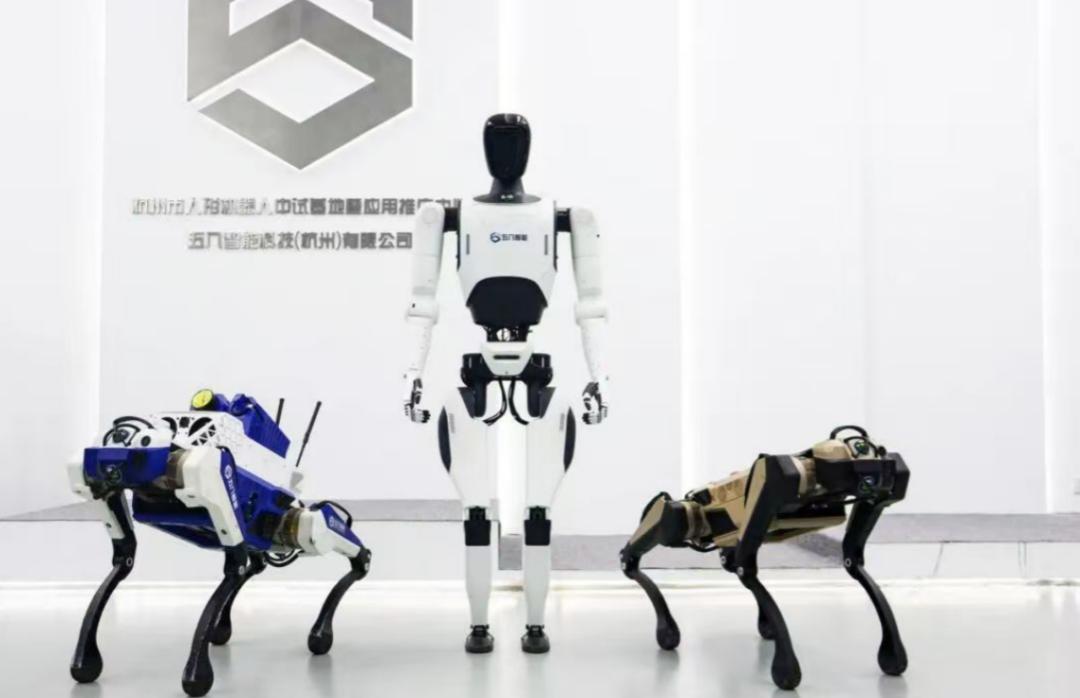
Core Viewpoint - The company "Wuba Intelligent" has recently announced a financing round of approximately 500 million yuan, positioning itself as a unique player in the robotics sector with strong ties to state-owned enterprises and applications in public safety and industrial sectors [1][4]. Company Overview - Wuba Intelligent is a state-owned enterprise under the China Ordnance Equipment Group [2]. - The current round of investment includes major state-backed funds such as the National New Industry Fund and Zhejiang Provincial Science and Technology Innovation Fund [3]. Product Offerings - Wuba Intelligent has developed several core products, including: - Patrol and security robots capable of autonomous 24-hour surveillance in various environments [7]. - Riot control robots equipped with payload delivery systems and tactical features for dangerous tasks [8]. - The Q10 small wheeled police robot designed for specific law enforcement scenarios [8]. - The "Da Sheng" humanoid robot aimed at public safety and industrial applications, capable of traffic management and crowd control [8]. Market Analysis - The company operates in two main sectors: public safety and industrial robotics, with a current emphasis on safety applications [10]. - The safety robot market is characterized by both red and blue ocean opportunities, with intense competition in established areas like police patrols and firefighting [18][19]. - The market for police patrol robots is projected to reach approximately 7.83 billion yuan in 2024, accounting for 41.7% of the overall safety robot market [18]. Challenges and Opportunities - Current limitations in safety robots include algorithmic intelligence, hardware durability, and the establishment of industry standards [15][16]. - There is a growing demand for advanced safety robots in complex environments, such as underwater and extreme conditions, which presents significant market potential [21][22][24]. - Wuba Intelligent's recent financing is seen as a signal for the accelerating development of the safety robot sector [25].

多行业联合解读十五五规划建议稿
2025-10-28 15:31
Summary of Key Points from Conference Call Records Industry or Company Involved - The records primarily discuss the **Fifteenth Five-Year Plan** (十五五规划) and its implications across various industries, including technology, energy, manufacturing, and real estate. Core Points and Arguments 1. **Economic Growth Targets**: The plan sets a GDP growth target of 4.7% to double the GDP by 2035, with a short-term goal of maintaining a 5% growth rate in the initial years [1][3][4] 2. **Focus on Manufacturing and Innovation**: The plan emphasizes transforming innovation into manufacturing power, placing industry as the top priority followed by innovation [1][3] 3. **Consumer Spending and Domestic Demand**: There is a strong push to increase consumer spending and enhance domestic demand as a primary driver of economic growth, with specific targets for consumer rates [1][4] 4. **Digital Transformation Support**: The government will provide subsidies and tax reductions to support the digital transformation of manufacturing and basic software sectors, creating opportunities for companies in these fields [1][6] 5. **New Energy Development**: The plan highlights the development of a new energy system focusing on hydrogen, electric energy, and solid-state batteries, indicating investment opportunities in these areas [1][7][8] 6. **Metal Industry Outlook**: The copper and aluminum sectors are expected to benefit from increased demand for energy storage and efficient power utilization materials, with a positive outlook for these metals [2][10] 7. **Investment in High-End Manufacturing**: Key areas include integrated circuits, high-end instruments, and industrial mother machines, with recommendations to focus on leading domestic manufacturers [15] 8. **Real Estate Market Dynamics**: The real estate market shows complexity, with core cities performing better than others. The plan emphasizes tailored policies for different cities and improving housing quality [24] Other Important but Possibly Overlooked Content 1. **Artificial Intelligence Integration**: The plan includes a significant focus on AI, aiming to integrate it across various sectors, indicating a shift towards smart transformation rather than traditional digitalization [5][6] 2. **Energy Security**: The importance of energy security is reiterated, especially in light of geopolitical risks, with a long-term positive outlook for oil and gas sectors [13] 3. **Emerging Technologies**: The plan identifies brain-computer interfaces as a key area for development, with significant market growth expected and a focus on clinical applications [22] 4. **Financial Sector Opportunities**: The banking sector is highlighted for its potential growth, driven by increased credit demand in green loans and technology sectors [23] This summary encapsulates the essential insights from the conference call records, providing a comprehensive overview of the Fifteenth Five-Year Plan's implications across various industries and investment opportunities.
10月28日深证国企股东回报(970064)指数跌1.74%,成份股铜陵有色(000630)领跌
Sou Hu Cai Jing· 2025-10-28 12:22
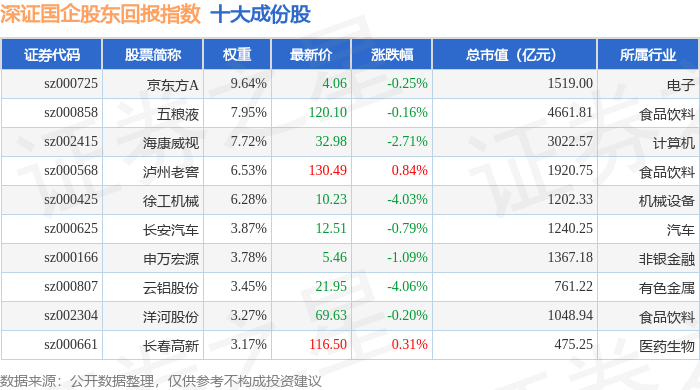
Market Performance - The Shenzhen State-Owned Enterprises Shareholder Return Index closed at 1666.46 points, down 1.74% with a trading volume of 37.581 billion yuan and a turnover rate of 1.6% [1] - Among the index constituents, 9 stocks rose while 41 stocks fell, with Shenzhen Properties A leading the gainers at a 10.05% increase and Tongling Nonferrous Metals leading the decliners at a 10.07% decrease [1] Key Constituents - The top ten constituents of the Shenzhen State-Owned Enterprises Shareholder Return Index include: - BOE Technology Group (9.64% weight, latest price 4.06 yuan, -0.25% change, market cap 151.9 billion yuan) [1] - Wuliangye Yibin (7.95% weight, latest price 120.10 yuan, -0.16% change, market cap 466.18 billion yuan) [1] - Hikvision (7.72% weight, latest price 32.98 yuan, -2.71% change, market cap 302.26 billion yuan) [1] - Luzhou Laojiao (6.53% weight, latest price 130.49 yuan, +0.84% change, market cap 192.08 billion yuan) [1] - XCMG Machinery (6.28% weight, latest price 10.23 yuan, -4.03% change, market cap 120.23 billion yuan) [1] - Changan Automobile (3.87% weight, latest price 12.51 yuan, -0.79% change, market cap 124.03 billion yuan) [1] - Shenwan Hongyuan (3.78% weight, latest price 5.46 yuan, -1.09% change, market cap 136.72 billion yuan) [1] - Yunnan Aluminum (3.45% weight, latest price 21.95 yuan, -4.06% change, market cap 76.12 billion yuan) [1] - Yanghe Brewery (3.27% weight, latest price 69.63 yuan, -0.20% change, market cap 104.89 billion yuan) [1] - Changchun High & New Technology (3.17% weight, latest price 116.50 yuan, +0.31% change, market cap 47.53 billion yuan) [1] Capital Flow - The index constituents experienced a net outflow of 3.006 billion yuan from major funds, while retail investors saw a net inflow of 2.346 billion yuan [1] - Notable capital flows include: - Zhongcai Technology with a net inflow of 179 million yuan from major funds [2] - Shenzhen Properties A with a net inflow of 57.37 million yuan from major funds [2] - Changchun High & New Technology with a net inflow of 27.65 million yuan from major funds [2]

10月28日深证国企ESG(970055)指数跌0.5%,成份股云铝股份(000807)领跌
Sou Hu Cai Jing· 2025-10-28 12:22
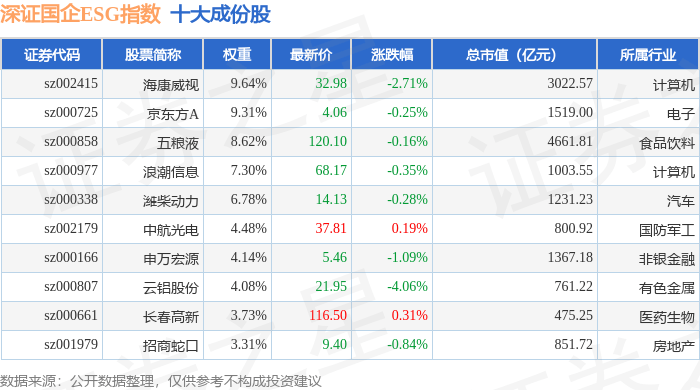
Core Points - The Shenzhen State-owned Enterprise ESG Index (970055) closed at 1406.55 points, down 0.5%, with a trading volume of 38.737 billion yuan and a turnover rate of 1.15% [1] - Among the index constituents, 20 stocks rose while 29 stocks fell, with Zhongtung High-tech leading the gainers at a 10.02% increase, and Yun Aluminum leading the decliners with a 4.06% drop [1] Index Constituents Summary - The top ten constituents of the Shenzhen State-owned Enterprise ESG Index are as follows: - Hikvision (sz002415): Weight 9.64%, Latest Price 32.98, Change -2.71%, Market Cap 302.257 billion yuan, Industry: Computer [1] - BOE Technology Group (sz000725): Weight 9.31%, Latest Price 4.06, Change -0.25%, Market Cap 151.9 billion yuan, Industry: Electronics [1] - Wrigley (sz000858): Weight 8.62%, Latest Price 120.10, Change -0.16%, Market Cap 466.181 billion yuan, Industry: Food & Beverage [1] - Inspur Information (sz000977): Weight 7.30%, Latest Price 68.17, Change -0.35%, Market Cap 100.355 billion yuan, Industry: Computer [1] - Weichai Power (sz000338): Weight 6.78%, Latest Price 14.13, Change -0.28%, Market Cap 123.123 billion yuan, Industry: Automotive [1] - AVIC Optoelectronics (sz002179): Weight 4.48%, Latest Price 37.81, Change 0.19%, Market Cap 80.092 billion yuan, Industry: Defense [1] - Shenwan Hongyuan (sz000166): Weight 4.14%, Latest Price 5.46, Change -1.09%, Market Cap 136.718 billion yuan, Industry: Non-banking Financial [1] - Yun Aluminum (sz000807): Weight 4.08%, Latest Price 21.95, Change -4.06%, Market Cap 76.122 billion yuan, Industry: Non-ferrous Metals [1] - Changchun High-tech (sz000661): Weight 3.73%, Latest Price 116.50, Change 0.31%, Market Cap 47.525 billion yuan, Industry: Pharmaceuticals [1] - China Merchants Shekou (sz001979): Weight 3.31%, Latest Price 9.40, Change -0.84%, Market Cap 85.172 billion yuan, Industry: Real Estate [1] Capital Flow Analysis - The index constituents experienced a net outflow of 989 million yuan from institutional investors, while retail investors saw a net inflow of 1.076 billion yuan [1] - The detailed capital flow for selected stocks includes: - Zhongtung High-tech: Net inflow from institutions 509 million yuan, net outflow from retail -239 million yuan [2] - China National Materials: Net inflow from institutions 179 million yuan, net outflow from retail -176 million yuan [2] - Changchun High-tech: Net inflow from institutions 27.645 million yuan, net outflow from retail -130.24 million yuan [2]

海康威视(002415.SZ):中心存储产品,是公司存储业务核心产品之一
Ge Long Hui· 2025-10-28 07:33
Core Viewpoint - Hikvision (002415.SZ) has introduced a new storage product, the "Wen Sou CVR" storage, which integrates natural language processing with video image multimodal large models to enhance data retrieval efficiency in massive video recordings [1] Group 1: Product Development - The center storage product is one of the core products in the company's storage business [1] - The new product allows for the modeling of massive view data, making the data understandable and enabling retrieval of relevant targets and events using natural language [1] - The introduction of this technology significantly improves the efficiency of searching for targets within large volumes of recorded video [1]