长安汽车

Search documents
2026“国补”首单已于近期陆续送达!关注可选消费板块机会
Mei Ri Jing Ji Xin Wen· 2026-01-12 00:59
Group 1 - The core viewpoint of the news is the launch of a new round of national subsidies for consumer goods, with a total of 62.5 billion yuan allocated to support the "trade-in" policy, aimed at boosting consumption during peak seasons like New Year's and Spring Festival [1] - The 2026 national subsidy program has optimized the range and standards of subsidies compared to 2025, adding smart glasses to the digital product category and focusing on "high-efficiency" appliances in the home appliance category [1] - The "trade-in" policy from 2024 to 2025 led to a significant increase in consumer goods sales, reaching 3.92 trillion yuan and benefiting 494 million consumers [1] Group 2 - The optional consumer ETF (562580.SH) is expected to benefit significantly from the continuation of the national subsidy policy, with a focus on sectors such as automobiles (46%) and home appliances (34%) [2] - The top ten weighted stocks in the optional consumer ETF include major companies like Midea Group, BYD, Gree Electric, and Haier Smart Home, indicating strong potential for growth in these sectors [2] - The index valuation PE-TTM stands at 23.47 times, which is in the 38.04% percentile over the past decade, suggesting a relatively attractive investment opportunity [2]
“死了么”APP一夜估值千万,最新回应;佐香园与闫学晶解约;鸿蒙智行首款MPV定档,定位50万级豪华市场丨邦早报
创业邦· 2026-01-12 00:13
Group 1 - The "Did You Die?" app has gained significant popularity, ranking first in Apple's paid tools category, and is designed as a safety tool for individuals living alone, requiring users to check in regularly [3] - The app's creator revealed that it was developed in less than a month with an initial investment of only over 1,000 yuan, and it has already become profitable with a download increase of over 100 times in recent days [3] - The app's valuation is estimated at 10 million yuan based on a proposed sale of 10% equity for 1 million yuan [3] Group 2 - Elon Musk announced that the X platform will open-source its content recommendation algorithm within a week, covering all code used for recommending content and ads [4] - Musk stated that this process will be repeated every four weeks, providing developers with explanations and updates on algorithm changes [4] Group 3 - BYD has launched a new automotive brand called Linghui, which includes four new models, three of which are pure electric sedans and one is a plug-in hybrid MPV [8] - The Linghui brand aims to cater to B-end market demands and is part of BYD's strategy to differentiate between B-end and C-end market vehicles [8] Group 4 - SanDisk is reportedly planning to increase prices by over 100% and has introduced a strict payment policy requiring 100% cash prepayment for future storage chip allocations [10] - This unprecedented move challenges traditional payment practices in the semiconductor supply chain, driven by strong demand for storage devices in AI infrastructure [10] Group 5 - CATL's service brand, NING Service, has opened the largest new energy after-market experience center in the Middle East, providing comprehensive lifecycle services for various battery types [10] - The center aims to support the growing demand for electric vehicle maintenance and battery recycling in the region [10] Group 6 - The Beijing-Tianjin-Hebei region has emerged as a leader in the production of new energy vehicles, with a total automotive output of 285,000 units in 2024, marking an 11.8% year-on-year increase [23] - The production of new energy vehicles in the region surged by 154% year-on-year, highlighting the area's strong industrial growth and leadership in the sector [23]


刑事立案同比下降16.2% 破获经济犯罪案件1192起
Xin Lang Cai Jing· 2026-01-11 17:16
Core Insights - The core message of the news is the significant progress made by the Chongqing Public Security Bureau in enhancing public safety and service efficiency, with a focus on crime reduction and community engagement. Group 1: Crime Reduction Achievements - Criminal cases in Chongqing are projected to decrease by 16.2% by 2025, marking a historic low, with violent crime cases down by 21.4% [4][11] - The police have established over 7,900 "school safety posts" to protect students, with an average of over 8,000 police personnel deployed daily [12] - The establishment of over 7,000 smart security communities has led to a 30.1% decrease in residential burglary cases [13] Group 2: Public Safety Initiatives - The Chongqing police have implemented proactive policing strategies, including 776 operational units and 53 smart policing stations, resulting in a significant reduction in street violence and disturbances by over 40% [5] - The police have successfully managed 1,286 large-scale events with over 7.29 million attendees, ensuring safety through advanced monitoring and crowd control techniques [6] Group 3: Economic Crime and Business Support - The police have cracked down on economic crimes, solving 1,192 cases and recovering 1.82 billion yuan in losses, thereby supporting business development [14] - The "Police Quick Service" online processing rate has increased to 87.1%, streamlining 102 government services and 142 convenience services [15] Group 4: Efficiency Improvements - The response time for emergency calls in urban areas has been reduced by over 40%, with police arriving at incidents 37.5% faster on average [16] - Over 2,400 training exercises were conducted, resulting in 65 awards at national competitions, showcasing the operational readiness of the police force [17][19] Group 5: Community Engagement and Technology - The Chongqing police have developed an "AI + Anti-Fraud" system, recovering over 380 million yuan for citizens through smart alerts and rapid fund recovery mechanisms [10][18] - The introduction of the "Yuzhao Tong" service has simplified the process for citizens needing to submit photos for documentation, benefiting over 60,000 individuals [8]
中国车企出海业务100%使用阿里云;中国「科技军团」闪耀CES2026,通义智能硬件展同期举办|36氪出海·要闻回顾
36氪· 2026-01-11 13:35
Core Insights - Chinese automotive companies are fully utilizing Alibaba Cloud for their global business operations, marking a shift from vehicle sales to "smart infrastructure export" [5] - The 2026 CES showcased over 1,100 Chinese companies, representing about 25% of total exhibitors, highlighting China's strength in AI, robotics, and consumer electronics [6] - XTransfer is accelerating its entry into the North and South American markets by establishing partnerships with major U.S. banks for compliance and localization [6] - Cainiao has become the first logistics company to offer G2G services across three continents, launching cross-border logistics from the U.S. to Mexico [7] - Xiaomi International has joined AliExpress's "Super Brand Export Plan," achieving significant sales during the Black Friday event [7] - JD Logistics successfully completed its first overseas drone test flight in Saudi Arabia, enhancing its international logistics capabilities [8] - Meituan Keeta has expanded its food delivery services to Bahrain, marking its fifth country in the Middle East [9] - TikTok Shop is experiencing rapid growth, with projected active consumers reaching 400 million by 2025 and GMV nearing $100 billion [10] - Guanzhou Automobile International has formed a strategic partnership with Grab to promote electric vehicles in Southeast Asia [10] - Nine Science Information has completed a B2 round of financing to enhance its overseas business layout [10] - Yao Le Technology has secured nearly 100 million yuan in Pre-A financing to expand its market presence [11] - The global humanoid robot market is expected to see a shipment of 13,000 units by 2025, with Chinese manufacturers leading the market [12] - Recent reports indicate a high demand for transformers in overseas markets, particularly in the Middle East, Europe, and South America [13] - Saudi Arabia plans to open its financial market to all foreign investors starting February 1, aiming to attract more overseas capital [13]


“终于上路了”!北汽、长安等车企竞逐L3
Xin Lang Cai Jing· 2026-01-11 11:44
Core Insights - The approval of L3 conditional autonomous driving vehicles by the Ministry of Industry and Information Technology marks a significant step towards commercial application in China [4][18] - Companies like BAIC and Changan are leading the charge in the L3 autonomous driving sector, with their models set to begin trial operations [1][2] Group 1: L3 Autonomous Driving Approval - The first batch of L3 conditional autonomous driving vehicles approved includes the BAIC Arcfox Alpha S (L3 version) and Changan SC7000AAARBEV [1][2] - These vehicles are designed for specific urban and highway scenarios, with the Arcfox model capable of operating at speeds up to 80 km/h on designated routes in Beijing [2][3] - The approval process involves a phased approach, with commercial operations expected to gradually open to individual users by Q2 2026 [3][12] Group 2: Competitive Landscape - Multiple automakers, including BYD, NIO, and Geely, are vying for entry into the L3 autonomous driving market, with some obtaining local government permits for testing [2][14] - The distinction between permits from the Ministry of Industry and Information Technology and local governments lies in their nature; the former allows for commercial pilot projects, while the latter focuses on research and development [15][17] - Geely's Zeekr 9X has received a testing permit covering over 9,224 square kilometers in Hangzhou, indicating the scale of testing efforts [14] Group 3: Future Developments - The industry anticipates 2026 to be a pivotal year for the mass production of L3 autonomous driving technology, with potential breakthroughs in L4 technology as well [6][18] - BAIC is committed to expanding its lineup of vehicles equipped with L3 technology, indicating a long-term strategy in the autonomous driving space [18] - The partnership between BAIC and Pony.ai aims to develop a comprehensive operational model for Robotaxi services, showcasing the industry's focus on commercializing autonomous driving [19]

“终于上路了”!车企竞逐L3
Zhong Guo Ji Jin Bao· 2026-01-11 11:19
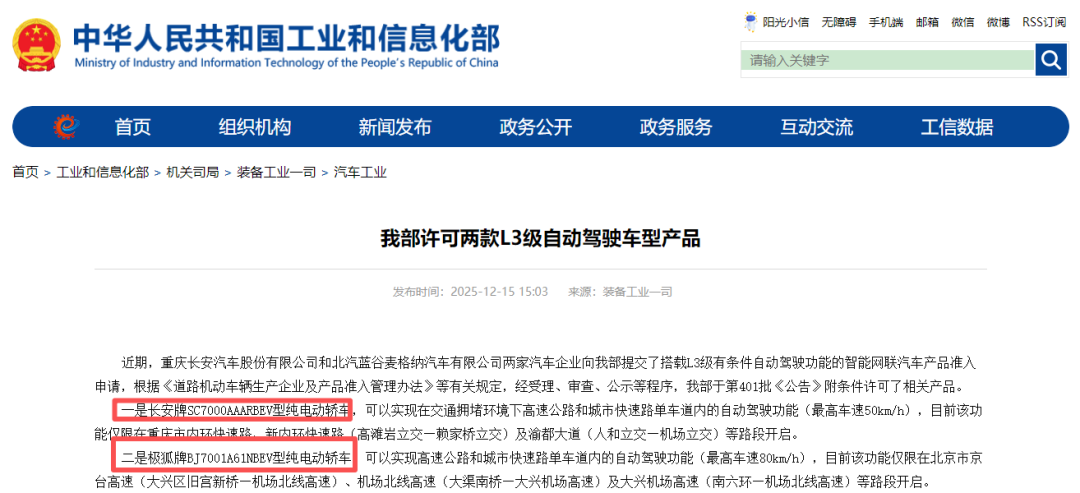
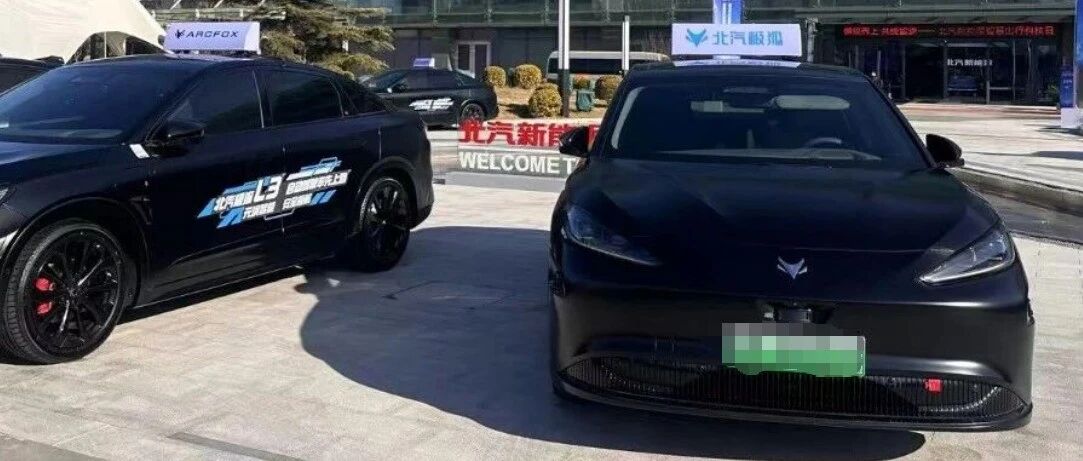
Core Insights - The article discusses the approval of L3 conditional autonomous driving vehicles by the Ministry of Industry and Information Technology in China, highlighting the competitive landscape among various automotive companies to secure entry into this advanced driving technology market [2][11]. Group 1: Approval and Launch of L3 Vehicles - BAIC's Arcfox Alpha S (L3 version) has officially started trial operations for L3 conditional autonomous driving [2][6]. - The first batch of approved L3 vehicles includes the Arcfox BJ7001A61NBEV and Changan SC7000AAARBEV, which are set to operate in designated areas in Beijing and Chongqing [6][11]. - The L3 vehicles are designed for specific scenarios, such as urban congestion and highway driving, with a maximum speed of 80 km/h [7][8]. Group 2: Competitive Landscape - Multiple companies, including BYD, NIO, and Geely, are vying for L3 conditional autonomous driving permits, with some obtaining local government approvals for testing [5][9]. - The distinction between the approvals from the Ministry and local governments lies in their nature; the former allows for commercial trial operations, while the latter is focused on research and testing [10][12]. Group 3: Future Developments and Collaborations - The industry is moving towards mass production of L3 technology, with 2026 anticipated as a pivotal year for its commercial launch [13]. - BAIC is collaborating with Pony.ai to enhance its Robotaxi services, aiming to expand its autonomous driving capabilities across various urban and highway scenarios [14]. - The development of Robotaxi services is seen as a significant opportunity for commercializing autonomous driving technology [14].
“终于上路了”!车企竞逐L3
中国基金报· 2026-01-11 11:13
Core Viewpoint - The article discusses the recent approval of L3 level conditional autonomous driving vehicles by the Ministry of Industry and Information Technology in China, highlighting the competitive landscape among various automotive companies to secure entry into this advanced driving technology market [2][4][12]. Group 1: Approval and Launch of L3 Vehicles - BAIC and Changan have received approval for their L3 level conditional autonomous driving vehicles, marking a significant step in the commercialization of autonomous driving technology in China [4][12]. - The first batch of approved L3 vehicles includes the BAIC Arcfox Alpha S and Changan SC7000AAARBEV, which are set to operate in designated areas in Beijing and Chongqing [4][12]. - The BAIC Arcfox Alpha S can achieve autonomous driving at speeds up to 80 km/h on specific highways and urban expressways, with plans to gradually open access to individual users by Q2 2026 [12][13]. Group 2: Competitive Landscape and Testing - Multiple automotive companies, including BYD, NIO, and Geely, are competing for L3 level conditional autonomous driving licenses, with some obtaining local government permits for road testing [7][15]. - The distinction between the licenses issued by the Ministry of Industry and local governments is significant; the former allows for commercial pilot operations, while the latter is primarily for research and testing purposes [16]. - Geely's vehicles have received road testing permits in Hangzhou, covering an area of 9,224 square kilometers, which will help in accumulating real-world data for optimizing autonomous driving technologies [15][16]. Group 3: Future Developments and Collaborations - The approval of L3 vehicles is seen as a pivotal moment for the autonomous driving industry, with expectations that 2026 will mark the beginning of mass production for L3 technology [18]. - BAIC is planning to introduce more high-end models equipped with L3 technology and is focusing on the development of Robotaxi services as a key application for commercializing autonomous driving [18][19]. - A strategic partnership between BAIC and Pony.ai aims to promote the deployment of the Arcfox T5 Robotaxi, with plans to establish a comprehensive operational model and technical standards for global markets [19][21].
中国“汽车第一城”再易主,造车地域格局生变
Xin Jing Bao· 2026-01-11 11:09
Core Viewpoint - The automotive manufacturing industry in Chongqing is poised to become China's "Automobile Capital" by 2025, driven by significant growth in production and a successful transition towards electric vehicles [1][2]. Group 1: Industry Performance - Chongqing's automotive production reached 2.54 million units in 2024, marking a seven-year high, with 950,000 units being electric vehicles, over six times the production in 2021 [1][2]. - From January to November 2025, Chongqing's automotive output was 2.4981 million units, reflecting a year-on-year increase of 12.1% [1]. - The city aims to achieve an automotive production target of 2.6 million units by 2025, which appears attainable based on current trends [1]. Group 2: Competitive Advantages - Chongqing's competitive edge in becoming the "Automobile Capital" includes a complete industrial chain, relatively low labor costs, diverse transportation infrastructure, and proactive government support [2]. - The automotive industry in Chongqing has developed a robust ecosystem with major headquarters and numerous manufacturing bases, supported by over a thousand ancillary enterprises [2]. Group 3: Export Growth - Chongqing's automotive exports reached 45.98 billion yuan from January to November 2025, a year-on-year increase of 16.8%, with electric vehicle exports alone amounting to 13.41 billion yuan, up 78.9% [2]. Group 4: Historical Context and Transformation - The automotive sector in Chongqing faced challenges from 2017 to 2019, dropping to the seventh position in national production due to a focus on quantity over quality and slow adoption of electric vehicles [4][5]. - In response, Chongqing initiated a transformation strategy focusing on electric vehicles, leading to a resurgence in production, with 2023 output reaching 2.318 million units, ranking second nationally [6]. Group 5: Future Challenges and Market Dynamics - The automotive industry in Chongqing must enhance its research and development capabilities, industry chain collaboration, and overall business environment to sustain growth [7]. - The shift in automotive production statistics from "enterprise location" to "production location" starting in 2025 may impact Chongqing's competitive landscape, as production could be redistributed to other cities [8].
百亿级私募,调研路径曝光
Shang Hai Zheng Quan Bao· 2026-01-11 09:54
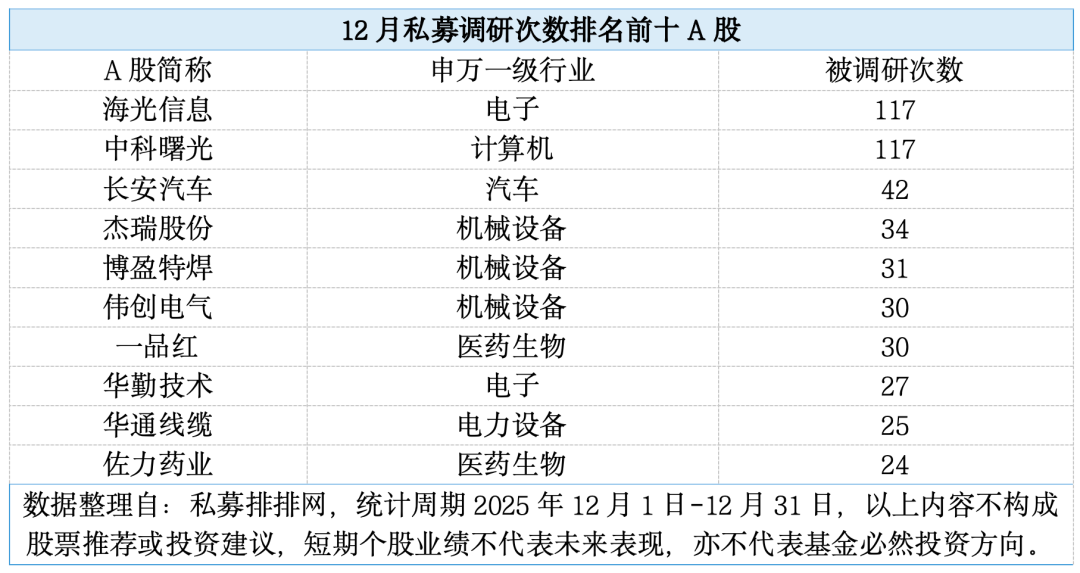
Group 1 - The core focus of private equity research in December 2025 was on the electronics and machinery sectors, with significant interest from major private equity firms [1][4][6] - A total of 713 private equity firms participated in A-share research activities, covering 392 stocks with a total of 1,765 research instances [2][5] - Notable companies such as Haiguang Information and Zhongke Shuguang were the most researched, each receiving 117 inquiries, with their stock prices increasing by 50% and 18.9% respectively in 2025 [2][3] Group 2 - The electronics sector had 60 stocks receiving private equity research, with a total of 384 inquiries, while the machinery sector had 64 stocks with 286 inquiries [4][5] - The computer, biomedical, automotive, and power equipment sectors also saw significant research activity, each exceeding 100 inquiries [4][5] - Major private equity firms showed a strong preference for technology stocks, particularly in the semiconductor industry, indicating a favorable outlook for domestic chip demand and equipment penetration [6][7] Group 3 - Investment strategies for 2026 are expected to focus on both technology and non-ferrous metals, suggesting a "two-legged" approach to investment [7] - The AI sector remains a key area for growth, while commodities like gold and copper are also seen as valuable investment opportunities due to geopolitical uncertainties and increasing demand [7] - The domestic supply structure for aluminum and other materials is positioned favorably, with new demands emerging from trends in automotive lightweighting and photovoltaic industries [7]


中国汽车第一城,变了!
商业洞察· 2026-01-11 09:23
Core Viewpoint - The article discusses the significant shifts in China's automotive industry by 2025, highlighting the rise of new cities as automotive powerhouses and the decline of traditional leaders, emphasizing the importance of innovation, government support, and strategic partnerships in shaping the future of the industry [5][6][52]. Group 1: The Rise of New Leaders - In 2025, Chongqing emerged as "China's Automotive Capital" with nearly 2.5 million vehicles produced, marking a 12.1% year-on-year increase, surpassing traditional leaders like Shanghai and Guangzhou [8][15]. - Chongqing's success is attributed to the combination of state-owned enterprises and aggressive private sector strategies, particularly the partnership between Seres and Huawei, which transformed traditional manufacturing into high-end smart vehicle production [16][17]. - Hefei became the "New Energy Capital" with over 1.246 million new energy vehicles produced, showcasing a model of government investment and strategic partnerships with companies like NIO and Volkswagen [21][23]. Group 2: The Decline of Traditional Leaders - Shenzhen, once a leader with nearly 3 million vehicles produced in 2024, saw its data become ambiguous in 2025 due to changes in statistical methods that shifted focus from corporate registration to actual production locations [28][30]. - Guangzhou experienced a 20% decline in traditional vehicle production, primarily due to the slow transition of Japanese automakers to electric vehicles, highlighting the risks of reliance on outdated business models [45]. - Shanghai's production remained strong at 1.6 million vehicles, but without Tesla's contribution, the figures would be significantly lower, indicating challenges in revitalizing the local automotive supply chain [46]. Group 3: Emerging Trends and Insights - The competition in the automotive industry is shifting from "production capacity" to "supply chain integration," with cities like Hefei and Chongqing demonstrating the importance of a comprehensive ecosystem that includes manufacturing and technology [49]. - The future of the automotive sector will increasingly depend on advanced technologies such as AI and automated driving, positioning cities with strong tech capabilities, like Beijing, for potential advantages [50]. - The article emphasizes the growing "Matthew Effect" in urban development, where leading cities attract more resources and talent, while smaller cities face significant challenges, potentially leading to a decline in their automotive industries [51].