华安基金

Search documents
光伏ETF上周领涨,太空光伏新需求获机构看好丨ETF基金周报
2 1 Shi Ji Jing Ji Bao Dao· 2026-02-09 03:21
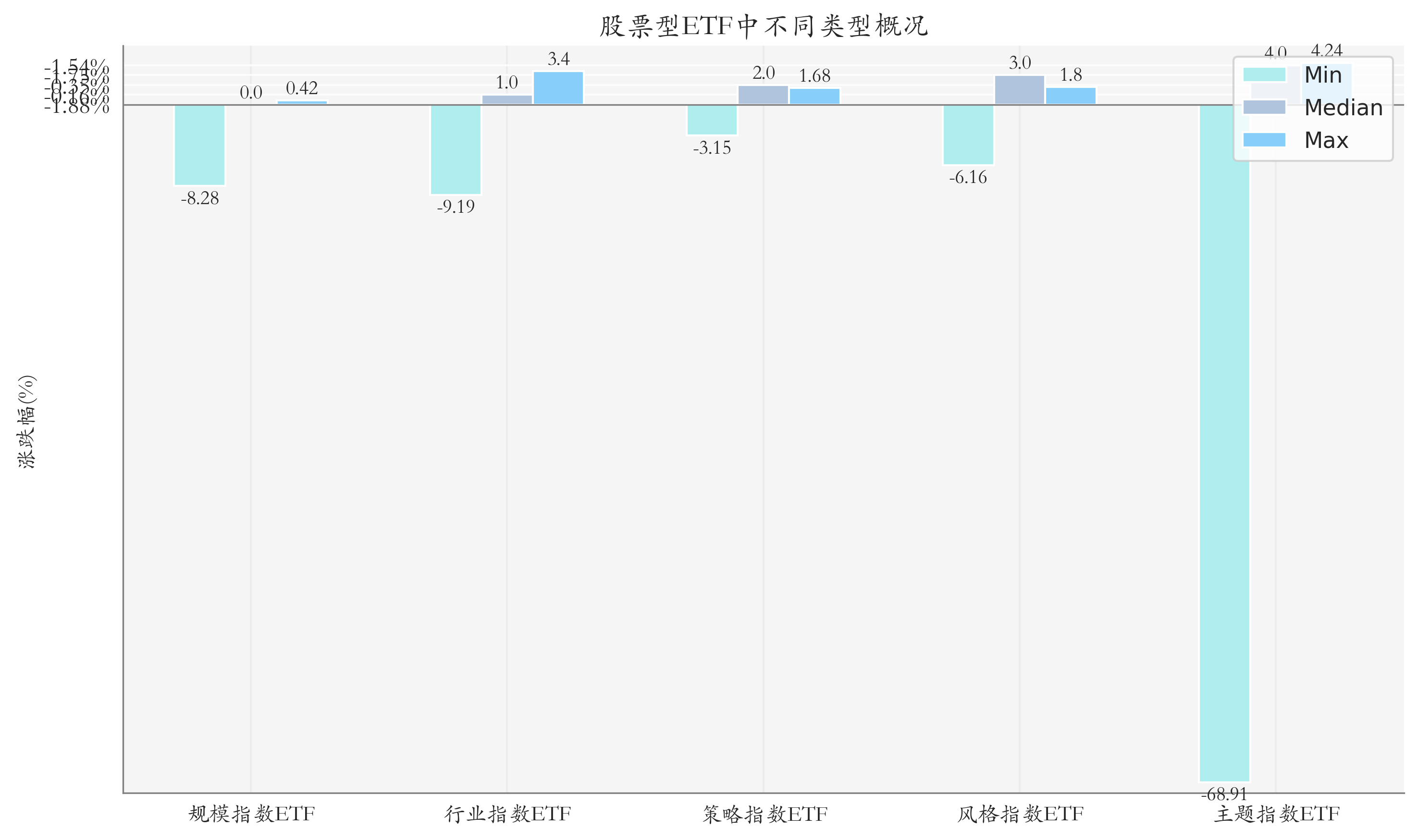
Market Overview - The Shanghai Composite Index fell by 1.27% to 4065.58 points, with a weekly high of 4104.62 points [1] - The Shenzhen Component Index decreased by 2.11% to 13906.73 points, reaching a high of 14213.61 points [1] - The ChiNext Index dropped by 3.28% to 3236.46 points, with a peak of 3390.3 points [1] - In the global market, the Nasdaq Composite Index declined by 1.84%, while the Dow Jones Industrial Average rose by 2.5% [1] ETF Market Performance 1. Stock ETF Overall Performance - The median weekly return for stock ETFs was -1.63% [2] - The highest weekly return among scale index ETFs was 0.42% for the Southern Shenzhen Main Board 50 ETF [2] - The highest weekly return in industry index ETFs was 3.4% for the China Southern Shanghai Composite Main Consumer ETF [2] 2. Stock ETF Gain and Loss Rankings - The top five performing ETFs were: - China Southern Photovoltaic Industry ETF (4.24%) - Fortune Shanghai Stock Exchange Sci-Tech Innovation Board New Energy ETF (4.09%) - E Fund Shanghai Stock Exchange Sci-Tech Innovation Board New Energy ETF (3.93%) - Penghua Shanghai Stock Exchange Sci-Tech Innovation Board New Energy ETF (3.88%) - Tianhong China Southern Photovoltaic Industry ETF (3.42%) [6] - The five ETFs with the largest declines included: - Guotai China Southern All-Index Communication Equipment ETF (-68.91%) - Guolian An Shanghai Stock Exchange Sci-Tech Innovation Board Chip Design Theme ETF (-54.59%) - Huaan China Southern Shanghai-Hong Kong Gold Industry Stock ETF (-13.25%) [6] 3. Stock ETF Liquidity - Average daily trading volume for stock ETFs decreased by 32.4%, while average daily trading volume increased by 20.9% [8] 4. Stock ETF Fund Flows - The top five ETFs with the highest inflows were: - Southern China 500 ETF (inflow of 2.26 billion) - Huatai-PB CSI 300 ETF (inflow of 1.086 billion) - Huaxia CSI 1000 ETF (inflow of 600 million) [11] - The top five ETFs with the largest outflows included: - Huaxia Shanghai 50 ETF (outflow of 331 million) - Huaxia CSI Subdivision Food and Beverage Industry Theme ETF (outflow of 324 million) [12] ETF Financing and Margin Trading - The financing balance for stock ETFs decreased from 53.0598 billion to 52.7352 billion [14] - The highest financing buy amount was for Southern China 500 ETF, totaling 845 million [14] ETF Market Size - The total market size for ETFs reached 5321.655 billion, a decrease of 135.866 billion from the previous week [17] - Stock ETFs accounted for 59.0% of the total ETF market size [19] ETF Issuance and Establishment - No new ETFs were issued last week, but nine new ETFs were established, including: - Huaan CSI Nonferrous Metal Mining Theme ETF - Wanji Guo Zheng New Energy Vehicle Battery ETF [20] Institutional Insights - CITIC Securities predicts exponential growth in space photovoltaic demand, with leading Chinese photovoltaic equipment manufacturers likely to enter the supply chains of companies like Tesla and SpaceX [21] - GF Securities anticipates that the demand for energy from space satellites and data centers will drive global photovoltaic demand, projecting a growth of 18.6% in global photovoltaic demand by 2026 [22]

正泰电源股价涨5.13%,华安基金旗下1只基金位居十大流通股东,持有222.67万股浮盈赚取293.92万元
Xin Lang Cai Jing· 2026-02-09 03:01
Group 1 - The core viewpoint of the news is that Zhengtai Power's stock has increased by 5.13%, reaching a price of 27.05 yuan per share, with a total market capitalization of 9.762 billion yuan [1] - Zhengtai Power, established on October 28, 2002, and listed on August 10, 2007, is located in Changshu, Jiangsu Province, and specializes in the research, production, and sales of metal tool cabinets and high/low voltage switchgear and components [1] - The main business revenue composition of Zhengtai Power includes: 54.62% from solar storage inverters, 27.39% from tool cabinets, 9.27% from electromechanical sheet metal products, 7.03% from energy storage products, and 1.16% from other products [1] Group 2 - Among Zhengtai Power's top ten circulating shareholders, Hu'an Fund has a fund that entered the top ten, holding 2.2267 million shares, accounting for 0.62% of circulating shares, with an estimated floating profit of approximately 2.9392 million yuan [2] - The Hu'an Ankang Flexible Allocation Mixed A Fund (002363) was established on February 1, 2016, with a latest scale of 1.647 billion yuan, and has achieved a year-to-date return of 4.77% [2] - The fund manager, Shi Yuxin, has a tenure of 10 years and 211 days, with a total fund asset scale of 2.849 billion yuan, achieving a best return of 108.21% during the tenure [3]

首批377亿!国泰海通、中信证券,霸榜!商业不动产REITs来了
证券时报· 2026-02-09 02:51
Core Viewpoint - The first batch of 10 commercial real estate REITs has been submitted for approval, aiming to raise a total of 37.7 billion yuan, marking the official entry of China's public REITs market into a comprehensive development phase for both infrastructure and commercial real estate [1][9]. Group 1: REITs Submission Details - As of February 8, 10 commercial real estate REITs have been submitted, with 9 to the Shanghai Stock Exchange and 1 to the Shenzhen Stock Exchange [3]. - The specific funds include Everbright's closed-end commercial real estate fund, Bosera's infrastructure fund, and several others, with notable fundraising targets [3][4]. - The largest fundraising target is for the CICC Vipshop closed-end commercial real estate fund at 7.47 billion yuan, followed by Guotai Junan's fund at 5.064 billion yuan [4]. Group 2: Asset Types and Market Dynamics - The underlying assets of the commercial real estate REITs are diverse, including hotels, office buildings, shopping malls, and commercial complexes [5]. - The hotel assets are primarily four-star and above, with only one project involving hotel assets, indicating sensitivity to economic cycles [5]. - The CICC Vipshop fund's underlying projects include the Zhengzhou and Harbin Outlets, with significant operational history and remaining land use rights [5][6]. Group 3: Regulatory and Institutional Support - The development of commercial real estate REITs is supported by regulatory bodies, with the China Securities Regulatory Commission emphasizing its importance for the capital market and real estate sector [9][10]. - Various local securities regulatory bureaus are actively promoting the implementation of commercial real estate REITs, conducting training sessions and preparing for pilot submissions [10]. - Multiple listed companies, including Poly Developments, are preparing to submit their commercial real estate REITs, aligning with regulatory calls to enhance their real estate management capabilities [11]. Group 4: Role of Intermediaries - The commercial real estate REITs involve various intermediaries, including fund managers, custodians, and financial advisors, with major firms like Guotai Junan and CITIC Securities playing significant roles [7][12]. - The regulatory framework mandates strict adherence to responsibilities by all involved parties to ensure compliance and effective operation of the REITs [7].


资金加仓恒生科技等赛道 宽基核心资产受关注
Zhong Guo Zheng Quan Bao· 2026-02-08 21:55
Group 1 - The consumer and photovoltaic sectors saw significant gains last week, with several related ETFs rising over 3% [1][2] - The A-share market's broad-based products experienced active trading, with ETFs tracking the CSI A500 index exceeding a total transaction volume of 250 billion yuan [1][2] - The market outlook for February suggests a continuation of the upward trend, driven by concentrated earnings forecasts and the recovery of leading companies' performance [1][4] Group 2 - The Hong Kong consumer sector performed strongly, with ETFs such as the Hang Seng Consumer ETF leading the gains [2] - Gold-related ETFs faced a downturn, with an average decline of over 5% across 14 commodity gold ETFs, and some gold stock ETFs dropping more than 13% [2] - The technology sector attracted significant capital inflow, with the Huatai-PineBridge Hang Seng Technology ETF seeing a net inflow of over 3.8 billion yuan last week [3] Group 3 - Several asset management institutions have released macro outlooks for China's equity market in 2026, highlighting diverse growth paths driven by the 14th Five-Year Plan [4][5] - Key investment areas identified include technology, manufacturing, renewable energy, healthcare, and emerging consumer sectors [4][5] - The market is expected to maintain a structural trend in February, with a focus on core growth assets that are currently at historical median valuation levels [5]
资金加仓恒生科技等赛道宽基核心资产受关注
Zhong Guo Zheng Quan Bao· 2026-02-08 20:22
Group 1 - The consumer and photovoltaic sectors saw significant gains, with several related ETFs rising over 3% last week, while gold and artificial intelligence sectors experienced declines, with some ETFs dropping over 9% [1][2] - A-shares market showed active trading in broad-based products, with ETFs tracking the CSI 500 index exceeding a total trading volume of 250 billion yuan, and those tracking the Sci-Tech 50 index surpassing 30 billion yuan [1][2] - The market outlook for February suggests a continuation of the upward trend, driven by concentrated earnings forecasts and the recovery of leading companies' performance, benefiting core assets [1][4] Group 2 - The Hong Kong consumer sector performed strongly, with ETFs such as the Hang Seng Consumer ETF leading the gains, while the photovoltaic sector also showed positive performance [1] - The gold sector underperformed, with commodity gold ETFs declining over 5%, and gold stock ETFs experiencing even greater declines, with some dropping over 13% [2] - The technology sector attracted significant capital inflow, with the Hang Seng Technology ETFs seeing substantial net inflows, particularly the Huatai-PineBridge Hang Seng Technology ETF, which had a net inflow of over 3.8 billion yuan last week [2] Group 3 - The satellite communication sector also experienced notable capital inflow, with the Yongying National Commercial Satellite Communication Industry ETF seeing a net inflow of over 1.8 billion yuan [3] - Several ETFs, including the Huazhong Gold ETF and the Southern CSI Nonferrous Metals ETF, reported net inflows exceeding 10 billion yuan this year [3] - Investment firms are focusing on five key areas for the Chinese equity market by 2026: technology, manufacturing, renewable energy, healthcare, and emerging experiential consumption [3] Group 4 - The market is expected to stabilize in February, with a shift in focus from January's credit and liquidity performance to macro and industry clues [4] - The "14th Five-Year Plan" is anticipated to provide a clearer framework for high-quality development and new growth drivers, stabilizing market perceptions of future growth [4] - Core assets are recommended for continued attention, as their valuations are at historical median levels, with stable profit expectations and increasing foreign capital inflow [4]
“千亿ETF”仅剩3只!股票型ETF开年“失血”超7000亿元
Mei Ri Jing Ji Xin Wen· 2026-02-08 03:30
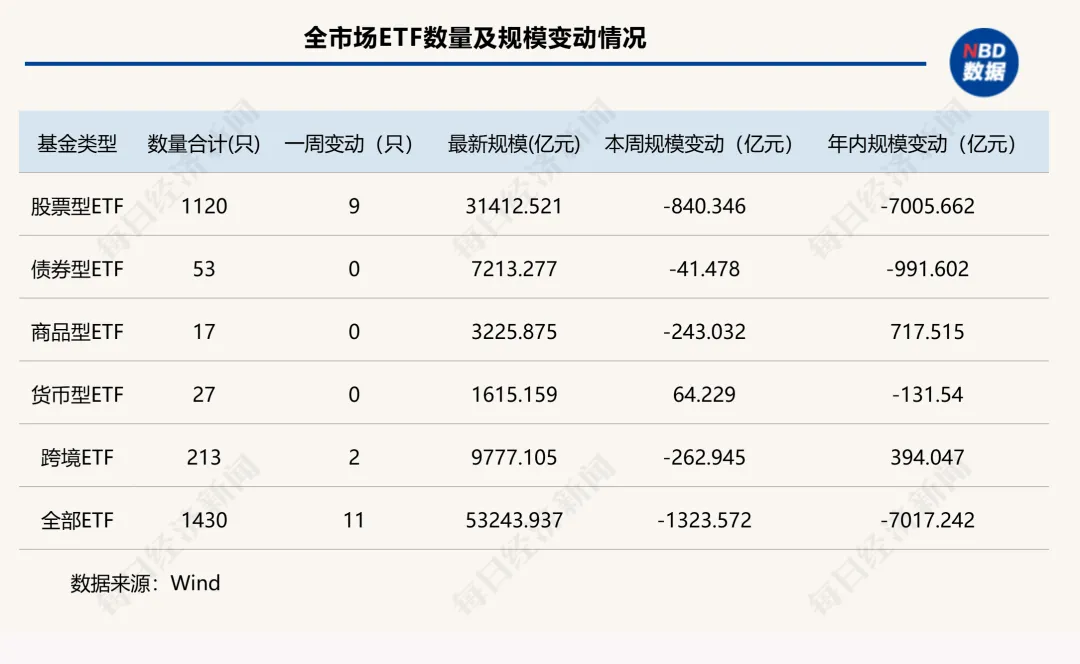
Market Overview - A-shares experienced fluctuations with major indices declining, including a 1.13% drop in the CSI 300 and a 3.28% drop in the ChiNext Index [1][16] - The ETF market is undergoing significant changes, with stock ETFs shrinking by over 700 billion yuan this year, reducing the number of "billion club" products to just three [1][16] ETF Market Dynamics - As of February 7, the total ETF market size decreased to 5.32 trillion yuan, with a weekly decline of 1,323 billion yuan [2][17] - Stock ETFs alone saw a reduction of 840.35 billion yuan, bringing their total size down to 31,412.52 billion yuan [3][18] - The number of ETFs listed reached 1,430, with 11 new ETFs introduced in the week, including 9 stock ETFs [2][17] Fund Management Changes - Fund size reshuffling is evident, with Guotai Fund maintaining its position in the top five, while Huabao Fund entered the top ten [1][22] - Major funds like Huaxia and E Fund have seen their ETF sizes shrink by over 100 billion yuan this year [1][22] Performance of Specific ETFs - The SGE Gold 9999 index saw a significant reduction of over 22 billion yuan, marking it as the largest decline among major indices [4][19] - The CSI 300 ETF managed by Huatai-PB has shrunk by over 2,000 billion yuan this year, now standing at 2,208.55 billion yuan [29][30] Institutional Fund Performance - Five institutions reported ETF size reductions exceeding 100 billion yuan, with Southern Fund experiencing the largest drop of 268.53 billion yuan [22][26] - Conversely, Huabao Fund and Hai Futong Fund both saw increases of over 30 billion yuan in their ETF sizes [23][26] Growth and Decline of ETFs - Only two products in the top 20 managed to achieve size growth, indicating a general trend of decline in the ETF market [26][27] - The "billion club" for ETFs has diminished, with only three members remaining due to widespread shrinkage [26][30]
“顶流”基金经理大起底
Zhong Guo Ji Jin Bao· 2026-02-08 03:13
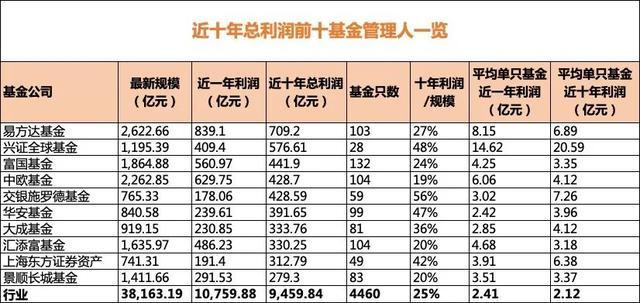
Core Insights - The active equity fund industry in China has generated nearly 1 trillion yuan in profits over the past decade, with significant contributions from leading fund companies [2][4] - Among 29 fund managers managing over 20 billion yuan, only 11 have consistently outperformed benchmarks over 1, 3, and 5 years, indicating a notable divergence in management capabilities [1][6] Industry Performance - The total profit generated by active equity funds in the last ten years reached 9,459.84 billion yuan, with an annual profit of 10,759.88 billion yuan in 2025 [2][4] - The top ten fund management companies contributed nearly 40% of the total profits, with E Fund, Xingzheng Global Fund, and Fortune Fund leading the profit rankings [3][4] Fund Manager Analysis - E Fund achieved the highest total profit of 709.20 billion yuan over ten years, while Xingzheng Global Fund demonstrated high profitability relative to its size, with a profit-to-scale ratio of 48% [4][6] - A select group of fund managers, including Yang Dong and Liu Jianwei, have shown exceptional performance, with some achieving over 100% excess returns over various time frames [7][8] Future Industry Trends - The industry is entering a new phase where the focus is shifting from mere scale growth to long-term value creation efficiency and the ability to manage large funds effectively [9] - Developing a robust investment research system that is resilient to market style changes and nurturing talent capable of managing large-scale funds will be crucial for high-quality development in the future [9]
公募基金密集示警、限购,原油LOF高溢价“退烧”
Hua Xia Shi Bao· 2026-02-07 04:32
Core Viewpoint - International oil prices are experiencing fluctuations due to geopolitical factors and macroeconomic sentiment, leading to significant premium trading risks in domestic oil and gas funds, prompting warnings from major public fund institutions [2][4]. Group 1: Fund Company Announcements - Multiple fund companies, including Southern Fund, have issued risk warnings regarding their oil LOF products, highlighting that secondary market prices are significantly higher than net asset values, indicating a large premium [3][4]. - Southern Fund has issued multiple announcements regarding the premium risk of its Southern Oil Securities Investment Fund A class shares, noting a closing price of 1.397 yuan on February 2, 2026, compared to a net asset value of 1.2304 yuan on January 29, 2026 [3]. - Other fund companies, such as GF Fund and E Fund, have also issued similar warnings about their oil LOF products, indicating significant price deviations from net asset values [4]. Group 2: Premium Rate Trends - The premium rates of certain oil LOF funds have shown signs of cooling, with the Huaan S&P Global Oil Index Securities Investment Fund experiencing a drop in premium rates from over 40% to just 2.01% as of February 6 [5][6]. - The measures taken by public fund institutions to manage high premiums have begun to show initial effectiveness, as evidenced by the significant reduction in premium rates [5]. Group 3: Regulatory Measures - Starting from late January, several fund companies implemented a combination of "suspension" and "strict purchase limits" on their oil LOF products to manage the high premium situation [7][8]. - Specific measures included suspending trading for certain funds and drastically reducing purchase limits, with some funds lowering limits from 100 yuan to as low as 2 yuan [8]. Group 4: Market Outlook - Analysts predict that the oil market will continue to face a supply surplus in the medium to long term, despite potential short-term geopolitical disruptions [9]. - Supply from OPEC+ is expected to increase by 1.5 million barrels per day in 2026, while global demand is projected to rise by only 0.8 to 1 million barrels per day, indicating a continued oversupply situation [9].

银行理财到期后怎么投?一个自建多元资产配置实例
雪球· 2026-02-06 13:01
Core Viewpoint - The article discusses a customized investment strategy aimed at achieving an annualized return of 8%-12% through a diversified asset allocation model tailored to the specific financial profile and risk tolerance of an individual investor [4][9]. Group 1: Investment Strategy Overview - The investment strategy is based on a "60/30/10" model, allocating 60% to equities, 30% to bonds, and 10% to commodities [10][11]. - Historical data indicates that when the holding period exceeds three years, the probability of achieving positive returns from equity assets exceeds 85% [13]. Group 2: Asset Allocation Breakdown - The equity portion (60%) is divided into three pillars: global technology growth (30%), A-share "barbell strategy" (30%), and a defensive component (10%) in gold [14][15]. - The global technology growth pillar includes QDII funds focused on U.S. and Hong Kong tech stocks, specifically selecting two funds: Franklin Global Technology Internet Fund and GF Global Select Equity Fund [16][17]. - The A-share component employs a "dividend + quantitative" strategy, utilizing various funds to balance stability and market volatility [19][20]. Group 3: Fixed Income and Commodities - The fixed income portion (30%) serves as a "safety cushion," providing liquidity and positive returns regardless of market fluctuations [25]. - The gold allocation (10%) is justified as a hedge against currency devaluation and extreme risks, supported by ongoing central bank purchases and geopolitical tensions [29]. Group 4: Performance Management - The strategy emphasizes the importance of managing expectations, acknowledging potential drawdowns of 15%-20% in extreme market conditions [36]. - The investment approach includes regular portfolio reviews to ensure performance aligns with benchmarks and to make necessary adjustments [36]. Group 5: Conclusion - The article concludes that the key to successful investing lies not in predicting market movements but in establishing a resilient investment framework that diversifies across asset classes and geographies [38].