银行

Search documents
银行应为农业绿色转型注入金融活水
Zheng Quan Ri Bao· 2025-11-16 14:43
Core Viewpoint - The Ministry of Agriculture and Rural Affairs emphasizes the need for a comprehensive green transformation in agriculture, which opens new avenues for banks to serve the agricultural sector [1] Group 1: Agricultural Green Transformation - The green transformation of agriculture requires long-term financial investment, with banks playing a crucial role as "blood suppliers" and "empowerers" [1] - The transformation faces challenges such as long cycles, strong public welfare nature, and unclear returns, necessitating banks to incorporate green transformation indicators into their credit rating systems [1][2] - Key areas for resource allocation include comprehensive utilization of livestock manure, research and development of green agricultural machinery, and carbon sequestration in planting [1] Group 2: Financial Product Innovation - The mismatch between traditional credit products and the needs of green transformation leads to issues of "difficult and expensive financing" [2] - Banks should innovate financial products tailored to the unique attributes of green agriculture, simplifying approval processes and adopting a "one-time approval, on-demand lending" model [2] - New collateral models should be explored, including loans backed by forestry carbon credits and pollution rights, to broaden financing channels for green agriculture [2] Group 3: Collaborative Efforts - The green transformation is a systemic project requiring collaboration among government, banks, enterprises, and farmers [3] - Banks need to break down "information silos" and strengthen cooperation with various departments to create a shared agricultural public information data platform [3] - Financial technology should be leveraged to enhance the accessibility and convenience of green financial services, particularly in rural areas [3] Group 4: Financial Responsibility and Goals - The comprehensive green transformation of agriculture is essential for food security and environmental improvement, presenting significant opportunities for banks [3] - Banks should integrate green development concepts into their agricultural financial services, ensuring continuous financial support flows into key areas of agricultural green transformation [3]
银行应锚定多领域场景以“金融+”服务实体经济
Zheng Quan Ri Bao· 2025-11-16 14:39
Core Insights - The State Council's recent implementation opinion encourages financial institutions to enhance their services by integrating financial resources with real economy demands, focusing on a "finance + scenario" model to support digital economy, industrial upgrades, and livelihood security [1][2] Group 1: Financial Services and Digital Economy - Banks are urged to move beyond traditional service boundaries and create a new ecosystem that deeply integrates financial services with various scenarios, particularly in the digital economy [1] - The focus should be on building a technology-driven financial scenario foundation, utilizing data as a core element to develop innovative financial models that seamlessly connect financial services with digital life and production [1][2] Group 2: Industry Transformation and Financial Support - Banks should shift from "single-point services" to a "full-chain empowerment" approach, addressing the needs of industries such as manufacturing, transportation, smart logistics, and modern agriculture [2] - In manufacturing, banks can develop products like "flexible production line renovation loans" and "zero-carbon park green credit" to support digital transformation [2] - For smart logistics, integrating data from "smart ports + unmanned transport + warehouse management" can lead to innovative financing solutions that match logistics nodes with capital flow in real-time [2] Group 3: Social Governance and Livelihood Services - Financial services should also be embedded in public services, healthcare, elderly care, and cultural tourism, focusing on convenience and comprehensiveness [2][3] - The competition for scenarios has become a core battleground for financial services to the real economy, with banks encouraged to prioritize comprehensive application scenario construction as a key transformation task [3]
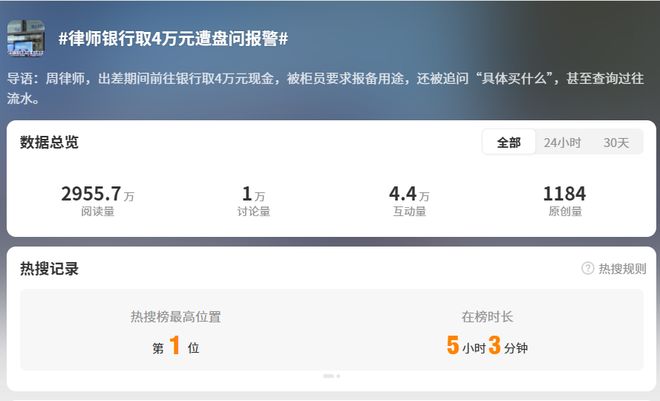
取款被查流水,银行算侵犯个人隐私吗?律师:或违反个保法
Nan Fang Du Shi Bao· 2025-11-14 09:40
Core Viewpoint - The incident involving a bank questioning a customer withdrawing 40,000 yuan has sparked widespread discussion regarding potential violations of personal privacy and the necessity principle under the Personal Information Protection Law [1][2]. Group 1: Legal Perspectives - Multiple lawyers have indicated that the bank's actions may violate the "necessity principle" outlined in the Personal Information Protection Law, suggesting that the inquiry into the customer's transaction history was excessive [2][4]. - The definition of sensitive personal information includes bank account information, which is categorized as sensitive due to the potential harm from its unauthorized disclosure [2][3]. - Legal experts emphasize that banks must adhere to strict guidelines when accessing personal account information, which should only occur under specific circumstances such as customer consent or legal obligations [4][3]. Group 2: Implications for Banking Practices - The incident highlights the need for banks to enhance employee training regarding the protection of customer personal information and privacy rights [3][4]. - There is a call for banks to reflect on and adjust their standards and practices concerning the querying of customer transaction histories, balancing social governance needs with individual privacy rights [4].

银行直供房,对房价有何影响?
Sou Hu Cai Jing· 2025-11-14 04:11
Group 1 - The core point of the article highlights the significant impact of banks directly selling properties, which reflects the serious implications of the rising default rates in the housing market [1][3] - The introduction of four channels for purchasing properties—new homes from sales offices, second-hand homes from agents, auctioned properties, and now direct sales from banks—provides buyers with more options to choose from based on price and safety [1] - Banks are offering properties at a discount of up to 15%, which allows them to sell at a price advantage due to their cost structure, potentially leading to significant price reductions in the market [1] Group 2 - The sudden emergence of bank direct sales could trigger a ripple effect in first-tier cities, where property prices are higher and the likelihood of defaults is greater, potentially leading to a more severe impact on the housing market [3] - The article suggests that if banks continue to sell properties at low prices, it could undermine the pricing strategies of second-hand homes and affect developers' land acquisition strategies and pricing expectations [3] - The phenomenon of banks acting as price disruptors in the market is described as a "gray rhino" event, indicating a significant and visible risk that could have widespread consequences [3]

银行反诈不能“越界”为难取款人
Bei Jing Shang Bao· 2025-11-12 15:47
Core Viewpoint - The recent incident of a man being questioned by a bank while attempting to withdraw 40,000 yuan highlights the excessive measures taken by financial institutions in anti-fraud efforts, which, while well-intentioned, have led to unnecessary inconveniences for law-abiding citizens [1][2] Group 1: Anti-Fraud Measures - The necessity of anti-fraud measures is acknowledged, as telecom and online fraud is becoming increasingly sophisticated, with banks playing a crucial role in intercepting fraudulent transactions to protect customers' funds [1] - However, the current approach of "over-correcting" has resulted in rigid execution that deviates from the essence of financial services and creates multiple risks [1][2] Group 2: Regulatory and Operational Challenges - Recent regulatory changes have removed the strict requirement for banks to inquire about the source of cash transactions over 50,000 yuan, yet some banks have lowered the threshold to 10,000 yuan, effectively shifting regulatory responsibility onto the public [2] - This practice reveals a lack of risk identification capabilities and outdated technological methods within banks, leading to misjudgments that infringe on customers' rights to withdraw funds [2] Group 3: Recommendations for Improvement - To resolve the conflict between anti-fraud efforts and customer convenience, banks should transition from excessive scrutiny to precise empowerment, balancing security and convenience [3] - There is a need for enhanced focus from bank executives on anti-fraud initiatives, increased resource allocation, and collaboration across departments to create a unified approach [3] - Banks should shift the focus of anti-fraud responsibilities from frontline staff to specialized risk management teams, providing clear operational guidelines to alleviate pressure on frontline employees [3] - The integration of advanced technologies, such as big data analytics, is essential for real-time risk assessment and the automatic identification of suspicious activities, achieving a balance between effective fraud prevention and seamless customer service [3]
【西街观察】银行反诈,不能“越界”为难取款人
Bei Jing Shang Bao· 2025-11-12 14:41
Core Viewpoint - The recent incident of a man being questioned by a bank while attempting to withdraw 40,000 yuan highlights the excessive measures taken by financial institutions in anti-fraud efforts, which, while well-intentioned, have led to unnecessary inconveniences for law-abiding citizens [1][2]. Group 1: Anti-Fraud Measures and Their Implications - The initial intent of anti-fraud measures is to protect citizens' financial security, especially as telecom and online fraud becomes increasingly sophisticated [1]. - However, the rigid execution of these measures can lead to a misalignment with the essence of financial services, creating multiple hidden risks [1]. - Recent regulatory changes have removed the strict requirement for banks to inquire about the source of cash transactions over 50,000 yuan, yet some banks have lowered this threshold to 10,000 yuan, effectively shifting regulatory burdens onto the public [2]. Group 2: Challenges Faced by Banks - The current fraud detection methods employed by banks are outdated and lack precision, leading to misjudgments that infringe on customers' rights to withdraw their funds [2]. - The pressure of risk management is disproportionately placed on frontline staff, who lack the necessary authority and comprehensive data to accurately assess risks, resulting in potential conflicts with customers [2]. - This "pressure down" model not only burdens employees with undue responsibility but also hampers the establishment of a systematic and intelligent anti-fraud capability within banks [2]. Group 3: Recommendations for Improvement - To reconcile the conflict between anti-fraud efforts and customer convenience, banks should transition from excessive scrutiny to precise empowerment, achieving a balance between security and service [3]. - There is a need for enhanced focus from bank executives on anti-fraud initiatives, along with increased resource allocation and inter-departmental collaboration [3]. - Banks should shift the focus of anti-fraud responsibilities from frontline staff to specialized risk management teams, providing clear operational guidelines to alleviate pressure on employees [3]. - The integration of advanced technologies, such as big data analytics, is essential for real-time risk assessment and the automatic identification of suspicious activities, ensuring a balance between effective fraud prevention and seamless customer service [3].
银行直供房可以“捡漏”? 业内律师:需要警惕特殊限制条款
Zheng Quan Shi Bao Wang· 2025-11-12 11:57
Core Insights - The recent trend of banks selling properties directly through online platforms has garnered significant market attention, making "bank direct supply housing" a hot topic of discussion [1] - The acceleration of banks in promoting direct property sales is linked to their increased focus on debt disposal and the inevitable trend of direct engagement with consumers in the context of "Internet+" [2] Group 1: Definition and Comparison - "Bank direct supply housing" refers to properties that banks acquire through judicial processes, such as debt-for-property exchanges, and sell directly under their ownership, unlike regular auctioned properties where ownership remains with the debtor until the sale is completed [2] - Compared to regular auctioned properties, bank direct supply housing has already cleared ownership issues, reducing the "blind box" risks associated with traditional auction properties, such as tenant disputes or unresolved ownership claims [2] Group 2: Market Implications - Both bank direct supply housing and regular auctioned properties offer certain price advantages compared to standard market listings, attracting buyers looking for "bargain" opportunities [2] - Buyers are advised to conduct thorough due diligence similar to purchasing regular properties, including verifying the authenticity of ownership documents and inspecting the physical condition of the property [3] Group 3: Buyer Considerations - Potential buyers should be aware of any special conditions attached to the properties, such as requirements for full payment upfront or restrictions on loan processing and transfer times [3] - It is recommended that buyers consult legal professionals or experts to review contract terms, especially concerning liability waivers and cost settlements, to avoid potential pitfalls in the transaction process [3]
8点1氪:银行App迎来关停潮;全国多地西贝门店闭店;李斌回应被网暴:无所谓,CEO有娱乐大家的责任
36氪· 2025-11-11 00:10
Group 1 - The banking industry is experiencing a wave of app shutdowns, particularly in the credit card and direct banking sectors, as banks begin to streamline their digital offerings [3][4] - Many independent banking apps, initially launched to attract users, have resulted in high download rates but low daily active users, leading to inefficiencies and increased compliance costs [4] - The credit card industry is entering a contraction phase due to weakened consumer spending, prompting some banks to close their credit card apps [4] Group 2 - The Chinese government has successfully launched a group of 13 low-orbit satellites for internet connectivity, marking a significant achievement in the country's space capabilities [9] - The film industry in China has seen a total box office revenue of 450 billion yuan as of November 10, 2025, indicating a strong performance in the market [8] - TSMC reported a 16.9% year-on-year increase in sales for October, with a total revenue of approximately 367.47 billion NTD [22]




8点1氪|银行App迎来关停潮;全国多地西贝门店闭店;李斌回应被网暴:无所谓,CEO有娱乐大家的责任
3 6 Ke· 2025-11-10 23:58
Group 1 - Several banks are shutting down their mobile apps, particularly in the credit card and direct banking sectors, due to low user engagement and high operational costs [2][3] - The credit card industry is entering a contraction phase, prompting some banks to close their credit card apps as part of a broader digital transformation strategy [2][3] - The trend of banks discontinuing apps reflects a shift from user acquisition to managing existing customer bases amid declining consumer spending [2][3] Group 2 - The first "JD Car" has been launched with a price of 49,900 yuan for battery rental and 89,900 yuan for outright purchase, indicating a strategic partnership between JD, GAC Group, and CATL [4] - The Aion UT super model features a range of 500 kilometers and supports battery swapping, significantly reducing refueling time to 99 seconds [4] Group 3 - TSMC reported a 16.9% year-on-year increase in October sales, with consolidated revenue reaching approximately 367.47 billion NTD [20] - Nanchao Foods announced a 5.27% decrease in October revenue, totaling 235 million yuan [20] Group 4 - CPE Yuanfeng is investing $350 million into Burger King China, acquiring approximately 83% of the joint venture to expand its restaurant presence from 1,250 to over 4,000 by 2035 [15] - The market regulator has issued compliance guidelines for the "Double 11" shopping festival to prevent unfair practices and protect consumer rights [16]
银行直供房低于市价25%,又一只“靴子”落地
Sou Hu Cai Jing· 2025-11-10 08:41
Core Viewpoint - The emergence of bank-direct housing sales is significantly impacting the already sluggish second-hand housing market, with banks offloading non-performing loans through property sales at discounted prices, further depressing market expectations [1][3][6] Group 1: Bank-Direct Housing Sales - Banks are pushing non-performing mortgage properties onto the market, with local banks leading in volume, selling properties valued at 2 million for as low as 1.5 million [1] - The urgency for banks to reduce non-performing loan ratios is driving this trend, as failure to do so could lead to high holding costs [1][6] - Bank-direct properties are perceived as superior to auctioned properties due to clearer ownership and fewer post-sale issues, although risks still exist [3] Group 2: Market Impact - The introduction of bank-direct housing is seen as a negative signal for the second-hand market, which is already experiencing low transaction volumes and buyer hesitation [3][6] - The presence of low-priced bank-direct properties is likely to set new price benchmarks, affecting negotiations between buyers and sellers in the second-hand market [3][4] - Despite the potential for bank-direct properties to disrupt the market, many second-hand properties have already seen significant price reductions, making it challenging for bank-direct sales to further lower prices [4] Group 3: Broader Market Dynamics - The overall sentiment in the market is one of pessimism, with various policies aimed at stimulating the housing market failing to yield positive results [6] - The influx of bank-direct properties, along with other state-owned assets entering the market, is increasing pressure on individual sellers and revealing the extent of market weaknesses [6] - The belief that bank-direct properties are inherently trustworthy due to the bank's reputation is questioned, as the market dynamics suggest a more complex reality [6]