蔚来

Search documents
趋势研判!2026年中国智能设备行业发展历程、政策、发展现状、重点企业及未来趋势:全场景智能化生态加速形成,引领智能设备规模达万亿级别[图]
Chan Ye Xin Xi Wang· 2026-01-22 01:07
Core Insights - The smart device industry is experiencing significant growth driven by increasing consumer demand and advancements in technology, with the market size in China projected to grow from 5,133 billion yuan in 2018 to 17,157 billion yuan by 2024, representing a compound annual growth rate (CAGR) of 22.28% [1][14][15] - The industry is categorized into three main segments: smart home, smart wearables, and smart mobility, each with distinct applications and market dynamics [3][16][17] Industry Overview - Smart devices integrate hardware, software, and internet technologies, enabling them to perform tasks such as data collection and self-optimization [1][14] - The market is expected to reach 20,979 billion yuan by 2025, indicating continued growth and innovation in the sector [1][14] Industry Development Stages - The smart device industry in China has evolved through three phases: the initial stage (1990s to early 2000s), the development stage (2000 to 2015), and the explosive growth stage (2015 to present), with significant technological advancements and market expansion occurring in the latter two phases [6][8] Industry Policies - The Chinese government has implemented various policies to support the smart device industry, including initiatives to promote digital transformation and the development of smart products across multiple sectors [8][9] Industry Value Chain - The smart device industry value chain consists of upstream raw materials, hardware, and software systems; midstream manufacturing; and downstream applications in sectors such as healthcare, education, and transportation [10][11] Market Segmentation - The smart home market is characterized by diverse competition among traditional appliance manufacturers and tech companies, with a focus on integrated solutions and consumer experience [15] - The smart wearable segment includes products like smart glasses and smartwatches, with significant growth potential driven by consumer acceptance and technological advancements [16][17] - The smart mobility sector, particularly smart cars, is rapidly expanding, with the market size projected to grow from 777 billion yuan in 2020 to 2,152 billion yuan by 2024, reflecting a CAGR of 29% [17][18] Competitive Landscape - The smart device industry is marked by an ecosystem of competition, with leading companies leveraging core technologies and brand advantages to create comprehensive solutions across various applications [18][19] Future Trends - The industry is expected to see innovations in human-computer interaction, moving towards more natural and multi-modal interfaces [21] - There will be a shift from single-product intelligence to integrated scene intelligence, enhancing cross-device collaboration and user experience [22] - Smart devices will increasingly focus on personalized health management, evolving into digital health assistants capable of providing tailored recommendations [24]





存储“涨飞”!“美股最强”闪迪涨超10%,美光、西部数据、希捷科技等全线大涨
Hua Er Jie Jian Wen· 2026-01-22 00:34
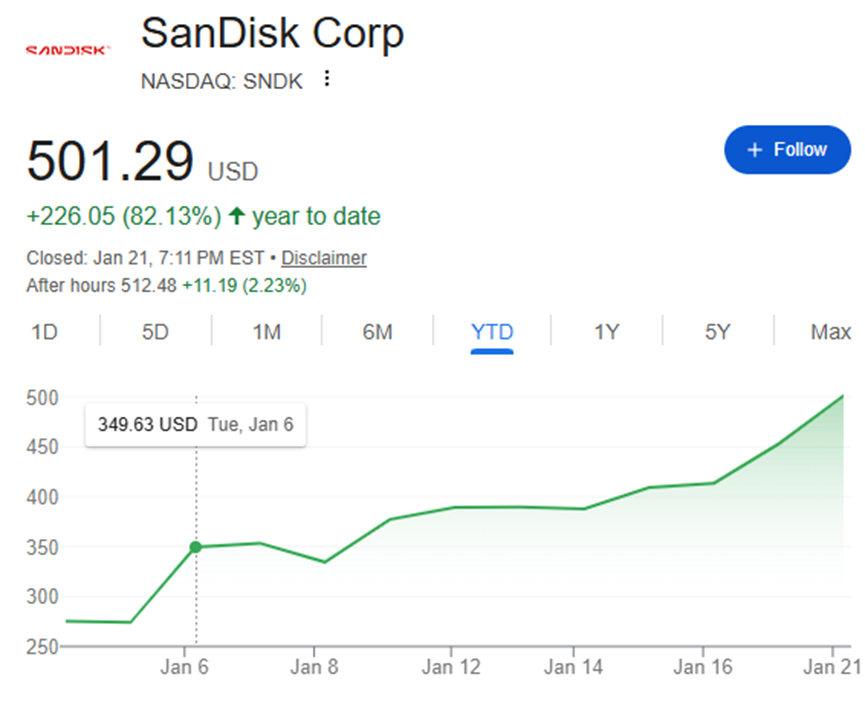
Core Viewpoint - The U.S. storage sector is experiencing a significant surge, with major companies' stock prices reaching historical highs due to a spike in demand for storage chips driven by the AI boom and supply shortages, indicating a new "super cycle" in the global storage market [1] Group 1: Market Performance - The storage chip sector saw a remarkable performance on Wednesday, with SanDisk surging 10.63%, Micron Technology rising 6.6%, Western Digital increasing over 8.5%, and Seagate Technology up over 5.6%, reflecting strong market expectations for the industry's pricing power and profitability [1] - SanDisk's stock has increased over 80% year-to-date, and since its spin-off from Western Digital in February 2025, its stock price has risen more than tenfold [2] - Micron's stock also reached a historical high, with a 20% revenue growth in Q1 of fiscal 2026 and a 167% increase in adjusted earnings per share, indicating strong pricing power [7] Group 2: Analyst Upgrades and Predictions - Analysts have significantly raised their target prices for SanDisk, with Citigroup increasing it from $280 to $490 and Bernstein from $300 to $580, citing strong enterprise SSD demand and tightening NAND supply [5] - Zacks predicts that SanDisk's fiscal 2026 sales will grow by 42% to $10.45 billion, with earnings per share expected to soar 350% to $13.46, supporting the optimistic sentiment [6] Group 3: Supply and Demand Dynamics - The current market dynamics are characterized by a fundamental shift in supply and demand, with major manufacturers reducing production to maximize profits, leading to a severe supply shortage [1][8] - Despite the high valuation concerns, the industry is transitioning from traditional cyclical fluctuations to a "high profit, stable price" model, with expectations that storage chip prices will continue to rise until 2026 due to significant supply gaps [1][9] Group 4: Broader Industry Implications - The semiconductor industry is undergoing a profound transformation, with a shift towards a "super cycle" characterized by reduced cyclicality and increased profit margins, as indicated by strong performance from upstream manufacturers like TSMC [9] - The automotive industry is facing new cost pressures and supply risks due to chip manufacturers prioritizing higher-margin data center and AI clients, as noted by industry leaders [8]
开年价格战重现:汽车公司从最难的第一季度开始更难的一年
Xin Lang Ke Ji· 2026-01-22 00:03
Core Viewpoint - The automotive industry in China is facing a significant shift in 2026, with predictions of a price war initiated earlier than expected, influenced by changes in subsidy policies and market dynamics [2][3]. Group 1: Market Predictions - The China Passenger Car Association (CPCA) forecasts that domestic car sales in Q1 2026 may remain flat year-on-year but could drop by 25% compared to Q4 2025, with overall annual sales expected to show zero or minimal growth [2]. - Morgan Stanley predicts a substantial decline in Q1 2026 sales by 30%-35% due to reduced purchase tax subsidies, with an annual decrease of 5% anticipated, potentially reaching 7% without considering export sales [2]. - UBS shares a similar outlook, projecting a 2% decline in annual car sales, with export growth slowing from 28% in 2025 to 15% [3]. Group 2: Policy Changes - The National Development and Reform Commission and the Ministry of Finance have yet to announce the continuation of "two new" subsidies for 2026, with significant changes expected in the subsidy structure for new energy vehicles (NEVs) [3]. - The new policy will halve the purchase tax for NEVs, increasing costs for consumers, while the subsidy for new cars will be more detailed and based on vehicle price, with a maximum of 20,000 yuan [3]. Group 3: Industry Sentiment - Industry executives express cautious optimism regarding their companies' growth, with many expecting double-digit growth driven by overseas market expansion, despite a general conservative outlook on overall market growth [7]. - The total sales target for nine major automakers in 2026 is set at 18.339 million units, surpassing the actual sales of 3.86 million units in 2025 [7]. - New energy vehicle manufacturers have aggressive growth targets, with some aiming for increases of 70%-121%, while traditional automakers maintain more conservative targets [9]. Group 4: Price War Dynamics - A price war has already begun, with companies like BMW and Tesla implementing significant price cuts and financing options to stimulate demand ahead of the anticipated subsidy changes [10][13]. - Over 20 automakers have introduced purchase tax guarantees to attract customers, but initial sales data for January 2026 indicate a decline in demand compared to previous months [10][11]. - The adjustment of subsidy policies has raised the entry barriers for consumers, particularly affecting lower-priced vehicles, which may suppress demand in that segment [11]. Group 5: Competitive Landscape - The competition in the high-end market is expected to intensify, with new energy vehicles priced above 300,000 yuan becoming more competitive due to favorable subsidy policies [13]. - Companies like NIO, Xiaomi, and Xpeng are preparing to launch multiple new models in 2026, indicating a strategic focus on high-end segments [13].

我国首个海上液体火箭发射回收试验平台将投用;双重引擎驱动,GPU放量与存储涨价催生扩产需求——《投资早参》
Mei Ri Jing Ji Xin Wen· 2026-01-21 23:44
Market News - US stock indices collectively rose, with the Dow Jones up 1.21%, Nasdaq up 1.18%, and S&P 500 up 1.16%. Storage stocks performed strongly, with SanDisk rising over 10% and a year-to-date increase of over 111%. Western Digital rose over 8%, and Micron Technology rose over 6% [1] - The KBW regional bank index increased by 4.7%, marking its best single-day performance since August. Popular Chinese concept stocks mostly rose, with the Nasdaq Golden Dragon China Index up 2.21% [1] - European indices showed mixed results, with the Stoxx 600 up 0.01% and the Eurozone blue-chip stocks down 0.06% [1] Oil and Commodity Prices - International oil prices saw slight increases, with light crude oil futures for March rising by $0.26 to $60.62 per barrel (0.43% increase) and Brent crude oil futures rising by $0.32 to $65.24 per barrel (0.49% increase) [2] - Natural gas futures rose over 30%, currently at $5.083 per million British thermal units [2] - Gold prices increased by 1.54%, reaching $4836 per ounce, while silver prices fell by 1.45% to $93.17 per ounce [2] Industry Insights - The year marks the beginning of the "14th Five-Year Plan," with the goal of "accelerating the construction of a strong aerospace nation" included in key tasks. A commercial aerospace offshore launch recovery test platform is under construction in Haiyang, Shandong, expected to be completed by February 5 [3] - The satellite internet sector is becoming a new battleground in global technology competition, with the satellite communication industry projected to exceed 200 billion to 400 billion yuan by 2030, with an annual compound growth rate between 10% and 28% [4] - The People's Bank of China is advancing the digital yuan (e-CNY) for cross-border payments, aiming to connect with ASEAN and Middle Eastern countries, potentially bypassing the SWIFT system for 38% of global trade [5] - The global AI industry is rapidly developing, with North American companies investing billions in NVIDIA GPUs. The domestic cloud computing market holds about 20% of the global share, indicating a significant demand for advanced process technology [6] Company Updates - Dongjian Technology announced that a shareholder plans to reduce holdings by up to 10.8 million shares (2.56% of total shares) [7] - Xueqi Electric announced a shareholder intends to reduce holdings by up to 5.49 million shares (3% of total shares) [7] - Jingrui Electric Materials plans to reduce holdings by up to 21.46 million shares (2% of total shares) [7] - Yong'an Futures announced a shareholder intends to reduce holdings by up to 43.67 million shares (3% of total shares) [7] - XinJie Electric announced a senior management member plans to reduce holdings by up to 638,200 shares (0.41% of total shares) [7]
特朗普取消对欧加征关税,美股三大指数均涨超1%,中概股多数上涨
Feng Huang Wang· 2026-01-21 22:14
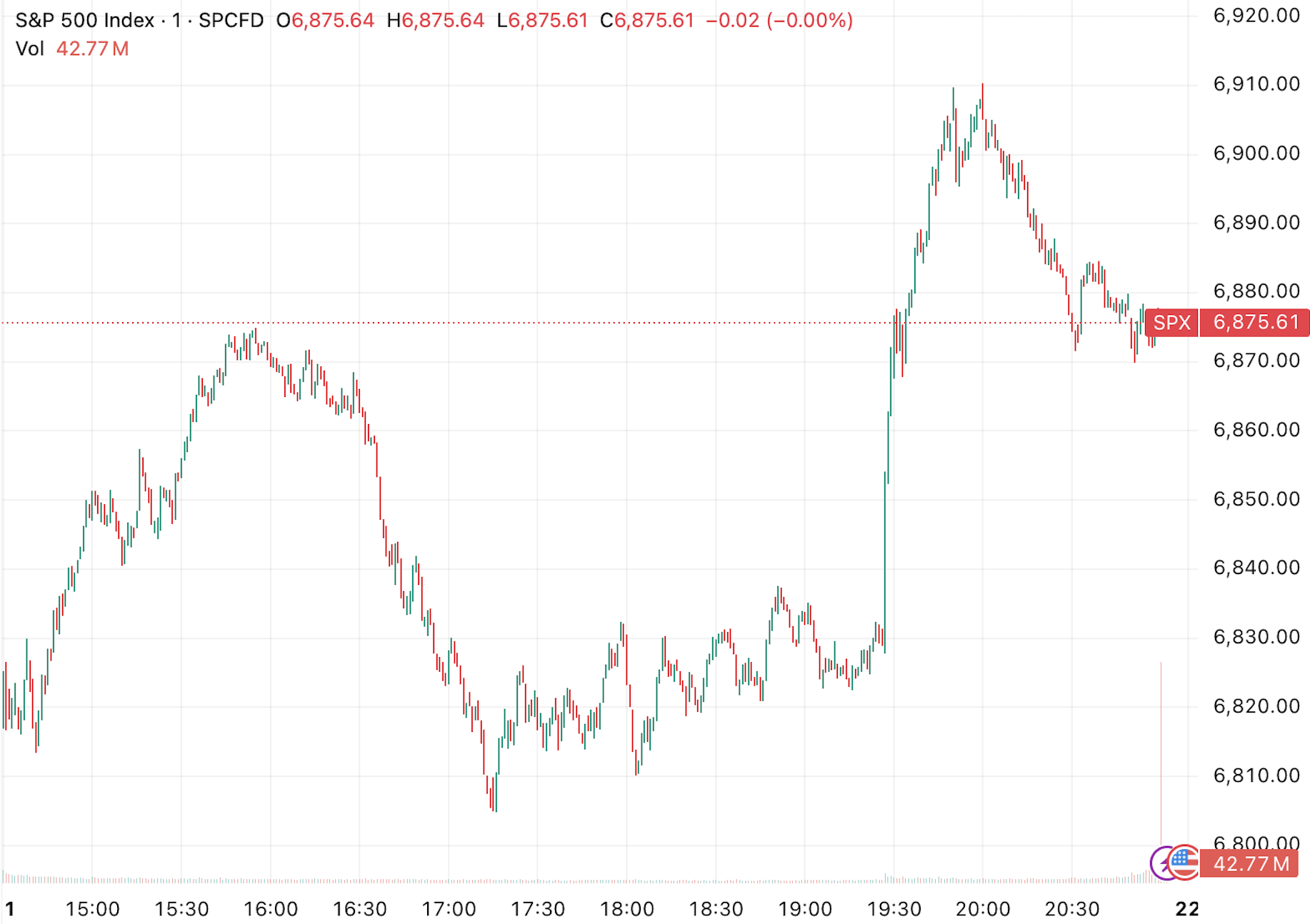
美东时间周三,在美国总统特朗普取消针对欧洲国家的新一轮关税、并称已就格陵兰问题达成"协议框架"后,美国股市大幅反弹,三大指数均涨超1%。 (标普500指数日内走势图,来源:TradingView) 截至收盘,道琼斯指数涨1.21%,报49,077.23点;标普500指数涨1.16%,报6,875.62点;纳斯达克指数涨1.18%,报23,224.82点。 特朗普周三在瑞士达沃斯举行的世界经济论坛上发表讲话,表示不会动用武力获取格陵兰,这一表态提振了股市。 随后,特朗普在其自创社交平台Truth Social上表示:"基于我与北约秘书长马克·吕特进行的一次极富成效的会谈,我们已经就格陵兰问题,事实上也是就整 个北极地区,形成了一项未来协议的框架。基于这一共识,我将不会实施原定于2月1日生效的关税措施。" 马斯克于周二表示,公司旗下Cybercab自动驾驶出租车、Optimus人形机器人的初期生产速度将"极其缓慢",之后才会逐步提升。据了解,Cybercab是一款双 座车型,整车未配备方向盘、踏板等人工操控装置。这家电动汽车制造商此前曾表示,Cybercab计划于2026年启动大规模量产,Optimus人形机器人 ...
2025年中国汽车产业:“规模答卷”优异 “质量赛道”争先
Xin Lang Cai Jing· 2026-01-21 20:32
(来源:经济参考报) 产销双双突破3400万辆、产销连续17年稳居全球第一,新能源汽车新车销量占比近半、L2功能乘用车 渗透率达到64%……2025年,中国汽车产业交出了一份亮眼成绩单。 而在这些数据的背后,是技术创新持续突破,市场秩序与安全规范体系逐步完善,整体产业质量不断提 升。规模是过去的答卷,质量是未来的考卷。在政策指引下,随着电动化、智能化、网联化等的不断推 进,中国汽车产业从规模积累到质量跃升的转型正在不断深化。 交出连续17年全球第一"规模答卷" 2025年,我国汽车行业取得多方面突破。中国汽车工业协会(以下简称"中汽协")数据显示,2025年, 我国汽车产销分别完成3453.1万辆和3440万辆,同比分别增长10.4%和9.4%,高于年初预期。 中汽协副秘书长陈士华表示,2025年,汽车行业顶住贸易保护和全球产业链重构等外部压力,克服技术 攻关难题、行业"内卷"等多重挑战,展现出强大的发展韧性和活力。加上"两新"政策加力扩围,实现平 稳过渡与有序衔接,企业新品密集上市,终端需求持续释放,全年汽车产销实现超预期增长。 具体来看,新能源汽车方面,2025年在政策利好、供给丰富和基础设施持续改善等多 ...
免费领取!100+硅碳负极项目清单(第1批)——企业、产能、技术、进度......
DT新材料· 2026-01-21 16:05
| 800+ 200+ 30+ 50,000m | | --- | | 企业参展 科研院所 | | 2026 . 06 . 10 → 06 . 12 | 在新能源产业迭代升级的浪潮中,固态电池已成为撬动行业变革的核心支点,是衡量国家高端制造实力的重要 标志。 在固态电池体系中,负极直接决定电池的能量密度、循环寿命, 是制约电池整体性能升级的关 键环节 。 相比于传统石墨负极, 硅基负极凭借优异的性能 ( 硅理论 比容量 是传统石墨负极的10倍以上 )和与固态 电池体系的高匹 配 度( 降低 固-固界面阻抗,抑制锂 枝晶析出 ), 已成为当前固态电池体系主流选择 。 作为高能量密度电池的核心材料, 硅碳负极已成为固态电池产业链的关键布局方向。 2025年,国内硅碳负极 赛道更是呈现全面开花、项目密集落地的火热态势。 据 DT 新材料不完全统计,2025年国内硅碳负极落地项 目数量突破 100 个,规划总产能超 30 万吨,行业总投资额高达800 亿元! 我们已梳理2025年硅碳负极项目(涵盖受理、公示、开工、投产等全阶段)的核心信息 , 囊括产能规划、技 术路线、项目规模等关键内容。 扫描下方二维码,转发即可领 ...
存储芯片价格暴涨好几倍,雷军在关注,蔚来李斌直言“根本抢不过”
Mei Ri Jing Ji Xin Wen· 2026-01-21 15:05
TrendForce集邦咨询公布的数据显示,2025年9月以来,DDR5内存价格上涨超300%,DDR4涨幅也超 150%;PCPartPicker平台数据则显示,消费级DDR4与DDR5内存条价格已翻两至三倍,部分面向数据中 心的高端服务器内存条单价更是逼近5万元。 "相较之下,上游动力电池原材料的价格波动对车价的影响,反而不如近期存储芯片等关键电子元器件 价格变化对整车成本和定价的影响更为显著。"日前,Omdia高级分析师刘运程在接受《每日经济新 闻》记者采访时道出了汽车行业当前面临的一项难题。 动态随机存取存储器(DRAM)广泛应用于智能汽车的信息娱乐系统、高级驾驶辅助功能以及日益集中 的电子架构中。而与此同时,作为电子设备的核心运行内存,DRAM能实现数据随机高速存取,被广泛 应用于服务器、手机、PC等各类需要高速数据处理的场景。 摩根士丹利在近日发布的研究报告中指出,传统存储芯片供需缺口正持续扩大,2025年第二季度至2026 年,行业将迎来新一波超级周期,DDR4(一种计算机内存规格)、DDR3、NOR Flash(一种非易失性 闪存)及SLC/MLC NAND(闪存的两种存储单元)等内存产品供应 ...
价格暴涨好几倍,雷军在关注,蔚来李斌直言“根本抢不过”!华尔街巨头:恐慌性购买迹象已现,车企要留心
Mei Ri Jing Ji Xin Wen· 2026-01-21 14:39
Group 1 - The automotive industry is facing significant cost pressures due to rising prices of memory chips, which are critical for vehicle electronics and smart systems [5][6][8] - Demand for DRAM and NAND flash memory is surging, driven by the growth of AI applications and data centers, leading to a supply shortage that affects automotive manufacturers [2][3][4] - Major semiconductor manufacturers are prioritizing high-margin clients in the AI and cloud sectors over automotive clients, exacerbating the supply challenges for the automotive industry [2][5] Group 2 - The price of DDR4 memory has increased by over 150% since September 2025, with predictions of further increases of 40% to 50% by the end of Q1 2026 [3][8] - Automotive manufacturers are struggling to secure memory supplies, with reports indicating that supply satisfaction rates may fall below 50% in the near future [8][9] - The automotive sector's share of the global DRAM market is less than 10%, placing it at a disadvantage compared to other industries [2][5] Group 3 - The transition to new memory technologies like LPDDR5 is being hindered by the high demand from AI applications, leading to a mismatch between automotive memory needs and available supply [7][9] - Companies in the automotive sector are unlikely to fully pass on the increased costs to consumers due to competitive market conditions, which may lead to internal cost absorption strategies [8][9] - Experts suggest that automotive companies should consider long-term agreements with local memory manufacturers to stabilize supply and mitigate price volatility [9]

价格暴涨好几倍 雷军在关注 蔚来李斌直言“根本抢不过”!
Mei Ri Jing Ji Xin Wen· 2026-01-21 14:34
Core Insights - The automotive industry is facing significant cost pressures due to rising prices of memory chips, which are critical for smart vehicle systems, as demand from AI and data centers outpaces supply [1][2][6][8]. Group 1: Market Dynamics - The demand for DRAM and NAND flash memory is surging, driven by AI applications and data centers, leading to a supply shortage that is expected to worsen [2][4]. - Memory chip prices have seen dramatic increases, with DDR5 prices rising over 300% and DDR4 over 150% since September 2025 [3]. - The automotive sector, which accounts for less than 10% of the global DRAM market, is at a disadvantage as chip manufacturers prioritize higher-margin clients in the AI and cloud sectors [2][6]. Group 2: Supply Chain Challenges - Major semiconductor manufacturers are reallocating production capacity to meet the growing demand from AI, leaving automotive manufacturers to compete for limited resources [6][7]. - The transition to new memory technologies, such as LPDDR5, is hampered by the ongoing demand from AI, leading to a mismatch between automotive needs and available supply [7][8]. Group 3: Cost Implications - Automotive manufacturers are currently unable to fully pass on the increased costs of memory chips to consumers due to competitive market pressures [8][10]. - There are concerns that the supply of memory chips may not meet automotive production needs, with forecasts suggesting that supply satisfaction could fall below 50% [8][9]. Group 4: Strategic Recommendations - Industry experts suggest that automotive companies should consider long-term agreements with local memory manufacturers to secure supply and stabilize prices [10]. - A balanced approach to product memory configuration and transparent communication with consumers regarding pricing adjustments is recommended to manage cost pressures effectively [10].