美的集团

Search documents
中国消费必定重走日本老路吗?这份研究给出了新答案
3 6 Ke· 2026-01-13 02:34
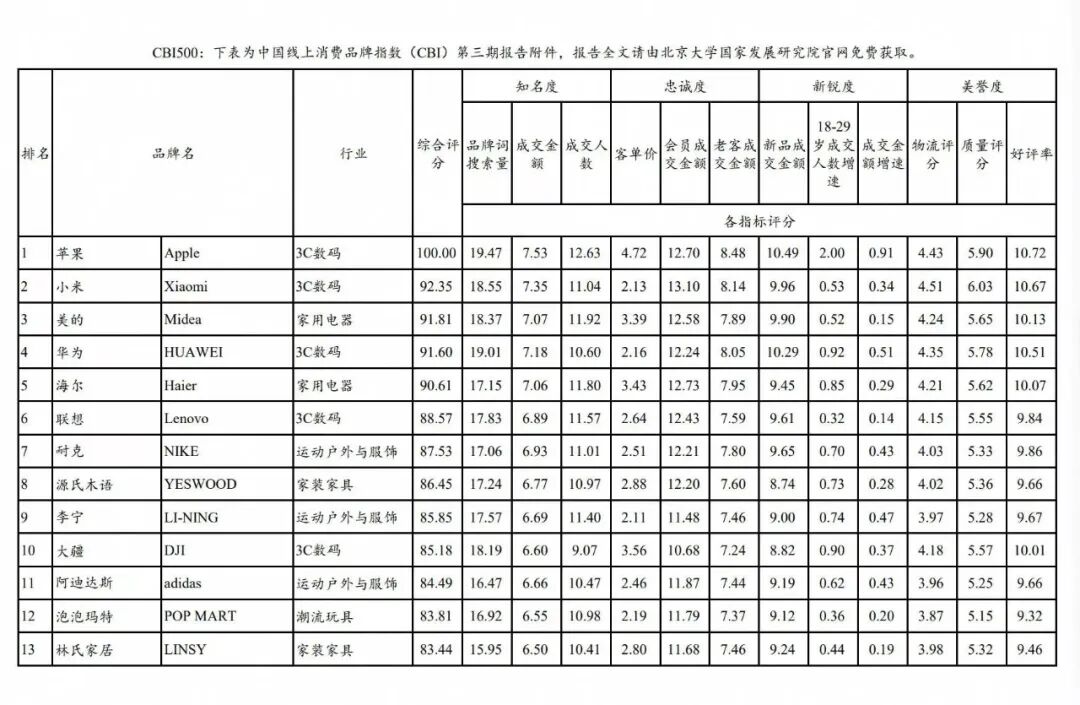
Core Viewpoint - The article discusses the evolving consumer behavior in China, contrasting it with Japan's "lost three decades," emphasizing a trend towards selective consumption upgrades rather than a decline in consumption quality [1][2]. Group 1: Consumer Behavior Trends - The Chinese online consumption brand index (CBI) reached 62.65 in Q3 2025, showing a 4.4% increase year-on-year and a 0.92% increase compared to the same quarter in 2024, indicating a stable growth in consumer preference for high-quality brands [2][4]. - The CBI reflects the proportion of consumers purchasing high-quality branded goods, suggesting that consumers are not entering a "consumption menopause" but are instead actively seeking quality [3][4]. - The trend of "selective consumption upgrade" is evident, where consumers pursue cost-effectiveness for necessities while being willing to pay a premium for emotional and experiential products [5][6]. Group 2: Brand Performance and Market Dynamics - Brands like DJI and Pop Mart have shown significant growth, with DJI entering the top ten for the first time, indicating a shift towards innovative products that create new demand rather than relying on price competition [7][16]. - The CBI report highlights that brands achieving high scores are not necessarily those known for low prices but those that create unique experiences and emotional value for consumers [7][18]. - The report indicates a seasonal pattern in consumer behavior, with higher CBI scores during promotional periods, but the third quarter's performance reflects a solid foundation for brands in non-promotional times [12][14]. Group 3: Platform Strategies and Market Evolution - E-commerce platforms like Taobao are shifting their focus towards supporting quality brands and original merchants, moving away from price wars to fostering product quality and service [24][25]. - The growth in the CBI index is attributed to a strategic shift in platform policies that encourage brands to enhance their value proposition rather than compete solely on price [25][26]. - The article emphasizes that a market balanced between daily sales and promotional periods is more resilient, indicating that brands are building long-term value rather than relying on short-term sales spikes [26][28].







中国消费 2026 展望:围绕五大投资主题选股-China Consumer 2026 Outlook Stock Picking with Five Investment Themes
2026-01-13 02:11
Summary of the Conference Call on China Consumer Sector Outlook 2026 Industry Overview - The focus is on the **China consumer sector** with an emphasis on stock picking strategies for 2026E, balancing "value" vs "growth" investments [1][11] - Anticipation of a less inflationary environment and low expectations for immediate consumption boosts from government policies [1][11] Key Investment Themes 1. **Shift Towards Experience/Service Consumption** - Consumers are increasingly valuing emotional experiences over basic needs, seeking happiness and self-expression [2][23] - 66% of respondents in a survey indicated a willingness to spend more for special moments [23] - Notable examples include Pop Mart's affordable entertainment options and Haidilao's casual dining as social venues [2][23] 2. **Focus on Well-being** - Increased spending on wellness, including health, fitness, and nutrition [3] - Growth potential identified in sportswear (Anta), health supplements (H&H), beauty care (Mao Geping), and tourism (Atour) [3] 3. **Rising "Silver" Economy** - The aging population is creating demand for leisure and cultural experiences [4] - Industries like tourism (Atour, H World), sportswear (Anta), and health supplements (H&H) are expected to benefit [4] 4. **Emerging New Channels** - Growth in omni-channel operations and new offline channels such as membership stores and snack specialty chains [5] - Food companies like Eastroc and Nongfu are adapting to these changes [5] 5. **Multi-brand Strategy** - Industry leaders are expanding brand portfolios to meet diversified consumer demands [6] - Companies like Anta and Midea are revising growth targets to ease channel inventory pressure [6] Top Buys in Consumer Sector - **Consumer Discretionary**: Anta (2020.HK), Pop Mart (9992.HK), Haidilao (6862.HK), Atour (ATAT.O), Midea (300.HK) [1][14] - **Consumer Staples**: CR Beer (291.HK), Eastroc (605499.SS), Mao Geping (1318.HK) [1][14] Additional Insights - The report emphasizes the importance of sustainable profit growth amid a dynamic marketplace [1][11] - The analysis includes a pecking order of various consumer sub-sectors, highlighting the relative strengths of companies within those sectors [1][14] - The report also notes the potential for companies like Li Ning and Haitian to outperform in case of a better-than-expected recovery in consumption [1] Conclusion - The China consumer sector is poised for a transformation driven by changing consumer preferences towards emotional and experiential consumption, with significant opportunities identified across various industries and companies. The focus on well-being, the aging population, and the emergence of new channels are critical factors influencing investment strategies for 2026E [1][2][3][4][5][6]


300ESGETF华夏(159791)开盘涨0.00%
Xin Lang Cai Jing· 2026-01-13 01:42
300ESGETF华夏(159791)业绩比较基准为沪深300ESG基准指数收益率,管理人为华夏基金管理有限 公司,基金经理为张金志,成立(2022-02-24)以来回报为13.17%,近一个月回报为4.46%。 来源:新浪基金∞工作室 风险提示:市场有风险,投资需谨慎。本文为AI大模型自动发布,任何在本文出现的信息(包括但不 限于个股、评论、预测、图表、指标、理论、任何形式的表述等)均只作为参考,不构成个人投资建 议。 1月13日,300ESGETF华夏(159791)开盘涨0.00%,报1.129元。300ESGETF华夏(159791)重仓股方 面,宁德时代开盘涨1.26%,贵州茅台涨0.25%,招商银行涨0.19%,中际旭创跌1.89%,长江电力涨 0.18%,美的集团跌0.92%,比亚迪涨1.57%,兴业银行涨0.10%,工商银行涨0.13%,恒瑞医药涨 0.70%。 ...
北向资金2025全景图:买卖总额突破50万亿 科技及资源股持仓市值大增
Zheng Quan Shi Bao Wang· 2026-01-12 23:30
Core Insights - The article highlights significant growth in northbound capital flows into A-shares, with a record high in trading volume and a shift in investment preferences towards hard technology and non-ferrous metals sectors [1][2][3][4][5][6]. Group 1: Northbound Capital Trends - Northbound capital's total trading volume exceeded 50 trillion yuan for the first time in 2025, reaching 50.33 trillion yuan, marking a year-on-year increase of over 40% [3]. - By the end of 2025, the total market value of northbound capital holdings surpassed 2.5 trillion yuan, specifically reaching 2.59 trillion yuan, which is a nearly 20% increase from the previous year [2]. - The number of A-shares held by northbound capital remained above 1 trillion shares for four consecutive years, totaling nearly 1.08 trillion shares by the end of 2025 [2]. Group 2: ETF Trading Activity - Northbound capital's ETF trading volume exceeded 810 billion yuan in 2025, a 76% increase from 2024, with ETF transactions accounting for 1.62% of total northbound trading volume, both figures representing historical highs [4]. - The launch of the "ETF Connect" in July 2022 has significantly enhanced cross-border capital flows, providing a low-cost and efficient tool for foreign investors to access A-shares [4]. Group 3: Sector Preferences - There has been a notable shift in sector preferences, with hard technology and non-ferrous metals becoming favored sectors for northbound capital, contrasting with previous preferences for large financial and consumer sectors [6][7]. - By the end of 2025, the electric equipment sector led with a holding value exceeding 449.6 billion yuan, followed by the electronics sector at over 387 billion yuan, and non-ferrous metals at over 185.5 billion yuan [6]. Group 4: Market Dynamics - The concentration of northbound capital holdings has decreased to the lowest level in five years, indicating a trend towards a more diversified portfolio [9]. - The top 20 companies held by northbound capital accounted for less than 36% of total holdings, a decline of over 2 percentage points from 2021 [9]. Group 5: Performance of Specific Stocks - Eighteen stocks have seen continuous accumulation by northbound capital for five consecutive quarters, primarily in the machinery, electric equipment, and automotive sectors [10]. - Conversely, 26 stocks have experienced continuous reduction in holdings, mainly in the pharmaceutical, banking, and consumer sectors, with significant declines in their market performance [10].
北向资金2025全景图: 买卖总额突破50万亿 科技及资源股持仓市值大增
Zheng Quan Shi Bao· 2026-01-12 22:28
Core Insights - Northbound capital has shown significant growth in trading activity and investment preferences, particularly favoring hard technology and non-ferrous metals sectors in 2025 [1][2][3][7]. Group 1: Market Performance - By the end of 2025, northbound capital held nearly 1.08 trillion shares of A-shares, with a market value surpassing 2.59 trillion yuan, marking a nearly 20% increase from the previous year [2]. - The total trading volume of northbound capital exceeded 50.33 trillion yuan in 2025, representing a more than 40% increase year-on-year, contributing nearly 6% to the overall A-share market trading volume [3]. - The trading activity of northbound capital reached new heights, with 33 trading days exceeding 300 billion yuan, 27 of which occurred in 2025 [3]. Group 2: ETF Trading - Northbound capital's ETF trading volume surpassed 810 billion yuan in 2025, a 76% increase from 2024, indicating a growing preference for ETF investments among foreign investors [4]. - The proportion of ETF trading in the total northbound capital trading volume reached 1.62%, setting a historical high [4]. Group 3: Sector Preferences - The hard technology and non-ferrous metals sectors emerged as the new favorites for northbound capital, with 14 industries seeing holdings exceed 50 billion yuan, and 10 industries surpassing 100 billion yuan [7]. - The electric equipment sector led with a holding value of over 449.6 billion yuan, followed by the electronics sector at over 387 billion yuan, and the non-ferrous metals sector at over 185.5 billion yuan [7]. - The non-ferrous metals sector saw a remarkable growth of over 172% in holdings compared to the end of 2024, reflecting a shift in investment focus [8]. Group 4: Stock Concentration - The concentration of holdings by northbound capital reached a five-year low in 2025, indicating a trend towards diversification in investment strategies [10]. - The top 20 companies held by northbound capital accounted for less than 36% of total holdings, a decrease of over 2 percentage points from 2021 [11]. Group 5: Popular Investment Themes - In 2025, eight out of ten popular investment themes, including commercial aerospace and semiconductor sectors, saw over 50% of their constituent stocks receiving increased holdings from northbound capital [9]. - The commercial aerospace sector, in particular, had over 80% of its stocks increased in holdings, driven by strong market performance and supportive policies [9]. Group 6: Long-term Trends - Eighteen stocks have been consistently increased in holdings for five consecutive quarters, primarily in the machinery, electric equipment, and automotive sectors, indicating strong institutional confidence [12]. - Conversely, 26 stocks have seen reductions in holdings over the same period, mainly in the pharmaceutical, banking, and consumer sectors, reflecting a shift in investment focus [12][13].





部委年度会议的6大要点——政策周观察第63期
一瑜中的· 2026-01-12 16:04
Monetary Policy - The central bank emphasizes a flexible and efficient use of various monetary policy tools, including reserve requirement ratio (RRR) cuts and interest rate reductions, to maintain relatively loose social financing conditions and guide reasonable growth in financial totals and balanced credit issuance [2][13] - The focus on supporting key areas such as expanding domestic demand, technological innovation, and small and medium-sized enterprises (SMEs) has been reinforced [2][13] Consumption - The Ministry of Commerce highlights a shift towards prioritizing service consumption and optimizing the implementation of the old-for-new consumption policy, aiming to accelerate the cultivation of new growth points in service consumption [2][16] - The previous year's focus was on expanding the scope of the old-for-new policy and innovating diverse consumption scenarios [2][16] Real Estate - The central bank's annual meeting did not mention real estate in the context of risk prevention, focusing instead on local debt risks and risks associated with small financial institutions [3] Foreign Trade - The Ministry of Commerce emphasizes structural optimization in foreign trade, with a detailed approach to foreign-related security deployments, including promoting trade innovation and encouraging service exports [3][16] - The focus has shifted from merely stabilizing foreign trade to fostering high-quality development and expanding new foreign trade drivers [3][16] Industry - The Civil Aviation Administration and the Postal Administration both address the need to strengthen and innovate macro-control to prevent "involution" competition within industries [4] - The Ministry of Natural Resources stresses the importance of enhancing strategic mineral resource security and monitoring risks [4] Social Welfare - The National Health Commission proposes optimizing childbirth support policies and promoting integrated development of childcare services, while the Ministry of Civil Affairs emphasizes implementing comprehensive elderly care consumption subsidy projects [4] - The Ministry of Education outlines initiatives for revitalizing ordinary high schools in counties and advancing artificial intelligence education across all school levels [4] Recent Policy Developments - The Ministry of Finance announced adjustments to export tax rebate policies for photovoltaic products, with a phased reduction in VAT export rebates starting from April 2026 [5][14] - The Ministry of Industry and Information Technology issued implementation opinions for the "Artificial Intelligence + Manufacturing" initiative, aiming for significant advancements in AI applications within the manufacturing sector by 2027 [5][15]

A股越走越强引全球关注,瑞银报告:2026趋势上行,七大板块值得超配
Zhi Tong Cai Jing· 2026-01-12 14:21
Group 1 - The core viewpoint of the article is that the A-share market is entering a new upward trend in 2026, supported by a recovery in funds and sentiment, along with corporate earnings, highlighting structural investment opportunities [1][2] - UBS predicts that the overall profit growth rate of A-shares will increase from 6% in 2025 to 8% in 2026, driven by both profit and valuation [3] - The report emphasizes that the current equity risk premium in A-shares is still above historical averages, indicating clear potential for valuation recovery [4] Group 2 - Key factors supporting profit growth include the recovery of nominal GDP growth, narrowing PPI declines, and targeted policy support such as equipment upgrade subsidies and new infrastructure investments [4] - The report suggests focusing on growth stocks, with a preference for cyclical sectors over defensive ones, as growth stocks are expected to outperform in an upward market cycle [6] - UBS recommends overweighting seven key sectors: electronics, telecommunications, non-bank financials, defense and military, non-ferrous metals, chemicals, and electric power equipment, each with specific growth drivers [7] Group 3 - The report identifies four thematic investment directions: technology self-sufficiency, consumer recovery, beneficiaries of "anti-involution," and global leaders with competitive advantages [8][9] - The A-share market has seen a significant increase in trading activity, with average daily turnover rising to 24.6 trillion yuan, up from 17.3 trillion yuan in 2025, indicating strong investor interest [2] - The influx of various long-term funds, including insurance capital and foreign investment, is expected to provide ongoing support for the market [2]

兴发集团:公司黑磷制备技术已实现百公斤级连续化稳定生产
Zheng Quan Ri Bao Wang· 2026-01-12 13:41
证券日报网讯1月12日,兴发集团(600141)在互动平台回答投资者提问时表示,产业化方面,公司黑 磷制备技术已实现百公斤级连续化稳定生产,百吨级生产线具备快速建成能力,同时产品制造成本显著 下降,从经济性角度已具备商业化条件。应用研发方面,基于当前高质量、低成本的黑磷制备能力,公 司前瞻布局未来潜力巨大的应用领域,合作科研机构及企业数量从2024年末的30余家扩大至2025年末近 90家。近期公司与合作伙伴在航天材料领域取得重大科研成果,将黑磷下游应用领域从磷碳负极材料、 光电子芯片、生物医药和催化剂等领域进一步扩大。商业应用方面,黑磷-钯催化剂已在兴瑞公司双氧 水生产中实现工业化应用,氢效最高提升近20%;黑磷净味催化剂已通过美的集团(000333)企业标准 认证,标志着相关技术产业化与市场应用取得重要进展。2025年公司对外供应黑磷产品近200公斤,同 比增长超210%。 ...

曾被吐槽“鸡肋”的AI智能锁,快被年轻人玩坏了
创业邦· 2026-01-12 10:19
Core Viewpoint - The smart lock industry has evolved significantly over the past decade, transitioning from basic electronic locks to advanced AI-driven solutions that enhance security and convenience, with a projected market growth from $2.77 billion in 2024 to $8.1 billion by 2030 [5][7]. Market Overview - The smart lock market in China is experiencing rapid growth, with a penetration rate exceeding 40% in first-tier cities by 2025 [5]. - The global smart door lock market is expected to reach $27.7 billion in 2024 and grow to $81 billion by 2030, indicating a robust demand for smart locking solutions [7]. Industry Dynamics - Major tech companies like Xiaomi, Huawei, and Haier are heavily investing in the smart lock sector, leading to intense competition and a "red ocean" market environment [7][12]. - The number of smart lock brands in China surged from 600 in 2015 to over 3,500 by mid-2018, highlighting the industry's explosive growth [19]. Technological Advancements - The evolution of smart locks has been driven by advancements in AI, biometrics, and IoT technologies, transforming locks from passive security devices to proactive smart solutions [21]. - New features such as 3D facial recognition and palm vein identification are becoming standard in high-end models, addressing previous limitations of fingerprint recognition [34][38]. Consumer Experience - The shift from basic functionality to enhanced user experience is evident, with smart locks now integrating with home automation systems to create a seamless living environment [26][32]. - Companies are focusing on user-friendly features, such as visitor interaction capabilities and automated home settings upon unlocking [30][32]. Challenges and Concerns - Despite advancements, the reliability of smart locks remains a concern, with reports of malfunction leading to security breaches and user dissatisfaction [40][42]. - Data privacy issues are also critical, as many smart locks collect sensitive user information, raising concerns about potential data breaches if not properly secured [44]. Conclusion - The smart lock industry is at a pivotal point, where the focus is not only on technological innovation but also on ensuring security and user trust. The ultimate goal is to provide a reliable solution that allows users to feel safe and secure in their homes [46].

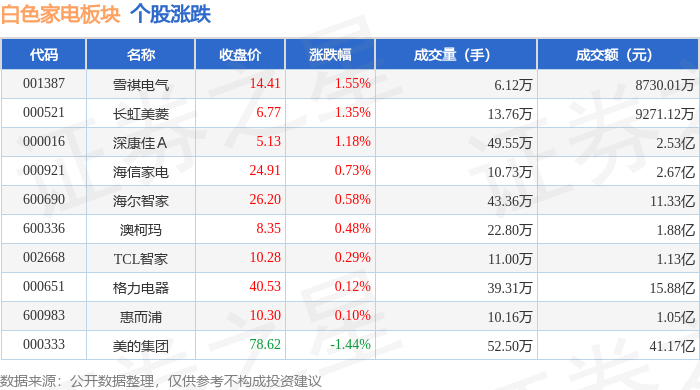
白色家电板块1月12日跌0.62%,美的集团领跌,主力资金净流出6471.93万元
Zheng Xing Xing Ye Ri Bao· 2026-01-12 09:04
证券之星消息,1月12日白色家电板块较上一交易日下跌0.62%,美的集团领跌。当日上证指数报收于 4165.29,上涨1.09%。深证成指报收于14366.91,上涨1.75%。白色家电板块个股涨跌见下表: | 代码 | 名称 | 收盘价 | 涨跌幅 | 成交量(手) | 成交额(元) | | | --- | --- | --- | --- | --- | --- | --- | | 001387 | 雪祺电气 | 14.41 | 1.55% | 6.12万 | | 8730.01万 | | 000521 | 长虹美菱 | 6.77 | 1.35% | 13.76万 | | 9271.12万 | | 000016 | 深康佳A | 5.13 | 1.18% | 49.55万 | | 2.53亿 | | 000921 | 海信家电 | 24.91 | 0.73% | - 10.73万 | | 2.67亿 | | 600690 | 海尔智家 | 26.20 | 0.58% | 43.36万 | | 11.33亿 | | 600336 | 澳柯玛 | 8.35 | 0.48% | 22.80万 | | 1.88Z ...