三星

Search documents
春节换机潮叠加“国补”,中端机配置全面“旗舰化”
Nan Fang Du Shi Bao· 2026-01-23 06:30
Group 1 - The Chinese smartphone market is entering a competitive phase with a focus on mid-range devices as manufacturers target the demand for high cost-performance products during the pre-Spring Festival sales season [1][3] - The government subsidy policy, which extends until 2026, offers a 15% subsidy for devices priced under 6000 yuan, enhancing the attractiveness of mid-range smartphones [3] - Consumers are shifting their focus from low prices to high cost-performance, with mid-range devices now offering performance and features close to flagship models at 60%-70% of their price [3][7] Group 2 - Major brands like Honor, OnePlus, Redmi, iQOO, and realme are launching new models priced between 2000 yuan and 3000 yuan, indicating a fierce competition in the mid-range segment [3][7] - Battery life is a critical concern for users, leading manufacturers to equip mid-range devices with large-capacity batteries, such as Honor Power 2 with a 10080mAh battery [5][7] - The introduction of high-performance processors, such as Snapdragon 8 Gen 5 and MediaTek's Dimensity 9500S, is becoming standard in new mid-range devices, enhancing their appeal [5][6] Group 3 - The smartphone market in China is transitioning to a phase characterized by slight declines in total volume and structural upgrades, with an expected shipment of 278 million units in 2026, a 2.2% year-on-year decrease [8] - High-end market shares are dominated by Apple, Huawei, and Samsung, with Apple holding nearly 50% of the high-end market share in the first three quarters of 2025 [9] - The rising costs of core components are pressuring manufacturers to either raise prices or reduce specifications, leading to a focus on the 2000-3000 yuan price range for maintaining higher profit margins [9]

存储行业深度报告:骐骥驰骋,AI“存”变,国产“储”势,星火燎原
Bank of China Securities· 2026-01-23 05:50
Investment Rating - The report assigns a "Outperform" rating to the storage industry, driven by the expansion of AI and data, which is pushing the storage sector into a new cycle with increasing prices and demand for new technologies like HBM [2]. Core Insights - The storage market is experiencing significant growth due to the increasing demand for storage technology across various sectors of the digital economy, particularly driven by AI applications. The demand for AI edge storage is growing at a much faster rate than other segments, becoming a key driver for global storage market expansion [7][14]. - The report highlights that the prices of storage products have already seen substantial increases in 2025 and are expected to rise further in 2026, driven by both AI servers and general server demands. The supply-demand dynamics are complex, with structural capacity constraints and competition across multiple dimensions [7][30]. - The report emphasizes the importance of domestic storage manufacturers in China, such as Changxin Memory and Yangtze Memory Technologies, which are making significant strides in production and technology, potentially reshaping the competitive landscape [7][67]. Summary by Sections Market Overview - The global data generation is projected to reach 213.56ZB by 2025 and exceed 527.47ZB by 2029, with China's data generation expected to grow from 51.78ZB in 2025 to 136.12ZB by 2029, reflecting a CAGR of 26.9% [14][17]. - The capital expenditure of major cloud service providers (CSPs) is expected to increase significantly, with a projected total exceeding $600 billion in 2026, marking a year-on-year growth of approximately 40% [23][26]. Supply Side Dynamics - The supply of storage components is constrained, with a shift in capital expenditure focus towards advanced process technologies and high-value products rather than mere capacity expansion. This is expected to maintain a supply-demand imbalance throughout 2026 [67][70]. - The report notes that HBM technology is becoming increasingly competitive, with significant growth expected in the high-performance memory segment, particularly for AI applications [73][79]. Demand Side Dynamics - The demand for AI storage is rapidly increasing, with traditional HDDs facing supply shortages due to the lack of planned expansions by major manufacturers. This has led to a shift towards high-performance SSDs, particularly QLC SSDs, which are expected to see significant growth in 2026 [83][84]. - High-end DRAM remains a standard for AI applications, with a notable shift towards LPDDR5X memory, which is projected to see a demand increase of 169% in 2026 [86][91]. Investment Opportunities - The report suggests focusing on specific segments within the storage industry that are likely to benefit from the current market dynamics, including distributors and module manufacturers, niche market IC design companies, and domestic semiconductor supply chains [4].
真我Neo8发布,搭载165Hz三星苍穹屏
WitsView睿智显示· 2026-01-23 05:44
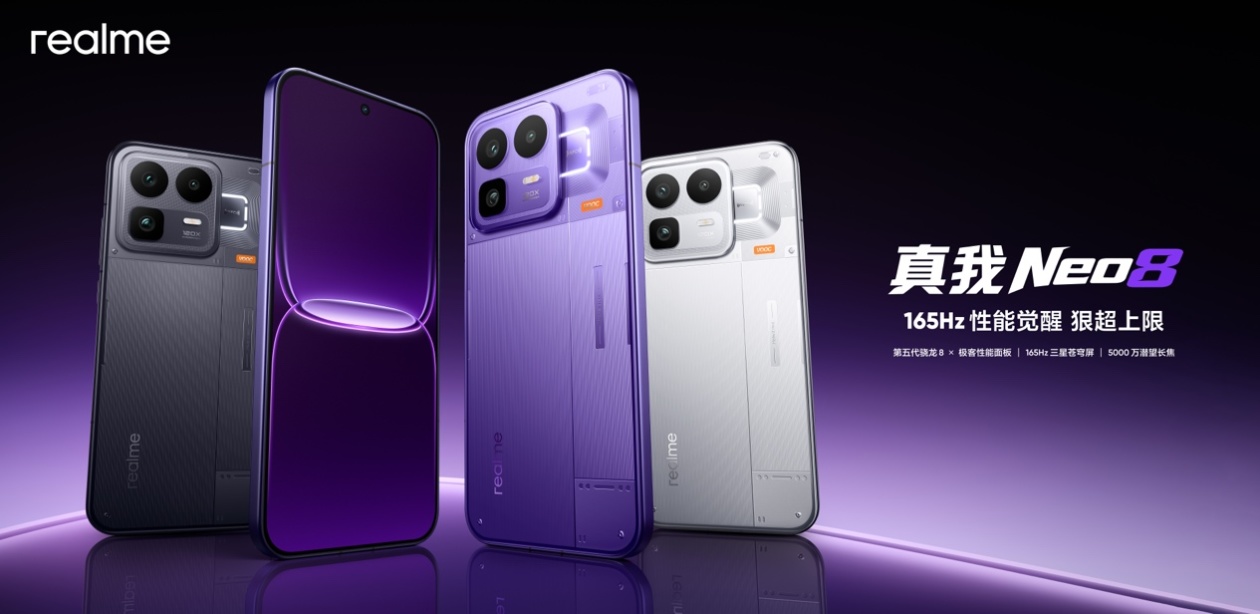
1月22日, realme真我Neo8手机 正式 发布,产品首销价2399元起,国补到手价2039.15元 起。 图片来源: realme真我 屏幕方面,真我联合三星显示定制全新165Hz三星苍穹屏,采用M14旗舰发光材料。屏幕的手动 峰值亮度1000nit、全局峰值亮度1800nit、局部峰值亮度6500nit,支持3800nit阳光显示, 3800nit极限高亮度下仍能实现103%的P3超广色域覆盖。 据悉,为满足电竞需求,Neo8手机屏幕支持超30款热门游戏实现原生165Hz超高帧显示。同时, 手机还搭载定制妙感触控芯,支持3800Hz瞬时触控采样率;拥有全新绿野护眼技术,支持全亮度 DC调光、硬件级低蓝光、AI主动护眼技术等。 此外,Neo8手机搭载第五代骁龙8处理器、UFS 4.1+LPDDR5X、大气流冷锋散热系统、苍穹通 信系统、8000mAh电池等配置,并拥有新一代极客性能面板、新一代GT性能引擎等技术,全面满 足电竞需求。(集邦Display) TZ 不器研究中心 面板产业链市场供需及价格报告 面板价格"Plus"和市况更新月度报告 面板产业市况季度报告 . 面板价格预测月度报告 . 面板出 ...

苹果进入印度手机市场前五,去年出货增长28%
Guan Cha Zhe Wang· 2026-01-23 05:42
Core Insights - The Indian smartphone market is projected to see a decline in shipments, with approximately 34.5 million units expected in Q4 2025, a 7% year-over-year decrease, and an annual total of 154.2 million units, reflecting a slight 1% decline [1][2] - Vivo maintains its leading position in both quarterly and annual shipments, with a market share of 23% in Q4 and 21% for the year, showing a growth rate of 19% [2][3] - The market is experiencing a shift towards value-driven strategies, influenced by rising component costs, cautious consumer spending, and extended upgrade cycles [1][4] Quarterly Performance - In Q4 2025, Vivo shipped approximately 7.9 million units, capturing 23% of the market share, followed by Samsung with 4.9 million units (14% share) and OPPO with 4.6 million units (13% share) [1] - The overall decline in Q4 shipments is attributed to high channel inventory, currency depreciation, and increased memory costs leading to higher product prices, which have weakened purchasing power [1][2] Annual Performance - For the full year, Vivo's total shipments reached 32.1 million units, securing a 21% market share, while Samsung and OPPO followed with 23 million and 20 million units, respectively [2] - Apple ranked fifth with a market share of approximately 10%, showing the most significant growth among the listed companies at 28% year-over-year [2] Market Dynamics - The fourth quarter is characterized as a period for inventory digestion, with brands like Vivo and OPPO achieving double-digit year-over-year growth due to strong retail execution and effective product management [2][3] - Other leading brands faced challenges, including cautious channel behavior and price adjustments, with Samsung and Xiaomi experiencing sales slowdowns despite targeted promotions [2][3] Future Outlook - The Indian smartphone market is expected to see a mid-single-digit percentage decline in 2026, driven by rising terminal prices and limited incremental value in products [3][4] - Brands are anticipated to shift focus towards value growth strategies in the entry-level market, particularly in the ₹25,000 to ₹60,000 segment, which offers better profit margins [3][4] - The high-end market above ₹60,000 will continue to be dominated by Apple, Samsung, and Vivo, with brands increasingly relying on channel leverage and localized marketing strategies to maintain market stability [4]


黄仁勋:大规模数据中心建设对建筑、技术工人需求上升|首席资讯日报
首席商业评论· 2026-01-23 05:16
Group 1 - Huang Renxun, CEO of Nvidia, stated that the development of AI will require the largest infrastructure investment in human history, necessitating trillions of dollars in new investments, with a significant increase in demand for construction and technical workers for data center construction [2] - OpenAI's CEO Sam Altman is seeking to raise at least $50 billion in new funding, with a valuation between $750 billion and $830 billion, indicating a competitive landscape for AI investments [3] - Shenzhen aims for an annual growth rate of over 10% in technology insurance premiums by the end of 2028, with a target of providing over 5 trillion yuan in risk protection for tech companies each year [4] Group 2 - Samsung denied rumors of an 80% price increase across all memory products, indicating ongoing market speculation [5] - The Chinese government announced that grain production is expected to reach a historical high of 14.298 billion jin in 2025, an increase of 1.68 billion jin from the previous year [8] - Japan's trade deficit for 2025 is projected to be 26.507 trillion yen, with a 4.1% decrease in exports to the U.S., marking the fifth consecutive year of trade deficits [9] Group 3 - JD.com has established a new service technology company in Beijing, focusing on engineering, technology research, and environmental protection monitoring [10] - Elon Musk is pushing for SpaceX's IPO to be completed by July of this year, indicating a significant move in the space industry [11] - Meta's global chief affairs officer warned that EU actions against U.S. tech companies could harm European businesses and consumers, emphasizing the importance of technology for improving lives [12] Group 4 - Changan Automobile and Midea Group signed a comprehensive strategic cooperation agreement to enhance collaboration in digitalization, smart manufacturing, and user experience in the automotive sector [13]

和欧洲闹掰后,特朗普调转方向,对华送出双重大礼,还有大事相求
Sou Hu Cai Jing· 2026-01-23 04:43
Group 1 - The article discusses the shift in Trump's approach towards China after tensions with Europe, indicating a need for partnership to address domestic issues and international challenges [1][11][34] - Trump has previously sought to acquire Greenland for its strategic importance but faced resistance from European nations, leading to threats of tariffs on imports from several countries [3][5] - The NATO summit highlighted disagreements over defense spending, with Trump demanding European countries increase military budgets, which they found unsustainable [7][9] Group 2 - Trump has recently softened his stance towards China, allowing the sale of high-end AI chips and equipment to Chinese companies, indicating a strategic pivot [16][19] - The U.S. is looking to stabilize its trade relationship with China, aiming to end the tariff war and seeking Chinese cooperation in various sectors, including rare earth elements [26][28] - The article emphasizes that Trump's actions are driven by self-interest, aiming to secure political gains and economic benefits through cooperation with China [34][39]
真我Neo8正式发布,首发165Hz三星苍穹屏与多项创新功能
Huan Qiu Wang· 2026-01-23 02:55
Core Viewpoint - Realme has launched its new gaming flagship smartphone, the Realme Neo8, which aims to provide an upgraded gaming experience for young users and targets a total sales volume of over 300 million units by 2025 [1][3]. Performance - The Realme Neo8 is powered by the fifth-generation Snapdragon 8 flagship chip, utilizing TSMC's 3nm process and the third-generation Oryon architecture, achieving an AnTuTu score exceeding 3.58 million [3]. - It features a unique geek performance panel that allows users to customize CPU and GPU frequencies and temperature control across five levels for different gaming scenarios [3]. Display - The device introduces the world's first 165Hz Samsung Aegis display, which enhances luminous efficiency by 26% and reduces power consumption by 16% compared to industry-standard 144Hz screens [3]. - The display supports a peak brightness of 1000 nits manually, 1800 nits globally, and 6500 nits locally, ensuring clear color display even under direct sunlight [3]. Innovation - The Neo8 features a PC handheld mode that allows seamless integration with Steam accounts, enabling smooth operation of over 50 popular PC games [3]. - It includes a 50MP periscope telephoto camera capable of 3.5x optical zoom, 7x lossless zoom, and 120x ultra-clear zoom, along with AI text enhancement and automatic correction features [3]. Battery and Protection - The smartphone is equipped with an 8000mAh Titan battery, supporting 80W super flash charging, and retains over 80% capacity after five years of use [5]. - It has received triple waterproof certification (IP66, IP68, IP69), allowing it to function for 72 hours in 2-meter deep water [5]. Additional Products and Services - Alongside the Neo8, Realme also launched the Buds Air8 earbuds, featuring dual drivers, deep-sea level noise cancellation, and AI real-time translation capabilities [5]. - Starting April 2026, Realme phones will be integrated into the OPPO after-sales service system, providing users with high-quality repair services at OPPO outlets [5].
SPIR:2026全球锂电池行业发展白皮书发布
起点锂电· 2026-01-23 02:44
Core Insights - The global lithium battery shipment in 2025 is projected to reach 2042.7 GWh, representing a year-on-year growth of 46.8%, with power batteries accounting for 62.2% of the demand structure [2] - By 2030, the global lithium battery shipment is expected to reach 5333.6 GWh, with a decreasing share of power batteries and an increasing trend in energy storage batteries [2] Group 1: EV Power Lithium Batteries - In 2025, global sales of new energy vehicles are expected to reach 24.04 million units, a year-on-year increase of 31.8%, driving the global EV power battery shipment to 1271 GWh, up 39.9% [3] - The market concentration for EV power batteries is increasing, with the top five companies accounting for 72% of the market share [10] Group 2: Energy Storage Lithium Batteries - The global energy storage battery shipment is projected to be 637 GWh in 2025, a year-on-year increase of 78.9%, primarily driven by markets in China, Europe, the Middle East, and Southeast Asia [3][14] - The market concentration for energy storage batteries is also rising, with the top five companies expected to hold 53.3% of the market share in 2025 [14] Group 3: Lightweight Power Lithium Batteries - The implementation of new national standards for electric bicycles in September 2025 is expected to stimulate demand, with global lightweight power battery shipments reaching 55.4 GWh, a year-on-year increase of 10.8% [4] Group 4: 3C Lithium Batteries - The global 3C lithium battery shipment is projected to be 70.8 GWh in 2025, with a year-on-year growth of 5.8%, driven by device replacements and hardware upgrades [4] - The 3C electronics sector is expected to maintain steady growth, with shipments projected to exceed 115.2 GWh by 2030, reflecting a compound annual growth rate of 10.2% over the next five years [4] Group 5: Battery Materials Market - In 2025, the global shipment of lithium battery cathode materials is expected to reach 479.8 million tons, a year-on-year increase of 48.5%, with lithium iron phosphate accounting for 78% of the total [21] - The global shipment of lithium battery anode materials is projected to be 272.3 million tons in 2025, with artificial graphite making up 89.3% of the total [27] Group 6: Electrolyte and Separator Markets - The global lithium battery electrolyte shipment is expected to reach 239.6 million tons in 2025, a year-on-year increase of 53% [29] - The global lithium battery separator shipment is projected to be 384.9 billion square meters in 2025, with a year-on-year growth of 48.6% [36] Group 7: Copper and Aluminum Foil Markets - The global lithium battery copper foil shipment is expected to reach 148.7 million tons in 2025, with a year-on-year growth of 49.1% [39] - The global lithium battery aluminum foil market is projected to reach 72.3 million tons in 2025, a year-on-year increase of 48.8% [43]

存储大厂业绩预告亮眼,芯片ETF(159995.SZ)显分化,晶盛机电上涨8.56%
Mei Ri Jing Ji Xin Wen· 2026-01-23 02:13
Group 1 - A-shares opened on January 23 with all three major indices rising, with the Shanghai Composite Index up 0.09% during the session, led by gains in the power equipment, non-ferrous metals, and defense sectors, while telecommunications and home appliances saw declines [1] - The semiconductor sector showed mixed performance, with the Chip ETF (159995.SZ) down 0.24%, while component stocks like Jing Sheng Machinery and Sanan Optoelectronics rose by 8.56% and 5.05% respectively, whereas companies like Shengmei Shanghai and Longxin Zhongke experienced declines of -4.68% and -4.35% [1] - Global storage giants are gradually releasing strong earnings forecasts, with Samsung projecting a 23% year-on-year increase in revenue for Q4 2025 and a 208% year-on-year increase in operating profit, while Biwei Storage anticipates a 165% year-on-year increase in annual earnings [1] Group 2 - According to招商证券, the end of January and early February will see a concentrated earnings season for global storage giants, including Hynix, Samsung, SanDisk, and Western Digital, which is expected to bring positive news for the overall market [2] - There is an observed trend of rising prices in storage testing and packaging, with potential implications for related chips, suggesting that after the initial wave of price increases in testing, broader price increases in storage could follow [2] - The Chip ETF (159995) tracks the National Chip Index, comprising 30 leading companies in the A-share chip industry across materials, equipment, design, manufacturing, packaging, and testing, including firms like SMIC and Cambrian [2]

AI抢占产能,汽车芯片荒2.0逼近:单车成本或增加400美元,持续时间或超2021缺芯危机
Hua Er Jie Jian Wen· 2026-01-23 02:00
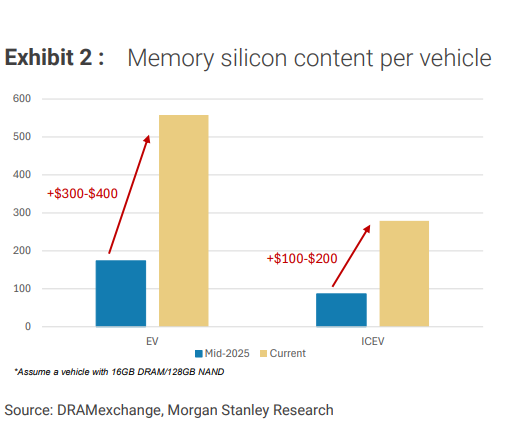
Group 1 - The automotive industry is facing a more severe structural "chip shortage" crisis than in 2021, driven by the explosive growth of artificial intelligence (AI) and the resulting shift in chip manufacturing capacity towards data centers, leading to a sharp contraction in the supply of traditional storage chips relied upon by the automotive sector [1][2] - Morgan Stanley's report warns that the surge in spot prices for storage chips is quickly being transmitted to automakers, which could significantly impact profit margins in an already thin-margin industry, particularly for electric vehicles (EVs) that are heavily reliant on smart features [1][3] Group 2 - Unlike the 2021 crisis that resulted in a reduction of approximately 12 million vehicles, the current shortage is characterized by a "lower intensity but longer duration," with structural supply chain disruptions expected to last at least until the end of 2026 [2][6] - The cost increase for electric vehicles could reach up to $400 per unit, with internal combustion engine (ICE) vehicles facing an additional cost of $100 to $200, despite storage chips only accounting for about 0.5% of the total cost of goods sold (COGS) [3][6] Group 3 - The current crisis is expected to be more persistent and structurally impactful than the previous one, with a shift from shortages of analog chips or microcontrollers (MCUs) to a dominance of DRAM shortages, particularly affecting Chinese EV manufacturers due to their high reliance on storage chips for smart cockpit and driving features [6][7] - The supply bottleneck is projected to extend into 2027, with significant tightening in the availability of traditional chips as major manufacturers phase out older production processes in favor of advanced technologies needed for AI [7][11] Group 4 - Automakers are responding differently, with companies like Volkswagen and Hyundai currently reporting no significant supply risks due to prior inventory management practices, although Morgan Stanley cautions that the situation remains uncertain and could worsen unexpectedly [12][13] - The real challenge may arise post-2028, as the availability of traditional DRAM is expected to decline sharply, potentially forcing automakers to redesign vehicles that are still dependent on older technologies [14][15]