招商蛇口

Search documents
地产承压下的韧性之光:从房企三季报透视行业冷暖
Cai Jing Wang· 2025-11-11 08:57
Core Insights - The real estate industry is currently in a "bottoming" phase, with profitability under pressure being a common challenge across the sector [1] - As of the first three quarters of 2025, over 50% of the 77 A-share listed real estate companies reported losses, highlighting the widespread impact of the industry's downturn [1][2] - Despite the overall industry challenges, leading companies like China Merchants Shekou and Poly Developments have demonstrated resilience through strong cash flow and diversified business strategies [2][4] Sales Performance - From January to October 2025, the top 100 real estate companies recorded sales of 28,967.1 billion yuan, a year-on-year decline of 16.3% [2] - The average sales for the top 10 companies decreased by 15.0%, while the average for companies ranked 11-30 fell by 17.8% [2] - The overall revenue and profit scale of the industry have contracted due to sluggish market transactions [2][3] Financial Health - In the first three quarters of 2025, 41 A-share listed real estate companies incurred losses totaling 872 billion yuan, with an industry gross margin of 14.22% and a net margin of -5.57% [2] - Leading firms like Poly Developments reported a net cash inflow from operating activities of 69.77 billion yuan, with cash reserves exceeding 1200 billion yuan, indicating strong financial health [4] Land Acquisition Strategies - Resilient companies are adopting disciplined land acquisition strategies, focusing on optimizing existing land reserves rather than blind expansion [5][6] - As of September 27, 2025, over 4600 parcels of idle land are set to be acquired through special bonds, covering more than 2.4 million square meters and totaling over 620 billion yuan [5] - The trend of cautious land investment is evident, with a significant increase in land transaction amounts in first-tier cities, which accounted for 32.6% of total transactions [7] Quality and Product Strategy - The concept of "good housing" has gained traction, with companies focusing on enhancing product quality to meet rising consumer expectations [8][9] - Leading firms are implementing comprehensive quality management systems and strategies to ensure product safety, comfort, and sustainability [9][10] - Poly Developments has established a four-tier, eight-dimensional quality management system to enhance product and service quality based on extensive customer research [10]

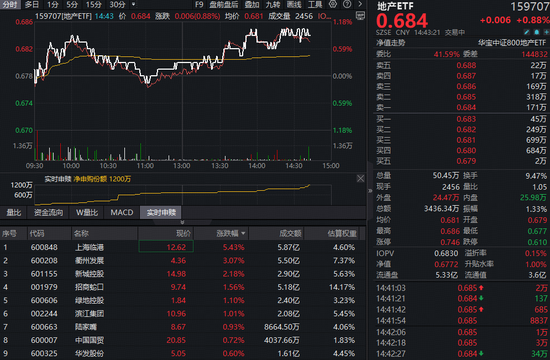
地产逆市修复!上海临港领涨超5%,全市场唯一地产ETF(159707)涨逾1%,资金净申购1200万份!
Xin Lang Ji Jin· 2025-11-11 07:09
Group 1 - The real estate sector is leading the market with the CSI 800 Real Estate Index rising over 1%, with Shanghai Lingang up 5.6% and several other companies like Quzhou Development and New Town Holdings increasing by over 2% [1] - The only ETF tracking the CSI 800 Real Estate Index, the real estate ETF (159707), saw a price increase of over 1% and a net subscription of 12 million shares, with a total transaction amount exceeding 33 million yuan [1][2] - In October 2025, the total bond financing in the real estate sector reached 51.24 billion yuan, marking a year-on-year increase of 76.9%, with credit bond issuance also showing significant growth [2] Group 2 - CITIC Securities predicts that 2026 may be a critical year for real estate companies to repair their balance sheets, with some firms potentially reaching the bottom of their profit cycles [3] - The real estate ETF (159707) is highlighted for its concentration on top-tier real estate companies, with over 90% of the weight in the top ten constituent stocks, indicating a strong focus on central state-owned enterprises and quality firms [3]





房地产行业周报(2025年第45周):万科与深铁签署220亿借款框架协议,新房二手房成交同比降幅较大-20251111
Huachuang Securities· 2025-11-11 04:35
Investment Rating - The report maintains a "Buy" recommendation for new homes and indicates a significant decline in second-hand home transactions year-on-year [2][33]. Core Insights - The real estate sector has seen a 0.2% decline in the week of November 3 to November 7, 2025, ranking 24th among 31 primary industry sectors [9][30]. - New home transaction volume in 20 monitored cities decreased by 38% year-on-year, with a total area of 159 million square meters sold in the week, averaging 22.7 million square meters per day [21][24]. - Second-hand home transactions in 11 monitored cities also fell by 29% year-on-year, with a total area of 186 million square meters sold in the week, averaging 26.6 million square meters per day [24][29]. Industry Overview - **Basic Data**: The real estate sector comprises 107 listed companies with a total market capitalization of 1,233.623 billion yuan and a circulating market capitalization of 1,183.334 billion yuan [3]. - **Relative Index Performance**: The absolute performance over 1 month, 6 months, and 12 months is -1.6%, 16.8%, and -8.9% respectively, while the relative performance is -3.3%, -5.3%, and -23.3% [4]. Policy Developments - Local policies include the implementation of "current housing sales" in Pingjiang County, Hunan, and the promotion of industrialized construction in Guangzhou, aiming for a total output value of 500 billion yuan by 2030 [14][15]. Sales Performance - The report highlights a significant drop in both new and second-hand home sales, with new home sales down 31% week-on-week and second-hand home sales down 6% week-on-week [21][24]. - Cumulative data shows that new home sales in 20 cities have decreased by 11% year-to-date, while second-hand home sales in 11 cities have increased by 7% year-to-date [21][24]. Financing Trends - Most bond issuances in the week were by local state-owned enterprises, with Guang'an Holdings issuing the largest scale of 2 billion yuan [30][31]. Investment Strategy - The report suggests focusing on companies with strong product differentiation and stable rental income from quality commercial real estate, highlighting firms such as Beike-W, Greentown China, and China Resources Land as potential investment opportunities [33].

中国的新兴前沿-C-REITs:开启未来十年的投资新篇章
2025-11-11 02:47
Summary of C-REITs Conference Call Industry Overview - The Chinese real estate industry is transitioning from new residential construction to rental asset operations, coinciding with the development of the REIT market, which may reshape the competitive landscape for developers and redefine long-term investment logic in the sector [1][3][11]. Key Points Importance of Current Developments - Since Q3 2025, favorable policies have accelerated the issuance of domestic REITs (C-REITs), expanding the range of assets and issuing entities. C-REITs are expected to become a significant asset class over the next 10 to 20 years, with a market potential of approximately $1 trillion, which is over 30 times the current size [3][9]. - The limited trading volume of C-REITs suggests that listed developers are a good entry point into this rapidly expanding theme due to their large rental asset portfolios and low participation in REIT issuance [3][9]. Beneficiaries - In-depth analysis indicates that China Resources Land (1109.HK) has the highest short-term benefit potential, followed by Seazen Holdings (601155.SS) and Longfor Group (0960.HK), due to their substantial shopping center portfolios and high pledge ratios. Other companies like China Overseas Land & Investment (0688.HK), China Merchants Shekou (001979.SZ), Vanke (2202.HK), Poly Developments (600048.SS), and Gemdale (600383.SS) also have significant non-retail rental assets that could benefit in the medium term as REIT coverage expands [4][9]. Signals to Watch - The normalization of REIT issuance, especially with private developers' participation, the expansion of covered commercial asset types, and increased flexibility in capital recycling will strengthen confidence in the mid-term investment logic [4][9]. Regulatory Framework and Market Development - C-REITs have a more stringent regulatory framework compared to mature markets like the US and Japan, including requirements on structure, holding ratios, leverage levels, and initial yield [15][19]. - The development of C-REITs has progressed through four phases over the past 25 years, with significant milestones including the first public REITs listed in 2021 and the expansion of eligible asset types [11][12]. Market Size and Performance - As of September 2025, there are 75 publicly listed C-REITs with a total issuance size of approximately RMB 200 billion and a market capitalization of about RMB 220 billion. Despite significant growth since the first listings, C-REITs currently represent only 0.15% of the total market capitalization of China's stock market [20][29]. - The average trading yield of C-REITs has compressed to 4.4%, reflecting a price increase of about 10% since IPOs, with specific sectors like water facilities and new infrastructure seeing substantial price increases [21][40]. Long-term Potential - The potential market size for C-REITs could reach between $800 billion to $1 trillion, which is 28 to 33 times the current market size, driven by the growth of commercial REITs and the completion of new properties [41][43]. - The estimated total value of commercial properties completed since 2000 is approximately $4.9 trillion, indicating a significant opportunity for C-REITs to capture a larger market share in the future [41][42]. Conclusion - The C-REIT market in China is poised for significant growth, driven by favorable policies, a shift in investment focus, and the potential for substantial market capitalization increases over the next decade. Developers with large rental portfolios are well-positioned to benefit from this emerging asset class [3][4][9].

房地产行业第45周周报:楼市成交同比降幅扩大,湖南平江县全面推行现房销售-20251111
Bank of China Securities· 2025-11-11 02:16
Investment Rating - The report rates the real estate industry as "Outperform the Market" [7] Core Views - The new housing transaction area has turned negative on a month-on-month basis, with a year-on-year decline expanding. The transaction area for new homes in 40 cities was 1.722 million square meters, down 34.8% month-on-month and down 47.0% year-on-year, with the year-on-year decline widening by 9.7 percentage points compared to the previous week [7][18] - The report highlights the implementation of a policy in Pingjiang County, Hunan, promoting the sale of completed homes, which is expected to enhance product quality and safety in the housing market [3][98] - The report expresses confidence in the future recovery of the real estate industry, suggesting that companies with strong liquidity, high market share in key cities, and innovative product offerings will have alpha attributes [7] Summary by Sections New Housing Market Tracking - In the week of November 1 to November 7, 2025, the new housing transaction area in 40 cities decreased significantly, with a year-on-year decline of 47.0% [17][18] - The inventory of new homes increased month-on-month but decreased year-on-year, with a depleting cycle of 18.7 months, indicating a mixed market condition [38][39] Second-Hand Housing Market Tracking - The transaction area for second-hand homes in 18 cities was 154.4 million square meters, down 6.6% month-on-month and down 31.9% year-on-year, reflecting ongoing market challenges [44][49] Land Market Tracking - The total area of land transactions in 100 cities was 27.091 million square meters, with a month-on-month increase of 29.4% but a year-on-year decrease of 9.0%. The total land transaction price was 65.34 billion yuan, up 29.1% month-on-month but down 10.9% year-on-year [61][66] - The average land price per square meter was 2,411.9 yuan, showing a slight decrease of 0.2% month-on-month and a decline of 2.1% year-on-year [61][66] Policy Overview - The report outlines several key policies aimed at stabilizing the real estate market, including promoting the sale of completed homes and optimizing housing supply mechanisms [3][98]


招商蛇口(001979):业绩平稳释放,经营边际改善
Changjiang Securities· 2025-11-11 02:14
丨证券研究报告丨 [Table_scodeMsg1] 公司研究丨点评报告丨招商蛇口(001979.SZ) [Table_Title] 业绩平稳释放,经营边际改善 ——招商蛇口 2025 年三季报点评 报告要点 [Table_Summary] 业绩方面,公司 2025 前三季度业绩相对平稳,开发业务毛利率筑底修复,全年业绩展望相对 稳健。经营方面,公司 2025 年前三季度销售金额同比略有下降,规模排名行业第四,拿地强 度保持相对积极,其中 Q3 销售拿地均有边际改善,且公司发行优先股方案有序推进,资产负 债表持续优化,综合竞争力有望保持行业前列。若后续行业迎来景气拐点,公司估值修复潜力 较大,维持"买入"评级。 分析师及联系人 [Table_Author] 刘义 宋子逸 %% %% research.95579.com 1 [Table_scodeMsg2] 招商蛇口(001979.SZ) cjzqdt11111 [Table_Title 业绩平稳释放,经营边际改善 2] ——招商蛇口 2025 年三季报点评 [Table_Summary2] 事件描述 公司发布 2025 年三季度报告,报告期内实现营收 89 ...
大摩闭门会:东稳西荡再现
2025-11-11 01:01
Summary of Key Points from the Conference Call Industry Focus - The conference primarily discusses the macroeconomic environment, focusing on the U.S.-China relations, the impact of AI technology investments, and the real estate market in China. Core Insights and Arguments U.S.-China Relations - The current U.S.-China relationship is characterized as a tactical ceasefire, with both countries needing each other for technology and supply chains, making a complete decoupling unlikely [doc id='25'][doc id='26'] - The recent agreement between the U.S. and China has delayed the implementation of certain export controls and tariffs, indicating a temporary stabilization in trade relations [doc id='26'][doc id='31'] - China controls over 85% of global rare earth supply and is unlikely to relinquish this advantage, which is a strategic asset in the ongoing tech competition with the U.S. [doc id='29'] Economic and Market Dynamics - The U.S. market is experiencing increased volatility due to uncertainties surrounding government shutdowns and the legality of tariffs, while the Chinese market remains relatively stable [doc id='2'][doc id='10'] - AI technology is seen as a double-edged sword, with potential for significant profit increases (estimated at $900 billion for S&P 500 companies) but also concerns about a possible investment bubble [doc id='12'][doc id='18'] - The impact of AI on employment is significant, with 90% of jobs potentially affected, particularly in sectors with high automation potential [doc id='15'] Real Estate Market in China - The real estate market is showing signs of weakness, with a reported over 40% decline in sales area and sales amount for major developers in October compared to the previous year [doc id='56'] - Consumer confidence in housing prices is declining, especially in first-tier cities, where 67% of residents expect further price drops [doc id='58'] - The anticipated recovery in the real estate market may be delayed until the high base effects from previous years are overcome [doc id='58'] Other Important Insights - The AI investment landscape is currently viewed as a capital expenditure concept, with tangible productivity improvements expected to materialize gradually, possibly by 2027 [doc id='17'] - The potential for a new normal in U.S.-China relations suggests ongoing negotiations and tactical adjustments rather than a return to previous levels of cooperation [doc id='30'] - The overall sentiment among global investors is cautiously optimistic about China's market, with a focus on high-quality stocks and stable earnings as key investment strategies [doc id='50'][doc id='54']
大摩闭门会:东稳西荡再现_纪要
2025-11-11 01:01
Summary of Key Points from Conference Call Industry Overview - The conference call discusses the current state of the **U.S. and Chinese markets**, highlighting the volatility in the U.S. due to government shutdowns, tariff legality concerns, and AI investment bubble worries, while the Chinese market remains relatively stable [1][4]. Core Insights and Arguments - **U.S. Market Volatility**: The U.S. market is experiencing increased volatility due to several factors, including government shutdowns and concerns over the legality of tariffs, which are expected to have limited actual impact [1][4][5]. - **AI Investment**: AI investments are currently in a pilot application phase, with full adoption expected by 2026. The potential for AI to increase profits for S&P 500 companies by 20% is noted, but hardware depreciation poses a risk [1][7][10]. - **Employment Impact of AI**: AI is projected to affect approximately 90% of jobs, particularly those with high automation and low creativity. Countries need to enhance social security systems to mitigate the impact on displaced workers [1][8]. - **U.S.-China Relations**: A recent agreement between the U.S. and China has delayed the implementation of certain key measures, indicating mutual dependence in technology resources and suggesting that disputes may become a new norm [1][13]. - **China's Rare Earth Strategy**: China controls over 85% of global rare earth mining and 90% of refining capacity, using this as a long-term strategy to counteract Western technological restrictions [1][14]. - **Chinese Real Estate Market**: The Chinese real estate market is under pressure, with top developers experiencing over a 40% decline in sales year-on-year. The market is expected to shift towards rental housing operations over the next decade, with significant potential for the REITs market [1][19][21]. Additional Important Insights - **Public REITs Development**: As of September 2025, there are 75 public REITs in China with a total market value of approximately 220 billion RMB, indicating significant growth potential compared to developed markets [1][22]. - **Challenges for Institutional Investors**: Institutional investors face challenges in participating in public REITs due to low trading volumes. It is suggested that they engage with listed developers to capitalize on this expanding theme [1][23]. - **Macroeconomic Outlook**: The GDP target for the upcoming year is likely set at around 5%, with a focus on maintaining confidence despite potential fiscal challenges. The allocation of resources is expected to favor technology sectors over consumer spending [1][24]. This summary encapsulates the key points discussed in the conference call, providing insights into the current market dynamics, investment opportunities, and potential risks.
免税店概念涨2.76%,主力资金净流入19股
Zheng Quan Shi Bao Wang· 2025-11-10 08:30
Group 1 - The duty-free shop concept index rose by 2.76%, ranking fifth among concept sectors, with 26 stocks increasing, including China Duty Free Group and Dongbai Group hitting the daily limit [1][2] - Leading gainers in the duty-free sector included Haikou Airlines Group, Zhuhai Duty Free Group, and Wangfujing, which rose by 6.07%, 5.49%, and 5.47% respectively [1][2] - The largest net inflow of funds in the duty-free sector was 1.639 billion yuan, with 19 stocks receiving net inflows, and 7 stocks seeing inflows exceeding 50 million yuan [2][3] Group 2 - China Duty Free Group had a net inflow of 1.164 billion yuan, leading the sector, followed by Dongbai Group and Bubugao with net inflows of 285 million yuan and 157 million yuan respectively [2][3] - The net inflow ratios for leading stocks were 34.03% for Dongbai Group, 15.14% for China Duty Free Group, and 12.85% for China Merchants Shekou [3][4] - The duty-free sector's performance was contrasted by declines in stocks such as Hainan Development, Hainan Airport, and Tibet Zhufeng, which fell by 4.03%, 2.53%, and 0.41% respectively [1][5]


小登老登吵起来了
投资界· 2025-11-10 02:38
Core Viewpoint - The article discusses the ongoing debate in the A-share market regarding the future of technology stocks versus domestic demand stocks, highlighting the contrasting investment strategies and sentiments among fund managers [5][12]. Group 1: Technology Sector Insights - Fund managers are beginning to express caution regarding the high valuations of AI stocks, suggesting a need for diversified investment strategies to mitigate potential volatility [8][9]. - The rapid growth of AI-related funds, such as the China Europe Digital Economy Fund, has been accompanied by warnings about the sustainability of current valuations and the importance of spreading investments across different sectors [8][9]. - Prominent figures in the investment community, including Michael Burry, have raised concerns about the AI bubble, indicating a broader skepticism about the pace of growth and valuation levels in the tech sector [9][10]. Group 2: Domestic Demand Focus - Fund managers who missed the tech rally are increasingly focusing on domestic consumption opportunities, particularly in the service sector, as a more stable investment strategy [13][14]. - The importance of domestic consumption is emphasized by fund managers like Zhang Kun, who maintain a strong belief in the long-term potential of China's consumer market [13][14]. - There is a notable divergence in strategies among fund managers regarding domestic demand, with some focusing on service consumption while others remain committed to traditional sectors like liquor [14][17]. Group 3: Real Estate Sector Dynamics - The real estate sector is viewed by some fund managers as a potential recovery area, despite ongoing challenges in the market, with a belief that the sector may present a once-in-a-decade opportunity [17][19]. - Recent data indicates a shift in the competitive landscape of real estate, with new leaders emerging in land acquisition, reflecting changes in market dynamics [17][18]. - Despite optimism from certain investors, the real estate sector continues to struggle with low growth in revenue and profits, leading to a cautious outlook among many market participants [20][19]. Group 4: Market Sentiment and Future Outlook - The article highlights a period of uncertainty in the market, with differing views on the timing and direction of future volatility, particularly between tech and domestic demand investors [24]. - Fund managers are preparing for a critical phase as annual performance evaluations approach, with the potential for significant shifts in market sentiment based on upcoming financial disclosures [24].