
中国联通

Search documents
通信服务板块11月25日涨0.26%,超讯通信领涨,主力资金净流出4.77亿元




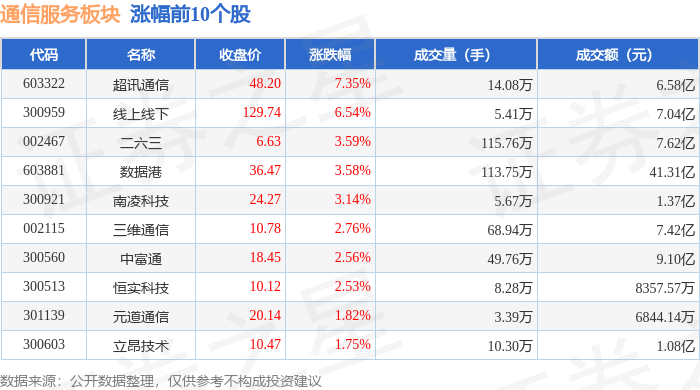
Zheng Xing Xing Ye Ri Bao· 2025-11-25 09:10
Core Insights - The communication services sector experienced a slight increase of 0.26% on November 25, with Chaoxun Communication leading the gains [1] - The Shanghai Composite Index closed at 3870.02, up 0.87%, while the Shenzhen Component Index closed at 12777.31, up 1.53% [1] Stock Performance - Chaoxun Communication (603322) closed at 48.20, with a rise of 7.35% and a trading volume of 140,800 shares, amounting to a transaction value of 658 million [1] - Online and Offline (300959) saw a closing price of 129.74, increasing by 6.54% with a trading volume of 54,100 shares, totaling 704 million [1] - Other notable performers included: - Erli San (002467) at 6.63, up 3.59% [1] - Dataport (603881) at 36.47, up 3.58% [1] - Nanling Technology (300921) at 24.27, up 3.14% [1] Fund Flow Analysis - The communication services sector saw a net outflow of 477 million from institutional investors, while retail investors contributed a net inflow of 454 million [2] - Notable stock fund flows included: - China Mobile (600941) with a net outflow of 46.68 million from institutional investors [3] - Erli San (002467) with a net inflow of 38.94 million from institutional investors [3] - Online and Offline (300959) with a net inflow of 31.11 million from institutional investors [3]

通信设备III行业周报:通信行业周观点:GPU/TPU高速共振增长,巨头合作加快算力扩张-20251125
Changjiang Securities· 2025-11-25 08:42
Investment Rating - The report maintains a "Positive" investment rating for the communication industry [10]. Core Insights - The communication sector experienced a decline of 2.80% in the 47th week of 2025, ranking 8th among major industries, but has risen 51.24% since the beginning of the year, ranking 2nd [2][4]. - Nvidia's FY26Q3 results exceeded expectations, with revenue reaching $57 billion, a year-on-year increase of 62% and a quarter-on-quarter increase of 22%. The data center business grew significantly, with revenue of $51.2 billion, up 66% year-on-year [5]. - Google's Gemini 3 showcases strong multimodal capabilities and is expected to enhance cost efficiency through self-developed TPU training [6]. - Global demand for computing power is accelerating, with major companies deepening ecosystem partnerships, validating industry prosperity and maintaining a positive outlook on AI and computing power [7]. Summary by Sections Market Performance - In the 47th week of 2025, the communication sector fell by 2.80%, ranking 8th among major industries, while year-to-date, it has increased by 51.24%, ranking 2nd [2][4]. Company Performance - Nvidia's FY26Q3 revenue was $57 billion, with a net profit of $31.9 billion, reflecting a year-on-year growth of 65% [5]. - Google’s Gemini 3 has over 650 million monthly active users, with a threefold increase in daily request volume compared to the previous quarter [6]. Investment Recommendations - The report recommends several companies across different segments: - Telecom operators: China Mobile, China Telecom, China Unicom - Optical modules: Zhongji Xuchuang, Xinyi Sheng, Tianfu Communication - Liquid cooling: Yingweike - AI applications: Bosijie, Heertai, Tuobang Co., Yiyuan Communication [8].


卫星物联网业务商用试验启动 填补通信空白,拓展低空经济应用场景
Ke Ji Ri Bao· 2025-11-25 05:46
Core Insights - The Ministry of Industry and Information Technology has officially launched a two-year commercial trial for satellite IoT services, aiming to enrich the satellite communication market, stimulate market vitality, enhance service capabilities, and establish a safety regulatory system [1] Group 1: Understanding Satellite IoT - Satellite IoT utilizes satellite communication technology to provide data collection and transmission services for a vast array of IoT devices across ground, ocean, and air [2] - It offers wide-area IoT connectivity for various terminals, including data collection terminals, wearable devices, handheld terminals, and transportation vehicles like cars, ships, and aircraft [2] - Satellite IoT addresses communication gaps in remote areas, sky, and ocean where traditional terrestrial networks cannot reach, providing global coverage [2] Group 2: Role in Emerging Industries - Satellite IoT can achieve global real-time tracking and data transmission for low-altitude aircraft, addressing communication shortcomings in the low-altitude economy [3] - In sectors like drone logistics, satellite IoT mitigates issues of signal interruption due to insufficient ground station coverage, enhancing flight safety and efficiency [3] - The technology is expected to attract more capital and resources into the low-altitude sector, promoting collaborative development across the drone manufacturing, airspace management, and data service industries, creating a virtuous cycle of "technology-scenario-industry" [3] Group 3: Future Development of "Internet of Everything" - China's satellite communication sector has accelerated, with recent policy initiatives aimed at optimizing business access and promoting industry development [4] - Major telecom companies, including China Telecom, China Mobile, and China Unicom, have obtained operational qualifications for satellite mobile communication, enabling services like direct satellite connections for emergency communications and remote area connectivity [4] - China Telecom has launched a trial for its "Tiantong + Beidou" domestic satellite-based high-precision positioning service, targeting areas with weak or no network coverage, enhancing support for scenarios like drone inspections and low-altitude navigation [4]


港股通红利ETF广发(520900)放量上涨,连续6周获得资金净申购
Xin Lang Ji Jin· 2025-11-25 04:20
Core Viewpoint - The article highlights the increasing attractiveness of dividend assets in the current volatile market, emphasizing the benefits of the Guangfa Hong Kong Stock Connect Dividend ETF (520900) as a tool for investors seeking stable returns [2][4]. Group 1: Market Environment - The A-share market experienced a significant rise, with the Guangfa Hong Kong Stock Connect Dividend ETF (520900) showing a 0.65% increase and a trading volume of 39.94 million yuan as of November 25 [1]. - From October 13 to November 21, the ETF saw continuous net subscriptions for six weeks, with its circulating scale increasing from 1.581 billion yuan to 1.852 billion yuan, representing a growth rate of 17.14% [1]. Group 2: Dividend Strategy - The current macroeconomic environment supports the effectiveness of dividend strategies, with the 10-year government bond yield dropping from 3.2% in 2021 to 1.75% as of November 3, 2025, marking a historical low for risk-free rates [2]. - The anticipated annual dividend amount for A-shares in 2024 is projected to reach a record high of 2.34 trillion yuan, driven by policies encouraging companies to enhance dividend payouts [2]. Group 3: Investment Opportunities - The Hong Kong market benefits from both domestic economic fundamentals and global capital flows, with an AH premium rate of 120.12, indicating significant value for dividend stocks [3]. - The year-end period is seen as an optimal time for reallocating to dividend strategies, as institutional investors often adjust their portfolios to secure annual returns [3]. Group 4: ETF Details - The Guangfa Hong Kong Stock Connect Dividend ETF (520900) was established on June 26, 2024, with an annual management fee of 0.50% and a custody fee of 0.10% [6]. - The ETF tracks the CSI National New Hong Kong Stock Connect Central Enterprise Dividend Index, focusing on high-dividend state-owned enterprises, with the top three sectors being oil and petrochemicals (29.7%), telecommunications (21.2%), and transportation (13.5%) [7].
商业航天迎重磅利好
2 1 Shi Ji Jing Ji Bao Dao· 2025-11-25 03:24
Core Insights - The establishment of the Commercial Aerospace Department by the National Defense Science and Technology Industry Administration is a significant move towards streamlining the regulatory framework in China's commercial aerospace sector [1][3][4] - This new department aims to address the fragmented regulatory landscape and improve the efficiency of approval processes for satellite launches and operations [3][4] Group 1: Regulatory Changes - The Commercial Aerospace Department will consolidate various regulatory functions that were previously scattered across multiple agencies, including the National Defense Science and Technology Industry Administration and the National Space Administration [3][4] - The new department is expected to enhance communication and coordination between commercial aerospace companies and regulatory bodies, moving from a "shared management" to a "dedicated management" approach [3][4] Group 2: Industry Development - China's commercial aerospace sector is transitioning from technology validation to large-scale deployment and application, with significant satellite constellations already in orbit [5] - The successful launch of satellites for the GW and Qianfan constellations marks a critical phase in the development of China's satellite internet infrastructure [5] - The demand for reduced launch costs and increased launch frequency is driving private rocket companies to focus on developing medium-sized, reusable launch vehicles [5] Group 3: Market Expansion - The approval and promotion of commercial satellite applications are accelerating, with major telecommunications companies entering the satellite communication market [6] - The introduction of satellite direct connection capabilities in consumer devices, such as smartphones and vehicles, is becoming a competitive advantage for manufacturers [6]
中原证券通信行业2026年度策略:智启新质 算力互联破浪前行
智通财经网· 2025-11-25 02:52
Core Viewpoint - The report from Zhongyuan Securities indicates that a series of AI industry catalytic events will occur in 2026, strengthening the leading position of top optical module manufacturers due to their technological, customer, and scale advantages. The current valuation of the communication industry index is below the ten-year average, and the industry maintains a "stronger than the market" investment rating based on performance growth expectations and valuation levels [1][2]. Summary by Sections Review of 2025 - In early 2025, the DeepSeek large model boosted market sentiment, and the three major operators completed the deployment of DeepSeek computing power private networks, enhancing their cloud service capabilities. Domestic cloud manufacturers provided positive capital expenditure guidance, leading to an increase in industry valuations. However, from February to April, the industry index experienced significant fluctuations due to concerns over U.S. tariff policies and future demand for optical modules. By mid-April, the easing of tariff policies and validation of AI computing power demand led to a gradual recovery in the industry index and valuations. In late July, North American cloud manufacturers raised their capital expenditure guidance, further catalyzing the industry. Since September, leading manufacturers faced short-term performance fatigue due to product iterations and customer structure adjustments, raising concerns about unclear downstream business models [2]. Outlook for 2026 - A series of AI industry catalytic events are expected, including the mass production of NVIDIA's next-generation Rubin GPU, the release of Google's new large model Gemini, and clear capital expenditure guidance from cloud manufacturers. AI smartphones equipped with large models are anticipated to become personalized smart assistants, potentially driving the next wave of smartphone upgrades. The development of key 6G technologies by telecom operators is expected to accelerate revenue growth from AI computing power. The report is optimistic about the high industry prosperity and strong growth potential of optical modules, optical devices, optical chips, and the increasing penetration of AI smartphones, as well as the stable operations of quality dividend assets in telecom operators [3][4]. Capital Expenditure Outlook for Leading Cloud Manufacturers - The demand for 800G is increasing, and the industry is transitioning from 800G to 1.6T technology. Leading optical module manufacturers are expected to further highlight their advantages due to technological leadership, stable customer relationships, and scalable delivery capabilities. The development of AI is driving the construction of large data centers, benefiting optical device manufacturers. The long R&D and expansion cycles for optical chips create high barriers in technology, talent, customer validation, and capital, leading to a persistent supply-demand gap for certain optical chips. The increasing demand for domestic controllable solutions is expected to translate into performance for domestic computing power. Recommended companies to watch include: NewEase, Huagong Technology, Guangxun Technology, Yuanjie Technology, Shijia Photon, and Taicheng Light [4]. AI Smartphones and Market Trends - Generative AI smartphones are set to provide users with new interactive experiences, multimodal content generation capabilities, personalized services, and innovative application ecosystems. The continuous improvement of edge AI computing power and large model capabilities is expected to further increase the market penetration of AI smartphones. Innovations and upgrades in AI smartphones are likely to lead to higher average selling prices and improved profit margins. The growth in edge AI shipments will drive sustained growth in core product lines of consumer electronics components [5]. Telecom Operators' Performance - The three major telecom operators are considered quality dividend assets with high dividend yield potential, offering cash dividends twice a year. The quality of traditional business revenue is improving, and a decrease in capital expenditure is expected to lower future depreciation and amortization costs, maintaining stable operations. Additionally, telecom operators are likely to leverage their advantages in data centers, big data, and network infrastructure to reconstruct business models with the help of AI. Investment recommendations include focusing on the optical module, optical device, and optical chip sectors, as well as AI smartphone and telecom operator sectors [6].



商业航天迎重磅利好
21世纪经济报道· 2025-11-25 02:42
Core Viewpoint - The establishment of the Commercial Space Administration by the National Defense Science and Technology Industry Bureau is a significant step towards streamlining the regulatory framework for China's commercial space industry, aiming to enhance efficiency and promote standardized, large-scale development [1][5]. Group 1: Regulatory Changes - The new Commercial Space Administration will consolidate various regulatory functions that were previously scattered across multiple departments, including the National Defense Science and Technology Industry Bureau, the National Space Administration, and the Ministry of Industry and Information Technology [3][5]. - The fragmented regulatory landscape has led to cumbersome approval processes and inconsistent standards, which have become increasingly problematic as the number of commercial space enterprises and launch frequencies have grown [3][4]. Group 2: Industry Impact - The creation of a dedicated administration for commercial space is expected to clarify the supervisory structure, transitioning from a shared management model to a specialized one, which will facilitate smoother communication and coordination for companies in the sector [4][5]. - The establishment of the Commercial Space Administration is anticipated to enhance the efficiency of critical processes such as launch approvals and satellite operation licensing, thereby fostering a healthier and more orderly development of the industry [5]. Group 3: Technological Advancements - China is at a pivotal moment in its commercial space sector, transitioning from technology validation to large-scale deployment and application, with significant satellite constellations already in orbit [7]. - The demand for reduced launch costs and increased launch frequency is driving private rocket companies to focus on developing medium-sized, reusable launch vehicles, which are expected to play a crucial role in the upcoming key period for commercial rocket technology breakthroughs [7]. Group 4: Market Expansion - The promotion and entry of commercial space applications into consumer markets are accelerating, with major telecommunications operators like China Unicom, China Mobile, and China Telecom now competing in the satellite communication business [8]. - The emergence of satellite-direct mobile phones and their integration into automotive features is becoming a selling point for car manufacturers, indicating a growing consumer interest in satellite connectivity [8].
平安证券(香港)港股晨报-20251125
Ping An Securities Hongkong· 2025-11-25 02:24
Market Overview - The Hong Kong stock market experienced fluctuations, with the Hang Seng Index closing at 23,831 points, down 145 points or 0.61% [1] - The market turnover decreased to 82.799 billion HKD, with net inflows of 484 million HKD recorded in the Hong Kong Stock Connect [1] - The US stock market saw all three major indices rise, with the Dow Jones up 0.44% to 46,448.27 points, the S&P 500 up 1.55% to 6,705.12 points, and the Nasdaq up 2.69% to 22,872.01 points [2] Investment Opportunities - The report emphasizes the importance of selecting undervalued sectors and companies in the current market environment, particularly in technology and state-owned enterprises [3] - Key sectors to focus on include artificial intelligence, semiconductors, industrial software, and upstream non-ferrous metals benefiting from anticipated interest rate cuts by the Federal Reserve [3] - The report highlights the potential for long-term growth in leading companies within the technology sector, as evidenced by significant stock price increases for Alibaba and other tech giants [3] Company Highlights - Kuaishou-W saw a substantial increase of 7.11%, attributed to accelerated commercialization of its AI capabilities and strong e-commerce performance in Q3 [1] - NetEase-S also performed well, rising by 5.87% [1] - China Unicom is noted for its robust performance in digital services, with a projected revenue of 45.4 billion CNY for its smart network business in H1 2025, reflecting a year-on-year growth of 4.3% [9] Sector Insights - The "5G + Industrial Internet" initiative is gaining traction, with over 1,200 5G factories established and investments exceeding 50 billion CNY, leading to improvements in product quality and operational efficiency [8] - The software and information technology services sector is performing well, with expectations for further expansion driven by advancements in 5G and upcoming 6G technologies [8]
为期两年,正式启动!填补通信空白
Ke Ji Ri Bao· 2025-11-25 01:39
Core Viewpoint - The Ministry of Industry and Information Technology of China has officially launched a two-year commercial trial for satellite IoT services, aiming to enrich the satellite communication market, stimulate market vitality, enhance service capabilities, and establish a regulatory framework to support the healthy development of emerging industries such as commercial aerospace and low-altitude economy [1]. Group 1: Understanding Satellite IoT - Satellite IoT utilizes satellite communication technology to provide data collection and transmission services for a vast array of IoT devices across land, sea, and air, covering applications in marine fisheries, transportation logistics, energy and water resources, emergency communications, low-altitude economy, and industrial internet [2][4]. - Unlike traditional IoT, which relies on terrestrial networks, satellite IoT offers full coverage, addressing communication gaps in remote areas, skies, and oceans [4]. Group 2: Role in Emerging Industries - Satellite IoT can achieve global real-time tracking and data transmission for low-altitude aircraft, effectively addressing communication shortcomings in low-altitude economies, such as in drone logistics where ground station coverage is insufficient [5]. - The technology can expand application scenarios in the low-altitude economy, such as supporting cross-regional operations of agricultural drones and maintaining communication for emergency rescue drones in disaster areas when ground networks are unavailable, thereby attracting more capital and resources into the low-altitude sector [6]. Group 3: Future Development of "Internet of Everything" - China's satellite communication sector is accelerating, with recent policy initiatives aimed at optimizing business access and promoting industry development, including the release of guidelines and a draft for public consultation on satellite IoT commercial trials [7]. - Major telecommunications companies in China, including China Telecom, China Mobile, and China Unicom, have obtained operational qualifications for satellite mobile communication, enabling them to conduct satellite direct connection services and enhance applications in emergency communications, maritime communications, and remote area connectivity [7].

2025中国5G+工业互联网大会武汉召开 5G应用已融入86个国民经济大类
Chang Jiang Shang Bao· 2025-11-25 00:12
Core Insights - The 2025 China 5G+ Industrial Internet Conference held in Wuhan focused on the integration of 5G technology with industrial internet, exploring new paths for industrial transformation under the backdrop of "Artificial Intelligence+" [1][2] - The conference showcased a "2+4+5+N" series of results, highlighting significant advancements in the 5G+ industrial internet sector [4] Group 1: 5G Application and Impact - 5G applications have been integrated into 86 out of 97 categories of the national economy, with over 138,000 cases reported [2][3] - There are 64,000 deployed 5G industry virtual private networks and 12,600 advanced 5G factories established across the country [2][3] - The implementation of 5G technology is enhancing efficiency in various sectors, such as a 90% reduction in production line adjustment time in automotive manufacturing and a 12% increase in production capacity in electrical manufacturing [2][3] Group 2: Innovations and Collaborations - The conference featured two major announcements, including the launch of satellite IoT business trials and the establishment of a low-altitude intelligent network security platform [4][5] - Four major innovative outcomes were presented, including the launch of a domestic satellite-based high-precision positioning service and the signing of a cooperation memorandum among Jiangxi, Hubei, and Hunan provinces to develop an industrial internet ecosystem [5] - Five exemplary benchmarks were highlighted, showcasing leading applications and cases in the 5G+ industrial internet space [5] Group 3: Industry Standards and Reports - China is leading the development of the world's first industrial 5G international standards, with over 100 national and industry standards established [3] - The conference also included the release of several professional reports, such as the "Industrial Data Security Collaborative Protection Initiative" and the "White Paper on the Integration of Information Communication and Embodied Intelligence" [6]