徐工机械

Search documents
机械行业进击10万亿!聚焦三大方向!
Zheng Quan Shi Bao· 2025-10-23 04:32
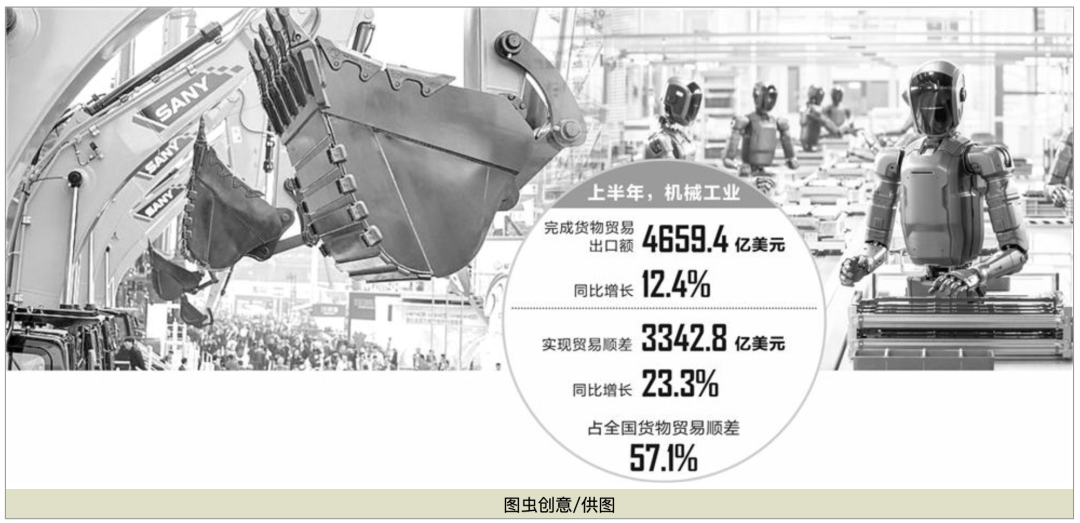
Core Viewpoint - The mechanical industry is positioned as a cornerstone of industrial economy, aiming for an annual revenue growth rate of approximately 3.5% and a revenue target of over 10 trillion yuan, as outlined in the "Mechanical Industry Steady Growth Work Plan" [1] Group 1: Industry Growth Strategies - The plan emphasizes the need to stimulate growth through three main strategies: tapping into existing domestic demand, nurturing new demand, and enhancing international competitiveness [1] - The mechanical industry relies heavily on infrastructure construction and equipment investment, with 70% of demand stemming from these areas, making the replacement of outdated equipment a key focus [3][4] Group 2: Equipment Upgrades and Innovations - The transition towards green, intelligent, and service-oriented equipment is accelerating, creating a market space worth trillions [3] - Companies like Shengtun Mining are investing significantly in equipment upgrades, such as heat recovery systems, which have led to substantial CO2 emissions reductions [3] - The industry is experiencing a concentrated period of equipment updates, particularly in the engineering machinery sector, driven by the aging of equipment from previous sales peaks [4] Group 3: International Competitiveness - The mechanical industry is showcasing enhanced international competitiveness, as evidenced by increased foreign participation in trade exhibitions, with foreign visitor numbers doubling compared to two years ago [5] - In the first half of the year, the mechanical industry achieved a goods trade export value of $465.94 billion, marking a 12.4% year-on-year increase, and a trade surplus of $334.28 billion, up 23.3% [6] Group 4: Strategic Goals and New Market Opportunities - Companies like LiuGong and XCMG are setting ambitious revenue targets for 2030, with international revenue expected to exceed 60% [7] - The plan includes initiatives for smart equipment innovation, focusing on industrial mother machines, smart agricultural machinery, and high-end robots [8] - The integration of AI technologies in new products is driving efficiency and sustainability, with companies reporting significant reductions in material usage and carbon emissions [9]

批量公交车再出口非洲!搭载谁家发动机?
第一商用车网· 2025-10-23 02:39
Group 1 - The core viewpoint of the article highlights Yuchai's successful deployment of natural gas engines in Nigeria's public transportation system, marking a significant achievement in its ongoing efforts in the African market [1][3]. - Yuchai's natural gas engines are characterized by an efficient and stable gas system, durable components, and multiple advantages including power, economy, and environmental friendliness, ensuring stable operation in extreme conditions [3]. - The Nigerian government is actively developing its natural gas resources and requires public transportation tools that meet large-scale operational needs while adhering to clean energy policies, which Yuchai's engines can fulfill [3]. Group 2 - Yuchai has over 130,000 engines in Africa, with a presence in countries such as Algeria, Ghana, Congo (Kinshasa), Angola, Mozambique, and Nigeria, indicating a strong market footprint [3]. - The company plans to further optimize engine power parameters and upgrade intelligent control systems to provide more solutions tailored to Africa's diverse and complex environments [4]. - Yuchai aims to assist local markets in integrating into the global "dual carbon" goals, reflecting its commitment to sustainable development [4].


机械行业进击10万亿 “三驾马车”打造内生动力
Zheng Quan Shi Bao· 2025-10-22 17:25
Core Insights - The mechanical industry is positioned as a cornerstone of industrial economy, aiming for an average annual revenue growth rate of approximately 3.5% and a revenue target exceeding 10 trillion yuan [1] - The industry seeks to stimulate growth through three main strategies: tapping into existing domestic demand, fostering new demand, and enhancing international competitiveness [1] Group 1: Industry Growth Strategies - The mechanical industry derives 70% of its demand from infrastructure construction and equipment investment in various sectors, with the renewal of old equipment being a key driver for market growth [2] - The push for equipment updates is moving towards greener, smarter, and service-oriented solutions, creating a market space worth trillions [2] - The industry is experiencing a concentrated renewal period for equipment sold during the last sales peak (2016-2021), with strong demand for updates due to factors like the transition to National IV standards [3] Group 2: International Competitiveness - The recent China International Fire Equipment Technology Exchange Exhibition showcased a significant increase in foreign participation, indicating a growing interest in Chinese products and technologies [4] - In the first half of the year, the mechanical industry achieved a trade export value of $465.94 billion, a year-on-year increase of 12.4%, with a trade surplus of $334.28 billion, reflecting resilience in international trade [5] Group 3: New Market Opportunities - The implementation of intelligent equipment innovation development projects is aimed at addressing national strategic needs and enhancing market demand [7] - Companies like UBTECH are making strides in humanoid robotics, securing significant contracts and preparing for large-scale production and application [7] - The integration of AI technologies in products is enhancing operational efficiency and reducing carbon emissions, with companies like Southern Road Machinery leading in AI-driven automation [8]
10月22日深证国企股东回报(970064)指数跌0.02%,成份股江铃汽车(000550)领跌
Sou Hu Cai Jing· 2025-10-22 10:19
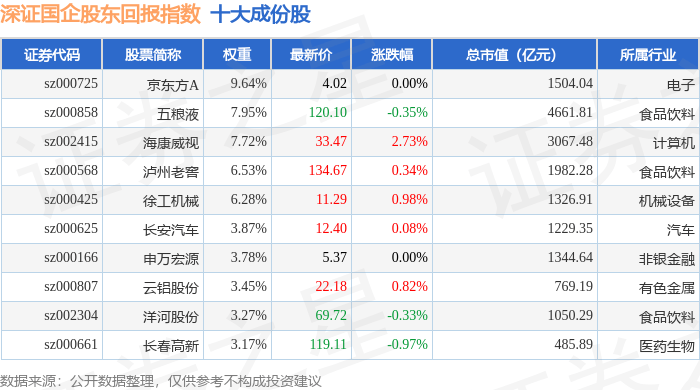
Core Points - The Shenzhen State-Owned Enterprises Shareholder Return Index (970064) closed at 1681.5 points, down 0.02%, with a trading volume of 29.062 billion yuan and a turnover rate of 1.04% [1] - Among the index constituents, 16 stocks rose while 30 stocks fell, with China Steel International leading the gainers at 4.27% and Jiangling Motors leading the decliners at 5.74% [1] Index Constituents Summary - The top ten constituents of the Shenzhen State-Owned Enterprises Shareholder Return Index include: - BOE Technology Group (sz000725) with a weight of 9.64%, latest price at 4.02, and a total market value of 150.404 billion yuan [1] - Wuliangye Yibin (sz000858) with a weight of 7.95%, latest price at 120.10, and a total market value of 466.181 billion yuan [1] - Hikvision (sz002415) with a weight of 7.72%, latest price at 33.47, and a total market value of 306.748 billion yuan [1] - Luzhou Laojiao (sz000568) with a weight of 6.53%, latest price at 134.67, and a total market value of 198.228 billion yuan [1] - XCMG Machinery (sz000425) with a weight of 6.28%, latest price at 11.29, and a total market value of 132.691 billion yuan [1] - Changan Automobile (sz000625) with a weight of 3.87%, latest price at 12.40, and a total market value of 122.935 billion yuan [1] - Shenwan Hongyuan (sz000166) with a weight of 3.78%, latest price at 5.37, and a total market value of 134.464 billion yuan [1] - Yunnan Aluminum (sz000807) with a weight of 3.45%, latest price at 22.18, and a total market value of 76.919 billion yuan [1] - Yanghe Brewery (sz002304) with a weight of 3.27%, latest price at 69.72, and a total market value of 105.029 billion yuan [1] - Changchun High & New Technology (sz000661) with a weight of 3.17%, latest price at 119.11, and a total market value of 48.589 billion yuan [1] Capital Flow Summary - The net outflow of main funds from the index constituents totaled 451 million yuan, while retail funds saw a net outflow of 61.161 million yuan [3] - Notable capital flows include: - Hikvision (002415) with a main fund net inflow of 374 million yuan and a retail net outflow of 29.5 million yuan [3] - Zhongcai Technology (002080) with a main fund net inflow of 141 million yuan and a retail net outflow of 18.8 million yuan [3] - Yunnan Aluminum (000807) with a main fund net inflow of 137 million yuan and a retail net outflow of 12.1 million yuan [3] - Jiangling Motors (000550) with a main fund net inflow of 30.4 million yuan and a retail net outflow of 74.7 million yuan [3]
体系出海,时代的Alpha
Shenwan Hongyuan Securities· 2025-10-22 10:13
Group 1: Key Insights on China's Global Expansion - The core assumption risks include uncertainties in overseas policies and compliance, market perception biases leading to operational risks, exchange rate fluctuations causing currency losses, and supply chain risks in overseas operations[3] - The shift in overseas demand for Chinese manufacturing has moved from cost and capacity advantages to a focus on technology with higher added value, allowing companies to leverage core technological advantages to expand internationally[4] - China's manufacturing value added is projected to increase from 8.6% of the global total in 2004 to 31.6% by 2024, indicating a significant enhancement in global industrial value chain construction capabilities[16] Group 2: Strategic Importance of Going Global - The "going out" strategy is crucial for utilizing technological comparative advantages to expand into global markets and build a community with a shared future for mankind[5] - China's foreign direct investment (FDI) has rapidly increased, with significant growth in investment flows and stock since 2006, reflecting a transition from "bringing in" to "going out"[8] - The Belt and Road Initiative (BRI) has become a national strategy since 2013, facilitating infrastructure connectivity and economic cooperation with participating countries[41] Group 3: Risks and Challenges - Uncertainties in overseas policies, such as geopolitical risks and trade protectionism, may hinder the pace of companies' international expansion[93] - Market perception differences can lead to operational risks if companies misjudge target markets, potentially resulting in economic losses[93] - Exchange rate volatility poses risks of currency losses, impacting corporate profitability during overseas operations[93]
巴西总统卢拉表示愿与中企携手推动可持续发展
人民网-国际频道 原创稿· 2025-10-22 09:00
当地时间10月20日,巴西总统卢拉在总统府会见来访的徐工集团董事长杨东升一行。徐工集团供图 杨东升介绍了徐工在巴西市场从贸易出口、绿地建厂到"智改数转网联"的发展历程,表示徐工将持续坚持高端化、智能化、绿色化、全球化、服务化的 发展方向,积极推进产业数字化升级,践行绿色制造理念,履行企业社会责任,加强本土青年人才培养,深化本地化运营,以巴西为中心辐射南美主要国 家,打造长期可持续发展的新格局。 巴西副总统兼发展、工业、贸易和服务部长阿尔克明,总统府首席部长鲁伊·科斯塔出席会见。 人民网里约热内卢10月20日电 (记者陈一鸣)巴西利亚消息:当地时间10月20日,巴西总统卢拉在总统府会见到访的徐工集团董事长杨东升一行时表 示,巴西欢迎包括徐工在内的中国企业积极参与当地基础设施建设、数字经济发展和绿色转型进程,愿与中国企业携手推动可持续发展,实现互利共赢。 卢拉对徐工集团在巴西深耕十余年取得的成果表示祝贺,高度评价企业在推动产业升级、节能减排和数字化转型方面作出的努力,并肯定徐工巴西银行 的稳健运营。他表示,期待徐工在巴西设立研究院,进一步扩大投资规模,为两国经贸往来与人文交流树立成功典范。 ...


从“核控”到“脱核” 江苏供应链金融一线观察
Jin Rong Shi Bao· 2025-10-22 04:35
Core Insights - Jiangsu province contributes nearly 10% of China's GDP, with a projected GDP of over 13.7 trillion yuan in 2024, driven by robust industrial clusters and efficient supply chain networks [1] - The traditional supply chain finance model, heavily reliant on core enterprise credit, is facing challenges and is undergoing a transformation towards a data-driven credit system [5][6] Supply Chain Challenges - Many small and medium-sized enterprises (SMEs) in Jiangsu's manufacturing sector struggle with financing due to reliance on traditional collateral methods, which do not suit their operational models [2][3] - The "nuclear control" model, which depends on core enterprises for credit, creates significant credit risks and fails to support the financing needs of smaller enterprises [3][4] Innovative Solutions - The emergence of the "de-nuclearization" model aims to reduce reliance on core enterprise credit by utilizing data credit systems, allowing for a more inclusive financing approach [5][6] - Companies like Qingtian Technology have successfully implemented innovative financing solutions, such as "Quick Payment," which leverages transaction data to facilitate quicker access to loans for SMEs [6][7] Collaborative Financing Models - XuGong Group has developed its own supply chain finance platform, XuGong Rongpiao, to integrate suppliers and financial resources, although it initially faced challenges with traditional financing models [4][8] - New risk-sharing mechanisms have been introduced, allowing for a more collaborative approach between core enterprises and financial institutions, enhancing credit access for SMEs [8][9] Policy and Technological Support - The Chinese government is promoting the "de-nuclearization" model through policies that encourage the use of data credit and support financing for SMEs [11][12] - Jiangsu province is actively exploring digital financial services to innovate supply chain financing, aiming to create a comprehensive credit evaluation system [11][12] Future Directions - The shift towards a decentralized credit system based on real transaction data is expected to enhance the resilience of supply chains and foster closer cooperation among industry players [12][13] - Financial institutions are encouraged to adopt multi-dimensional analyses of supply chain clients to support the development of data credit systems, which will be crucial for the future of supply chain finance [12][13]

流动性打分周报:短久期中低评级产业债流动性上升-20251022
China Post Securities· 2025-10-22 03:31
1. Report Industry Investment Rating No relevant content provided. 2. Core Viewpoints of the Report - This weekly report tracks the liquidity scores of individual bonds in different bond sectors based on the liquidity scores of QB's bond assets. In the urban investment bond sector, the number of high - grade liquid bond items in Jiangsu, Sichuan, and Chongqing has increased, and the overall situation in Shandong and Tianjin has remained stable. In terms of maturity, the number of high - grade liquid bond items with maturities of less than 1 year, 1 - 2 years, and 3 - 5 years has increased, while that of 2 - 3 years has decreased, and the situation for those over 5 years has remained stable. In terms of implied ratings, the number of high - grade liquid bond items with ratings of AAA, AA, AA(2), and AA - has increased, while that of AA+ has decreased. [2] - In the industrial bond sector, the number of high - grade liquid bond items in the real estate and steel industries has increased, while that in the public utilities, transportation, and coal industries has remained stable. In terms of maturity, the number of high - grade liquid bond items with maturities of less than 1 year and 1 - 2 years has increased, that of 3 - 5 years has decreased, and the situation for 2 - 3 years and over 5 years has remained stable. In terms of ChinaBond implied ratings, the number of high - grade liquid bond items with ratings of AAA+, AAA-, AA+, and AA has increased, with a relatively large increase in medium - and low - rated items such as AA+ and AA, while the number of those with a rating of AAA has decreased. [3] 3. Summaries According to Relevant Catalogs 3.1 Urban Investment Bonds: Increased Liquidity of Medium - and Short - Maturity High - Grade Bond Items - **Distribution of Bond Items**: The number of high - grade liquid urban investment bonds with medium - and short - maturities has increased. Regionally, the number in Jiangsu, Sichuan, and Chongqing has increased, while that in Shandong and Tianjin has remained stable. In terms of maturity, the number of high - grade liquid bond items with maturities of less than 1 year, 1 - 2 years, and 3 - 5 years has increased, that of 2 - 3 years has decreased, and the situation for those over 5 years has remained stable. In terms of implied ratings, the number of high - grade liquid bond items with ratings of AAA, AA, AA(2), and AA - has increased, while that of AA+ has decreased. [9] - **Yield Situation**: Regionally, the yields of high - grade liquid bond items in Jiangsu, Shandong, Sichuan, and Chongqing have mainly decreased, while that in Tianjin has mainly increased, with the fluctuation range concentrated between 1 - 7bp. In terms of maturity, the yields of high - grade liquid bond items in all maturities have mainly decreased, with the decline range concentrated between 1 - 5bp. In terms of implied ratings, the yields of high - grade liquid bond items with a rating of AAA have mainly increased, while those of AA+, AA, AA(2), and AA - have mainly decreased, with the decline range concentrated between 2 - 5bp. [10][11] - **Top 20 in Liquidity Score Increase**: The main body levels are mainly AA and AA+. The regions are concentrated in Jiangsu, Zhejiang, and Anhui. The top 20 main bodies are mainly involved in industries such as building decoration and comprehensive industries. [12] - **Top 20 in Liquidity Score Decrease**: The main body levels are mainly AA and AA+. The regional distribution is mainly in Zhejiang, Jiangsu, Shandong, etc. The top 20 main bodies are mainly in comprehensive, real estate, and building decoration industries. [12] 3.2 Industrial Bonds: Increased Liquidity of Short - Maturity Medium - and Low - Rated Bond Items - **Distribution of Bond Items**: The number of high - grade liquid industrial bonds with short - maturities and medium - and low - ratings has generally remained stable. By the issuer's industry, the number of high - grade liquid bond items in the real estate and steel industries has increased, while that in the public utilities, transportation, and coal industries has remained stable. In terms of maturity, the number of high - grade liquid bond items with maturities of less than 1 year and 1 - 2 years has increased, that of 3 - 5 years has decreased, and the situation for 2 - 3 years and over 5 years has remained stable. In terms of ChinaBond implied ratings, the number of high - grade liquid bond items with ratings of AAA+, AAA-, AA+, and AA has increased, with a relatively large increase in medium - and low - rated items such as AA+ and AA, while the number of those with a rating of AAA has decreased. [17] - **Yield Situation**: By industry, the yields of high - grade liquid bond items in the real estate, coal, and steel industries have mainly decreased, while those in the public utilities and transportation industries have mainly increased, with the fluctuation range concentrated between 0.5 - 6bp. In terms of maturity, the yields of high - grade liquid bond items with maturities of less than 1 year, 1 - 2 years, 2 - 3 years, and over 5 years have mainly decreased; the yields of B - grade liquid bond items with maturities of 3 - 5 years have mainly increased, with a very small increase; the yields of A - grade bond items have mainly decreased, with a decline of about 2bp. In terms of implied ratings, the yields of high - grade liquid bond items with a rating of AAA+ have mainly increased, with an increase range of 2 - 11bp; the yields of other implied - rated high - grade liquid bond items have mainly decreased, with the decline range concentrated between 1 - 3bp. [19] - **Top 20 in Liquidity Score Increase**: The industries of the top 20 main bodies in liquidity score increase are mainly building decoration, commercial retail, and transportation. The main body levels are mainly AAA and AA+. The industries of the top 20 bonds are mainly transportation, building decoration, commercial retail, and real estate. [21] - **Top 20 in Liquidity Score Decrease**: The top 20 main bodies in liquidity score decrease are mainly in building decoration, transportation, and public utilities. The main body levels are mainly AAA and AA+. The industries of the top 20 bonds are mainly transportation, public utilities, and real estate. [21]
工程机械行业强劲复苏 9月出口额增近30%
Zheng Quan Shi Bao· 2025-10-21 17:31
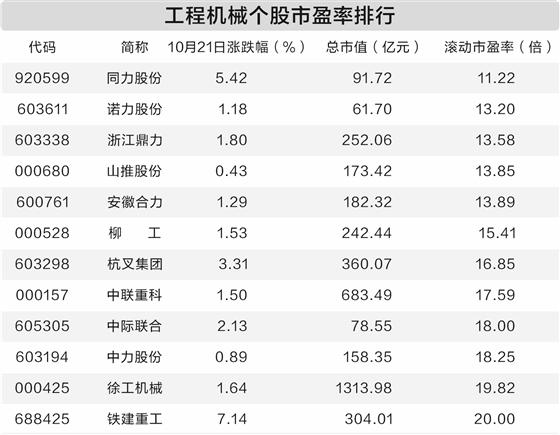
Core Viewpoint - The Chinese construction machinery industry is experiencing a strong recovery, driven by both domestic and international market demands, with significant growth in import and export trade figures [2][3]. Group 1: Industry Performance - In September 2025, China's construction machinery import and export trade reached $5.505 billion, a year-on-year increase of 29.1%, with exports accounting for $5.271 billion, up 29.6% [2]. - For the first three quarters of the year, the cumulative trade amount was $45.873 billion, reflecting a 12.8% year-on-year growth, with exports at $43.855 billion, up 13.3% [2]. - Excavator sales in September reached 19,858 units, a 25.4% increase year-on-year, with domestic sales at 9,249 units (up 21.5%) and exports at 10,609 units (up 29%) [2]. Group 2: Market Drivers - The recovery in the construction machinery sector is attributed to the synchronization of domestic and international market demands, with equipment renewal cycles and large project initiations driving domestic demand [3]. - The "Belt and Road" initiative continues to boost infrastructure construction needs in partner countries, enhancing China's machinery exports [3]. - The demand for small excavators is growing due to urbanization and industrialization in "Belt and Road" countries, alongside domestic needs driven by agriculture and municipal projects [3]. Group 3: Stock Market Performance - On October 21, the A-share construction machinery sector saw a 2% increase in the industry index, with a net inflow of 1.394 billion yuan into the sector [3]. - Notable stock performances included Xugong Machinery and Tieshan Heavy Industry, with the latter rising by 7.14% [3]. Group 4: Company Valuations - Among 35 listed companies in the construction machinery sector, the median rolling price-to-earnings (P/E) ratio is 41.2 times, with 12 companies having P/E ratios below 20 times [4]. - Tongli Co. has the lowest rolling P/E ratio at 11.22 times, focusing on non-road dump trucks and mining vehicles [5]. Group 5: International Business Growth - In the first half of the year, 24 listed companies reported overseas business revenues totaling 84.685 billion yuan, a year-on-year increase of over 10% [5]. - Companies like Tuoshan Heavy Industry and Weibow Hydraulic reported significant growth in overseas revenues, with increases of 54.61% and 53.23%, respectively [5].


工程机械行业点评报告:卡特收购矿业软件公司RPMGlobal,重视矿山机械投资机会
ZHESHANG SECURITIES· 2025-10-21 13:47
Investment Rating - The industry investment rating is "Positive" [7] Core Views - Caterpillar announced the acquisition of Australian software company RPMGlobal to enhance its mining software portfolio, with the deal expected to close in Q1 2026. RPM shareholders will receive A$5 per share, valuing the equity at A$1.12 billion (approximately US$730 million) [2] - The mining machinery market is projected to reach US$125.91 billion in 2024 and US$207.37 billion by 2033, with a CAGR of 5.7% from 2023 to 2033. The market is supported by rising prices of gold, silver, and copper, which have increased by 62%, 76%, and 22% respectively since the beginning of 2025 [3] - The Chinese construction machinery industry is experiencing a recovery, with excavator sales in September 2025 reaching 19,858 units, a 25% year-on-year increase. Domestic sales were 9,249 units, up 22%, while exports rose by 29% to 10,609 units [4] Summary by Sections Acquisition and Market Dynamics - Caterpillar's acquisition of RPMGlobal aims to strengthen its position in the mining software sector, with the transaction expected to complete in early 2026 [2] - The mining machinery market is currently valued at US$119.12 billion in 2023, with significant growth anticipated due to rising metal prices and increased capital expenditure from mining companies [3] Sales Performance and Recovery - The excavator sales data indicates a robust recovery in the construction machinery sector, with significant growth in both domestic and export markets. The overall sales for the first nine months of 2025 reached 174,039 units, marking an 18% increase year-on-year [4][5] - The recovery is driven by improved domestic demand from infrastructure projects and a global push for market share expansion [4] Company Listings and Incentives - Major construction machinery manufacturers are planning to list on the Hong Kong stock exchange, which is expected to enhance their international brand presence and provide efficient financing channels [6] - XCMG has announced a stock incentive plan for 2025, aiming to grant rights to up to 4.7 million shares, representing approximately 4% of the company's total equity [6]