碧桂园

Search documents
出险房企提速化债:融创、碧桂园等8家披露进展,近2万亿债务安全推进
Bei Jing Shang Bao· 2025-11-09 05:53
Core Insights - The debt risk resolution for distressed real estate companies has entered a comprehensive advancement phase, with significant debt restructuring efforts from major firms like Sunac China and Country Garden [1][4][9] - A total of 21 distressed real estate companies have completed or received approval for debt restructuring, amounting to a total debt relief of approximately 1.2 trillion yuan, which has helped nearly 2 trillion yuan of interest-bearing liabilities enter a safe period [1][5][6] Group 1: Debt Restructuring Progress - Sunac China announced the completion of its $9.55 billion offshore debt restructuring, marking a significant milestone in the debt relief process [4] - Country Garden's offshore debt restructuring plan, amounting to 127 billion yuan, was approved, utilizing a combination of cash buybacks, equity tools, new debt swaps, and physical interest payments [4][5] - The restructuring efforts have significantly reduced interest-bearing liabilities, with Country Garden's new debt financing costs dropping to 1%-2.5% and extending the debt maturity to 11.5 years [4][5] Group 2: Industry Impact and Future Outlook - The debt restructuring wave has alleviated short-term repayment pressures for these companies, allowing them to focus on maintaining project delivery and restoring market confidence [1][6][9] - The industry is witnessing a shift towards light asset models, with companies like CIFI Holdings and Kaisa Group planning to transition to low-debt, high-quality development models [7][8] - Experts believe that while debt restructuring provides temporary liquidity relief, the long-term solution lies in enhancing the companies' operational capabilities and transitioning to asset management and light asset operations [8][9]


企业月报 | 单月销售维持低位,投融资均环比下降(2025年10月)
克而瑞地产研究· 2025-11-09 01:06
Core Insights - In October 2025, the top 100 real estate companies achieved a sales turnover of 253 billion yuan, a month-on-month increase of 0.1% but a year-on-year decrease of 41.9%. Cumulatively, the sales turnover from January to October 2025 reached 25,766.6 billion yuan, reflecting a year-on-year decline of 16%, with the decline rate widening by 4.2 percentage points compared to the first nine months of the year [2][3]. Group 1: Contract Sales - The top 100 real estate companies achieved a sales turnover of 253 billion yuan in October [3]. - The sales threshold for each tier of companies has further decreased compared to the same period last year, with the top 10 companies' sales threshold dropping by 9.4% to 67.89 billion yuan [6]. Group 2: Land Acquisition - In October, the investment amount for land acquisition decreased by nearly 30% compared to the average monthly amount in the first three quarters, with over half of the companies not acquiring any land [10][12]. - The average land price in October fell to 19,809 yuan per square meter, a significant decrease of 54% month-on-month [12]. Group 3: Financing - In October 2025, the total financing amount for 65 typical real estate companies was 34.907 billion yuan, a month-on-month decrease of 9.6% but a year-on-year increase of 4.8% [17]. - The financing cost for newly issued bonds by 65 typical real estate companies averaged 2.92%, a slight decrease from the previous year [19][21]. Group 4: Organizational Dynamics - In October 2025, there was a significant turnover in key positions within the real estate industry, including changes in leadership at major companies such as Vanke and Kincor [23][24]. - Vanke's chairman position changed hands from Xin Jie to Huang Liping, reflecting a strategic continuity amid risk management [24]. - Kincor completed a board restructuring, forming a new management team aimed at stabilizing operations and facilitating strategic transformation [25].





第八届进博会参展企业再创新高,央行连续12个月增持黄金丨一周热点回顾
Di Yi Cai Jing· 2025-11-08 02:50
Group 1: Trade and Export - In the first ten months of the year, China's total goods trade value increased by 3.6% year-on-year, with a slight decrease of 0.4 percentage points compared to the previous nine months [1] - In October, exports decreased by 0.8% in RMB terms and 1.1% in USD terms, marking the first negative growth since February this year, slightly below market expectations [1] - Exports to the US saw a significant decline of 25.2%, which pulled down the overall export growth by 3.8 percentage points [1] - Despite the decline, new export drivers such as "new three samples" products and green products like railway electric locomotives and wind power generators maintained double-digit growth [1] Group 2: Monetary Policy and Debt Management - The People's Bank of China resumed government bond trading in October, injecting 20 billion yuan into the banking system, marking the end of a suspension since January [2][3] - The scale of bond purchases in October was relatively low compared to previous months, indicating a cautious approach by the central bank to avoid rapid declines in interest rates [3] - The establishment of a Debt Management Department by the Ministry of Finance aims to enhance the management and monitoring of government debt, aligning with high-quality development goals [6] Group 3: Economic Events and Trends - The eighth China International Import Expo (CIIE) opened with over 4,000 participating companies, including 290 Fortune 500 firms, showcasing a strong international interest in the Chinese market [4][5] - China's central bank has increased its gold reserves for 12 consecutive months, reaching approximately 2,304.457 tons, reflecting a strategic move to diversify foreign reserves amid global uncertainties [8][9] - The ongoing US government shutdown has reached a record 36 days, with potential economic losses estimated at $11 billion if it continues, impacting key economic data releases [10][11]
行业透视 | 龙头房企债务重组破局,融创碧桂园连传捷报
克而瑞地产研究· 2025-11-08 01:09
Core Viewpoint - The successful debt restructuring of major real estate companies like Sunac China and Country Garden enhances industry confidence and provides a reference for other companies facing debt challenges [2][4][13]. Group 1: Debt Restructuring Developments - On November 5, Sunac China's $9.6 billion offshore debt restructuring plan was approved by the Hong Kong High Court, marking a significant milestone as it becomes the first major real estate company to complete both domestic and offshore debt restructuring [2][4]. - Country Garden's debt restructuring meetings on November 5 received overwhelming support, with 83.71% of the total debt amount of $4.101 billion voting in favor in the first meeting, and 96.03% support from 2,382 creditors in the second meeting, indicating a strong likelihood of successful restructuring [2][4]. - Since the beginning of 2025, the pace of debt restructuring and bankruptcy reorganization among real estate companies has accelerated, with 42 companies disclosing restructuring plans and 17 completing all or part of their debt restructuring [5][10]. Group 2: Changes in Debt Restructuring Models - The debt restructuring model for real estate companies has fundamentally shifted from merely extending repayment periods to substantial debt reduction, with many companies aiming for a debt reduction ratio of around 70% [9][10]. - The successful restructuring of leading companies like Sunac and Country Garden serves as a demonstration effect, encouraging other companies to pursue their own debt restructuring plans [10][13]. Group 3: Specific Debt Restructuring Cases - Sunac China has achieved a 100% debt-to-equity conversion for its $9.6 billion offshore debt, effectively clearing its offshore debt [11]. - Country Garden aims to reduce its offshore debt by up to $11.6 billion, with a debt reduction ratio of 65% and an extension of maturity to 11.5 years [11]. - Other companies, such as Longfor Group and Shimao Group, have also reported significant debt reductions, with Longfor achieving a 70% reduction on $8.038 billion of offshore debt [11].

保定楼市的巅峰与低谷:曾靠京津冀概念暴涨,如今靠什么托底?
Sou Hu Cai Jing· 2025-11-07 19:17
Core Viewpoint - Baoding's real estate market is undergoing a significant adjustment, with both new and second-hand housing prices experiencing declines, reflecting a broader trend influenced by historical developments and economic factors [1][10]. Price Trends - As of September 2025, the average price of new residential properties in Baoding is 8,729 yuan, down 0.82% month-on-month and 1.63% year-on-year. The average price for second-hand homes is 8,669 yuan, with a month-on-month decrease of 0.62% and a year-on-year drop of 7.71% [1][10]. Historical Context - Baoding has experienced significant fluctuations in its real estate market, influenced by historical events such as its status as a provincial capital and the establishment of the Xiong'an New Area [3][5][6]. - The city's real estate market saw a peak in 2014 following the announcement of the Beijing-Tianjin-Hebei coordinated development strategy, which led to a surge in property prices due to speculation and demand from investors [5][6]. Economic Factors - Baoding's GDP in the previous year was 477.3 billion yuan, ranking third among Hebei's cities, but still less than half of Tangshan's GDP [13][14]. - The local economy is transitioning from traditional industries to emerging sectors like new energy vehicles and biomedicine, but remains vulnerable to cyclical fluctuations [14]. Administrative Challenges - Baoding's numerous administrative divisions (24 county-level units) contribute to resource dispersion, which negatively impacts the real estate market's stability and attractiveness [15]. - The high administrative costs associated with this fragmentation limit investments in urban infrastructure and public services, further reducing the appeal of the housing market [15]. Demographic Trends - Baoding has experienced a population decline, with a reduction of 196,400 people (2.13%) compared to the previous year, which exacerbates the supply-demand imbalance in the housing market [16]. - The total area of unsold residential properties reached 1.665 million square meters, a 39.6% increase year-on-year, indicating a significant oversupply in the market [16]. Future Outlook - Despite current challenges, Baoding may benefit from the ongoing development of the Beijing-Tianjin-Hebei region, potentially enhancing its economic vitality and providing long-term support for the real estate market [17].

中资离岸债每日总结(11.6) | 信达香港、重庆巴洲文旅发行
Sou Hu Cai Jing· 2025-11-07 03:10
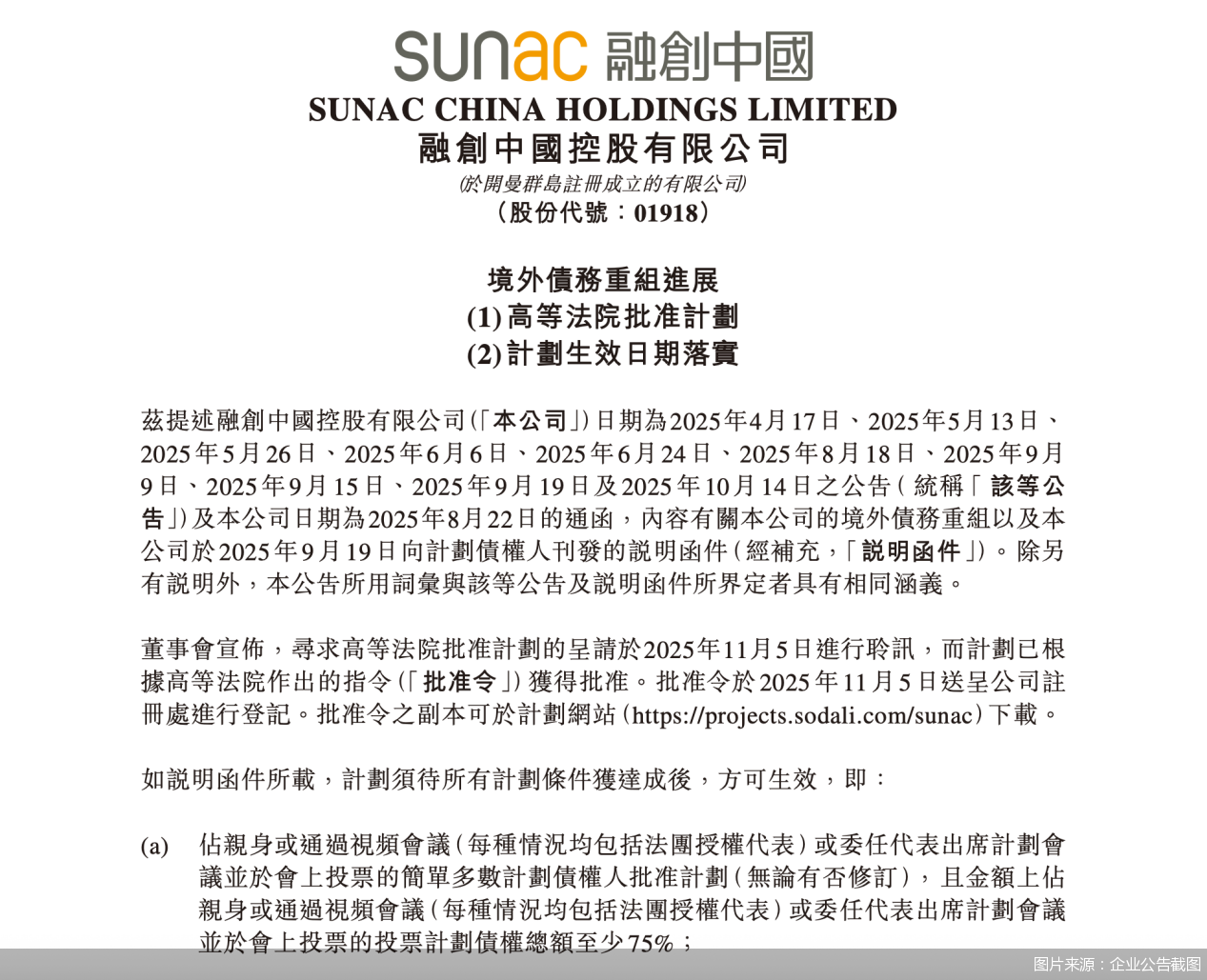
Group 1: Employment Data and Federal Reserve Actions - The October employment data from the U.S. private sector showed a surprising increase of 42,000 jobs, significantly better than the expected 30,000 jobs, while the previous month's data was revised down by 29,000 jobs [2] - Federal Reserve Governor Milan emphasized that current interest rates are still high and suggested that rates may need to be lowered further, despite the recent job growth being limited and wage growth slowing down [2][2] - Milan has consistently called for further rate cuts, advocating for a 50 basis point reduction instead of the 25 basis points implemented in September and October [2] Group 2: Corporate Debt Restructuring - Country Garden announced it has received the necessary support from a statutory majority of plan creditors for its offshore debt restructuring, with a court hearing scheduled for December 4, 2025 [3] - Sunac China sought the High Court's approval for its plan, which was granted on November 5, 2025, with all conditions met for the plan to take effect on the same date [3] - Maosheng Investment initiated a consent solicitation for a specific bond, aiming to modify the bond's maturity date, redemption terms, and default waiver provisions [3] Group 3: Market Movements - As of November 5, the yield on China's two-year government bonds was 1.43%, while the ten-year yield was 1.80% [6] - In the U.S., the two-year government bond yield rose by 5 basis points to 3.63%, and the ten-year yield increased by 7 basis points to 4.17% [6] Group 4: Rating Changes - Vanke Enterprises' long-term issuer credit rating was downgraded from "B-" to "CCC" with a negative outlook [5] - China Cinda (2020) I Management Ltd. received a long-term issuer rating of "BBB+" for its proposed issuance of senior unsecured notes [5]

资讯早班车-2025-11-07-20251107
Bao Cheng Qi Huo· 2025-11-07 03:03
1. Macroeconomic Data Overview - GDP growth rate in Q3 2025 was 4.8% year - on - year, down from 5.2% in the previous quarter but up from 4.6% in the same period last year [1] - Manufacturing PMI in October 2025 was 49%, down from 49.8% in the previous month and 50.1% in the same period last year [1] - Non - manufacturing PMI in October 2025 was 50.1%, up from 50% in the previous month but down from 50.2% in the same period last year [1] - In September 2025, the year - on - year growth rates of M0, M1, and M2 were 11.5%, 7.2%, and 8.4% respectively [1] - In September 2025, CPI was - 0.3% year - on - year, and PPI was - 2.3% year - on - year [1] - In September 2025, exports and imports increased by 8.3% and 7.4% year - on - year respectively [1] 2. Commodity Investment Reference 2.1 Comprehensive - China conducts license reviews on rare earths and related items in accordance with laws and regulations, aiming to ensure the security and stability of the global industrial and supply chains [2] - After the gold tax policy adjustment on November 1st, the Shenzhen Shuibei gold market has experienced "pricing chaos", with the gap between purchase and recycling prices widening significantly [2] - On November 6th, 32 domestic commodity varieties had positive basis, and 36 had negative basis [3] 2.2 Metals - On November 6th, international precious metal futures generally closed lower due to the Fed's stance on inflation and monetary policy [4] - Many institutions believe that a new cycle of resource commodities may have begun [5] - On November 6th, LME nickel cancelled warehouse receipts decreased by 7,218 tons, the largest decline since May [6] 2.3 Coal, Coke, Steel, and Minerals - Multiple provinces and cities have issued air pollution prevention and control action plans for the autumn and winter of 2025 - 2026, with some steel enterprises facing production restrictions [7] - The US has included copper in its 2025 list of critical minerals [7] - Indonesia has stopped approving applications for nickel ore processing plants producing certain intermediate products [7] 2.4 Energy and Chemicals - On November 6th, the main contract of US crude oil closed lower due to concerns about supply surplus and weak demand [8] - A new safety standard for chemical enterprises' flammable liquid atmospheric storage tank areas will be implemented on April 30, 2026 [8] - Saudi Aramco has lowered its crude oil selling prices to Asia for December [8] 2.5 Agricultural Products - Market regulatory authorities are soliciting public opinions on the "List of First - Time Non - Penalty for Administrative Violations in Market Supervision (II)" and the "List of Non - Penalty for Minor Administrative Violations in Market Supervision (II)" [10] - Malaysian enterprises will ensure the supply of raw materials for local sustainable aviation fuel plants [10] - Germany's grain corn production in 2025 is expected to decrease by 3.5% year - on - year [11] 3. Financial News Compilation 3.1 Open Market - On November 6th, the central bank conducted 928 billion yuan of 7 - day reverse repurchase operations, with a net withdrawal of 249.8 billion yuan [12] 3.2 Important News - China aims to achieve the goals of Hainan Free Trade Port construction, expanding institutional opening - up and promoting the cross - border flow of production factors [13] - The Dutch government is responsible for the escalation of the global supply chain crisis regarding the Anshi Semiconductor issue [13] - Most multinational enterprises are confident in the Chinese market, with an increasing proportion optimistic about China's economic growth in the next 3 - 5 years [14] - A polysilicon industry consolidation may be on the way, with a planned fund of about 70 billion yuan [15] - The "15th Five - Year Plan" proposes to improve the central bank system and the "dual - pillar" regulatory framework of monetary and macro - prudential policies [16] - The US employment situation is severe, increasing the expectation of a Fed rate cut in December [20] - The UK central bank maintained its interest rate at 4%, with increased internal divergence [20] 3.3 Bond Market Summary - A - share strength put pressure on the bond market, with bond yields generally rising and some bond prices falling [22] - Convertible bond indices showed mixed performance, with some bonds rising and others falling [23] - US and European bond yields generally declined [26] 3.4 Foreign Exchange Market - The on - shore RMB against the US dollar rose on November 6th, and the US dollar index fell [27] 3.5 Research Report Highlights - Huatai Securities warns of potential risks in overseas AI development, especially during the transition period [28] - CITIC Securities expects the real estate market to stabilize in 2026, and some enterprises may see the bottom of the profit cycle [28] - Shenwan Fixed Income believes that floating - rate bonds have advantages and the market may expand [29] - UBS Group analyzes the potential impact of a possible US Supreme Court ruling on Trump's tariff policy [29] 4. Stock Market News - A - shares rose unilaterally, with the Shanghai Composite Index returning to 4000 points, and the computing power hardware industry chain booming [32] - The Hong Kong Hang Seng Index and related indices rose, with some new stocks breaking their issue prices [32] - MSCI China Index added 26 stocks and removed 20 stocks in its November adjustment [32] - China Securities Index Company will release new indices on November 7th [33]
多家房企债务重组现新进展 涉及化债金额1.2万亿
Zhong Guo Xin Wen Wang· 2025-11-07 02:27
Core Insights - The Chinese real estate industry is experiencing accelerated risk clearance as multiple companies achieve progress in debt restructuring and reorganization [1][2] Group 1: Company Developments - Sunac China Holdings Limited announced the approval of its approximately $9.6 billion offshore debt restructuring by the Hong Kong High Court, marking a significant milestone as it becomes one of the first large real estate firms to clear its offshore debt [1] - Following the restructuring, Sunac's overall debt pressure is expected to decrease by nearly 100 billion RMB, resulting in substantial annual interest savings [1] - Country Garden's offshore debt restructuring plan has been approved, involving a debt scale of approximately $17.7 billion (around 127 billion RMB), significantly reducing its total debt [2] - The new debt instruments for Country Garden have a financing cost reduced to 1.0%-2.5%, with the longest debt term extended to 11.5 years, providing a crucial buffer period for operational recovery [2] Group 2: Industry Trends - As of now, 21 distressed real estate companies in mainland China have received approval or completed their debt restructuring, with a total debt reduction scale of approximately 1.2 trillion RMB [2] - The core of many recent debt restructuring plans has shifted from merely extending repayment terms to directly "cutting debt" through mechanisms such as debt-to-equity swaps and lowering repayment interest rates, with many companies achieving debt reductions exceeding 50% and some reaching 70% [2] - The emergence of new business models in the real estate sector has allowed some companies to achieve performance growth, thereby "unburdening" their balance sheets and enhancing their operational capabilities [3]
碧桂园境外债重组方案通过,有望减债117亿美元
Sou Hu Cai Jing· 2025-11-07 02:05
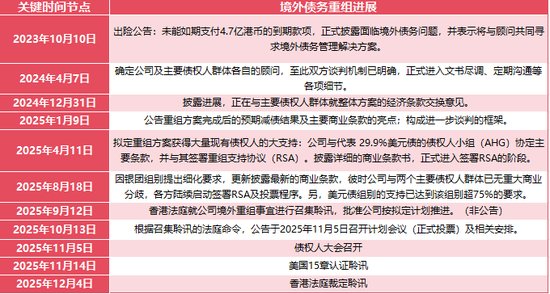
Core Viewpoint - Country Garden's offshore debt restructuring plan has successfully passed a creditor meeting, with over 75% approval from both debt groups, marking a significant step towards reducing its debt burden of approximately $17.7 billion [3][6][12] Debt Restructuring Progress - The offshore debt restructuring plan involves a total of about $17.7 billion, equivalent to approximately 127 billion yuan, with an expected debt reduction of about $11.7 billion (approximately 84 billion yuan) and a potential restructuring gain of up to 70 billion yuan [3][12] - The restructuring process has taken 300 days, starting from the announcement of key terms on January 9, 2025, to the creditor meeting on November 5, 2025 [6][9] - The restructuring plan includes options such as cash buybacks, debt-to-equity swaps, and new debt replacements, providing creditors with various choices [9][12] Financial Situation - As of mid-2025, Country Garden's interest-bearing liabilities amounted to approximately 254.58 billion yuan, with over 60% being bank and other borrowings, and more than 80% of these due within one year [4] - The company has a cash balance of approximately 24.06 billion yuan, which has decreased by 5.83 billion yuan since the beginning of the year [4] Support from Major Shareholders - The support from Country Garden's major shareholder has been crucial for the successful passage of the restructuring plan, with the shareholder providing approximately 3 billion HKD in cash support since the debt restructuring began [10][11] Operational Focus - Country Garden aims to maintain project delivery and stabilize sales while seeking new growth drivers post-restructuring [14] - The company has delivered over 380,000 housing units in 2024, accounting for about 10% of the national total, and plans to deliver 200,000 units in 2025 [14][15] - Despite a 35.55% year-on-year decline in total sales to approximately 33.99 billion yuan from January to October 2025, the company has substantial land reserves of about 10.4 million square meters, with 23% located in Guangdong [16][17] Cost Control Measures - Since 2022, Country Garden has implemented various cost control measures, including asset disposals that have recouped over 65 billion yuan, and reductions in marketing, administrative, and financial expenses [20][21]

碧桂园,跨过大坎
Xin Lang Cai Jing· 2025-11-07 01:56
Core Viewpoint - Country Garden's offshore debt restructuring has successfully passed a critical milestone, with over 75% approval from creditors, marking a significant turning point for the company and the real estate industry [1][2]. Group 1: Debt Restructuring Progress - The restructuring process took 300 days, involving complex negotiations over approximately $17.7 billion in offshore debt across 34 obligations under various legal jurisdictions [2][3]. - The restructuring plan includes a combination of cash buybacks, equity tools, new debt swaps, and physical interest payments, optimizing debt scale, term, and cost [4][3]. - Following the restructuring, Country Garden expects to reduce approximately $11.7 billion (RMB 84 billion) of interest-bearing debt and recognize up to RMB 70 billion in restructuring gains, significantly enhancing its net assets [4][5]. Group 2: Creditor Support and Strategic Moves - Creditors supported the restructuring due to the avoidance of liquidation losses, as direct liquidation could lead to greater losses given the current market conditions [6][5]. - The restructuring plan's appeal is enhanced by the potential for creditors to share in future profits through equity arrangements, with the controlling shareholder converting $1.148 billion in loans to equity, boosting creditor confidence [6][5]. Group 3: Industry Implications - Country Garden's successful restructuring serves as a replicable model for other distressed real estate companies, accelerating the clearing of risks in the industry [9][10]. - The shift from debt extension to significant debt reduction has become a core element of recent restructuring plans, reflecting a fundamental change in industry expectations [9][10]. - The industry is transitioning from a focus on scale to quality and efficiency, with companies like Country Garden exploring light asset businesses such as property management and construction services [10][11].