浦发银行

Search documents
从“服务者”到“共建者” 大连金融机构助力文体旅融合发展样本调查
Jin Rong Shi Bao· 2025-12-19 03:37
Core Insights - Dalian is positioning itself as a national "football city" with significant investments in football infrastructure and events, including hosting the 2024 International Sports Federation Football World Cup and the 2025 International University Sports Federation Football World Cup [1][5] - The establishment of the first football-themed bank branch by Shanghai Pudong Development Bank in Dalian aims to integrate financial services with the sports industry, enhancing the local football ecosystem [1][3] Financial and Sports Integration - The partnership between Shanghai Pudong Development Bank and Dalian Yingbo Football Club, initiated in August 2025, focuses on creating a "financial + sports" ecosystem, offering comprehensive financial services tailored to the sports industry [3][10] - The bank's new branch features a unique design that incorporates football culture, aiming to provide a blend of financial services and fan experiences [1][3] Youth Development and Community Engagement - Dalian Yingbo Football Club's U21 team won the 2025 China Youth Elite League (U21 group), showcasing the effectiveness of the city's youth training system [2] - Financial institutions are actively involved in supporting youth football training programs, with initiatives that include insurance coverage and financial products aimed at fostering young talent [4][8] Economic Impact of Sports Events - The hosting of major football events has significantly boosted local attendance and consumption, with the Dalian Shoyu Bay Football Stadium attracting over 934,000 attendees in the 2025 season, making it the most attended venue in Asia [2][7] - The integration of sports events with local tourism and consumption has led to increased economic activity, benefiting various sectors such as hospitality and retail [7][9] Innovative Financial Products - Dalian's financial institutions are launching innovative products to support the sports and tourism sectors, including specialized loans for hospitality and restaurant businesses [9] - The introduction of themed credit cards and membership systems aims to enhance the financial experience for fans while supporting the football club's financial needs [4][10] Future Directions - The financial sector in Dalian is exploring new avenues for collaboration with the sports industry, including the establishment of a sports industry innovation development fund to attract social capital for promising sports technologies and events [13] - The ongoing development of a comprehensive financial service ecosystem is expected to support the growth of the sports industry, aligning with national goals to enhance sports consumption and industry quality [11][12]
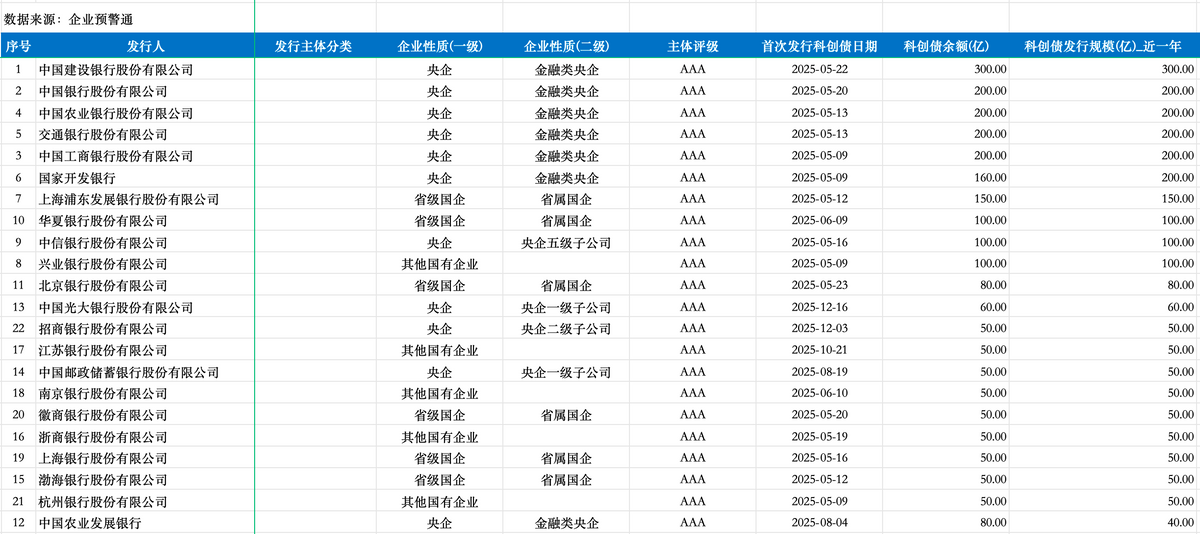
银行科创债破3000亿元,六大国有行占比超 38%,部分城农商行利率破2%
Tai Mei Ti A P P· 2025-12-19 01:13
Core Viewpoint - The issuance of technology innovation bonds by banks has significantly increased since the announcement by the central bank and the China Securities Regulatory Commission on May 7, with a total issuance scale reaching 301.4 billion yuan by December 18, 2023 [1][2]. Issuance Scale - A total of 67 banks have issued 75 technology innovation bonds, with state-owned banks being the primary issuers, accounting for 38.16% of the total issuance [1][3]. - The six major state-owned banks have collectively issued bonds worth 115 billion yuan, while city commercial banks and rural commercial banks have issued 74.9 billion yuan and 15 billion yuan, respectively [1][5]. - The issuance period is mainly concentrated in 5-year bonds, followed by 3-year bonds, with a small number of 6-month and 7-year bonds [1][9]. Interest Rates - The interest rates for the issued bonds range from 1.67% to 2.07%, with state-owned banks having slightly lower rates between 1.65% and 1.81% [1][7]. - City commercial banks and rural commercial banks have higher rates, with many exceeding 1.8% [1][9]. - The policy banks have rates of 1.4% for the National Development Bank and 1.65% for the Agricultural Development Bank [1][7]. Fund Allocation - The funds raised from technology innovation bonds are directed towards technology innovation sectors, including issuing loans for technology and investing in technology innovation enterprises [6].




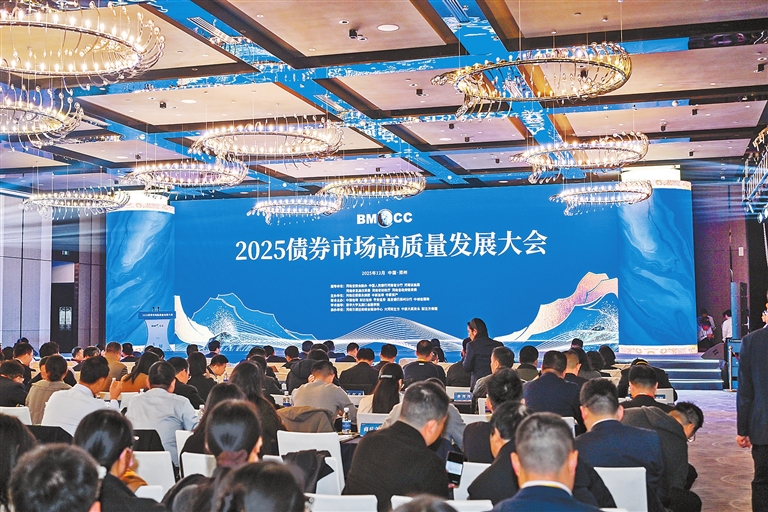
引债市创新“活水” 助经济大省担当——2025债券市场高质量发展大会侧记
He Nan Ri Bao· 2025-12-19 00:00
Core Insights - The 2025 Bond Market High-Quality Development Conference was held in Zhengzhou, focusing on the bond market's role in supporting national strategies and economic transformation [5] - The conference highlighted the significant growth of the bond market in Henan, with a focus on increasing direct financing and enhancing the financial ecosystem [5][6] Group 1: Bond Market Development - The "2025 Henan Province Bond Market Development White Paper" was released, indicating that Henan enterprises have achieved over 100 billion yuan in bond financing for four consecutive years [5] - As of October this year, the stock of corporate bonds issued in Henan surpassed 500 billion yuan, leading among the six central provinces [5] - Innovative bond types such as green bonds and technology innovation bonds are expanding, providing financial support to key sectors and regions [5] Group 2: Participation and Contributions - Various stakeholders, including the Henan Investment Group and CITIC Bank, have made significant contributions to the bond market's development, with CITIC Bank underwriting over 200 billion yuan in credit bonds for Henan enterprises [6] - The bond market in Henan is characterized by a continuous expansion of market size and optimization of financing structure [6][7] Group 3: Government and Academic Support - The provincial government emphasizes the importance of improving policies, credit environments, and risk management to enhance the quality and effectiveness of bond market development [7] - The conference was supported by various financial institutions and included academic guidance from Tsinghua University's Wudaokou School of Finance, marking a significant collaboration in promoting the bond market [7]
金融护航海南自贸港封关运作
Bei Jing Shang Bao· 2025-12-18 16:00
Core Viewpoint - The official launch of the Hainan Free Trade Port's full island closure operation on December 18 marks a new development stage characterized by "one line open, two lines controlled, and free within the island," emphasizing further expansion of openness rather than closure [1] Financial Support and Development - The People's Bank of China has actively promoted financial policies and institutional frameworks suitable for the Hainan Free Trade Port since the release of the overall plan in June 2020, effectively supporting the construction of the port [1] - As of now, all three financial preparations for the closure have been completed, with improvements in cross-border capital flow management systems [1] - The multi-functional free trade account (EF account) has been launched, with a total business volume of 268.9 billion yuan, facilitating capital transfers with 80 countries and regions [2] Loan Growth and Financing Costs - By the end of November, the total balance of various loans in Hainan reached 1.4101 trillion yuan, a year-on-year increase of 11% [2] - Specific sectors such as technology-related industries, green loans, and digital economy loans have seen significant growth, with increases of 9.2%, 25.4%, and 8.4% respectively [2] - The average interest rate for general loans in Hainan was 3.18% as of October, a decrease of 0.34 percentage points compared to the previous year [3] Cross-Border Financial Services - The establishment of a comprehensive system for cross-border financial openness, including monitoring and early warning mechanisms, enhances the ability to prevent financial risks [3] - The People's Bank of China has issued guidelines for cross-border asset management pilot business, with initial applications totaling 5 billion yuan from four institutions [4] Digital Payment Innovations - The digital yuan pilot program is advancing, with significant coverage in various sectors, including duty-free shopping and rural revitalization [5] - The "Hainan Wallet" project has been successfully launched, and mobile payment products have seen transaction numbers and amounts increase by 97.46% and 100.11% respectively [5] - The rapid development of mobile payment products enhances payment convenience and meets diverse consumer needs, contributing to innovation in the payment sector [5]
2026年转债年度投资策略:高价高估新环境,推荐哑铃配置
Huachuang Securities· 2025-12-18 15:21
Group 1 - The 2026 equity market outlook indicates strong liquidity support, with a focus on performance and thematic trends, particularly in sectors like commercial aerospace and CPO [2][7] - The valuation of the equity market has risen to historical highs, with potential concerns about future profit and revenue growth rates compared to valuation percentiles, suggesting further upside may exist [2][39] - The report highlights the importance of monitoring sectors with significant ROE improvements, such as steel, media, and military industries, which may present investment opportunities [39] Group 2 - The 2026 convertible bond market is expected to see gradual supply and demand recovery, with valuations likely to remain volatile [3][4] - Supply-side improvements are noted, with new bond issuances increasing year-on-year, although still at historically low levels, and regulatory changes may further influence supply dynamics [3][46] - Demand is shifting towards relative return investors, with public funds increasing their holdings in convertible bonds, indicating a potential easing of the supply-demand imbalance [3][16] Group 3 - The report recommends a "barbell" strategy in the current high-price, high-valuation environment, emphasizing the need to focus on elastic convertible bonds that may offer valuation advantages [5][9] - There is a noted shift in the demand for traditional core convertible bonds, with a focus on large-cap and dividend-paying bonds as potential substitutes in a low-interest-rate environment [5][9] - The valuation advantage of near-term convertible bonds is highlighted, suggesting that they may present opportunities for investors, while caution is advised regarding new bonds due to high valuation differentials [5][9]
海南自贸港启动全岛封关后 跨境资金如何自由便利流动?
Mei Ri Jing Ji Xin Wen· 2025-12-18 13:38
Core Viewpoint - The official launch of the Hainan Free Trade Port's full island closure operation on December 18 marks a significant step in China's commitment to high-level opening-up and the construction of an open world economy. The closure is characterized as greater openness rather than isolation, facilitating more convenient cross-border trade and investment flows [1]. Group 1: EF Account Characteristics - The EF account allows for the free and convenient transfer of funds between multi-functional free trade accounts and overseas accounts, as outlined in the Hainan Free Trade Port's overall construction plan [2]. - The People's Bank of China is actively promoting the establishment of the multi-functional free trade account system, which aims to create a financial platform for external openness [2]. - The EF account features two main characteristics: first, it allows for convenient fund transfers across the "first line" with no restrictions on capital item business except for securities investment [2][3]. Group 2: EF Account Operations - The EF account operates through banks, with the Construction Bank being one of the pilot banks. For instance, Hainan Rubber opened an EF account at the Construction Bank and received a loan of 472 million yuan for purchasing raw materials [4]. - The EF account facilitates cross-border capital flows by reducing the time for funds to reach overseas subsidiaries, as demonstrated by Hainan Rubber's investment in its overseas subsidiary [4]. - The Hainan Provincial Branch of the State Administration of Foreign Exchange has developed over 20 innovative policies to promote cross-border trade and investment, including guidelines for qualified foreign and domestic limited partners [4]. Group 3: Cross-Border Asset Management Pilot - Hainan Free Trade Port is advancing the pilot for cross-border asset management, with the People's Bank of China and other departments collaborating to implement the pilot business [5]. - As of October 2025, four pilot institutions have submitted applications totaling 5 billion yuan, with dynamic management of the pilot scale being established [6]. - Two private placement pilot products have successfully completed the subscription by overseas investors, indicating progress in the cross-border asset management pilot [6].

银行信用卡调整进入深水区!停发潮蔓延,渠道收缩与业绩承压并行
券商中国· 2025-12-18 11:19
Core Viewpoint - The article discusses the recent trend of banks, particularly in Zhejiang, ceasing the issuance of co-branded credit cards, indicating a shift in the credit card business from expansion to cost reduction and structural optimization [2][3][4]. Group 1: Recent Developments - Zhejiang Rural Commercial Bank announced the discontinuation of the "Harvest JD Co-branded Card" across multiple rural banks [1][3]. - A wave of credit card discontinuations has been observed, with various banks, including state-owned and joint-stock banks, halting the issuance of several co-branded credit cards [4][5]. - The trend of ceasing co-branded cards has been ongoing, with major banks like Agricultural Bank and Ping An Bank previously stopping numerous themed cards [4][5]. Group 2: Market Dynamics - The adjustments in credit card offerings are driven by economic slowdown and weak consumer expectations, leading to underperformance in card issuance and stagnant consumption growth [5]. - Banks are now focusing on high-value, high-loyalty consumption scenarios rather than blindly expanding their partnership networks [5]. Group 3: Channel and Product Adjustments - Banks are undergoing a "decluttering" process in both product offerings and distribution channels, with a focus on integrating online and offline services [6][8]. - Many banks are closing down offline credit card centers and merging credit card operations into retail banking departments to reduce management costs and enhance efficiency [6][7]. Group 4: Performance Metrics - The credit card industry is experiencing a decline, with the total number of credit cards in circulation dropping to 707 million, a decrease of 20 million from the previous year, marking the third consecutive year of decline [9][10]. - Over 70% of listed banks reported a reduction in credit card loan balances by mid-2025, indicating a significant contraction in the credit card business [10]. - For instance, China Merchants Bank reported a credit card transaction volume of 2.02 trillion yuan in the first half of 2025, down 8.54% year-on-year [10].

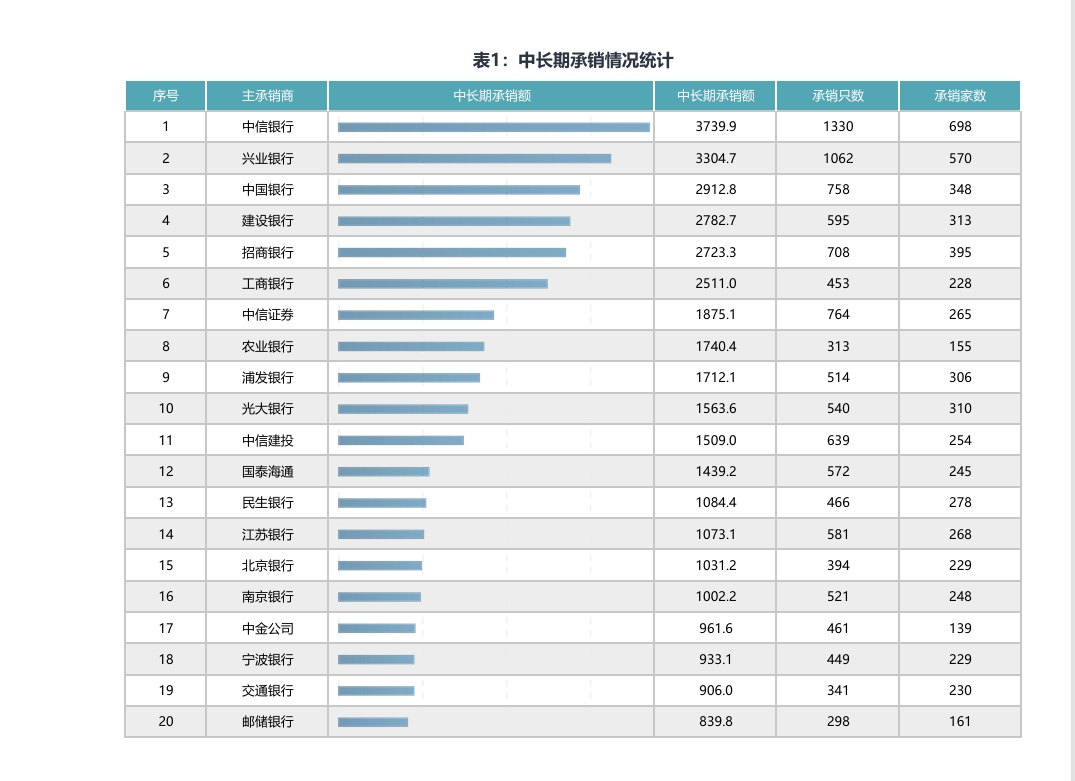
年内19例!债券承销为何频被交易商协会“点名”?
2 1 Shi Ji Jing Ji Bao Dao· 2025-12-18 11:15
Core Viewpoint - The self-regulatory investigation announced by the Interbank Market Dealers Association highlights ongoing violations in the bond underwriting process, indicating that non-compliant practices still exist in project solicitation, due diligence, and issuance sales [1][4]. Group 1: Regulatory Actions - On December 16, the Dealers Association initiated a self-regulatory investigation against a bank for alleged violations of fairness and diligence principles during debt financing tool underwriting [1]. - As of December 18, there have been 19 cases of bond underwriting violations or self-regulatory investigations disclosed by the Dealers Association and exchanges this year [4]. - The Dealers Association has been increasingly using self-regulatory investigations as a standard regulatory measure in the bond market [4]. Group 2: Market Dynamics - The bond underwriting market has seen intensified competition among underwriting institutions due to the expansion of the credit bond market and the diversification of issuers [4]. - There are notable differences in market strategies between securities firms and banks in the bond underwriting sector, with banks having advantages in interest rate bonds and interbank bonds [4]. - The prevalence of low-price underwriting, underwriting fees below cost, and self-financing behaviors are significant issues in the current bond underwriting landscape [5][7]. Group 3: Compliance and Future Outlook - The Dealers Association has strengthened supervision of underwriting business processes since 2023, with new regulations targeting low-price underwriting and other market irregularities set to be released by June 2025 [7][8]. - Institutions that are rated as D-class for two consecutive years will lose their main underwriting qualifications, reflecting the increasing regulatory scrutiny on underwriting capabilities [8]. - The number of institutions signing the self-regulatory convention has increased to 168, indicating a growing focus on compliance and market reputation among bond underwriting institutions [8].
封关不是封岛!金融护航海南自贸港“向海而兴”
Hua Xia Shi Bao· 2025-12-18 09:32
本报(chinatimes.net.cn)记者付乐 北京报道 《华夏时报》记者从交行获悉,其将发挥交行账户多元、全球协同、创新引领优势,打造跨境贸易结 算、跨境投融资、跨境财资管理、跨境资管和个人跨境金融服务五大特色跨境服务体系,将政策优势转 化为发展动能,以金融创新助力海南自贸港高质量发展。 截至目前,交通银行海南省分行已向文体娱乐及住宿餐饮行业累计投放贷款达29亿元,契合海南自贸港 封关后"文旅+免税""文旅+会展"的融合发展需求,为封关后国际旅游消费中心建设筑牢产业根基,推动 文旅业态提质升级。 作为本土金融企业,海南银行先后出台一系列措施,集中金融资源支持种业、深海、航天、数字、绿色 五大领域,创新推出专属信贷产品,重点支持专精特新企业等科创企业,助力产业升级动能转换,服务 新质生产力培育壮大。特别是在服务商业航天产业发展方面,海南银行还将进一步深化与文昌国际航天 城平台公司、园区产业基金等业务深度协同,赋能"向天图强"技术研发、成果转化、企业孵化、产业培 育一体化发展,助力培育火箭链、卫星链、数据链,服务打造千亿级的商业航天产业集群。 12月18日,海南自贸港全岛封关正式启动,开启了高水平对外开放的 ...


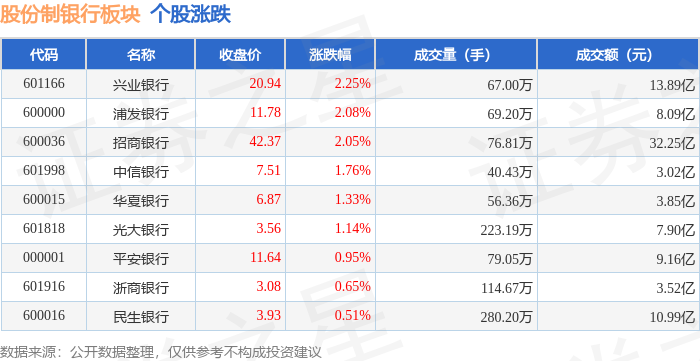
股份制银行板块12月18日涨1.76%,兴业银行领涨,主力资金净流入3.09亿元
Zheng Xing Xing Ye Ri Bao· 2025-12-18 09:09
Core Insights - The banking sector saw a rise of 1.76% on December 18, with Industrial Bank leading the gains [1] - The Shanghai Composite Index closed at 3876.37, up 0.16%, while the Shenzhen Component Index closed at 13053.98, down 1.29% [1] Stock Performance - Industrial Bank (601166) closed at 20.94, up 2.25% with a trading volume of 670,000 shares and a transaction value of 1.389 billion [1] - Other notable performers include: - Shanghai Pudong Development Bank (600000) at 11.78, up 2.08% [1] - China Merchants Bank (600036) at 42.37, up 2.05% [1] - CITIC Bank (601998) at 7.51, up 1.76% [1] - The overall trading volume and transaction values for various banks indicate active market participation [1] Fund Flow Analysis - The banking sector experienced a net inflow of 309 million from institutional investors, while retail investors saw a net outflow of 118 million [1] - Detailed fund flow for key banks includes: - Industrial Bank had a net inflow of 101 million from institutional investors [2] - China Everbright Bank (601818) saw a net inflow of 63 million from institutional investors [2] - Shanghai Pudong Development Bank had a net inflow of 46 million from institutional investors [2] - Retail investors showed significant outflows across most banks, indicating a cautious sentiment among smaller investors [2]