
信贷开门红

Search documents
信贷开门红偏弱,春节后投融资景气度受关注
Di Yi Cai Jing· 2026-02-24 05:25
Core Viewpoint - The January financial data indicates a "good start" for social financing in 2026, supported by government and corporate bonds, despite overall weak credit issuance, with new RMB loans in January falling short of the previous year's figures [1][2]. Group 1: Credit Performance - In January, new RMB loans amounted to 4.71 trillion yuan, lower than 5.13 trillion yuan in January 2025, reflecting a year-on-year decrease in social financing of 317.8 billion yuan [2][3]. - The trend of loan pre-positioning is strengthening, with January loans accounting for 22%, 27%, and 32% of annual credit issuance from 2023 to 2025, respectively [2]. - The corporate sector saw a decrease in medium to long-term loans by approximately 280 billion yuan and a reduction in bill discounts by about 360 billion yuan, indicating a shift towards balanced lending practices [1][3]. Group 2: Residential Sector Insights - Residential loans increased by 456.5 billion yuan, with short-term loans rising by 1.1 trillion yuan, while medium to long-term loans decreased by 1.47 trillion yuan [8]. - The real estate market's slow recovery and early repayments are major factors affecting residential loan growth, with January's property sales down 18.9% year-on-year [8][9]. - Short-term loans are seen as a critical indicator for consumer recovery, with their growth attributed to low base effects, holiday influences, and new subsidy policies [8][9]. Group 3: Market Dynamics and Future Outlook - Analysts suggest that the demand for credit post-Spring Festival will be crucial for both corporate and residential sectors, with expectations of continued monitoring of credit structure and volume in February and March [5][7]. - The reduction in bill financing by 873.9 billion yuan indicates banks are reallocating resources towards general loans, reflecting a shift away from aggressive credit growth [7]. - The overall sentiment in the corporate sector remains cautious, with expectations of credit growth being tempered by high base effects and regulatory influences [3][6].
经观月度观察|价格温和修复 提振经济仍需政策协同
Jing Ji Guan Cha Bao· 2026-02-20 04:25
Core Viewpoint - The economic recovery is moderate, but structural differentiation remains a concern, necessitating more policy support to maintain year-on-year price increases [1] CPI - The CPI year-on-year growth rate decreased from 0.8% to 0.2%, while the core CPI increased by 0.3% month-on-month, indicating early signs of inflation recovery [3] - The improvement in consumer demand is supported by ongoing consumption promotion policies, with prices for household goods and daily necessities continuing to rise [3] PPI - The PPI year-on-year rate narrowed from -1.9% to -1.4%, with a month-on-month increase of 0.4% [4] - Input factors, such as rising international metal prices and geopolitical risks, are contributing to price increases in domestic industries [4] PMI - The manufacturing PMI fell to 49.3, down 0.8 percentage points from the previous month, with all five sub-indices declining [5] - The decrease is attributed to year-end rush production and the upcoming Spring Festival, affecting supply and demand [5] Credit - New RMB loans totaled 4.71 trillion yuan in January, with a year-on-year decrease of 420 billion yuan [7] - Short-term loans showed improvement, while medium and long-term loans for enterprises weakened, indicating a lack of robust demand [7] M2 - M2 growth accelerated to 9% year-on-year, up from 8.5%, driven by increased deposits from non-bank financial institutions [8] - The narrowing gap between M1 and M2 growth rates reflects improved liquidity transmission to the real economy [8]

如何理解社融与货币增速背离
GOLDEN SUN SECURITIES· 2026-02-14 11:49
1. Report's Industry Investment Rating - Not mentioned in the report 2. Core Viewpoints of the Report - The credit performance at the beginning of the year was lackluster, and government bonds drove the growth of social financing. In the context of the front - loaded government bond issuance and the weak recovery of corporate medium - and long - term loans, the growth rate of social financing in the first half of 2026 may continue a gentle downward trend [1][6][10] - The increase in the M1 growth rate in January 2026 was mainly due to the Spring Festival factor, and the divergence between the M2 growth rate and the social financing growth rate might be affected by multiple factors such as the increase in the scale of foreign exchange settlement and the low base of non - bank deposits [2][12][16] - The large increase in fiscal deposits led to a withdrawal of funds, and the improvement in liquidity might be due to weak credit demand or the central bank's use of structural tools. Under the expectation of monetary easing, the bond market is expected to continue to strengthen after the Spring Festival [3][19][21][23] 3. Summary by Related Content Credit Situation - In January 2026, the new credit was 4.71 trillion yuan, a year - on - year decrease of 0.42 trillion yuan. Considering the Spring Festival factor, credit demand was even weaker. Corporate credit increased by 44,500 yuan billion, a year - on - year decrease of 3,300 billion yuan, and medium - and long - term loans increased by 31,800 billion yuan, a year - on - year decrease of 2,800 billion yuan. Resident medium - and long - term loans increased by 346.9 billion yuan, a year - on - year decrease of 146.6 billion yuan, mainly dragged down by the weak real estate market [1][6] Social Financing Situation - In January 2026, the new social financing was 7.2 trillion yuan, a year - on - year increase of 165.4 billion yuan. The year - on - year increase in social financing was mainly driven by the large - scale issuance of government bonds, and the year - on - year growth rate of the social financing stock was 8.2%, a slight decrease of 0.1 percentage points from the previous month. The new scale of government bonds in January 2026 was 976.4 billion yuan, a year - on - year increase of 283.1 billion yuan. In the first half of 2026, the growth rate of social financing may continue to decline gently [1][10] M1 and M2 Growth Rate Situation - In January 2026, the year - on - year growth rate of M1 rebounded by 1.1 percentage points to 4.9%, mainly due to the Spring Festival misalignment factor, which pushed up the year - on - year growth rate of M1 in January by about 1.3 percentage points [2][12][14] - From November last year to January this year, the year - on - year growth rate of M2 increased by 1.0 percentage point to 9.0%, while the growth rate of the social financing stock slowed down by 0.3 percentage points to 8.2%. The increase in the foreign exchange settlement ratio and the large year - on - year increase in non - bank deposits might be the reasons for the divergence between the two [2][16] Liquidity Situation - The increase in foreign exchange settlement did not form liquidity injection, and the large increase in fiscal deposits in January led to a withdrawal of liquidity. However, the liquidity was actually very loose in January. One reason was the weak credit demand, and the other was the possible use of structural tools by the central bank [3][19][21] Bond Market Outlook - Currently, social financing is weak. Under the expectation of the use of aggregate monetary tools and loose money, the bond market is expected to continue to strengthen after the Spring Festival, with short - term interest rates likely to decline further, and the dumbbell strategy on the curve is relatively more advantageous [3][23]
宏观点评:信贷“开门红”成色几何?-20260214
GOLDEN SUN SECURITIES· 2026-02-14 05:25
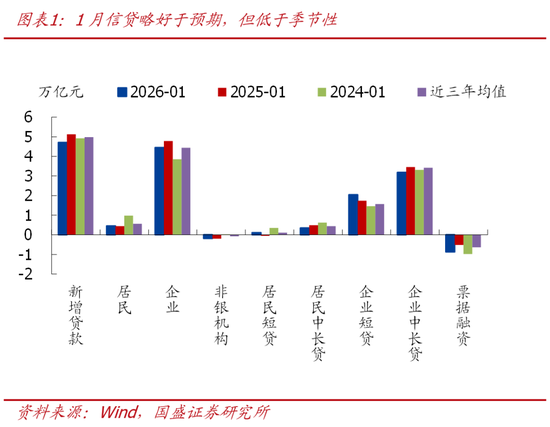
Credit Data Overview - In January 2026, new RMB loans amounted to 4.71 trillion, slightly above the market expectation of 4.5 trillion but lower than the seasonal average of 4.98 trillion[2] - New social financing (社融) reached 7.22 trillion, exceeding both market expectations of 6.51 trillion and the seasonal average[7] - The growth rate of outstanding social financing decreased to 8.2%, down 0.1 percentage points from the previous month[7] Loan Structure Analysis - Short-term loans for residents increased by 1.097 trillion, indicating a potential marginal improvement in consumer spending due to early consumption subsidies[6] - Long-term loans for residents continued to decline for four consecutive months, with a decrease of 1.466 trillion, primarily due to weak real estate sales[6] - Corporate short-term loans surged to 2.05 trillion, reflecting increased cash flow pressures, while medium to long-term loans fell by 2.8 trillion, indicating weak corporate investment sentiment[6] Monetary Policy Outlook - The central bank is expected to maintain a cautious approach to monetary easing, focusing on the effectiveness of fiscal policies and key economic indicators such as real estate and exports[3] - The overall economic environment is characterized as "weak reality," with significant downward pressure remaining due to insufficient domestic demand and weak confidence[3] Key Economic Indicators - M1 growth rose to 4.9%, driven by a lower base and accelerated activation of resident deposits[8] - M2 growth increased to 9%, supported by accelerated fiscal spending[8] - In January, total deposits rose by 8.09 trillion, with a notable decrease in resident deposits by 3.39 trillion, indicating a shift in deposit behavior[8]
信贷“开门红”成色几何?【国盛宏观熊园团队】
Xin Lang Cai Jing· 2026-02-14 03:05
Core Viewpoint - Overall, the January credit "opening red" is insufficient, particularly reflected in the weak performance of long-term loans for residents and enterprises, while short-term loans for enterprises show signs of a surge [2][26] Group 1: Credit Data Summary - In January, new RMB loans amounted to 4.71 trillion, a year-on-year decrease of 420 billion, slightly better than market expectations of 4.5 trillion but below seasonal averages of 4.98 trillion [4][28] - New social financing reached 7.22 trillion, a year-on-year increase of 165.4 billion, exceeding market expectations of 6.51 trillion and seasonal averages [13][37] - The growth rate of outstanding social financing decreased to 8.2%, down 0.1 percentage points from the previous month [13][39] Group 2: Loan Structure Analysis - On the residential side, short-term loans increased by 1.097 trillion, indicating potential marginal improvement in consumer spending due to early issuance of consumption subsidies, while long-term loans decreased for four consecutive months [7][31] - For enterprises, short-term loans increased by 2.05 trillion, reflecting cash flow pressures, while long-term loans decreased by 2.8 trillion, indicating weak investment willingness [10][34][35] Group 3: Monetary Indicators - M1 increased by 4.9% year-on-year, up 1.1 percentage points from the previous month, attributed to a lower base and accelerated activation of resident deposits [17][41] - M2 rose by 9% year-on-year, up 0.5 percentage points, likely supported by increased fiscal spending [17][41] - Total deposits in January increased by 8.09 trillion, with a year-on-year increase of 3.77 trillion, indicating a shift in resident deposits [17][41]
上市银行,迎密集调研!
证券时报· 2026-02-10 11:49
Core Viewpoint - Since 2026, listed banks have experienced intensive institutional research, particularly focusing on small and medium-sized banks in economically developed coastal regions [1] Group 1: Institutional Research and Credit Performance - As of February 9, 2026, 13 listed banks have undergone 54 institutional research sessions, with 386 participating institutions [2] - Key topics of interest include the performance of credit in the "opening red" period, the "14th Five-Year Plan," asset-liability management, and wealth management [2] - Multiple analysts noted that the credit performance in the opening of 2026 is strong, with banks actively developing wealth management and other intermediary businesses [2][4] Group 2: Focus on Credit Allocation - Credit allocation is primarily directed towards the technology and innovation sectors [3] - Banks reported that their credit issuance aligns with expectations, with overall performance better than the previous year [4] - For instance, Suzhou Bank and Hangzhou Bank indicated a good start to the "opening red" period, with increased credit issuance compared to the same period last year [4] - Shanghai Bank focuses on major strategic projects in Shanghai, while also expanding housing mortgages and loans for new energy vehicles in retail [4] Group 3: Intermediary Business Income - Banks are looking to expand intermediary business income as a core strategy to address margin pressure, with wealth management being a key area of focus [6][7] - Analysts from various banks believe that wealth management will continue to improve, driven by active capital market performance and a favorable environment for fee income [7] - The trend of "deposit migration" is not significantly observed, with many banks reporting an increase in new deposits compared to the previous year [7] Group 4: Preliminary Annual Performance Reports - As of February 9, 2026, 11 listed banks have released preliminary performance reports, showing positive growth in operating income and net profit [8][9] - Notably, Qingdao Bank and Qilu Bank reported net profit growth of 21.66% and 14.58%, respectively [9][10] Group 5: Asset Quality and Growth Trends - The asset scale of the listed banks has shown steady expansion, with many small and medium-sized banks growing at rates exceeding 10% [12] - The non-performing loan ratio remains stable, with no significant rebound observed [12] - Analysts expect that the recent implementation of structural monetary policy tools by the central bank will help stabilize net interest margin expectations and enhance credit issuance willingness [12]

上市银行,迎密集调研!
券商中国· 2026-02-10 10:30
Core Viewpoint - Since 2026, listed banks have experienced intensive institutional research, particularly focusing on small and medium-sized banks in economically developed coastal regions [1] Group 1: Institutional Research and Credit Performance - As of February 9, 2026, 13 listed banks have undergone 54 institutional research sessions, with 386 participating institutions [2] - Key topics of interest include the performance of credit in the "opening red" period, the "14th Five-Year Plan," asset-liability management, and wealth management [2] - Many banks reported a good start to the "opening red" period, with credit performance exceeding expectations compared to the previous year [4] Group 2: Focus on Credit Allocation - Credit allocation is primarily directed towards the technology and innovation sectors, with banks aligning their strategies with regional characteristics [3][4] - For instance, Shanghai Bank focuses on major strategic projects in Shanghai, while Qingdao Bank emphasizes technology finance and advanced manufacturing [5] - Analysts noted that the credit "opening red" performance is strong, with state-owned banks and high-quality city commercial banks showing positive feedback [5] Group 3: Middle Business Income Recovery - Banks are focusing on expanding middle business income as a core strategy to address margin pressure, with wealth management being a key area [6][7] - Many banks are enhancing their wealth management capabilities through diversified product offerings and improved customer service [7] - Analysts expect that wealth management will continue to drive fee income growth, supported by a favorable capital market environment [8] Group 4: Preliminary Annual Performance Reports - As of February 9, 2026, 11 listed banks have released preliminary performance reports, showing positive growth in operating income and net profit [9] - Notably, Qingdao Bank and Qilu Bank reported net profit growth of 21.66% and 14.58%, respectively [10] - The overall asset scale of these banks has expanded steadily, with many small and medium-sized banks achieving growth rates exceeding 10% [11] Group 5: Profit Growth Stability - Analysts believe that the stable profit growth of listed banks is due to a narrowing decline in interest margins and improved middle business income [12] - The recent implementation of structural monetary policy tools by the central bank is expected to stabilize net interest margin expectations and enhance credit issuance willingness [12]

黄金白银继续暴跌 轮到银行股机会了?
Di Yi Cai Jing· 2026-02-04 01:02
Core Viewpoint - The A-share market experienced significant declines in various sectors, particularly in metals and banks, with a notable focus on bank stocks as a safe haven amid volatility in precious metals prices [1][3][4]. Group 1: Market Performance - On February 2, A-share non-ferrous metals led the decline with a drop of 7.62%, while steel, chemicals, coal, and oil and gas sectors also fell over 5% [1]. - The Shanghai Composite Index closed down 2.48%, with over 4,600 stocks declining and a trading volume of approximately 2.61 trillion yuan, a decrease of nearly 250 billion yuan from the previous trading day [3][4]. - The banking sector showed resilience, with certain banks like Citic Bank and Shanghai Bank posting gains of 2.64% and 1.62%, respectively, amidst the overall market downturn [4]. Group 2: Bank Sector Analysis - The banking sector has seen a significant correction, with the China Securities Bank Index dropping 6.76% as of January 30, with major banks like Pudong Development Bank and Agricultural Bank of China experiencing declines of 19.29% and 12.5%, respectively [4][5]. - Analysts believe that the peak of fund outflows from the banking sector has passed, with the sector's valuation becoming more attractive, as the median price-to-book (PB) ratio is around 0.57 and the median dividend yield has risen to over 4.5% [5][6]. - Recent reports indicate that passive fund outflows have been a major factor in the banking sector's recent adjustments, but the selling pressure is expected to diminish, allowing for potential recovery in bank stock prices [6][7]. Group 3: Institutional Insights - Institutions are starting to show interest in bank stocks, with reports indicating that active funds had reduced their holdings in bank stocks by 1.3 billion shares by the end of the fourth quarter [7]. - Several regional banks have announced stock buyback plans, which have been positively received by the market, reinforcing confidence in the banking sector's fundamentals [7].





月末票据利率不升反降,信贷“开门红”成色不足?
第一财经· 2026-02-03 13:58
Core Viewpoint - The article discusses the cautious expectations for credit growth in January, highlighting the unusual decline in bill rates as a potential indicator of weaker credit demand [2][4]. Group 1: January Credit Market Overview - January is traditionally a strong month for credit issuance, but expectations for this year are subdued due to factors like the smoothing of credit issuance ahead of 2025 [2][5]. - A senior financial analyst predicts that new credit in January will be roughly in line with last year, with some institutions forecasting it to be below 5 trillion yuan [2][8]. - The bill rates showed an unusual downward trend in January, with the six-month bill rate dropping from 1.29% to a low of 1.07%, indicating weaker credit demand [3][4]. Group 2: Bill Rate Trends - The trend of bill rates in January has been declining over the years, with the six-month bill rate decreasing from around 2.5% in 2023 to below 2% in 2025 [3]. - The last week of January saw a notable decline in bill rates, which is interpreted as a sign of insufficient credit demand [3][4]. - The report suggests that the decline in bill rates, coupled with falling interbank certificate of deposit rates, indicates that banks may have sufficient liabilities but are lacking in assets [5]. Group 3: Future Outlook - Looking ahead to February, historical trends suggest that bill rates typically rise before falling back [6]. - Regulatory guidance has encouraged banks to maintain balanced loan issuance, which has led to a more stable growth in credit volume [6][7]. - The article notes that the first month of the year usually sees the highest credit issuance, with January data often serving as a peak for the year [7][8].

月末票据利率不升反降,信贷“开门红”成色不足?
Di Yi Cai Jing· 2026-02-03 11:33
Core Viewpoint - The market has a conservative expectation for January's credit growth, influenced by factors such as the smoothing of credit issuance before the end of 2025 and the performance of the bill market [1] Group 1: Credit Market Expectations - January is traditionally a significant month for credit issuance, but expectations for this year are subdued, with some analysts predicting new loans to be around 5 trillion yuan, lower than the previous year's levels [1][7] - The bill market, which combines both funding and credit attributes, is seen as a leading indicator for bank credit issuance, and the recent decline in bill rates has raised concerns about the strength of credit demand [2][3] Group 2: Bill Market Trends - In January, the six-month bill discount rate initially rose to 1.29% but then fell to a low of 1.07%, indicating a 22 basis point fluctuation, which is atypical for this time of year [2] - The three-month bill discount rate fluctuated between 1.30% and 1.50%, with a notable decline towards the end of the month, suggesting weaker credit demand than expected [2][3] Group 3: Historical Context and Predictions - Historically, January is a peak month for credit issuance, with new loans from 2019 to 2025 averaging between 3.23 trillion yuan and 5.13 trillion yuan, but this year is expected to be flat compared to last year [6] - Some institutions predict that January's new loans will be between 5.2 trillion and 5.5 trillion yuan, with a significant portion expected to be issued from mid-January onwards [6][7]