地方政府债务置换

Search documents
专辑 | 地方政府债务置换对城投债发行定价的影响——基于特殊再融资债视角
Sou Hu Cai Jing· 2026-02-24 13:30
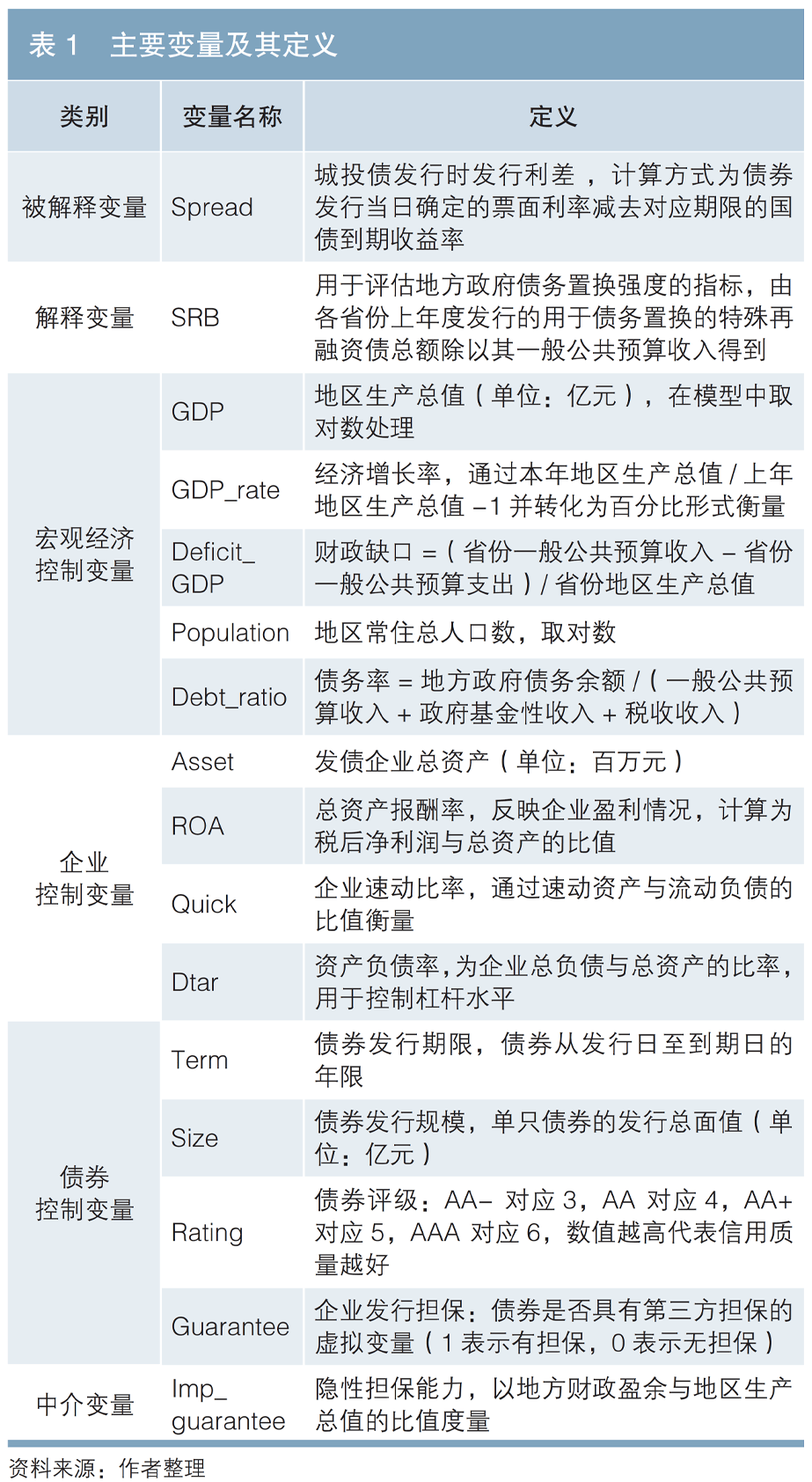
Core Viewpoint - The issuance of special refinancing bonds significantly reduces the credit spread of urban investment bonds, primarily through enhancing the implicit guarantee capacity of local governments [1][25]. Group 1: Research Background - The increasing economic downward pressure and adjustments in the real estate market have weakened the debt repayment capacity of some local governments, leading to rising issuance rates and credit spreads for urban investment bonds since 2023 [2]. - The Chinese government has emphasized the importance of preventing systemic financial risks and has adopted special refinancing bonds as a tool for debt restructuring and risk mitigation [2][3]. Group 2: Literature Review - Existing studies have focused on the impact of replacement bonds since 2015, highlighting their role in reducing interest expenses and extending debt maturity, which significantly affects urban investment bond rates and credit spreads [3]. - Special refinancing bonds, introduced in late 2020 and expanded in 2023, aim to address hidden debts not included in budgets, yet they have received limited academic attention [3]. Group 3: Empirical Analysis - The study analyzes data from 2021 to 2024, utilizing a sample of 13,413 urban investment bonds, with data sourced from authoritative databases and official statistics [8][9]. - The main variable, the credit spread of urban investment bonds, reflects the premium over risk-free rates and is crucial for measuring financing costs [9][10]. Group 4: Hypotheses and Mechanisms - Hypothesis one posits that the issuance of special refinancing bonds significantly lowers the credit spread of new urban investment bonds [5]. - Hypothesis two suggests that special refinancing bonds enhance local governments' implicit guarantee capacity, thereby reducing the credit spread of new urban investment bonds [7][20]. Group 5: Results and Robustness Checks - The results indicate that an increase in the special refinancing bond ratio significantly lowers the credit spread across various model specifications, confirming hypothesis one [15][16]. - Robustness checks further validate the findings, showing that the impact of special refinancing bonds on reducing issuance spreads remains significant under different variable constructions and sample sizes [17][18]. Group 6: Mechanism Analysis - The analysis reveals that the issuance of special refinancing bonds significantly enhances the market's perception of local governments' implicit guarantee capacity, which in turn reduces the credit spread of urban investment bonds [21][23]. Group 7: Conclusions and Policy Recommendations - The study concludes that special refinancing bonds effectively lower the financing costs of urban investment bonds by enhancing local governments' implicit guarantee capacity [25]. - Recommendations include establishing a supportive mechanism for special refinancing bonds linked to the operational efficiency of platform companies and reforming credit pricing mechanisms to mitigate implicit guarantee expectations [27][28].

第三批2万亿置换债启动发行 化债组合拳释放积极信号
Zhong Guo Jing Ying Bao· 2026-01-20 17:37
Core Viewpoint - The launch of the third batch of 2 trillion yuan debt replacement marks the beginning of a new round of local debt risk resolution, aimed at alleviating local financial burdens and signaling stability and growth to the market [1][3]. Group 1: Debt Replacement Overview - The 2 trillion yuan debt replacement is part of a larger 6 trillion yuan local government debt replacement plan approved by the National People's Congress, with the goal of significantly reducing hidden debt from 14.3 trillion yuan to 2.3 trillion yuan by 2028 [1]. - The average interest cost of local government debt has been reduced by over 2.5 percentage points, enhancing local development momentum [1][2]. Group 2: Policy Effectiveness - The debt replacement allows local governments to replace high-cost hidden debts with low-interest legal government bonds, effectively easing current fiscal pressures [2]. - The optimized debt structure enables local governments to redirect financial resources towards key areas such as domestic demand expansion, technological innovation, and social welfare, thereby boosting confidence among business entities [2][3]. Group 3: Market Response and Characteristics - As of January 11, 2026, 26 local bonds have been issued with a total scale of 1176.64 billion yuan, with Shandong and Zhejiang leading the issuance [2]. - The current issuance structure includes 21 new bonds totaling 884.34 billion yuan, with a significant portion allocated for replacing hidden debts [2]. - The characteristics of the current debt replacement include a focus on long-term and market-oriented bonds, with over 60% having a maturity of 10 years or more [3]. Group 4: Economic and Financial Implications - The introduction of the 2 trillion yuan debt replacement is expected to create multiple benefits for local economies and financial markets, allowing for increased investment in essential sectors [3]. - The transformation of urban investment enterprise debt into local government debt is anticipated to reduce credit risks for commercial banks and improve asset quality, particularly for regional banks [3].
尚福林、杨伟民、白重恩、高培勇,最新发声!
证券时报· 2025-12-27 09:14
Core Viewpoint - The conference emphasized the importance of accelerating the construction of a financial power during the "15th Five-Year Plan" period, focusing on the organic unity of qualitative improvement and reasonable quantitative growth, as well as comprehensive, systematic, and leading advancements [2][5]. Group 1: Financial Development - The financial sector in China has achieved historic growth in scale and quality during the "14th Five-Year Plan," laying a solid foundation for building a financial power [5]. - Challenges remain in the financial development landscape, including imbalances in social capital allocation and the need for traditional financing and risk control models to adapt to new economic realities [5][6]. - The "15th Five-Year Plan" suggests focusing on financial services for the real economy, deepening financial system reforms, and enhancing global financial governance [5][6]. Group 2: Manufacturing and New Quality Productivity - The conference highlighted the need to maintain a reasonable proportion of manufacturing in GDP and globally, emphasizing that new quality productivity should not be confined to traditional industrial models [2][8]. - New manufacturing should focus on technology and product innovation, with a concentration of research and development personnel in central cities and urban clusters [10][8]. - The development of emerging and future industries is expected to primarily occur in key regions such as Beijing, Shanghai, and the Guangdong-Hong Kong-Macau Greater Bay Area [10][8]. Group 3: Policy Optimization - Policies should not only focus on expanding demand and optimizing supply but also on optimizing distribution to create a cohesive system of supply, demand, and distribution [3][12]. - The transition from consumption stimulus policies to income distribution adjustment policies is necessary to enhance the income of low-income groups and ensure that disposable income growth outpaces economic growth [12][11]. Group 4: Debt Management and Reform Investment - The proposal to replace local government debt with national bonds aims to alleviate repayment pressure on local governments, improve their cash flow, and foster economic growth [15][13]. - Investment in reform is crucial, with a focus on using fiscal and monetary policies to support the transitional costs of reforms, thereby facilitating better conditions for future reforms [14][15].

河南53.37亿元地方债完成发行
Sou Hu Cai Jing· 2025-12-05 09:49
Core Viewpoint - The Henan Provincial Government successfully issued government bonds totaling 5.33742 billion yuan on December 5, 2023, aimed at optimizing debt structure and reducing financing costs [1] Group 1: Bond Issuance Details - The issuance included 3 billion yuan of 30-year new special bonds at an interest rate of 2.48%, intended to supplement government fund resources [1] - Additionally, 800 million yuan of 20-year new special bonds were issued at an interest rate of 2.49% for existing government investment projects [1] - Furthermore, 1.11259 billion yuan of 20-year refinancing special bonds were issued at an interest rate of 2.48% to replace existing hidden debts [1] Group 2: Impact and Future Actions - The issuance completes the local government debt limit set by the Ministry of Finance for Henan Province for the replacement of existing hidden debts in 2025, positively impacting debt structure and financing costs [1] - The Provincial Finance Department will enhance fund management and guide local governments to ensure the precise use of bond funds for replacing high-cost, short-term hidden debts [1] - There will be a continued strict regulatory approach to prevent new illegal borrowing and ensure accountability in the implementation of debt replacement policies [1]
财政部:上半年隐性债务置换政策落地见效
Zhong Guo Jing Ying Bao· 2025-11-12 17:03
Core Insights - The article discusses China's management of local government debt, emphasizing the importance of strict debt limit controls to support stable economic growth. Group 1: Debt Management and Economic Support - In the first half of the year, China implemented strict limits on local government debt, which is crucial for ensuring stable economic development [1] - The government has arranged for 2 trillion yuan in local government debt limit replacements for hidden debts, with 1.8 trillion yuan of related bonds issued in the first half, completing 90% of the 2025 quota [1] - The average interest cost of the replaced debt has decreased by over 2.5 percentage points [1] Group 2: Transparency and Financial Stability - The Ministry of Finance's research team noted a "multiple benefits" effect, enhancing the transparency of local debt and improving unified debt management [1] - This initiative significantly reduces the repayment pressure on local governments, freeing up more financial resources and policy space to stimulate the microeconomic cycle [1] - The reform of financing platforms is being accelerated, effectively improving the asset quality of financial institutions and enhancing their willingness and ability to lend to the real economy [1] Group 3: Accountability and Regulation - The Ministry of Finance is strictly enforcing a lifelong accountability system for government borrowing and a mechanism for tracing debt issues [1] - A closed-loop management system for hidden debt accountability is being established, utilizing various methods such as audits and inspections to improve the detection of new hidden debts [1] - There is an increased emphasis on publicizing accountability results to serve as a warning and to further enforce financial discipline [1]
财政部《报告》显示 上半年2万亿债务置换完成90%
Zhong Guo Jing Ying Bao· 2025-11-11 07:30
Group 1 - The report indicates that local government debt risk prevention and resolution have been effectively implemented in the first half of the year [1] - A total of 2 trillion yuan of local government debt limit was arranged to replace hidden debts, with 1.8 trillion yuan of related replacement bonds issued, completing 90% of the 2025 quota [1] - The average interest cost of the replaced debt has decreased by over 2.5 percentage points [1] Group 2 - The report emphasizes the need to strengthen budget constraints and prohibits the addition of hidden debts as a strict discipline [2] - It calls for a comprehensive management mechanism for hidden debt accountability, utilizing various methods such as auditing and inspections to identify and address new hidden debts [2] - The report advocates for a lifelong accountability system for government borrowing and a mechanism for tracing debt issues [2]
瑞达期货沪镍产业日报-20251104
Rui Da Qi Huo· 2025-11-04 09:07
Report Summary 1. Report Industry Investment Rating No information provided on the industry investment rating. 2. Core View of the Report The report predicts that nickel prices will fluctuate and adjust. Technically, with an increase in positions and a decline in prices, the bearish sentiment is rising, and the lower limit of the range is being tested. It is recommended to wait and see for now [3][4]. 3. Summary by Relevant Catalogs Futures Market - The closing price of the main futures contract of Shanghai nickel is 119,700 yuan/ton, down 1,250 yuan; the spread between the December - January contracts of Shanghai nickel is -240 yuan/ton, down 10 yuan [3]. - The LME 3 - month nickel price is 15,115 dollars/ton, down 135 dollars; the open interest of the main contract of Shanghai nickel is 118,460 lots, up 9,789 lots [3]. - The net long position of the top 20 futures holders of Shanghai nickel is -31,010 lots, up 3,503 lots; the LME nickel inventory is 252,750 tons, up 648 tons [3]. - The inventory of nickel in the Shanghai Futures Exchange is 36,751 tons (weekly), up 676 tons; the LME nickel cancelled warrants total 6,426 tons, unchanged [3]. - The warehouse receipt quantity of Shanghai nickel is 30,952 tons, down 254 tons [3]. 现货 Market - The SMM 1 nickel spot price is 121,800 yuan/ton, down 200 yuan; the spot average price of 1 nickel plate in Yangtze River Non - ferrous is 122,000 yuan/ton, down 100 yuan [3]. - The CIF (bill of lading) price of Shanghai electrolytic nickel is 85 dollars/ton, unchanged; the bonded warehouse (warehouse receipt) price of Shanghai electrolytic nickel is 85 dollars/ton, unchanged [3]. - The average price of battery - grade nickel sulfate is 28,800 yuan/ton, unchanged; the basis of the NI main contract is 2,100 yuan/ton, up 1,050 yuan [3]. - The LME nickel (spot/three - month) premium is -211.5 dollars/ton, down 6.66 dollars [3]. Upstream Situation - The monthly import volume of nickel ore is 611.45 million tons, down 23.22 million tons; the total port inventory of nickel ore is 1,479.1 million tons (weekly), down 18.81 million tons [3]. - The average monthly import unit price of nickel ore is 56.72 dollars/ton, down 4.61 dollars; the tax - included price of Indonesian laterite nickel ore with 1.8% Ni is 41.71 dollars/wet ton, unchanged [3]. Industry Situation - The monthly output of electrolytic nickel is 29,430 tons, up 1,120 tons; the total monthly output of nickel iron is 21,700 metal tons, down 300 metal tons [3]. - The monthly import volume of refined nickel and alloys is 28,570.87 tons, up 4,144.03 tons; the monthly import volume of nickel iron is 1.0853 billion tons, up 0.2112 billion tons [3]. Downstream Situation - The monthly output of 300 - series stainless steel is 1.7627 billion tons, up 24.8 million tons; the total weekly inventory of 300 - series stainless steel is 580,800 tons, up 4,100 tons [3]. Industry News - Lan Fo'an stated that the package debt resolution plan should be further implemented, and the replacement of local government's existing implicit debts should be done well. Not adding new implicit debts is regarded as an "iron - clad discipline", and a unified long - term supervision system for local government debts should be established [3]. - The US ISM manufacturing PMI in October did not rise as expected but fell to 48.7%, contracting for eight consecutive months, with weak demand and employment and cooling inflation [3]. - Federal Reserve Governor Milan believes that the Fed's policy is too tight and a series of 50 - basis - point interest rate cuts should be made to achieve a neutral interest rate [3]. Viewpoint Summary - On the macro - level, the US ISM manufacturing PMI in October declined instead of rising, with weak demand and employment and cooling inflation. On the fundamental level, the Indonesian government's PNBP policy restricts the supply, increasing the cost of nickel resource supply, and the premium of domestic - trade ore remains stable. The supply of Philippine nickel ore is at a high level, but the grade of nickel ore has declined, and the domestic nickel ore inventory is lower than the same period last year [3]. - At the smelting end, newly invested electrolytic nickel projects are being put into production slowly. Due to low nickel prices and cost - end pressure, some smelters are suffering losses and reducing production, so the growth of refined nickel output is expected to be limited [3]. - On the demand side, stainless steel mills show the characteristic of a weak peak season, but with the decline of nickel iron cost, the profit of steel mills has improved, and the planned output is expected to increase. The production and sales of new energy vehicles continue to rise, and ternary batteries contribute a small incremental demand [3]. - Domestic nickel inventory continues to grow, and the market mainly purchases as needed, with the spot premium rising; overseas LME inventory also shows an increase [3].
瑞达期货沪锡产业日报-20251104
Rui Da Qi Huo· 2025-11-04 09:06
Report Summary 1. Report Industry Investment Rating No investment rating information is provided in the report. 2. Core View of the Report The tin market shows a situation of weak supply and demand, and it is expected that tin prices will fluctuate at a high level in the short term. Technically, the decline in positions and price corrections indicate a decrease in the bullish sentiment. It is recommended that previous long positions be held with caution, and attention should be paid to the support levels at 280,000 and 282,000 yuan/ton [3]. 3. Summary by Relevant Catalogs 3.1 Futures Market - The closing price of the main futures contract for Shanghai tin is 283,730 yuan/ton, down 2,030 yuan; the 12 - 1 - month contract closing price is -330 yuan/ton, down 110 yuan. - The LME 3 - month tin price is 35,915 US dollars/ton, down 265 US dollars. - The main contract holding volume of Shanghai tin is 34,378 lots, down 2,184 lots; the net holding of the top 20 futures is -1,790 lots, down 118 lots. - LME tin total inventory is 2,850 tons, down 25 tons; Shanghai Futures Exchange inventory of tin is 5,919 tons, up 153 tons; Shanghai Futures Exchange tin warrants are 5,976 tons, up 246 tons [3]. 3.2 Spot Market - The SMM 1 tin spot price is 285,400 yuan/ton, unchanged; the Yangtze River Non - ferrous Market 1 tin spot price is 285,960 yuan/ton, unchanged. - The basis of the Shanghai tin main contract is -360 yuan/ton, down 850 yuan; the LME tin premium (0 - 3) is 74 US dollars/ton, up 34 US dollars [3]. 3.3 Upstream Situation - The import volume of tin ore and concentrates is 0.87 million tons, down 0.16 million tons. - The average price of 40% tin concentrate is 273,400 yuan/ton, up 1,000 yuan; the average price of 60% tin concentrate is 277,400 yuan/ton, up 1,000 yuan. - The processing fee for 40% tin concentrate by Antaike is 10,500 yuan/ton, unchanged; the processing fee for 60% tin concentrate by Antaike is 6,500 yuan/ton, unchanged [3]. 3.4 Industry Situation - The monthly output of refined tin is 1.4 million tons, down 0.16 million tons; the import volume of refined tin is 1,501.64 tons, up 63.06 tons [3]. 3.5 Downstream Situation - The price of 60A solder bar in Gejiu is 184,850 yuan/ton, unchanged. - The cumulative output of tin - plated sheets (strips) is 110.93 million tons, up 14.48 million tons; the export volume of tin - plated sheets is 19.76 million tons, up 3.1 million tons [3]. 3.6 Industry News - Blue Fuan stated that the government will further implement a package of debt resolution plans, replace local government's existing implicit debts, and establish a long - term supervision system for local government debts. - The US ISM manufacturing PMI in October dropped to 48.7%, contracting for eight consecutive months, with weak demand and employment and cooling inflation. - Fed Governor Milan believes that Fed policy is too tight and should achieve a neutral interest rate through a series of 50 - basis - point interest rate cuts [3].

瑞达期货沪锌产业日报-20251104
Rui Da Qi Huo· 2025-11-04 09:05
1. Report Industry Investment Rating - No information provided on the industry investment rating 2. Core View of the Report - The report suggests a long - position strategy. The zinc ore import volume has increased, but domestic zinc ore processing fees have been lowered, and sulfuric acid prices have dropped, leading to a significant contraction in smelter profits and restricted growth in refined zinc output. Overseas zinc supply is tight, and the export window has opened. On the demand side, the traditional peak season effect of "Golden September and Silver October" is weak, with the real estate sector being a drag, and there are some bright spots in the automotive and home appliance sectors due to policy support. Downstream demand recovery is insufficient, domestic inventory accumulation has slowed, LME inventory has decreased, and the spot premium has risen. Technically, the increase in positions and price rise signals a strong long - position sentiment, and attention should be paid to the MA5 support [3] 3. Summary by Relevant Catalog 3.1 Futures Market - The closing price of the main SHFE zinc contract is 22,670 yuan/ton, up 105 yuan; the 12 - 01 contract price spread of SHFE zinc is - 30 yuan/ton, unchanged. The LME three - month zinc quotation is 3,108 dollars/ton, up 58 dollars. The total open interest of SHFE zinc is 225,814 lots, up 4,126 lots; the net open interest of the top 20 in SHFE zinc is 12,756 lots, up 1,900 lots. The SHFE zinc warehouse receipts are 68,197 tons, up 548 tons. The SHFE inventory is 103,416 tons, down 5,752 tons; the LME inventory is 33,825 tons, down 1,475 tons [3] 3.2现货市场 - The spot price of 0 zinc on Shanghai Non - ferrous Metals Network is 22,580 yuan/ton, up 230 yuan; the spot price of 1 zinc in the Yangtze River Non - ferrous Metals Market is 22,720 yuan/ton, up 400 yuan. The basis of the main ZN contract is - 90 yuan/ton, up 125 yuan; the LME zinc premium (0 - 3) is 130.71 dollars/ton, up 45.14 dollars. The arrival price of 50% zinc concentrate in Kunming is 18,080 yuan/ton, up 690 yuan; the price of 85% - 86% crushed zinc in Shanghai is 15,950 yuan/ton, up 100 yuan [3] 3.3 Upstream Situation - The WBMS zinc supply - demand balance is - 27,800 tons, down 5,700 tons; the ILZSG zinc supply - demand balance is 47,900 tons, up 17,700 tons. The global zinc ore production is 1.0976 million tons, up 21,400 tons; domestic refined zinc production is 651,000 tons, up 34,000 tons. Zinc ore imports are 505,400 tons, up 38,100 tons [3] 3.4 Industry Situation - Refined zinc imports are 22,677.51 tons, down 2,979.32 tons; refined zinc exports are 2,477.83 tons, up 2,166.92 tons. The social zinc inventory is 162,200 tons, down 1,200 tons [3] 3.5 Downstream Situation - The production of galvanized sheets is 2.32 million tons, up 10,000 tons; the sales of galvanized sheets are 2.28 million tons, down 90,000 tons. The newly started housing area is 453.99 million square meters, up 55.9799 million square meters; the completed housing area is 311.2888 million square meters, up 34.3534 million square meters. Automobile production is 3.227 million vehicles, up 474,600 vehicles; air - conditioner production is 18.0948 million units, up 1.276 million units [3] 3.6 Option Market - The implied volatility of at - the - money call options for zinc is 13.54%, up 1%; the implied volatility of at - the - money put options for zinc is 13.54%, up 1%. The 20 - day historical volatility of at - the - money zinc options is 10.49%, up 0.98%; the 60 - day historical volatility of at - the - money zinc options is 9.42%, up 0.19% [3] 3.7 Industry News - China will further implement a package of debt resolution plans, replace local government's existing implicit debts, and establish a long - term supervision system for local government debts. The US ISM manufacturing PMI in October dropped to 48.7%, contracting for eight consecutive months, with weak demand and employment and cooling inflation. A Fed governor believes that the Fed's policy is too tight and should achieve a neutral interest rate through a series of 50 - basis - point interest rate cuts [3]
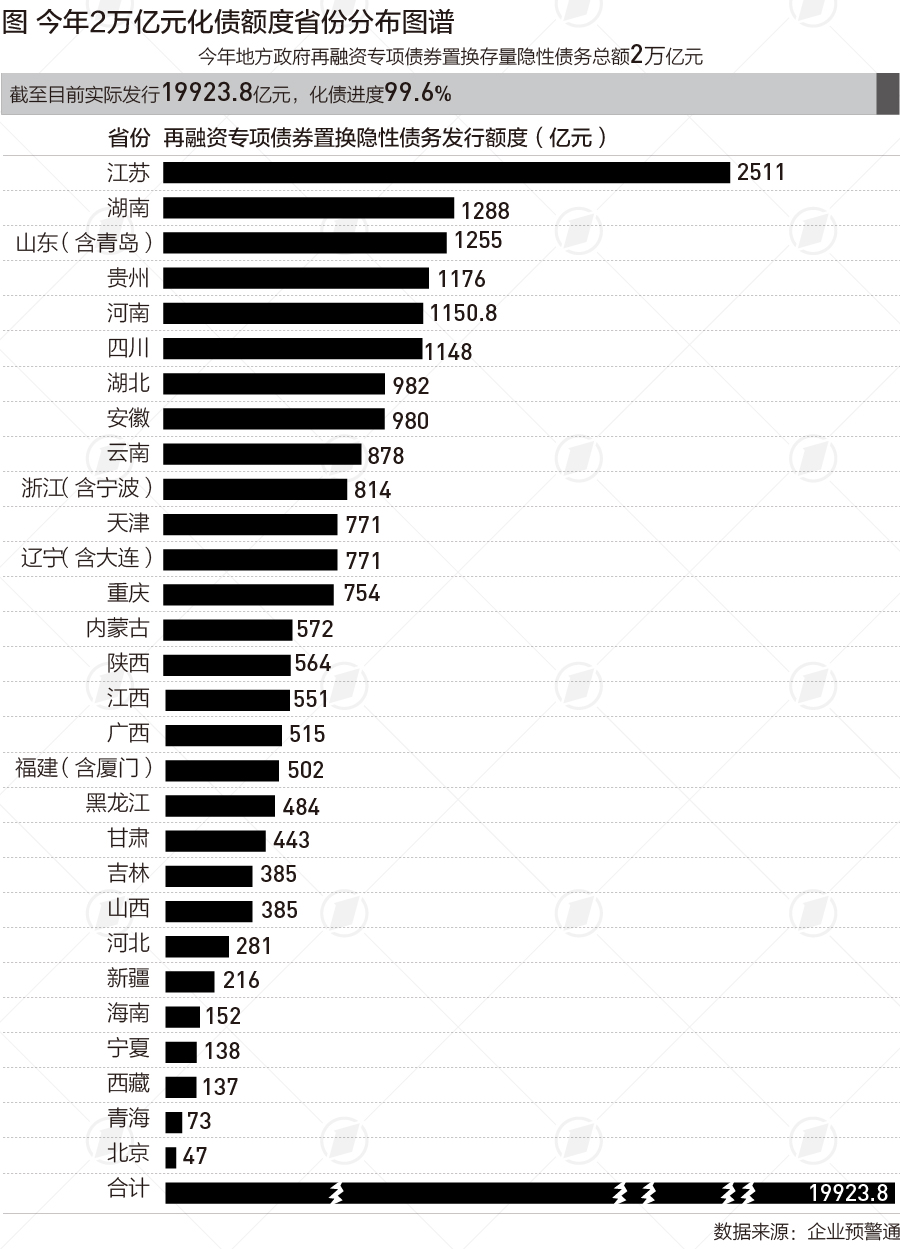
29省份化债近2万亿,江苏等六地超千亿|财税益侃
Di Yi Cai Jing· 2025-10-16 12:07
Core Viewpoint - The article discusses the issuance of special refinancing bonds by local governments in China to replace hidden debts, aiming to mitigate repayment risks and reduce interest costs. Group 1: Debt Replacement Plans - Local governments plan to issue a total of 2 trillion yuan in special refinancing bonds this year to replace 2 trillion yuan of existing hidden debts, thereby extending debt maturity and lowering interest rates [1] - As of October 16, 29 provinces have issued approximately 1.99 trillion yuan in refinancing bonds, nearly completing the 2 trillion yuan debt replacement plan for this year [1] - China plans to allow local governments to issue 2 trillion yuan in refinancing bonds annually from 2024 to 2026, totaling 6 trillion yuan, with 4 trillion yuan already completed for 2024 and 2025 [1] Group 2: Provincial Debt Issuance - Jiangsu province leads with a planned issuance of 251.1 billion yuan in refinancing bonds for debt replacement, having received 753.3 billion yuan of the total 6 trillion yuan allocation [2] - Other provinces such as Hunan, Shandong, Guizhou, Henan, and Sichuan have issued over 100 billion yuan each, while Guangdong and Shanghai, as pilot regions for clearing hidden debts, did not receive any allocation [2] - Henan's issuance of 115.08 billion yuan this year is lower than last year's 122.7 billion yuan, indicating a remaining allocation of approximately 7.6 billion yuan [2] Group 3: Financial Impact - The average interest cost of replaced debts has decreased by over 2.5 percentage points, saving local governments more than 450 billion yuan in interest payments [3] - The debt replacement process has improved the asset quality of financial institutions, significantly reducing risks and enhancing their willingness and ability to lend to the real economy [4] Group 4: Future Plans and Recommendations - The remaining 2 trillion yuan for 2026 will be expedited, with suggestions to issue an additional 1 trillion yuan in local government bonds this year to further alleviate hidden debt risks [5] - Experts recommend adjusting the distribution of the 6 trillion yuan debt replacement strategy to better address local debt situations rather than spreading it evenly [5] Group 5: Overall Debt Safety - As of August 2025, the total local government debt stands at 53.2484 trillion yuan, remaining within the approved limit of 57.9874 trillion yuan [6]