
学科专业设置调整优化

Search documents
二〇二五十大教改热词发布
Ren Min Ri Bao Hai Wai Ban· 2026-01-11 23:07
Core Viewpoint - The article discusses the implementation of a three-year action plan for building a strong education system in China, highlighting various reforms and initiatives aimed at improving educational quality and accessibility across different levels of education [10]. Group 1: Educational Reforms - The "Big Ideological and Political Course" aims to integrate social resources into education, enhancing the teaching of the Communist Party's stories and promoting national rejuvenation [11]. - The initiative "Daily Exercise for 2 Hours" mandates that primary and secondary school students engage in at least two hours of physical activity daily, as part of a broader effort to reform school sports [12]. - The "Adjustment and Optimization of Academic Programs" focuses on aligning higher education disciplines with national strategic needs, resulting in the establishment of new programs in fields like artificial intelligence and integrated circuits [13]. Group 2: Higher Education Initiatives - "University Technology Transfer" is emphasized as a key reform to enhance the integration of education, technology, and talent, facilitating the conversion of academic research into practical applications [14][15]. - The "Excellence Engineer Training" program aims to cultivate high-level engineering talents through a collaborative education model that integrates industry needs with academic training [16]. - "Expansion of Quality Undergraduate Education" seeks to increase enrollment in top-tier universities while ensuring that the quality of education is maintained, particularly in emerging fields [19][20]. Group 3: Support for Rural Education - The "County High School Revitalization" plan aims to improve the quality of education in rural areas by optimizing resource allocation and enhancing teaching conditions [17]. - The "Free Year Before School" initiative will eliminate fees for the final year of preschool education in public institutions, addressing financial barriers for families [18]. Group 4: Vocational Education - The "New Dual High for Vocational Education" focuses on enhancing the quality of vocational training to better serve industry needs, with a significant proportion of programs aligned with major national industries [21]. Group 5: Collaborative Education Models - The "Education Alliance" initiative promotes collaboration among schools, families, and communities to support student development and address educational challenges [22].

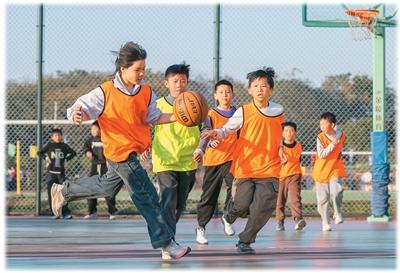
每天锻炼2小时、学前一年免费……2025十大教改热词发布
Ren Min Ri Bao· 2025-12-30 04:57
Core Viewpoint - The Ministry of Education and the National Language Resources Monitoring and Research Center have launched the "Top 10 Education Reform Buzzwords for 2025," highlighting key initiatives aimed at advancing educational reform and quality in China [40]. Group 1: Major Education Reform Buzzwords - "Big Ideological and Political Course" aims to integrate traditional ideological education with real-world examples to enhance students' understanding of socialist values and national stories [40][41]. - "Daily Exercise for 2 Hours" mandates that primary and secondary school students engage in at least 2 hours of physical activity daily, promoting health and fitness [42]. - "Adjustment and Optimization of Subject and Major Settings" focuses on aligning higher education programs with national strategic needs and industry developments, enhancing talent quality and adaptability [43]. - "Transformation of University Scientific Achievements" emphasizes the importance of converting academic research into practical applications to foster economic and social development [44][45]. - "Cultivation of Excellent Engineers" aims to develop high-level engineering talents through a collaborative education model that integrates industry needs with academic training [46]. - "County High School Revitalization" seeks to improve the quality of education in rural areas by optimizing resources and enhancing teaching conditions [47]. - "Free Year of Preschool Education" will eliminate fees for the final year of public kindergarten starting in the 2025 academic year, promoting educational equity [48]. - "Expansion of Quality Undergraduate Education" focuses on increasing enrollment in top-tier universities while ensuring quality through targeted adjustments in program offerings [50]. - "New Dual High Standards in Vocational Education" aims to enhance vocational training by aligning educational programs with industry demands and national strategies [51]. - "Education Collaborative Network" promotes cooperation among schools, families, and communities to support student development and well-being [52].
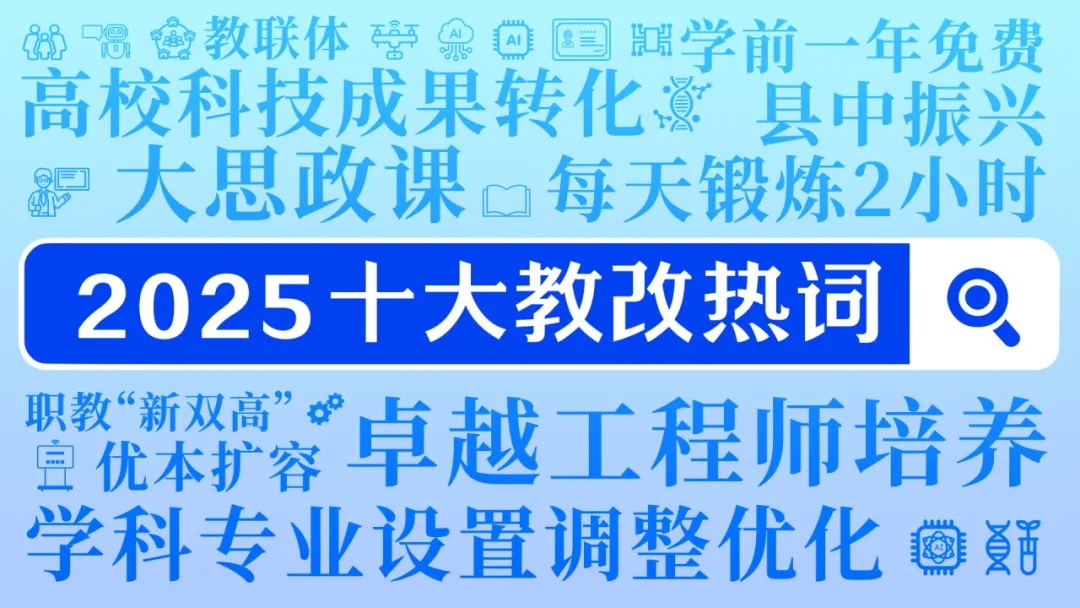
速递!2025十大教改热词发布
Bei Jing Ri Bao Ke Hu Duan· 2025-12-30 04:30
Core Viewpoint - The article discusses the "Top Ten Education Reform Buzzwords for 2025" released by the Ministry of Education, highlighting key initiatives aimed at advancing educational reform and strengthening the education system in China [3][4]. Group 1: Major Educational Initiatives - "Big Ideological and Political Course" aims to integrate social resources into education, focusing on practical education that aligns with Xi Jinping's thoughts on socialism with Chinese characteristics [3][4]. - "Daily Exercise for 2 Hours" mandates that primary and secondary school students engage in at least 2 hours of physical activity daily, as part of a broader initiative to enhance student health [6]. - "Adjustment and Optimization of Subject and Major Settings" involves systematic changes to higher education programs to better align with national strategic needs and industry developments, including the introduction of new disciplines like artificial intelligence and integrated circuits [7]. Group 2: Technology and Innovation in Education - "Transformation of University Scientific Achievements" focuses on enhancing the integration of education and technology, promoting the commercialization of research outcomes through various methods [8][9]. - "Cultivation of Excellent Engineers" emphasizes training high-level engineering talents through a collaborative education model that integrates industry needs and practical problem-solving [10]. Group 3: Enhancing Educational Access and Quality - "Revitalization of County High Schools" aims to improve the quality of education in rural areas by optimizing resource allocation and enhancing teaching conditions [11]. - "Free Year of Preschool Education" will eliminate fees for the final year of preschool education in public kindergartens starting in the fall of 2025, addressing public concerns about educational costs [12]. - "Expansion of Quality Undergraduate Education" seeks to increase enrollment in high-quality undergraduate programs, particularly in fields aligned with national needs [13]. Group 4: Vocational Education and Community Collaboration - "New Dual High Standards in Vocational Education" focuses on enhancing vocational education to better serve industry needs and societal development, with a strong emphasis on practical skills [14]. - "Educational Alliance" promotes collaboration among schools, families, and communities to support student development and address challenges in their growth [15][16].
教育部就《博士硕士学位授予资格审核办法》答记者问
Yang Shi Wang· 2025-12-25 06:33
Core Viewpoint - The newly revised "Measures for the Review of Doctoral and Master's Degree Granting Qualifications" aims to optimize graduate education and discipline settings in response to national strategic needs and technological development [2][3]. Group 1: Background and Purpose of the Revision - The revision of the "Measures" is driven by the central government's emphasis on graduate education and discipline optimization, serving as a key mechanism for high-level talent cultivation [2]. - Since the implementation of the "Degree Regulations" in 1980, the State Council Degree Committee has conducted 14 rounds of degree granting qualification reviews, leading to an increase in doctoral and master's degree granting institutions [2]. - The revision aligns with the requirements of the "Degree Law," which will be implemented in January 2025, necessitating updates to the management and quality assurance of degree granting qualifications [3]. Group 2: Key Directives of the Revision - The revision emphasizes three main directives: 1. Strategic demand, focusing on serving technological development and national strategic needs [4]. 2. Reform and decentralization, expanding the autonomy of local governments and universities in discipline settings [4]. 3. Quality standards, ensuring strict adherence to quality control and regulatory processes in degree granting qualifications [4]. Group 3: Implementation of Extraordinary Layout Review - The extraordinary layout review mechanism is designed to quickly establish degree granting points in response to urgent national needs, particularly in emerging fields [5][6]. - A pilot program has been initiated for low-altitude technology and engineering, with 24 universities authorized to establish related degree granting points [5]. Group 4: Expansion of Autonomous Review Units - Since 2017, 38 universities have been approved as autonomous review units, allowing them to independently review and establish new degree granting points [7][8]. - A total of 441 doctoral and 454 master's degree points have been added through this autonomous review process, focusing on key areas such as integrated circuits and artificial intelligence [8]. Group 5: Role of Provincial Degree Committees - Provincial degree committees are tasked with optimizing local discipline settings and ensuring alignment with regional economic needs [9]. - They are responsible for dynamically adjusting degree granting points and ensuring quality control in the review process [9]. Group 6: Quality Assurance Measures - Quality assurance is critical, with strict standards and procedures established for the review process [10]. - Regular evaluations of autonomous review units will be conducted to ensure compliance with quality standards, with potential penalties for non-compliance [10].
教育部学位管理与研究生教育司负责人就《博士硕士学位授予资格审核办法》答记者问
Xin Lang Cai Jing· 2025-12-25 06:05
Core Viewpoint - The newly revised "Measures for the Review of Doctoral and Master's Degree Granting Qualifications" aims to optimize graduate education and discipline settings in response to national strategic needs and technological development [2][3]. Group 1: Background of the Revision - The revision is driven by the central government's emphasis on graduate education and discipline optimization, with the State Council's Degree Committee having conducted 14 rounds of degree granting qualification reviews since 1980 [2]. - As of now, there are 504 doctoral degree granting institutions and 863 master's degree granting institutions in China, reflecting an ongoing optimization of discipline structures and enhancement of high-level talent cultivation capabilities [2]. Group 2: Key Directives of the Revision - The revision emphasizes three main directives: 1. Strategic Demand: Aligning degree granting qualifications with national strategic needs and enhancing talent supply-demand adaptability [4]. 2. Reform and Decentralization: Expanding the autonomy of local governments and universities in discipline settings, allowing for dynamic adjustments [4]. 3. Quality Standards: Establishing strict quality standards and regulatory mechanisms to ensure orderly and standardized review processes [4]. Group 3: Implementation of Extraordinary Layout Review - The extraordinary layout review mechanism is designed to quickly establish degree granting points in response to urgent national needs, such as the recent pilot for low-altitude technology and engineering [5][6]. - The State Council's Degree Committee will refine this mechanism based on pilot experiences, focusing on strategic emerging industries and enhancing adaptability in discipline settings [6]. Group 4: Expansion of Autonomous Review Units - Since 2017, 38 universities have been approved as autonomous review units, which can independently conduct reviews for new degree granting points [7][8]. - A total of 441 doctoral points and 454 master's points have been added through this autonomous review process, with a focus on key areas like integrated circuits and artificial intelligence [8]. Group 5: Role of Provincial Degree Committees - Provincial degree committees are tasked with optimizing local discipline settings and ensuring that degree granting points align with regional economic needs [9]. - They are responsible for dynamically adjusting degree granting points and maintaining quality standards in the review process [9]. Group 6: Quality Assurance Measures - Quality assurance is critical, with strict adherence to review procedures and conditions to ensure high standards in degree granting qualifications [10]. - The State Council's Degree Committee will conduct evaluations every three years and monitor the quality of newly established degree granting points [10].
教育部:工程教育占到我国高等教育人才培养规模的1/3
Jing Ji Guan Cha Bao· 2025-12-12 05:49
Core Viewpoint - The Ministry of Education in China is reforming the training of outstanding engineers to enhance the integration of education and industry, focusing on key strategic areas such as integrated circuits and artificial intelligence, which are crucial for national development [1][2]. Group 1: National Strategy Orientation - The reform emphasizes alignment with national strategic needs, concentrating on 18 key areas, leading to a significant adjustment in academic disciplines and professional settings [1]. - Over 20% of academic programs have been optimized in 2023 alone, enhancing the overall structure of disciplines and strengthening talent cultivation [1]. Group 2: Updating Academic Content - The reform employs innovative paradigms such as "Four Commons" and "Four Connections" to systematically reshape core elements like curriculum, faculty, and teaching methods, resulting in a comprehensive upgrade of academic content [2]. - This successful practice provides a reference for updating the content of other academic disciplines [2]. Group 3: New Evaluation Standards - A new evaluation standard has been established, replacing traditional thesis requirements with practical outcomes, which is expected to drive deeper integration across education, talent, industry, and innovation chains [2]. - The first batch of engineering master's graduates includes over 60 individuals who obtained degrees based on practical achievements, indicating a shift towards a more application-oriented evaluation system [2].
超30个“双一流”高校新校区,进入大规模建设阶段
Di Yi Cai Jing· 2025-12-03 12:44
Core Viewpoint - A number of prestigious universities in China are establishing new campuses and colleges to enhance the quality and capacity of higher education, particularly in response to the growing demand for quality undergraduate education and the adjustment of academic disciplines [2][3][5] Group 1: New Campus Developments - Nanjing University of Aeronautics and Astronautics is set to establish a new campus in Jiangbei New District, covering an area of approximately 265,900 square meters [2] - Southeast University has confirmed plans to build a new campus in Nantong, collaborating with the local government [2] - Over 30 "Double First-Class" universities are entering large-scale construction phases for new campuses to improve educational facilities and student accommodations [2] Group 2: Educational Policy and Strategic Goals - The Central Committee's proposal emphasizes the need to enhance the quality and capacity of higher education, aiming to expand the enrollment of quality undergraduate programs [3] - The current gross enrollment rate in higher education in China exceeds 60%, but the proportion of quality undergraduate programs remains low, indicating a need for improvement [3] - The Ministry of Education's action plan for 2025-2027 focuses on optimizing academic disciplines and professional settings, targeting strategic emerging industries and future industries [4] Group 3: New Academic Programs and Disciplines - A series of new colleges are being established by "Double First-Class" universities, focusing on urgent national needs in cutting-edge technologies and emerging industries such as artificial intelligence, aerospace technology, and quantum science [5] - The action plan includes initiatives for rapid deployment of urgently needed academic disciplines, support for foundational disciplines, and the establishment of interdisciplinary centers [4]
市委教育科技人才工作领导小组会议召开
Bei Jing Ri Bao Ke Hu Duan· 2025-09-15 22:44
Group 1: International Science Organizations - The meeting emphasized the importance of attracting more international science organizations to Beijing to enhance the city's role in global technological innovation [1] - It highlighted the need for a dual approach of attracting and nurturing leading enterprises and institutions to establish international science organizations [1] - The development of a first-class environment and the construction of headquarters clusters for international science organizations were underscored [1] Group 2: High-Level Scientific Journals - The meeting stressed the significance of scientific journals as platforms for showcasing and disseminating research results [2] - It called for the establishment of more high-level scientific journals in Beijing, focusing on strategic and emerging fields [2] - The need for improved publishing platforms and a better ecosystem for scientific journal development was highlighted [2] Group 3: Academic Discipline Optimization - The meeting pointed out that academic disciplines are crucial to modern higher education systems and should align with technological development and national strategic needs [2] - It advocated for the adjustment of academic disciplines to meet urgent industry demands, particularly in artificial intelligence and emerging industries [2] - The importance of interdisciplinary integration and innovative training models was emphasized to cultivate high-quality, versatile talents [2] Group 4: Excellence in Engineering Education - The meeting identified the need to build a world-class training system for outstanding engineers, focusing on national strategic directions [3] - It emphasized the integration of education and industry, promoting collaboration between schools and enterprises [3] - The establishment of new city-level industry-education integration bases in key fields like AI and biomedicine was discussed [3] Group 5: Postdoctoral Incentive Program - The meeting recognized the postdoctoral incentive program as a key initiative for building a high-level talent hub [3] - It called for enhanced collaboration between central and local governments to improve postdoctoral station construction [3] - The need for dynamic evaluation and policy measures to support postdoctoral work in Beijing was highlighted [3]
人才培养如何跟上社会需要(政策问答·回应关切)
Ren Min Ri Bao· 2025-09-14 22:03
Group 1 - The article emphasizes the importance of aligning talent cultivation with the needs of the economy and society, highlighting recent government policies aimed at improving this alignment [1][2][3] - A national big data platform for talent supply and demand has been initiated by the Ministry of Education, which has gathered 4.07 billion data entries to enhance the precision of talent supply and demand matching [1] - The "Action Plan for Adjusting and Optimizing Higher Education Disciplines and Majors (2025-2027)" has been issued to optimize academic disciplines in response to national strategic needs, focusing on urgent disciplines and optimizing existing ones [2] Group 2 - The article discusses the need for dynamic monitoring of talent cultivation to anticipate changes in supply and demand, including the development of analysis reports at various levels [2][3] - It highlights the importance of tracking employment status and linking it with enrollment plans and talent cultivation, encouraging collaboration between local governments and enterprises to provide personalized employment guidance [3] - The Ministry of Education plans to implement comprehensive reforms in the talent cultivation supply-demand matching mechanism to support the optimization of academic disciplines and talent training models driven by technological development and national strategic needs [3]
江苏试点高校学科专业设置调整优化到2027年超85%新增专业瞄准“急需”
Xin Hua Ri Bao· 2025-09-10 23:28
Core Viewpoint - The Jiangsu Provincial Education Department has announced a plan to optimize and adjust the discipline and major settings in higher education institutions, aiming for significant improvements by 2027 and full coverage by 2030 to support economic and social development [1][2]. Group 1: Implementation Actions - The plan includes four main actions: rapid layout of urgently needed disciplines, enhancement of discipline classification development, updating talent cultivation models, and deepening reform of discipline development mechanisms [2]. - A list of urgently needed disciplines will be published, and a mechanism for their extraordinary setup will be established to align with local industry needs [2]. - The plan aims to create a multi-dimensional evaluation system for disciplines and establish a warning and exit mechanism for underperforming programs [2]. Group 2: Industry Alignment - Jiangsu universities will focus on aligning academic disciplines with national strategic needs and local industrial innovation, particularly in fields like integrated circuits and low-altitude technology [3]. - Nanjing University is actively expanding its degree offerings in emerging interdisciplinary fields and establishing research centers to support innovation [3][4]. - Suzhou University has added six urgently needed majors in artificial intelligence over the past five years and is implementing a plan to create interdisciplinary innovation centers [4]. Group 3: Vocational Education - The plan also addresses vocational colleges, emphasizing the need for coordinated development across graduate, undergraduate, and vocational programs [5]. - Yangzhou Industrial Vocational Technical College has introduced 12 new majors in response to industry needs while discontinuing eight others, focusing on creating a responsive professional system [5].