
居民储蓄向资本市场转移

Search documents
公募发行“爆了”!增量资金正疯狂涌向A股
市值风云· 2026-02-27 10:14
Core Insights - The public fund issuance market has seen a significant increase in both the number and scale of new funds established in 2026, with 230 new funds launched and a total issuance scale exceeding 210 billion yuan [1][3]. Group 1: Fund Issuance Trends - The first week of trading in 2026 witnessed a high density and rapid pace of new fund launches, with 18 new funds starting their issuance on the first trading day alone [4][5]. - A total of 36 new funds were planned for issuance during the first trading week from February 24 to 27, 2026, with equity funds dominating the offerings [5][6]. - Among these 36 funds, 14 were actively managed equity funds and 11 were passive stock index funds, accounting for nearly 70% of the total [7]. Group 2: Comparative Analysis - In the first two months of 2026, the cumulative number of new funds reached 246, a significant increase compared to previous years: 177 in 2025, 212 in 2024, and 189 in 2023 [9][11]. - The increase in new fund issuance reflects a growing supply side in the public fund market, with more funds expected to launch in March 2026 [12][11]. Group 3: Fundraising Scale - The total fundraising scale for new funds in 2026 has surpassed 210 billion yuan, compared to less than 150 billion yuan in the same period in 2025, indicating a strong influx of capital into the market [15][18]. - Out of the new funds, 65 had an issuance scale exceeding 1 billion yuan, with 15 funds raising over 3 billion yuan each [17]. Group 4: Market Dynamics - The substantial growth in fundraising is attributed to improved market conditions that have enhanced investor willingness to enter the market, alongside a long-term trend of household savings shifting towards capital markets [18]. - The continuation of this influx of new capital is contingent upon the sustained "profitability effect" in the market, with expectations of a stable upward trend in the equity market for the year [19].

杨德龙:2026年市场大趋势研判投资机会依然较多
Xin Lang Cai Jing· 2026-02-21 10:44
Group 1: Market Trends - The overall adjustment in the Hong Kong stock market does not indicate a lack of opportunities for the year, as both A-shares and Hong Kong stocks are expected to continue a slow bull market with investment opportunities [2][8] - The Hang Seng Technology Index has experienced significant adjustments due to low growth in retail sales, affecting the performance of major internet companies [1][8] - The AI application and robotics sectors have seen a surge in investor confidence, particularly following their prominent display during the Spring Festival Gala [1][6] Group 2: Economic Policies - In 2026, macroeconomic policies are expected to be more proactive, with a moderately loose monetary policy aimed at supporting economic recovery and stabilizing prices [3][9] - The People's Bank of China is anticipated to maintain low interest rates and liquidity through measures such as interest rate cuts and reserve requirement ratio reductions [3][9] - The real estate sector is likely to see more supportive policies, with core urban properties beginning to attract demand after years of decline [3][10] Group 3: Investment Opportunities - The market is expected to attract more external capital, with a notable shift of household savings into the capital market as interest rates on deposits decline [4][11] - The demand for gold and silver is projected to grow, with long-term upward trends expected in international gold prices due to increasing government debt in the U.S. [5][12] - The technology sector, particularly in AI and robotics, is anticipated to be a key investment focus in 2026, with potential for significant returns despite the risk of market differentiation [6][13]
杨德龙:2026年A股和港股的投资机会依然较多
Xin Lang Cai Jing· 2026-01-23 07:51
Group 1 - The market shows resilience despite recent cooling, with a "spring offensive" anticipated as credit issuance peaks in January, potentially reaching 4 trillion RMB [1][8] - The first quarter is typically a "window" for companies to disclose earnings, allowing for market momentum as most companies do not report formal earnings during this period [1][8] - The discussion around investment returns during the previous year's Spring Festival has created a "wealth effect," attracting more retail investors into the market [1][8] Group 2 - A slow bull market has been established, with investor confidence gradually increasing, and skepticism about the bull market diminishing [2][8] - By 2026, approximately 50 trillion RMB in bank deposits will mature, prompting investors to choose between low-interest renewals or reallocating funds into stocks, bonds, or funds [2][8] - This shift indicates a potential acceleration of capital moving from savings to the stock market, providing additional liquidity [2][8] Group 3 - In 2025, technology stocks are expected to outperform traditional sectors, which are struggling during the economic transition [3][9] - New industries such as AI and semiconductor sectors are thriving, while traditional industries face significant challenges [3][9] Group 4 - The market is expected to deepen in 2026, with more sectors likely to experience rotation, as many traditional stocks are at historical lows and may present investment opportunities [4][10] - Investors will need to decide between high-flying tech stocks and undervalued traditional stocks, leading to diverse investment strategies [4][10] Group 5 - The U.S. financial market is experiencing a simultaneous decline in stocks, bonds, and the dollar, raising concerns about the stability of the dollar [5][11] - The rise in gold prices, nearing $4,800 per ounce, reflects a growing distrust in the dollar, with predictions of further increases in gold prices [5][11] Group 6 - A-shares are expected to outperform Hong Kong stocks, which in turn will outperform U.S. stocks, as domestic investors seek new opportunities in the capital market [6][12] - The potential for a "golden decade" in the A-share market is supported by the shift of residential savings into capital markets [6][12]
杨德龙:坚持正确的投资理念 把握我国经济转型带来的投资机会
Xin Lang Cai Jing· 2026-01-15 08:41
Group 1 - 2026 is seen as a year with significant opportunities, particularly for traditional blue-chip stocks that have been undervalued after years of adjustment [1][6] - Sectors such as consumer staples, new energy leaders, insurance, and brokerage firms are expected to present new investment opportunities despite their recent poor performance [1][6] - The investment community is advised to focus on companies with strong fundamentals and low valuations, as these may yield long-term benefits [1][6] Group 2 - There is potential for valuation recovery in sectors like new energy, insurance, and brokerage in 2026, although the recovery may not match the elasticity of technology stocks [2][7] - Technology stocks remain a key investment theme for 2026, but a broader rotation among sectors, including military and non-ferrous metals, is anticipated [2][7] - The shift of household savings towards capital markets is highlighted as a crucial factor for the formation of a slow bull market, especially as the real estate market faces downturns [2][7] Group 3 - Emphasis is placed on the importance of learning investment methods and adhering to value investment principles to achieve long-term wealth growth [3][8] - The concept of "Chinese-style value investing" is introduced, which combines industry research, company performance analysis, and appropriate position management [3][9] - Policy interpretation is crucial in this investment strategy, with a focus on sectors supported by government policies while avoiding those under restrictions [9] Group 4 - Three key investment recommendations include maintaining a long-term value investment approach, avoiding leverage, and continuously enhancing investment knowledge [10] - The current technological revolution necessitates a deep understanding of industry evolution to identify future-oriented sectors and competitive companies [10] - Investors are encouraged to treat investing as a lifelong endeavor, focusing on continuous improvement in their investment capabilities [11]
杨德龙:大盘实现16连阳站上4100点 牛市趋势进一步确立
Xin Lang Cai Jing· 2026-01-09 09:49
Group 1 - The Shanghai Composite Index has broken through the 4100-point mark for the first time in 10 years, with a trading volume exceeding 3 trillion yuan, indicating a strong bullish sentiment in the market [1][6] - The market has experienced a 16-day consecutive rise, suggesting that the 4000-point level is not the end of a market cycle but rather the beginning of a new one [1][6] - The bullish trend is supported by significant inflows of capital, particularly from retail investors, following a period of market adjustment in December [1][6] Group 2 - The underlying logic supporting the bull market in 2026 remains unchanged, including policy support, a shift of household savings to the capital market, and continuous foreign investment [2][7] - The bull market is expected to fulfill three historical missions: enhancing wealth for approximately 300 million stock investors and 700 million mutual fund investors, stabilizing the real estate market, and promoting technological innovation [2][8] - The real estate market is anticipated to stabilize and recover, particularly in core areas and first-tier cities, as investors may use returns from the stock market to improve housing conditions [8] Group 3 - The bull market is projected to last 3 to 5 years, or even 5 to 10 years, with annual growth rates expected to be between 10% and 20%, fostering a sustainable profit-making environment for investors [3][9] - Compared to the high valuations in the US stock market, A-shares and Hong Kong stocks are still near historical average valuation levels, indicating significant upside potential [3][9] - The transition from a golden investment period in the real estate market to a new golden investment period in the stock market is underway, driven by the shift of household savings [4][9] Group 4 - The bull market typically progresses through several stages, with the current phase characterized by a gradual upward trend and reduced market divergence expected in 2026 [10] - Key indicators to monitor include the issuance of new funds exceeding 10 billion yuan in a single day and daily trading volumes rising above 4 trillion yuan, which could signal a need for caution [10] - The market is currently in a continuation phase rather than a late-stage phase, suggesting that investors should maintain confidence and patience while focusing on quality stocks or funds [11]
杨德龙:2026年我国资本市场是大有可为的一年
Xin Lang Cai Jing· 2025-12-19 01:55
Group 1 - The core viewpoint is that the current slow bull market in A-shares is expected to continue for two to five years, with an annual index increase of 10% to 20% being common [1][7] - The market has entered a new phase, transitioning from a structure bull to a comprehensive bull market, with various sectors expected to perform, not just technology stocks [2][8] - The recent political meetings have set a positive tone for macroeconomic policies, which will further support the capital market and economic growth [3][9] Group 2 - There is a significant shift of household savings towards the capital market, with over 165 trillion yuan in deposits and a notable increase in new stock accounts and fund sales [4][10] - The stock market is seen as a historical investment opportunity, especially as the real estate investment phase ends, emphasizing the need for investors to adopt rational investment strategies [5][11] - The technology innovation sectors, including humanoid robots and AI, remain key investment themes, while consumer stocks are also expected to recover in valuation [3][9]
杨德龙:证监会主席吴清讲话高屋建瓴 大力推动资本市场高质量发展
Xin Lang Cai Jing· 2025-12-08 09:32
Core Viewpoint - The speech by the Chairman of the China Securities Regulatory Commission, Wu Qing, at the 8th Member Conference of the China Securities Association has positively impacted market sentiment, leading to a rebound in the capital market and enhancing investor confidence, which is crucial for the market's development in 2026 [1][7]. Group 1: Market Dynamics - The current bull market is characterized by a significant increase in trading activity, with daily transaction volumes exceeding 2 trillion yuan, indicating strong investor participation [2][8]. - The Shanghai Composite Index has surpassed the 4000-point mark, reflecting a preliminary formation of a slow bull market, which is expected to solidify investor confidence [2][8]. Group 2: Policy Implications - Wu Qing emphasized the need to moderately relax capital constraints for high-quality securities companies and optimize regulatory mechanisms, which is vital for the high-quality development of the securities industry [1][7]. - The integration and collaboration among securities firms through mergers and acquisitions are seen as essential steps towards creating "carrier-level" brokerages, which will alleviate competitive pressures and enhance industry quality [1][7]. Group 3: Investment Trends - There is a noticeable trend of household savings shifting towards the capital market, with nearly 25 million new stock accounts opened by the end of November 2025, and monthly account openings exceeding 2 million in some months [3][9]. - The issuance of equity funds has surpassed that of fixed-income funds, with new fund subscriptions reaching 1.06 trillion units in the first 11 months, indicating a shift in asset allocation among residents [3][9]. Group 4: Economic Impact - The current bull market is expected to drive three key missions: promoting consumer spending, improving household balance sheets through wealth effects, and providing efficient financing platforms for innovative enterprises [4][10]. - The healthy development of the capital market is crucial for supporting the real economy and technological innovation, with recent successful IPOs of prominent companies laying a foundation for future growth [4][10]. Group 5: Future Outlook - The trend of capital inflow from both domestic and foreign investors is anticipated to accelerate as the market transitions from a structural bull market to a comprehensive bull market by 2026 [5][11]. - The performance of brokerage stocks, typically a market barometer, is expected to improve in 2026 as macroeconomic policies take effect and investor confidence strengthens [6][12].
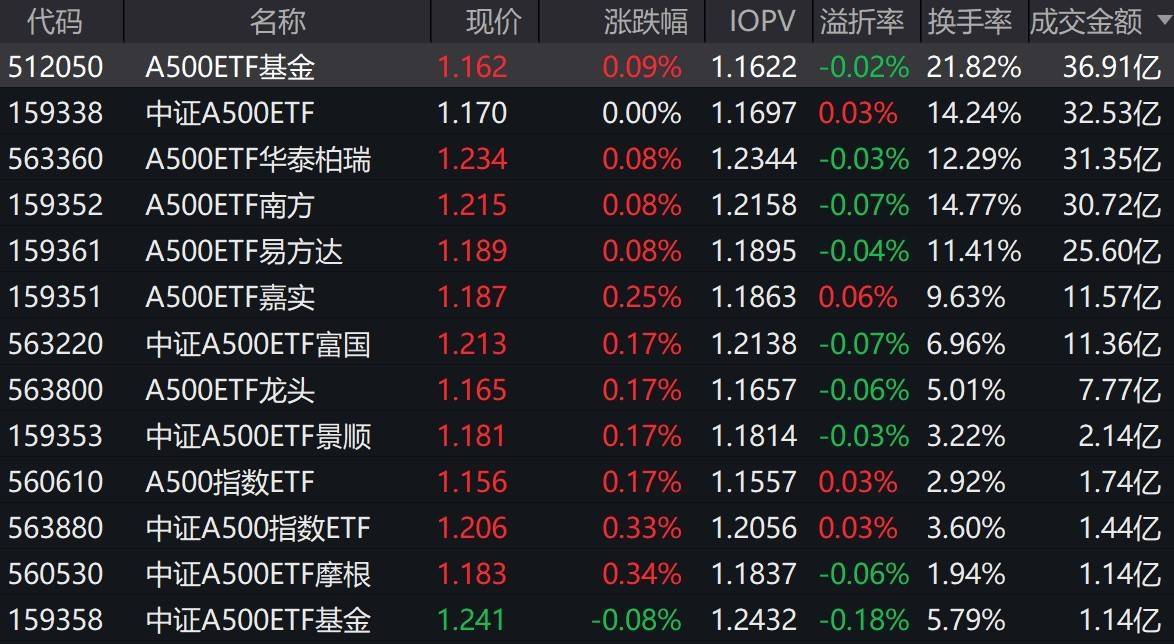
市场早盘震荡拉升,中证A500指数上涨0.19%,3只中证A500相关ETF成交额超31亿元
Sou Hu Cai Jing· 2025-10-16 04:00
Market Overview - The market experienced fluctuations in the early session, with the CSI A500 Index rising by 0.19% [1] - The semiconductor sector showed strength, particularly in storage chips, while the pharmaceutical sector continued its strong performance [1] - Conversely, stocks related to controlled nuclear fusion saw a collective decline [1] ETF Performance - As of the morning close, ETFs tracking the CSI A500 Index exhibited mixed results, with 13 ETFs having transaction volumes exceeding 100 million yuan, and 3 surpassing 3.1 billion yuan [1] - Specific transaction volumes for A500 ETFs included 3.691 billion yuan for A500 ETF Fund, 3.253 billion yuan for CSI A500 ETF, and 3.135 billion yuan for A500 ETF Huatai-PB [1] Earnings Outlook - Analysts predict that the upcoming third-quarter reports will show a rebound in profit growth across most industries due to a low base from the previous year, which is expected to bolster market confidence [1] - There is a noted shift of household savings towards the capital market, creating a sustained source of incremental funds [1] - The short-term outlook for the A-share market is expected to be characterized by steady fluctuations upward, with close attention needed on policy, funding, and external market changes [1]
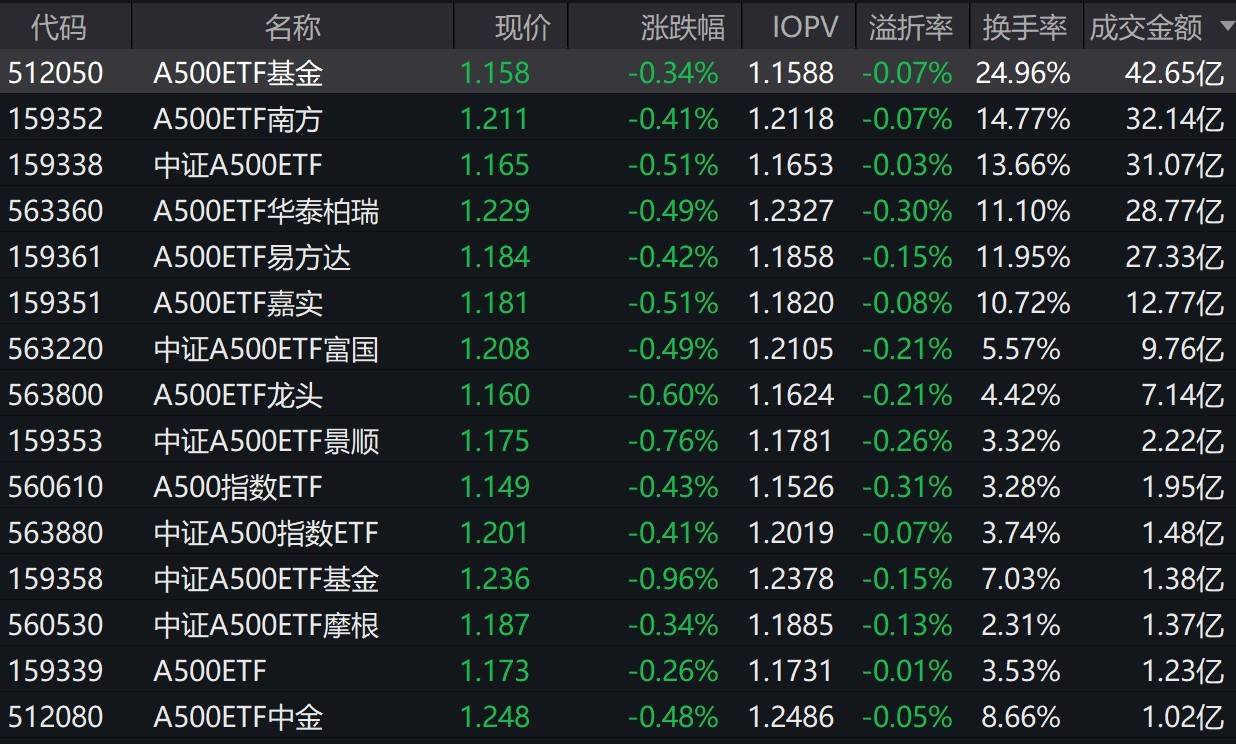
市场早盘高开低走,中证A500指数下跌0.5%,3只中证A500相关ETF成交额超31亿元
Sou Hu Cai Jing· 2025-10-14 03:51
Core Viewpoint - The market opened high but declined, with the CSI A500 index dropping by 0.5%. The financial sector showed resilience, particularly bank stocks, while the photovoltaic sector surged and liquor concept stocks strengthened. Conversely, chip concept stocks exhibited weakness [1]. Market Performance - The CSI A500 index ETF saw a slight decline, with 15 related ETFs trading over 100 million yuan, and 3 exceeding 3.1 billion yuan in trading volume. Specific trading volumes for A500 ETFs were 4.265 billion yuan, 3.214 billion yuan, and 3.107 billion yuan respectively [1]. Earnings Outlook - As October approaches, the third-quarter earnings reports are expected to show a rebound in profit growth across most industries due to a low base from the previous year. This is anticipated to bolster market confidence [1]. Capital Market Trends - There is a gradual shift of household savings towards the capital market, creating a sustained source of incremental funds. The A-share market is expected to experience steady fluctuations, with new investment opportunities emerging [1].
美联储降息25个基点有何影响?
Sou Hu Cai Jing· 2025-09-19 06:58
Group 1 - The Federal Reserve lowered the target range for the federal funds rate from 4.25%-4.50% to 4.00%-4.25%, a decrease of 25 basis points, primarily driven by weaker-than-expected non-farm employment data and inflation returning below 3% [1] - There is a possibility of a global central bank rate cut wave following the Fed's decision, with expectations for the People's Bank of China to have room for monetary policy easing to support the economy and stabilize the real estate and stock markets [2] - The shift in monetary policy may lead to a significant transfer of household savings to capital markets, as lower deposit rates make equities and funds more attractive, with a recommendation for investors to allocate around 20% of their portfolio to gold assets [3] Group 2 - The impact of the Fed's rate cut on global assets includes initial gains in U.S. stock indices followed by a quick pullback, while the dollar index experienced a drop but rebounded by the end of the trading session [2] - Historical trends suggest that Fed rate cuts typically support risk asset prices and alleviate capital outflow pressures in emerging markets, although the current economic conditions in Europe and Japan may limit the extent of dollar depreciation [4] - The Chinese yuan is expected to maintain stability, with a reduced risk of rapid appreciation or significant depreciation, as the narrowing of the China-U.S. interest rate differential alleviates depreciation pressure [4]