广场协议

Search documents
下调到0?央妈严防人民币升值过快,广场协议的陷阱,中国不能踩
Sou Hu Cai Jing· 2026-02-28 04:29
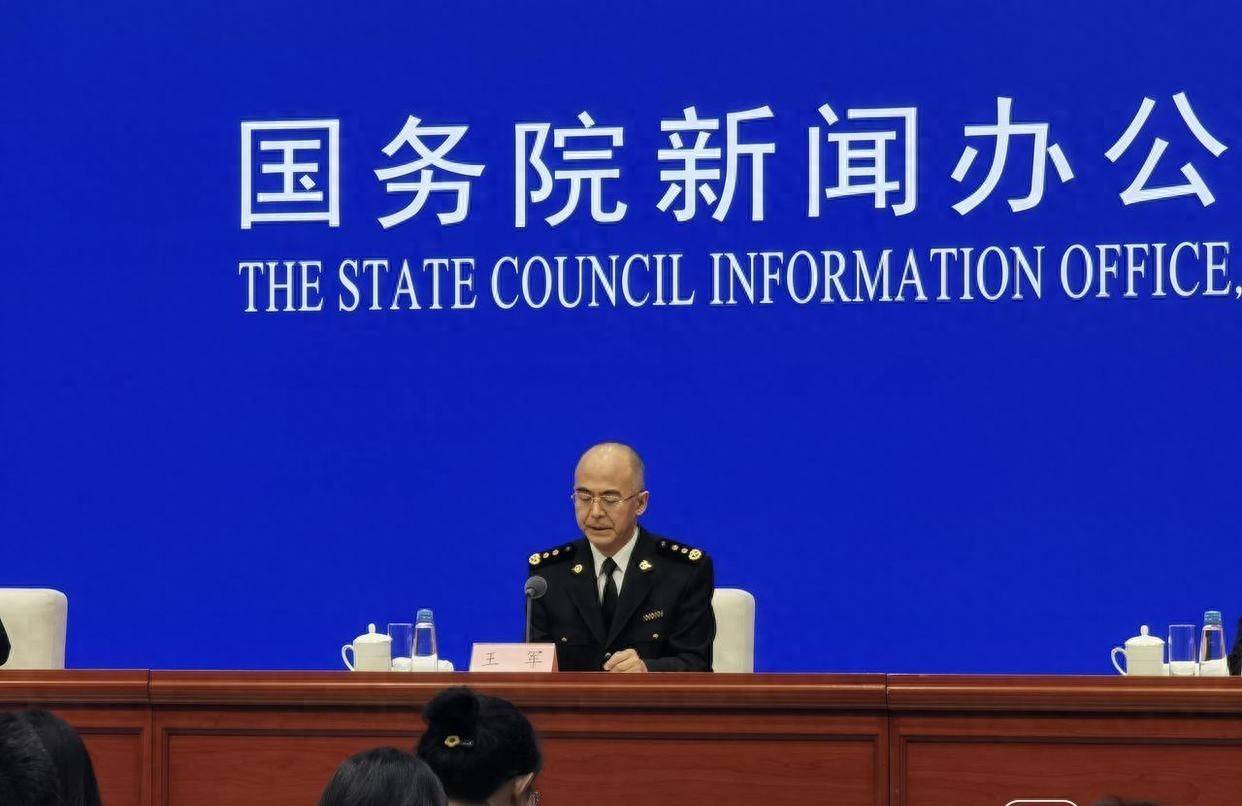
Core Viewpoint - The Chinese central bank has implemented urgent policies to stabilize the yuan amid significant fluctuations in the foreign exchange market, aiming to counteract the rapid appreciation of the currency and prevent a potential financial crisis [2][11][30]. Group 1: Central Bank Policy Actions - On February 27, the People's Bank of China announced targeted foreign exchange market control policies, effective March 2, which included reducing the foreign exchange risk reserve ratio for forward sales from 20% to 0% [6][11]. - The previous 20% reserve requirement increased costs for banks and ultimately for enterprises, making it more difficult for them to engage in forward foreign exchange transactions [8][11]. - The central bank's decision to eliminate this reserve requirement aims to lower the costs for enterprises hedging against exchange rate risks and to stabilize the foreign exchange market [11][23]. Group 2: Market Dynamics and Impacts - As of early 2026, Chinese enterprises held foreign exchange deposits totaling $932.2 billion, nearly equivalent to Germany's annual GDP, reflecting a significant accumulation of foreign exchange positions [16]. - The rapid appreciation of the yuan has led to substantial exchange rate losses for companies holding foreign exchange, negating the benefits of interest rate differentials they previously enjoyed [18][21]. - In response to these losses, many enterprises began to sell dollars and buy yuan to lock in losses, which further exacerbated the yuan's appreciation and created a feedback loop of market pressure [21][23]. Group 3: Historical Context and Global Considerations - The central bank's policy adjustment is informed by historical precedents, particularly the 1985 Plaza Accord, which serves as a cautionary tale against allowing external forces to manipulate domestic economic conditions through currency interventions [26][28][30]. - The central bank has emphasized that it will not permit excessive unilateral appreciation of the yuan or abnormal capital flows, aiming to maintain stability in the foreign exchange market [30]. - The recent policy changes are part of a broader strategy to respond to global monetary dynamics and to safeguard the yuan's pricing power in the international market [24][30].

马克龙想效仿美国,对华搞“广场协议”,中国凭什么答应?
Sou Hu Cai Jing· 2026-02-16 09:29
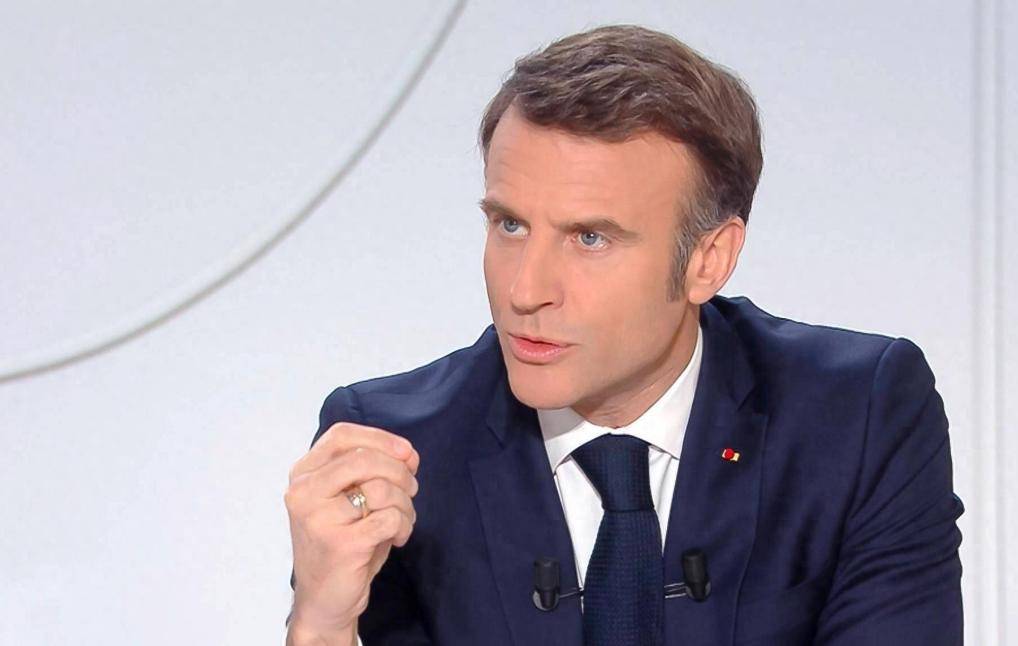
Core Viewpoint - The French government think tank has released a report indicating that European industries are being overwhelmed by China, and urgent measures are needed to avoid a crisis of survival [1] Group 1: Proposed Solutions - The report suggests two potential solutions: imposing a 30% tax on all Chinese goods or implementing a "Plaza Accord" style agreement to devalue the euro against the yuan by 30% [3] - The imposition of tariffs is seen as a form of trade protectionism aimed at raising import costs to protect domestic industries [3] - However, the effectiveness of such measures is contingent on various factors, including supply chains and infrastructure, making rapid development challenging [3] Group 2: Economic Implications - High tariffs on foreign goods may lead to increased costs for domestic consumers, ultimately burdening the local population [5] - Devaluing the currency is intended to stimulate exports by allowing more euros to be obtained for the same amount of yuan, thus encouraging European industrial exports [5] - Nonetheless, currency devaluation can lead to negative consequences such as decreased purchasing power and heightened inflation [5] Group 3: Historical Context and Feasibility - The report draws parallels to the 1980s Plaza Accord, which aimed to devalue the dollar to enhance U.S. export competitiveness but did not resolve the underlying economic issues [7] - The French approach to replicate the Plaza Accord with China is deemed unrealistic, as China is unlikely to accept coercive agreements [7] - The historical context suggests that industrial development relies on strong capabilities rather than suppressing competitors, questioning the effectiveness of such strategies [9]

法国“酒不醉人人自醉”!法官方放狠话,要跟中国搞“广场协议”
Sou Hu Cai Jing· 2026-02-15 07:46
Core Viewpoint - The French government has issued strong statements against China, claiming that China poses a threat to European industry and suggesting the implementation of tariffs and a potential agreement similar to the "Plaza Accord" [1][3]. Group 1: French Government's Position - A provocative report from a French advisory body claims that European industry is being crushed by China's economic power, warning of a "survival crisis" if unconventional measures are not taken [1][3]. - The report suggests imposing a 30% tariff on Chinese goods to protect European industries, which contradicts President Macron's previous calls against trade protectionism [3]. - The French government is also considering a drastic measure of devaluing the euro against the yuan by 30%, mimicking the historical "Plaza Accord" strategy used against Japan [3]. Group 2: China's Response - Chinese media has responded sharply, advising France to reconsider its stance, indicating that the proposed measures lack practical significance and are unlikely to be accepted by China [3][7]. - The response highlights that such measures would violate World Trade Organization rules and could lead to a trade war, which would not benefit either party [7]. - If the EU were to implement these tariffs, it could trigger retaliatory measures from China, including anti-dumping investigations on European products, particularly French wine, which could significantly impact the French wine industry [7]. Group 3: Economic Context - The underlying issues facing European industry are attributed to rising energy costs due to the Russia-Ukraine conflict and global supply chain disruptions, rather than solely the influence of Chinese imports [5]. - Even if the euro were to depreciate, it would not resolve the structural and energy-related challenges faced by European industries [5]. - The historical context of the "Plaza Accord" suggests that the EU lacks the collective strength to effectively challenge China as the U.S. did with Japan, indicating limited potential benefits from such an agreement [5].
30%关税还是30%升值?法国这波操作,连自己媒体都看不下去了!
Sou Hu Cai Jing· 2026-02-14 09:59
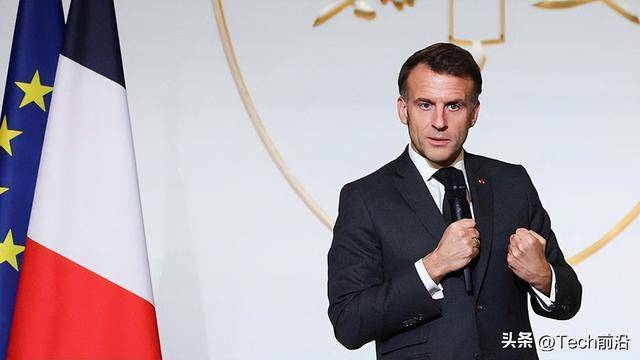
2月上旬,法国政府突然投下一枚震撼弹,在政府报告中渲染欧洲工业如何在中国面前面临"生存危 机",更提出了对抗性极强的经济干预建议,要么是全面对中国征收高达30%的关税,要么就是让欧元 对人民币汇率直接贬值30%,被广泛解读为针对中国的"广场协议"。 可法国执意发布,有四大核心动机。 第一,是国内的政治经济压力迫使法国政府"唱高调"。 不只是法国,欧洲核心区正在面临"去工业化"的切肤之痛,自2023年以来,仅德国就损失了20多万个工 业岗位,同时法国这边的高端制造业,也面临中国这边的强势竞争。 面对各方压力,马克龙需要迅速找到一个"替罪羊",何况他过去没少谈及中欧经贸不平衡。在这份报告 的语境下,中国扮演了参照物和竞争对手的双重角色。 而激进的干预措施,往往被视为"立竿见影",在政治层面会带来一定正向反馈,至少这段时间,法国的 这份报告确实引发了很高的讨论度。 第二,是要在欧盟层面主导议事进程。法国长期以来对欧盟 "过于天真" 的自由贸易政策持颇有微词。 通过复刻"广场协议"这样的极端选项,法国意在重新引导欧盟的政策重心。其逻辑不外乎是,把屋顶掀 了就会有人同意开窗,但前提是,法国得具有这个掀屋顶的能力。 连法 ...
27国要对我们加税30%?法国打响第一枪,美财长一句话定义中美关系
Sou Hu Cai Jing· 2026-02-14 04:41
Group 1 - France has proposed a significant government report suggesting that EU member states impose a 30% tariff on Chinese goods to address the trade deficit with China [2][10] - The report indicates that 55% of manufacturing output in the EU faces direct competition from China, with Germany at 70% and France at 36% [10][12] - The proposed tariffs are seen as a desperate measure to level the playing field, as Chinese products have a cost advantage of approximately 30% [12][14] Group 2 - The report reflects France's panic over its industrial decline, as it attempts to unify EU member states against China, despite differing interests among countries like Germany [15][18] - The U.S. Treasury Secretary's comments about being in a "comfortable position" regarding U.S.-China relations suggest a shift in strategy, moving from aggressive confrontation to a more pragmatic approach [20][22] - The U.S. has recognized that a hardline approach against China has not yielded the desired results, leading to a focus on "de-risking" rather than complete decoupling [24][26] Group 3 - France's proposal to manipulate the euro's value against the yuan is reminiscent of the 1985 Plaza Accord, which aimed to address trade imbalances through currency intervention [30][31] - The differences between China and Japan during the Plaza Accord era highlight China's current economic independence and robust domestic market, making such proposals less feasible [33][35] - The report indicates that France's protectionist measures may not effectively address the underlying issues of industrial competitiveness and could lead to further economic challenges [35][37]
法国想复制广场协议,30%关税压中国?时代变了,这招不灵了!
Sou Hu Cai Jing· 2026-02-12 04:42
Core Viewpoint - The report from the French Institute for Strategic and International Relations (IRIS) indicates that European industry is facing a survival crisis due to competition from China, proposing two radical solutions: imposing a 30% tariff on Chinese goods and devaluing the euro by 20% to 30% against the yuan [1][5][12] Group 1: Proposed Solutions - The first proposal suggests a 30% tariff on Chinese goods, which may face significant opposition from EU member states due to their reliance on the Chinese market for various industries, including automotive and luxury goods [7][9] - The second proposal involves devaluing the euro by 20% to 30%, which could lead to increased import costs and inflation, particularly affecting countries like Germany that are sensitive to inflation [7][9] Group 2: Historical Context and Comparison - The report draws parallels to the 1985 Plaza Accord, where the U.S. pressured Japan to appreciate the yen, resulting in long-term economic stagnation for Japan [3][5][12] - The current situation is different as China has a strong military and economic position, making it less susceptible to external pressures compared to Japan in the 1980s [5][12] Group 3: Economic Implications - If tariffs are implemented, European consumers would face higher prices, and Chinese companies could circumvent tariffs by relocating production or utilizing alternative markets [9][10] - A devaluation of the euro could lead to increased import costs, capital outflows, and potential financial instability in Europe, particularly affecting countries with high debt levels [10][12] Group 4: Underlying Issues - The report reflects a broader anxiety within Europe regarding its industrial decline and the need for innovation and structural optimization rather than relying on administrative and monetary measures to suppress competition [12]

国信证券晨会纪要-20260129
Guoxin Securities· 2026-01-29 01:00
Macro and Strategy - The report discusses the global economic changes and compares the current situation to the "Plaza Accord," indicating that recent interventions in the yen are not a direct repetition of past events but rather a response to Japan's fiscal narrative and asset repricing [7][8] - It highlights the dual pressure on Japan's economy from rising debt and currency stability, suggesting that if the yen continues to weaken, Japan may need to sell foreign assets, which could negatively impact US Treasury bonds [7][8] - The report anticipates a revaluation of asset prices, with resource commodities expected to see a systemic revaluation due to a weak dollar and geopolitical factors [8] Industry and Company - The report provides an analysis of the performance of the four major US banks in 2025, noting that while they maintained good profit growth due to credit expansion and resilient net interest margins, there are significant concerns regarding asset quality deterioration and rising provisioning pressures [15][16] - JPMorgan Chase reported a slight decline in net profit, while Bank of America, Citigroup, and Wells Fargo showed profit increases, with the latter two benefiting from improved consumer confidence and capital market recovery [15][16] - The report on Daikin Heavy Industries indicates a projected net profit increase of 137% year-on-year for 2025, driven by rapid growth in overseas offshore wind deliveries and enhanced service capabilities [16][17] - The company is expanding its production capabilities with new vessels and facilities, positioning itself for significant order growth in the offshore wind sector, particularly following a successful bid in the UK [17][18]
宏观经济深度报告:全球变局(2):“广场协议”再现?
Guoxin Securities· 2026-01-28 15:01
Group 1: Macroeconomic Context - The recent intervention in the yen's depreciation is not a repeat of the Plaza Accord but rather a re-pricing of assets under Japan's fiscal narrative[1] - The yen's decline has been accompanied by a rare simultaneous weakening of Japanese government bonds, driven by ineffective interest rate differentials and fiscal expansion expectations[1][3] - The Japanese government's strong fiscal narrative has led to increased government bond issuance and short-term debt supply pressure, resulting in rising interest rates[1][6] Group 2: US-Japan Cooperation - A coordinated effort between the US and Japan to stabilize the yen is seen as a "Nash equilibrium" to avoid significant selling pressure on US Treasuries[2] - If the US does not intervene, Japan's strategy would likely involve selling US Treasuries to stabilize the yen, which would exert significant downward pressure on US bonds[2][30] - The US's intervention aims to manage expectations rather than implement a substantial revaluation of the currency, focusing on stabilizing the Japanese yen[20][34] Group 3: Future Asset Pricing - Asset prices are entering a re-pricing window, with the yen expected to remain weak but potentially stabilize in a range due to political constraints and market pressures[3][34] - The long-term support for the US dollar is influenced by geopolitical factors and resource security, while short-term movements are constrained by Federal Reserve policies[3][37] - Resource commodities are undergoing a systemic re-evaluation, with both nominal and real values expected to rise due to a weak dollar and geopolitical tensions[3][42]

大选年美元贬值成双刃剑,特朗普恐打开“潘多拉魔盒”!
Jin Shi Shu Ju· 2026-01-28 09:18
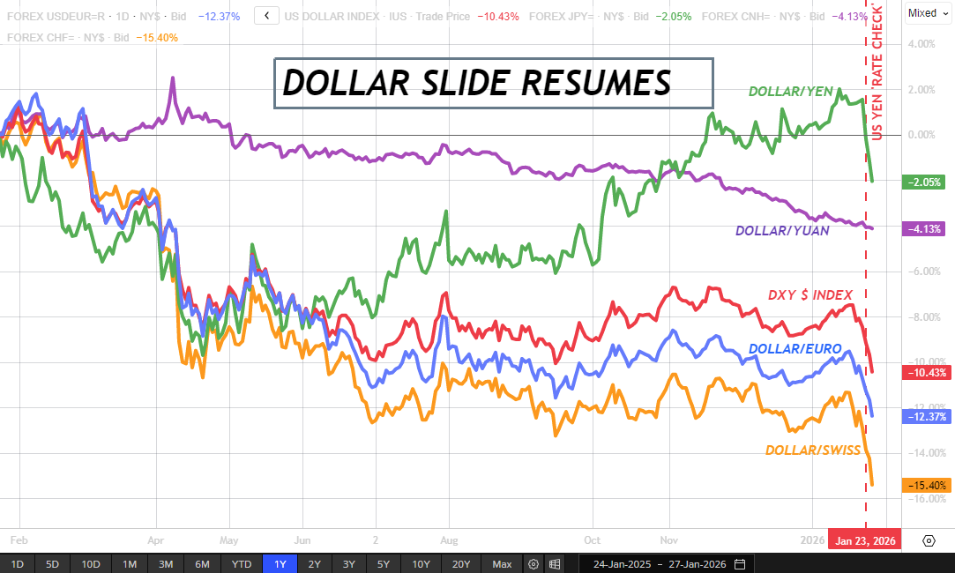
Core Viewpoint - The U.S. dollar is experiencing a significant decline, prompting speculation that the U.S. government may take concrete actions to lower the dollar's value and reshape global trade dynamics, moving beyond mere verbal statements [1][4]. Group 1: Dollar's Performance and Market Reactions - The dollar index has recorded its worst performance in the first half of 2025 since the floating exchange rate era, dropping to its lowest level since early 2022 [2]. - The dollar's decline is not limited to the Japanese yen; other currencies such as the South Korean won, Chinese yuan, and Australian dollar have also seen gains, with the euro reaching a nearly five-year high [1][3]. Group 2: Government Actions and Speculations - Speculation arises that the Trump administration aims to significantly reduce the dollar's real exchange rate, which has appreciated nearly 50% over the past decade, as a strategy to narrow the U.S. trade deficit [4]. - The U.S. Treasury Secretary's ambiguous stance on the dollar's value and recent actions to support the Japanese yen have intensified market speculation about potential U.S. intervention in the currency market [6]. Group 3: Economic Implications and Risks - The potential for a significant dollar depreciation raises concerns about the stability of U.S. assets held by foreign investors, which exceeded $27 trillion by the end of last year [7]. - A sudden and substantial drop in the dollar could complicate the Federal Reserve's policy-making, especially in the context of rising inflation concerns and political pressures [9]. - Analysts suggest that achieving a weaker dollar while avoiding market turmoil is a challenging balancing act, particularly given the current geopolitical and domestic political tensions [10].
不装了:美国掏出“广场协议”的刀,却发现中国脖子比刀还硬
Sou Hu Cai Jing· 2026-01-17 18:03
Group 1 - The U.S. heavily relies on imports from China, with 99% of toasters, 98% of umbrellas, and 95% of holiday fireworks sourced from China, indicating a significant dependency on Chinese goods for everyday products [2] - The trade war initiated by the Trump administration, imposing a 60% tariff, has resulted in an annual additional cost of $2,400 per American household, effectively acting as an "inflation tax" [2] - The U.S. exports to China have decreased by 18.9%, while China's exports to ASEAN and Africa have surged by 8.5% and 27.6% respectively, highlighting a shift in trade dynamics [4] Group 2 - China's export structure has evolved, with electric vehicles seeing a 99.9% year-on-year growth and solar components accounting for 80% of global production, indicating a strong position in high-tech exports [4][5] - The U.S. manufacturing sector is struggling, with only 10.2% of its GDP coming from manufacturing and a projected shortfall of 1.9 million manufacturing jobs in the future [9] - China's manufacturing value added is $4.44 trillion, surpassing the combined total of the U.S., Japan, and Germany, showcasing its dominance in industrial production [9] Group 3 - U.S. attempts to replicate the "Plaza Accord" are unlikely to succeed due to China's independent economic and defense capabilities, as well as its control over currency valuation tools [7] - The U.S. government's debt interest payments exceed $7 trillion, with daily interest payments of $19.8 billion, reflecting a precarious fiscal situation [9] - China's self-sufficiency in the photovoltaic industry has reached a 95% localization rate for core equipment, pushing foreign competitors out of the market [11] Group 4 - The IMF has raised its forecast for China's economic growth in 2025 to 5%, predicting that China will contribute approximately 30% to global economic growth [13] - The $1.08 trillion trade surplus reflects a global market response to China's economic resilience, indicating a shift away from U.S. financial dominance [13] - China's advancements in innovation and manufacturing capabilities are solidifying its position in the global supply chain, countering U.S. attempts to impose restrictions [13]