
日元干预

Search documents
日本前汇市高官献策:阻贬日元需“组合拳”,单边干预“药效”不及“干预+加息”持久
智通财经网· 2026-02-06 07:25
Core Viewpoint - The use of foreign exchange reserves for market intervention can have an immediate impact on exchange rates, but its effects will be more lasting if accompanied by a steady interest rate hike from the Bank of Japan [1] Group 1: Market Intervention and Interest Rates - Former senior foreign exchange official Takehiko Nakao emphasized that direct market intervention can create a strong influence, but a clear commitment to gradual interest rate increases by the Bank of Japan would enhance the durability of this impact [1] - The Bank of Japan raised the short-term policy interest rate to 0.75% in December last year and indicated readiness to continue increasing borrowing costs [1] - Nakao attributed the weakness of the yen to the Bank of Japan's continued accommodative stance, suggesting that a slow pace of interest rate hikes has resulted in significantly negative real interest rates adjusted for inflation [1] Group 2: Inflation and Currency Dynamics - Nakao noted that the inflation rate has remained above the Bank of Japan's 2% target for nearly four years, keeping real borrowing costs in negative territory [1] - He suggested that appropriately responding to inflation through interest rate hikes could help curb excessive rises in long-term government bond yields [1] - The potential nomination of Kevin Warsh as the next Federal Reserve Chair was highlighted, with Nakao warning that a slow pace of interest rate hikes by the Bank of Japan could lead to further depreciation of the yen [2]
日本财相为首相言论“灭火” 试图维持日元干预预期
Xin Hua Cai Jing· 2026-02-03 04:55
Core Viewpoint - The Japanese Finance Minister, Shunichi Suzuki, indicated that Prime Minister Fumio Kishida did not overly emphasize the benefits of the yen's depreciation, suggesting a cautious approach to government intervention risks [1] Group 1 - Finance Minister Suzuki stated that Kishida's comments on the yen's exchange rate were textbook responses and did not particularly highlight the advantages of a weak yen [1] - Suzuki agreed with Kishida's stance that the depreciation of the yen has both advantages and disadvantages [1] Group 2 - As the House of Representatives election approaches on February 8, traders are preparing for increased market volatility [1] - There is speculation that Kishida's ruling Liberal Democratic Party may achieve a significant victory, which could pave the way for more aggressive fiscal policies [1] - Such outcomes may lead to higher inflation and put pressure on the yen and Japanese government bonds [1]
美元崩跌!特朗普“火上浇油”
Sou Hu Cai Jing· 2026-01-28 02:56
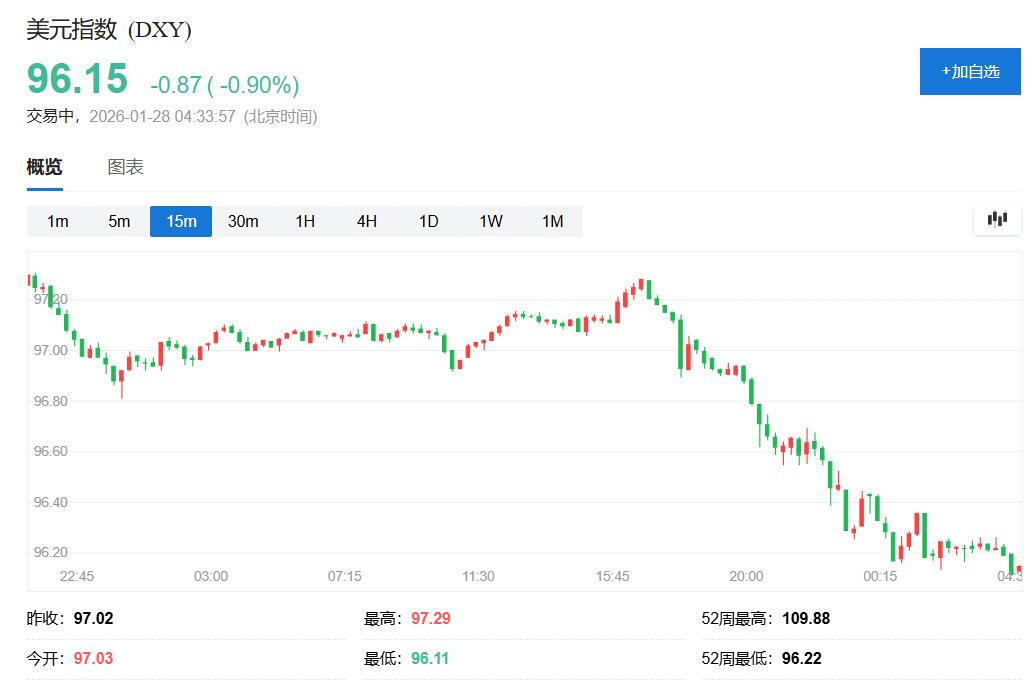
Core Viewpoint - Investors are increasingly concerned about the unpredictability of U.S. policies, leading to the U.S. dollar's decline to a four-year low against major currencies. President Trump, however, remains unconcerned about the dollar's depreciation, asserting that it is performing well and suggesting that fluctuations in the exchange rate are normal [2][3]. Group 1: Dollar Performance and Investor Sentiment - The dollar's recent decline reflects investor caution amid unpredictable policy directions from Washington, including Trump's threats regarding Greenland [6]. - The ICE Dollar Index (DXY) fell below 96.00 to 95.60, marking its lowest level since February 2022, with a daily drop of approximately 1.5% [3]. - The Bloomberg dollar spot index has also seen a four-day decline, reaching its lowest point since March 2022, with a cumulative drop of over 3% in the last six trading days [3]. Group 2: Structural Factors Affecting the Dollar - Structural factors such as weakened confidence in U.S. trade and security policies, the politicization of the Federal Reserve, and deteriorating U.S. fiscal credibility are likely to exert downward pressure on the dollar [5]. - Analysts note that the risk premium for the dollar has accumulated again, particularly following Trump's threats regarding Greenland, which negatively impacted the dollar's performance [6]. Group 3: Global Currency Movements - As the dollar weakens, other major currencies have strengthened, with the Japanese yen rising over 4% in the last three trading days and the euro surpassing 1.20 against the dollar for the first time since June 2021 [5]. - An emerging market currency index has risen for the fourth consecutive day, reaching record highs amid the dollar's decline [5]. Group 4: Speculation on Intervention - Speculation about potential intervention by the Japanese government to support the yen has increased, with reports suggesting that the Japanese finance ministry may coordinate with the U.S. if necessary [11]. - The dollar's decline against the yen has been significant, with the exchange rate dropping to 152.10, marking its lowest level since October 2025 [8]. Group 5: Federal Reserve Uncertainty - Uncertainty regarding the appointment of a new Federal Reserve chair is adding pressure to the dollar, with analysts suggesting that Trump may announce a replacement for Powell following the Fed's interest rate decision [7]. - The potential for a government shutdown and the Republican Party's reluctance to separate funding for the Department of Homeland Security further complicate the outlook for the dollar [7].


美元跌至四年低谷,特朗普不担心:美元表现出色,能找到合理水平
Hua Er Jie Jian Wen· 2026-01-27 21:24
Core Viewpoint - Concerns over the unpredictability of U.S. policies are increasing among investors, leading to the U.S. dollar falling to its lowest level against major currencies in four years, while President Trump remains unconcerned about the dollar's decline [1][2]. Group 1: Dollar Performance and Investor Sentiment - The ICE U.S. Dollar Index (DXY) fell below 96.20, marking its lowest point since February 2022, with a daily drop of over 0.9% [2]. - The Bloomberg dollar spot index also experienced a four-day decline, reaching its lowest level since March 2022, reflecting the largest four-day drop since Trump announced reciprocal tariffs in April of the previous year [2]. - Investors are seeking hedges against further dollar weakness, with short-term option premiums rising to the highest level since Bloomberg began tracking this data in 2011 [6]. Group 2: Structural Factors Affecting the Dollar - Structural factors such as declining confidence in U.S. trade and security policies, the politicization of the Federal Reserve, and deteriorating U.S. fiscal credibility are likely to exert downward pressure on the dollar [5]. - The uncertainty surrounding the selection of the next Federal Reserve chair and potential government shutdown risks further complicate the dollar's outlook [6]. Group 3: Currency Movements and Market Reactions - Other major currencies have strengthened against the dollar, with the Japanese yen rising over 3% in the last three trading days and the euro reaching its highest level since June 2021 [5]. - The dollar's decline has prompted speculation about potential intervention by the Japanese government to support the yen, particularly following reports of possible coordinated action with the U.S. [7][8]. - Market expectations indicate that the Federal Reserve is likely to maintain interest rates, with two anticipated rate cuts of 25 basis points each later in the year, contrasting with expectations from other major central banks [9].
Wall Street Is Fixated on a Possible Yen Intervention
WSJ· 2026-01-26 22:10
Core Viewpoint - A recent 'rate check' by U.S. officials has led to an appreciation of the Japanese currency, indicating potential shifts in currency dynamics and market reactions [1] Group 1 - The U.S. officials' actions have positively impacted the value of the Japanese yen, suggesting a response to economic conditions [1]

日元干预可能不会在日本央行会议前进行
Sou Hu Cai Jing· 2026-01-16 10:12
Core Viewpoint - The report by Derek Halpenny from MUFG indicates that prior to the Bank of Japan's policy decision on January 23, Japanese authorities may be hesitant to follow through on their threats to intervene in the yen's depreciation [1] Group 1: Bank of Japan's Stance - The Bank of Japan's Governor, Kazuo Ueda, is likely to maintain a cautious stance regarding further interest rate hikes [1] - This cautious approach could be a factor that leads to the potential failure of intervention measures aimed at supporting the yen [1] Group 2: External Influences - Other influencing factors include Prime Minister Fumio Kishida's plans for an early election and indications from Federal Reserve officials suggesting a pause in interest rate cuts [1] - A more explicit opposition to yen depreciation from the Bank of Japan, along with hints of earlier interest rate hikes, could enhance the success of intervention measures [1] Group 3: Market Reaction - The dollar fell by 0.3% to 158.10 yen [1]
日元干预前奏已现,市场或迎“突袭式”行动,紧盯“利率检查”
Hua Er Jie Jian Wen· 2026-01-15 07:55
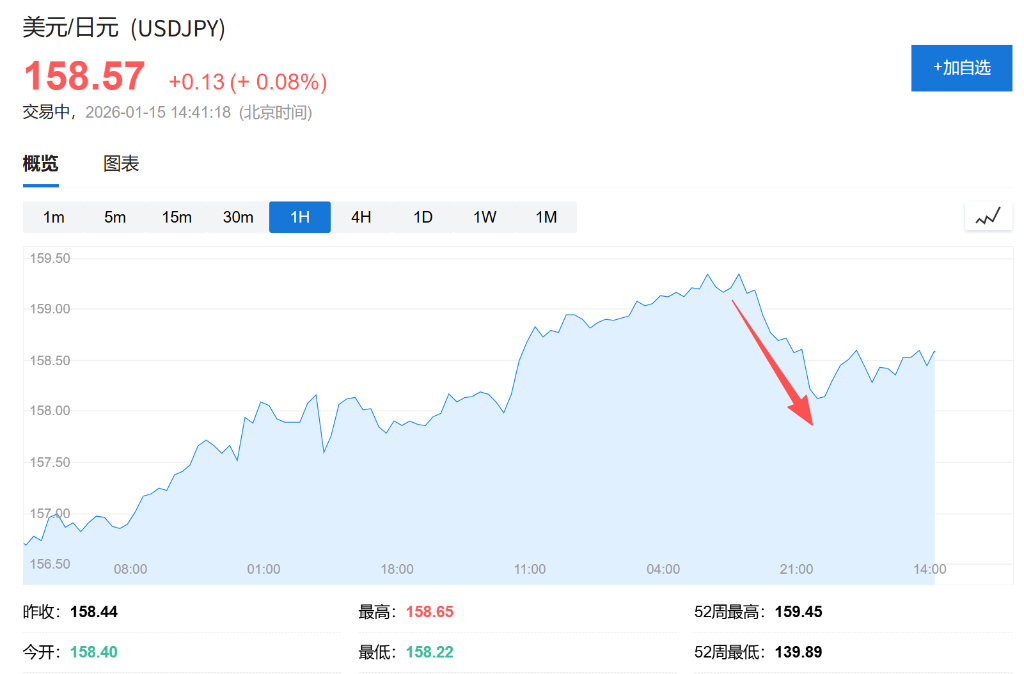
Core Viewpoint - Nomura warns that the rules of intervention by the Japanese Ministry of Finance regarding the yen are changing, indicating a significant increase in intervention risk as market volatility suggests a shift from verbal warnings to tactical preparations [1] Group 1: Market Behavior and Intervention Signals - The sudden drop in USD/JPY during the UK trading session, without any apparent positive news for the yen, is likely a result of a "Rate Check" by the Ministry of Finance, which often precedes actual intervention [4] - Historical context shows that after a similar "Rate Check" on September 14, 2022, the Japanese government intervened with a substantial amount of 2.8382 trillion yen (approximately $19.8 billion) just eight days later, suggesting that current market movements may signal impending intervention [4] Group 2: Caution Against Overreliance on Indicators - Nomura advises against placing too much faith in the so-called "Kanda Line," a set of intervention warning indicators, as no signals are currently active; however, this does not imply a low risk of intervention [5] - The former Finance Minister Kanda acknowledged that intervention decisions are not based on these indicators in an automated manner, highlighting the need for vigilance [5][6] Group 3: Broader Focus on Currency Pairs - The scope of the Ministry of Finance's intervention may be expanding beyond just USD/JPY, as new foreign exchange affairs chief Mimura indicated that authorities are monitoring various currency pairs, not solely focusing on the dollar-yen relationship [7] - Reports suggest that the Ministry conducted a "Rate Check" on EUR/JPY in July 2024, indicating potential alternative intervention strategies to curb yen weakness without directly purchasing yen [7][8] - Historical interventions by Japan around the year 2000 targeting EUR/JPY suggest that investors should be cautious and not solely focus on USD/JPY, as they may be caught off guard by unexpected actions [8]
国泰君安期货商品研究晨报:贵金属及基本金属-20251225
Guo Tai Jun An Qi Huo· 2025-12-25 01:54
1. Report Industry Investment Rating The report does not provide an overall industry investment rating. 2. Core Views - Gold: Inflation is moderately declining [2][4]. - Silver: Undergoing high - level adjustment [2][4]. - Copper: The external market is strong while the domestic market is weak, which restricts price increases [2][8]. - Zinc: Trading in a range [2][11]. - Lead: Reduced inventory supports the price [2][14]. - Tin: Supply is facing new disruptions [2][17]. - Aluminum: Trading in a range; Alumina is bottom - sideways; Cast aluminum alloy follows electrolytic aluminum [2][20]. - Platinum: The overseas market is closed, and a correction is to be watched out for [2][22]. - Palladium: Investment sentiment has shifted, and a large - scale decline is expected [2][23]. - Nickel: There is capital game on the market, and caution is needed when chasing high prices [2][27]. - Stainless steel: Both supply and demand in the fundamentals are weak, and there are disturbances from news about Indonesian nickel mines [2][28]. 3. Summary by Related Catalogs Gold - **Price and Trading Volume**: The closing prices of Shanghai Gold 2602, Gold T + D, and Comex Gold 2602 showed varying degrees of increase, with daily increases of 1.34%, 1.44%, and 0.77% respectively. The trading volume of Shanghai Gold 2602 decreased by 2,375, while that of Comex Gold 2602 increased by 42,965 [4]. - **Inventory**: Shanghai gold inventory increased by 1,995 kilograms, and Comex gold inventory (in troy ounces, the day before) increased by 114,168 [4]. - **Macro and Industry News**: The People's Bank of China will continue to implement a moderately loose monetary policy; the Beijing property market has new policies; the US employment market has warmed up [4]. Silver - **Price and Trading Volume**: The closing prices of Shanghai Silver 2602, Silver T + D, and Comex Silver 2602 all rose, with daily increases of 1.50%, 1.52%, and 3.65% respectively. The trading volume of Shanghai Silver 2602 decreased by 474,555 [4]. - **Inventory**: Shanghai silver inventory decreased by 1,805 kilograms, and Comex silver inventory (in troy ounces, the day before) decreased by 3,083,409 [4]. - **Macro and Industry News**: Similar to gold, and the Silver LOF hit the daily limit again during the session [4][7]. Copper - **Price and Trading Volume**: The closing price of the Shanghai Copper main contract increased by 2.31%, and the LME Copper 3M electronic disk increased by 0.65%. The trading volume of the Shanghai Copper index increased by 297,908, and the LME Copper 3M electronic disk decreased by 8,111 [8]. - **Inventory**: Shanghai copper inventory increased by 2,679 tons, and LME copper inventory decreased by 1,550 tons [8]. - **Macro and Industry News**: The People's Bank of China's policy, Beijing's property market policy, and the US employment market situation; Glencore acquired a copper project in Peru; Peru extended the temporary licenses of small - scale miners; Kazakhstan's refined copper production increased; China's copper ore imports increased [8][10]. Zinc - **Price and Trading Volume**: The closing price of the Shanghai Zinc main contract increased by 0.61%, and the LME Zinc 3M electronic disk increased by 0.60%. The trading volume of the Shanghai Zinc main contract increased by 37,673, and the LME Zinc trading volume increased by 2,888 [11]. - **Inventory**: Shanghai zinc inventory increased by 1,068 tons, and LME zinc inventory increased by 7,900 tons [11]. - **News**: The People's Bank of China's policy and hints from the US Treasury Secretary about the Fed's future direction [12]. Lead - **Price and Trading Volume**: The closing price of the Shanghai Lead main contract increased by 1.35%, and the LME Lead 3M electronic disk increased by 0.66%. The trading volume of the Shanghai Lead main contract increased by 23,412, and the LME Lead trading volume increased by 2,053 [14]. - **Inventory**: Shanghai lead inventory decreased by 152 tons, and LME lead inventory decreased by 4,200 tons [14]. - **News**: Similar to copper, including the People's Bank of China's policy, Beijing's property market policy, and the US employment market situation [15]. Tin - **Price and Trading Volume**: The closing price of the Shanghai Tin main contract increased by 1.27%, and the LME Tin 3M electronic disk increased by 0.25%. The trading volume of the Shanghai Tin main contract decreased by 11,222, and the LME Tin 3M electronic disk decreased by 9 [17]. - **Inventory**: Shanghai tin inventory increased by 655 tons, and LME tin inventory increased by 50 tons [17]. - **Macro and Industry News**: Similar to gold and silver, and France passed a short - term budget to avoid a government shutdown [17][18]. Aluminum, Alumina, and Cast Aluminum Alloy - **Price and Trading Volume**: The closing price of the Shanghai Aluminum main contract was 22,330 yuan/ton, and the LME Aluminum 3M closing price was 2,957 US dollars/ton. The trading volume of the Shanghai Aluminum main contract increased by 85,119. The closing price of the Shanghai Alumina main contract was 2,554 yuan/ton [20]. - **Inventory and Cost**: The domestic aluminum ingot social inventory decreased, and the LME aluminum ingot inventory increased. The electrolytic aluminum enterprise profit was 5,823.24 yuan/ton [20]. - **News**: The US dollar may have its worst year since 2003, and the Japanese finance minister hinted at possible intervention in the yen [21]. Platinum and Palladium - **Price and Trading Volume**: The closing prices of platinum and palladium futures showed different trends, with some rising and some falling. The trading volume of Shanghai Platinum and NYMEX Platinum decreased, while the trading volume of NYMEX Palladium increased [23]. - **Inventory and ETF**: The platinum ETF inventory increased by 5,271 ounces, and the palladium ETF inventory decreased by 384 ounces [23]. - **Macro and Industry News**: News about international relations and China's central bank's policy [25][26]. Nickel and Stainless Steel - **Price and Trading Volume**: The closing price of the Shanghai Nickel main contract was 128,000 yuan/ton, and the stainless - steel main contract was 13,075 yuan/ton. The trading volume of the Shanghai Nickel main contract was 1,095,331 [28]. - **Industry News**: An Indonesian nickel mining area was taken over, China suspended a non - official subsidy for Russian copper and nickel imports, and Indonesia implemented sanctions on mining companies and adjusted policies related to nickel mines [28][29][31].
法国兴业银行认为日元干预面临“颇具吸引力”的有利情境
Xin Lang Cai Jing· 2025-12-23 15:26
Group 1 - The current environment presents a "strong intervention backdrop," increasing the likelihood of the Japanese government successfully preventing yen depreciation compared to usual circumstances [1][3] - The rationale for intervention is clear: year-end market liquidity shortages provide an opportunity, and market participants are struggling to justify current price levels, indicating a higher chance of successful intervention [1][3] - Long-term interest rate differentials and volatility indicators suggest that the euro/yen and dollar/yen exchange rates should have peaked by the end of 2023; however, both pairs have continued to rise, with euro/yen reaching a record high near 184 and dollar/yen hovering around 162 [1][3] Group 2 - There has been a dramatic decoupling of dollar/yen and euro/yen exchange rates from interest rate differentials since spring, described as a disorderly state [2][4] - Intervention is expected to curb the upward momentum of dollar/yen and euro/yen, but the likelihood of a significant reversal in the yen's weakening trend is low due to generally weak Asian currencies and ongoing concerns about economic growth and an aging population [2][4] - A correction similar to the one seen in 2014 after the sharp rise in dollar/yen and euro/yen is still possible; in the long term, this could pull dollar/yen back to the 140 level and euro/yen down to the 160 level [2][4]


三菱日联:日元干预风险似乎加大
Sou Hu Cai Jing· 2025-12-19 10:24
Core Viewpoint - The risk of intervention to support the yen is increasing during the quiet Christmas period, as the yen has fallen to a near four-week low against the dollar despite the Bank of Japan's recent interest rate hike and indications of further increases [1] Group 1 - Derek Halpenny from MUFG Bank highlights that the Bank of Japan has failed to provide clearer guidance on its neutral interest rate level, which is perceived as neither stimulating nor slowing growth, leading to disappointment among some market participants [1] - Another factor potentially pressuring the yen is the market's perception of a lack of urgency for further interest rate hikes [1] - According to data from the London Stock Exchange Group, the dollar has risen by 1% to a peak of 157.12 yen [1]