消费提质

Search documents
山东消费季:烟火气里藏动能,民生暖处见担当
Qi Lu Wan Bao· 2026-02-27 04:11
消费是经济增长的"压舱石",也是民生幸福的"晴雨表"。2026年山东消费季大幕拉开,从"悦消费惠新 春"的主题活动,到270多亿元资金的精准投放;从家电以旧换新的真金白银让利,到文旅体育的多元场 景赋能,这场贯穿全年的消费盛宴,既燃动了齐鲁大地的烟火气,更彰显了山东以消费提质拉动经济增 长、以民生改善凝聚发展合力的责任担当。 高站位谋划,方能精准发力。山东消费季的核心要义,在于跳出"单纯促销"的局限,构建"政策赋能+场 景升级+全域联动"的消费生态。省级层面统筹布局,270多亿元资金定向投向消费品以旧换新、养老服 务消费等重点领域,新春专项75亿元补贴覆盖购物、文旅、餐饮等场景,政策红利直达市场主体与消费 者。这种精准滴灌的施策方式,既破解了群众"换新成本高""消费不便捷"的痛点,又为企业纾困解难、 激发活力,实现了"惠民"与"兴企"的双向共赢。 暖民心举措,激活消费春水。消费季的温度,藏在城乡遍地的便民场景中。城市里,家电卖场咨询络绎 不绝,线上平台补贴一键申领;乡村间,服务台搬进大集,上门收旧、现场评估等服务打通"最后一公 里";文旅领域,"百戏贺岁""千景迎新"活动好戏连台,体育消费补贴与冰雪赛事点燃冬 ...
商务部1月22日召开例行新闻发布会
Shang Wu Bu Wang Zhan· 2026-01-22 11:05
Group 1: Consumer Market Insights - In 2025, China's total retail sales of consumer goods exceeded 50 trillion yuan, reaching 50.1 trillion yuan, a 3.7% increase from the previous year, with final consumption expenditure contributing 52% to economic growth [4] - The consumer market is characterized by three key aspects: expansion, benefiting the public, and quality improvement. The implementation of a trade-in policy led to sales of 2.61 trillion yuan, benefiting 366 million people [4] - New consumption trends are emerging, with retail sales of new energy vehicles increasing by 17.6%, and by the end of 2025, 60% of passenger cars sold will be new energy vehicles [4] Group 2: Trade with Central Asia - In 2025, trade between China and Central Asian countries surpassed 100 billion USD for the first time, reaching 106.3 billion USD, with a year-on-year growth of 12% [6] - The trade structure is improving, with over 55% of China's exports to Central Asia being electromechanical products, and an increase in the market share of "new three" products [6][7] - Cross-border e-commerce trade reached 800 million USD, growing over 20%, supported by stable operations of China-Europe (Central Asia) freight trains [7] Group 3: Foreign Investment - By the end of 2025, over 50,000 Chinese enterprises were established abroad, with a total foreign direct investment of 174.38 billion USD, a 7.1% increase from the previous year [8] - Chinese enterprises are actively fulfilling social responsibilities, creating over 2 million jobs annually and contributing to various infrastructure projects in host countries [8] Group 4: Trade Agreements and Regulations - A trade agreement between Canada and China was reached regarding electric vehicles and canola seeds, allowing for an annual quota of 49,000 electric vehicles from China with reduced tariffs [12] - China has implemented export controls on dual-use items to prevent military use, ensuring compliance with international obligations while maintaining supply chain stability [11]
商务部:下一步将坚持惠民生和促消费紧密结合 不断释放消费潜力活力
智通财经网· 2026-01-22 08:33
Core Insights - The Chinese consumption market is expected to maintain steady growth in 2025, with both scale and quality improvements, highlighted by a retail sales total exceeding 50 trillion yuan for the first time, reaching 50.1 trillion yuan, a 3.7% increase from the previous year, contributing 52% to economic growth [1][4][5] Group 1: Consumption Market Characteristics - Expansion: The retail sales of consumer goods will surpass 50 trillion yuan, marking a significant milestone with a growth rate of 3.7% year-on-year [1][4] - Benefits to the Public: The implementation of the old-for-new consumption policy led to sales of 2.61 trillion yuan, benefiting 366 million people [1][4] - Quality Improvement: New consumption trends such as green and smart products are thriving, with retail sales of new energy vehicles increasing by 17.6%, and the penetration rate expected to reach 60% by the end of 2025 [1][5] Group 2: Future Initiatives - The Ministry of Commerce will continue to combine policies and activities to stimulate consumption and release consumer potential [2][5]
商务部召开例行新闻发布会(2026年1月22日)
Shang Wu Bu Wang Zhan· 2026-01-22 08:03
Group 1: Consumer Market Insights - In 2025, China's total retail sales of consumer goods exceeded 50 trillion yuan, reaching 50.1 trillion yuan, a 3.7% increase from the previous year, with final consumption expenditure contributing 52% to economic growth [2][3] - The implementation of the old-for-new consumption policy led to sales of related categories reaching 2.61 trillion yuan, benefiting 366 million people [2] - New consumption trends are emerging, with retail sales of new energy vehicles growing by 17.6%, and by the end of 2025, 60% of passenger cars sold will be new energy vehicles [3] Group 2: Trade with Central Asia - In 2025, China-Central Asia trade reached 106.3 billion USD, marking a 12% year-on-year growth, with imports and exports growing by 14% and 11% respectively [4][5] - The trade structure is improving, with over 55% of China's exports to Central Asia being electromechanical products, and more high-quality products from Central Asia entering the Chinese market [4] - Cross-border e-commerce trade reached 800 million USD, growing over 20%, supported by stable operations of the China-Europe (Central Asia) freight trains [4][5] Group 3: Foreign Investment - By the end of 2025, over 50,000 Chinese enterprises were established abroad, with foreign direct investment reaching 174.38 billion USD, a 7.1% increase from the previous year [6] - Chinese enterprises are actively fulfilling social responsibilities, creating over 2 million jobs annually and building various public facilities [6] Group 4: Trade Agreements and Regulations - A trade agreement between Canada and China was reached regarding electric vehicles and canola seeds, allowing for a quota of 49,000 electric vehicles annually with reduced tariffs [11] - China maintains strict export controls on dual-use items to prevent military applications, ensuring compliance with international obligations [10]
“内需主导”被列为年度经济工作重点任务之首 广州“先跑一步”
Guang Zhou Ri Bao· 2026-01-18 01:38
Core Viewpoint - Guangzhou is focusing on strengthening its internal capabilities to enhance both consumption and investment, aiming for a robust economic performance in the new year [2][10]. Consumption Renewal - The consumption market in Guangzhou is undergoing a transformation, showcasing a blend of local culture, Chinese aesthetics, and global influences [3]. - New commercial developments, such as the Sam's Club and the Taikoo Li shopping area, are attracting significant foot traffic and international brands, indicating a vibrant retail environment [3][4]. - The city is diversifying its commercial landscape, creating multiple shopping hubs to meet various consumer needs, thus breaking away from a previously centralized commercial model [3]. Investment Drive - Guangzhou is committed to investing in human capital to enhance living standards and stimulate consumption, as evidenced by the "33 measures" aimed at boosting consumer spending [6][10]. - The city has seen a significant increase in business registrations, with over 4.25 million entities, and is attracting foreign investment, with one in seven new foreign enterprises setting up in Guangzhou [7]. - Major projects, including the TCL Huaxing and HSBC training center, are indicative of an improved business environment and growing investor confidence [7]. Recruitment and Development - The "Ten-Hundred-Thousand Investment Project" aims to attract substantial investments, including 10 projects worth 10 billion, 100 projects worth 1 billion, and 1,000 projects worth 100 million [8]. - The establishment of a comprehensive ecosystem for cell and gene therapy in Nansha is a key example of Guangzhou's forward-looking industrial strategy [8]. Internal Demand Leadership - The central economic work conference emphasizes the importance of balancing consumption and investment, highlighting their interdependent relationship in driving domestic demand [9]. - Industrial investment in Guangzhou has shown resilience, with a 2.5% increase in industrial investment and significant growth in high-tech sectors [10]. Departmental Initiatives - The Guangzhou Development and Reform Commission is implementing measures to enhance investment efficiency and project management, ensuring timely execution of new and ongoing projects [11][12]. - The Guangzhou Commerce Bureau is focused on expanding quality consumer goods and services, enhancing the international consumption environment, and promoting local consumption initiatives [14][15]. Investment Development Actions - The Guangzhou Investment Development Committee is executing a comprehensive strategy to attract investments across various sectors, including biotechnology and new consumption industries [16][17].


从消费提质到投资优化:2026年扩大内需路径明晰
Xin Lang Cai Jing· 2026-01-02 18:29
Core Insights - The Chinese government emphasizes the importance of domestic demand as a key driver for economic growth, with a focus on boosting consumption and expanding domestic markets as primary tasks for 2026 [3][4]. Group 1: Domestic Demand and Consumption - The contribution of domestic demand to economic growth reached 71% in the first three quarters of 2025, highlighting its role as a stabilizing force [3]. - A series of policies aimed at stimulating consumption, particularly through "trade-in" programs, have led to significant sales increases, with over 2.5 trillion yuan in sales generated from these initiatives from January to November 2025 [4]. - Service consumption has seen a notable increase, with per capita spending on services rising to 46.8% in the first three quarters of 2025, indicating a shift towards sectors like tourism and elderly care [5]. Group 2: Investment Trends - Fixed asset investment (excluding rural households) decreased by 2.6% year-on-year in the first 11 months of 2025, but investment in key sectors remains robust, with project investment growing by 0.8% when excluding real estate [7]. - The government plans to stabilize investment by increasing central budget investments and optimizing the use of local government bonds, focusing on urban renewal and public infrastructure [8]. - Investment policies in 2026 are expected to target four main areas: "two重" project construction, new productivity sectors, urban renewal, and enhancing the environment for private investment [8].

清华大学朱岩:现在的企业家精神正发生技术型改变
Xin Lang Cai Jing· 2025-12-17 08:48
Core Insights - The entrepreneurial spirit in China is undergoing a technological transformation, moving beyond traditional economic scale changes to focus on innovation and data-driven approaches [1][4][5] Group 1: Entrepreneurial Spirit Transformation - The new entrepreneurial spirit is characterized by four key aspects: adherence to innovation, data-driven decision-making, paradigm leadership, and human-machine symbiosis [1][4] - Traditional entrepreneurial spirit emphasized market opportunity capture and resource integration, while the digital intelligence era requires a focus on technological breakthroughs [5] - The organizational structure is shifting from hierarchical and centralized management to flatter, customer-oriented, and intelligent collaboration [5] Group 2: Competition and Risk Management - The competition logic has evolved from zero-sum games based on scale and joint development to a paradigm-leading approach that emphasizes ecological win-win scenarios [5][6] - Traditional entrepreneurs often preferred risk avoidance, but the digital intelligence era encourages embracing technological innovation to reduce risks and maximize industry-wide value [2][5] - The focus is shifting from maximizing individual enterprise profits to enhancing the overall value of the industrial ecosystem [6] Group 3: Innovation and Responsibility - Innovation must become the core of entrepreneurial spirit, requiring a shift from following technology trends to mastering foundational technologies [6] - Data literacy is essential for respecting factual information and credible data, which is crucial in the digital intelligence era [6] - Entrepreneurs are encouraged to engage in institutional discussions and create new market theories and rules, positioning Chinese enterprises to lead globally in the next 30 years [3][6]
清华大学朱岩:数智时代企业家精神一定是范式引领,而非卷规模
Xin Lang Cai Jing· 2025-12-17 08:48
Core Viewpoint - The entrepreneurial spirit in China is undergoing a technological transformation, moving beyond traditional economic scale changes to focus on innovation and data-driven approaches [1][4]. Group 1: Key Aspects of Entrepreneurial Spirit - The new entrepreneurial spirit is characterized by four main points: adherence to innovation, data-driven decision-making, paradigm leadership, and human-machine symbiosis [1][4]. - Traditional entrepreneurial spirit emphasized market opportunity capture and resource integration, while the digital intelligence era requires a focus on technological breakthroughs [5]. - Organizational structures are shifting from hierarchical and centralized management to flatter, customer-oriented, and intelligent collaboration [5]. Group 2: Competition and Risk Management - The competition logic has evolved from zero-sum games based on scale and joint development to a focus on paradigm leadership rather than mere scale competition [5]. - Many traditional industries are still caught in scale and price competition, which is detrimental to overall industry health [5]. - In the digital intelligence era, entrepreneurs are encouraged to embrace technological innovation to reduce risks and maximize value across the entire industry ecosystem, rather than just focusing on individual profit maximization [2][5]. Group 3: Innovation and Responsibility - Innovation must become the core of entrepreneurial spirit, requiring a shift from following technology trends to mastering foundational technologies [6]. - Data literacy is essential, emphasizing the importance of respecting credible data [6]. - The ecological landscape should transition from single-point competition to symbiotic and win-win relationships, with an upgraded sense of responsibility that goes beyond compliance to value leadership for humanity [6]. Group 4: Consumer Quality and Market Evolution - There is a need to identify new consumption scenarios and business models, particularly as the state emphasizes the release of the consumer market by 2026 [2][6]. - Entrepreneurs should actively embrace new technological advancements while also engaging in discussions about institutional changes and market rules to foster a new level of entrepreneurial spirit that can lead globally in the next 30 years [3][6].
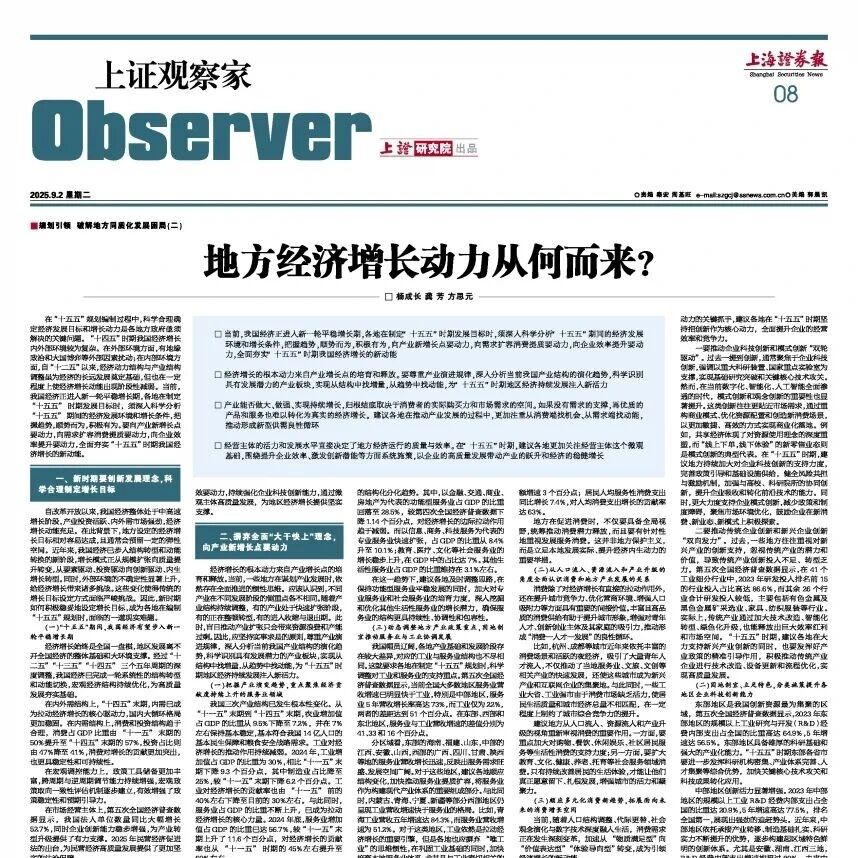
洞见 | “十五五”时期地方经济增长从三方面找动力
申万宏源证券上海北京西路营业部· 2025-09-08 02:08
Group 1 - The core viewpoint of the article emphasizes that during the "14th Five-Year Plan" period, local economic growth can seek new momentum from three aspects: supply side, demand side, and enterprise development [2][3] Group 2 - From the supply side, the article highlights the need to focus on new growth points in industries. The contribution of agriculture to GDP has decreased from 9.5% at the end of the "11th Five-Year Plan" to 7.2% at the end of the "14th Five-Year Plan," while the service sector's contribution has increased significantly, reaching 56.7% by the end of 2024, up 11.6 percentage points from the end of the "11th Five-Year Plan" [4][5] Group 3 - On the demand side, the article points out that service consumption is becoming a more direct driver of local economic growth compared to goods consumption. In 2024, national service retail sales are expected to grow by 6.2%, outpacing goods retail sales by 3 percentage points, with per capita service consumption expenditure increasing by 7.4% [6][7] Group 4 - The article discusses the importance of high-quality enterprise development as a source of economic momentum. It emphasizes the need for innovation in enterprises, including original technology, model innovation, and concept innovation, to enhance market responsiveness and efficiency [8][9]

申万宏源杨成长:地方经济增长动力从何而来?
申万宏源证券上海北京西路营业部· 2025-09-04 02:32
Core Viewpoint - The article emphasizes the need for local governments to scientifically analyze the economic development environment and growth conditions during the "14th Five-Year Plan" period, focusing on new growth points in industries, expanding demand, and improving enterprise efficiency to solidify new economic momentum for the "15th Five-Year Plan" period [5][6][9]. Group 1: Economic Growth and Development Goals - The article highlights that China is entering a new phase of stable economic growth, necessitating a careful determination of growth targets by local governments [6][7]. - It notes that internal demand has become the core driving force for economic growth, with consumption's contribution to GDP increasing from 50% at the end of the "11th Five-Year Plan" to 57% at the end of the "14th Five-Year Plan" [7]. - The article stresses the importance of setting realistic growth targets that are neither overly ambitious nor pessimistic, based on local resources and industrial foundations [8][9]. Group 2: Industry Development and Innovation - The article suggests that economic growth fundamentally relies on the cultivation and release of new industrial growth points, urging local governments to respect industrial evolution and identify promising sectors [11][12]. - It points out the significant shift in China's industrial structure, with the service sector's contribution to GDP rising to 56.7% by the end of 2024, while the industrial sector's contribution is declining [11][12]. - The article recommends focusing on enhancing the service sector's role in economic growth, particularly in lower-tier cities where its importance is often overlooked [12][14]. Group 3: Consumption and Demand Expansion - The article emphasizes the critical role of consumer purchasing power and market demand in driving economic growth, advocating for a focus on consumption-driven opportunities [15][16]. - It distinguishes between goods consumption and service consumption, noting that service consumption has a more direct local economic impact [16]. - The article highlights the need to adapt to changing consumer trends, particularly among younger and older demographics, to stimulate new consumption growth [18][19]. Group 4: Enterprise Development and Innovation - The article underscores the importance of enterprise vitality and development levels in determining local economic quality and efficiency, advocating for systematic policies to enhance enterprise efficiency and innovation [19][20]. - It calls for a dual focus on technological and model innovation to improve enterprise competitiveness, especially in the context of digital transformation [20][22]. - The article stresses the need for tailored strategies to enhance innovation capabilities across different regions, considering their unique industrial bases and development stages [23][24].