美元升值

Search documents
大宗商品价格暴跌冲击全球市场
Wen Hua Cai Jing· 2026-02-03 01:41
Group 1 - The commodity market experienced a significant decline, with gold, silver, crude oil, and industrial metals leading the drop, following President Trump's nomination of Kevin Warsh as the next Federal Reserve Chair, which triggered market sell-offs [1][4] - Gold prices fell by 5%, reaching a two-week low, while silver saw a decline of over 7% [3] - The MSCI global index dropped by 0.5%, marking a cumulative decline of 1.5% since its record high on January 27 [2] Group 2 - Crude oil prices decreased by nearly 5% from recent highs, and LME copper fell by 3% [4] - The market had anticipated a successor to Powell who would promote aggressive monetary easing, but Warsh's appointment disrupted this expectation, strengthening the dollar and making dollar-denominated commodities more expensive for holders of other currencies [4][5] - The recent sell-off in precious metals was exacerbated by the CME Group's announcement to raise margin requirements for metal futures contracts, leading to a significant increase in forced liquidations [6] Group 3 - Analysts noted that the current market conditions reflect a synchronized sell-off of precious metals and equities, indicating that investors perceive Warsh's stance as more hawkish, which could lead to higher interest rates for an extended period [5] - The energy market also faced downward pressure due to easing tensions between the U.S. and Iran, with reports suggesting that Iran is engaging in serious dialogue with Washington [6][7] - Concerns about high inventories and weak demand ahead of the Chinese New Year holiday are impacting copper and iron ore markets, with expectations of reduced trading activity as the holiday approaches [7]
白银会崩盘吗?——回顾历史十次白银崩盘启示
对冲研投· 2025-12-30 10:38
Core Viewpoint - Recent surge in silver prices, with over 40% increase in the past month, raises concerns about potential financial stability risks and necessitates a review of historical silver "crashes" and their macroeconomic contexts [3][4]. Group 1: Definition and Historical Cases of Silver Crashes - A "silver crash" is defined as a weekly price drop exceeding 15% or a monthly drop exceeding 30%. Since the 1980s, there have been 10 such instances [4][5]. - The identified crashes occurred in May 2004, December 2004, May 2006, March 2008, August 2008, May 2011, September 2011, April 2013, March 2020, and September 2020 [4][5]. Group 2: Observations from Historical Cases - Silver price declines are typically rapid, with 9 out of 10 cases showing weekly drops exceeding 15% [5]. - Prior to crashes, silver often experiences significant price increases, with a median deviation of 39% over the previous month, peaking at 90% in May 2011. However, this is not always the case, as seen in April 2013 [5][6]. Group 3: Narrative Review of Silver Crashes - Each crash had distinct macroeconomic triggers: - May 2004: Chinese macroeconomic controls and the "Iron Fund Incident" led to a rapid decline in silver prices [8]. - December 2004: A rebound in the dollar and profit-taking by hedge funds caused a significant drop [9]. - May 2006: A tightening of liquidity due to rising interest rates led to a "commodity avalanche" [10]. - March 2008: The Bear Stearns crisis shifted market sentiment from inflation hedging to cash [11]. - August 2008: Economic recession and a strong dollar led to a collapse in industrial demand for silver [12]. - May 2011: The death of Osama bin Laden and increased margin requirements triggered a sharp decline [13]. - September 2011: The European debt crisis caused a liquidity crunch, leading to a significant drop [14]. - April 2013: Anticipation of tapering by the Federal Reserve resulted in a historic flash crash [15]. - March 2020: The COVID-19 pandemic caused a liquidity crisis, leading to a record weekly drop [16]. - September 2020: A rebound in the dollar and failed stimulus expectations led to a significant correction [17]. Group 4: Other Asset Movements During Silver Crashes - The rise of the dollar index is a common trigger for silver crashes, with 8 out of 10 cases showing a notable increase in the dollar index during these periods [18]. - Real interest rates typically rise during silver crashes, but the increase is relatively modest [19]. - Silver crashes are often accompanied by declines in risk assets, with the S&P 500 showing a median drop of 2-3% and the VIX rising by about 10% [20]. Group 5: Conclusion on Future Silver Risks - Current macroeconomic conditions suggest increasing risks for silver, including a potential rise in the dollar and macro volatility [23]. - The recent increase in margin requirements for silver futures may further exacerbate these risks [23]. - Historical data indicates that gold and copper typically experience declines of about one-fourth that of silver during crashes, suggesting a need for cautious positioning in these assets [23].


睿盛银行:预期美联储明年降息3次,维持对股票长期升势的看法
Ge Long Hui A P P· 2025-12-15 02:08
格隆汇12月15日|睿盛银行预期,美联储明年会继续温和减息,在关税问题抑制经济增长下,虽然有低 利率和AI投资抵销相关影响,但预期2026年美国经济增长或略较2025年放缓。另一方面,美联储新主 席是否有亲特朗普的候选人担任,仍有待观察,现时预计美国明年会降息3次。 该行维持对股票长期升势的看法,指企业盈利和美国低利率环境会继续支撑股票市场。明年前景看来更 具挑战性,主要因为估值已变得很高及全球经济前景疲弱。企业能否继续以令人信服的盈利增速满足市 场的高预期,将成为关键因素。有机会令市况波动性变得更大。 该行提到,在在不稳定时期,美元仍是热门避险资产。如果美元出现意外的突然升值,部分沽美元进的 合约更有机会需要平仓,将会产生反效果,即推高美元。 ...
为什么美联储加息美元升值?详解四个主要影响因素
Sou Hu Cai Jing· 2025-12-08 04:21
Core Viewpoint - The Federal Reserve's interest rate hikes lead to an appreciation of the US dollar due to increased capital inflow, enhanced currency confidence, interest rate differentials, and demand for safe-haven assets [1][5]. Group 1: Capital Inflow - The Federal Reserve's interest rate hikes raise US interest rates, attracting global investors seeking higher returns, which increases demand for the dollar and leads to its appreciation [3]. Group 2: Currency Confidence - Interest rate hikes reflect the Federal Reserve's optimistic outlook on the economy and concerns about inflation, enhancing market confidence in the dollar's value [4]. Group 3: Interest Rate Differentials - Higher US interest rates compared to other countries create a wider interest rate differential, prompting investors to shift funds to the US for better yields, further increasing demand for the dollar [5]. Group 4: Risk Hedging - Interest rate hikes may induce volatility and uncertainty in global financial markets, leading investors to seek safe-haven assets like the dollar, which supports its appreciation [5].
今日油价下跌:11月24日92、95号汽油、柴油最新油价价格
Sou Hu Cai Jing· 2025-11-24 16:54
Group 1: Domestic Oil Price Adjustment - The domestic oil price adjustment is expected to occur on November 24, with a forecasted decrease in oil prices due to a negative change rate of -0.94% in international crude oil prices, leading to a potential drop of approximately 50 yuan per ton, or 0.04 to 0.05 yuan per liter for gasoline [1][2] - The current downward trend in oil prices has already met the minimum adjustment standard, indicating that gasoline prices, which recently exceeded 7 yuan per liter, are likely to revert to the "6 yuan era" [2] Group 2: International Oil Price Dynamics - The strong performance of the US dollar and changing market expectations regarding the Federal Reserve's future actions have exerted downward pressure on crude oil prices, with the probability of a rate cut in December dropping from 90% to 35% [3] - Light crude oil futures for January delivery fell by $0.94 to $58.06 per barrel, a decrease of 1.59%, while Brent crude oil futures also declined by $0.82 to $62.56 per barrel, down 1.29% [3] Group 3: Regional Gasoline Prices - Gasoline prices vary across regions, with notable prices including: - Northeast: Liaoning 8.19 yuan/liter, Jilin 8.12 yuan/liter, Heilongjiang 8.43 yuan/liter [3] - North China: Beijing 8.89 yuan/liter, Tianjin 8.82 yuan/liter, Hebei 8.14 yuan/liter [4] - East China: Shanghai 9.25 yuan/liter, Jiangsu 9.41 yuan/liter, Zhejiang 9.36 yuan/liter [5] - Central China: Henan 8.67 yuan/liter, Hubei 9.44 yuan/liter, Hunan 8.33 yuan/liter [6] - South China: Guangdong 9.54 yuan/liter, Guangxi 8.82 yuan/liter, Hainan 9.55 yuan/liter [7] - Southwest: Chongqing 8.35 yuan/liter, Sichuan 8.52 yuan/liter, Yunnan 8.29 yuan/liter [8] - Northwest: Shaanxi 9.48 yuan/liter, Gansu 7.97 yuan/liter, Xinjiang 8.05 yuan/liter [9] Group 4: Diesel Prices by Region - Diesel prices also show regional variation, with prices such as: - Northeast: Liaoning 6.49 yuan/liter, Jilin 6.50 yuan/liter, Heilongjiang 6.43 yuan/liter [11] - North China: Beijing 6.62 yuan/liter, Tianjin 6.58 yuan/liter, Hebei 6.58 yuan/liter [11] - East China: Shanghai 6.56 yuan/liter, Jiangsu 6.55 yuan/liter, Zhejiang 6.57 yuan/liter [11] - Central China: Henan 6.56 yuan/liter, Hubei 6.57 yuan/liter, Hunan 6.64 yuan/liter [11] - South China: Guangdong 6.59 yuan/liter, Guangxi 6.64 yuan/liter, Hainan 6.67 yuan/liter [11] - Southwest: Chongqing 6.65 yuan/liter, Sichuan 6.64 yuan/liter, Yunnan 6.66 yuan/liter [11] - Northwest: Shaanxi 6.48 yuan/liter, Gansu 6.49 yuan/liter, Xinjiang 6.36 yuan/liter [11]

日元跌至1美元兑155区间,创9个月来低点
日经中文网· 2025-11-13 02:46
Group 1 - The market generally believes that the downward pressure on the US economy will ease, leading to a stronger demand for the US dollar [2][4] - As of late September, the Japanese yen was trading around 147 yen per dollar, experiencing a significant depreciation of over 7 yen in just a month and a half [4] - On November 12, the yen fell to 155 yen per dollar, marking the first time it reached this level in about nine months since February 4 [2][6] Group 2 - The US Senate passed a temporary budget bill on the 10th to end the longest government shutdown in history, with expectations that the House will vote on it soon [4] - There are views that the new Japanese Prime Minister, Fumio Kishida, will implement expansionary fiscal policies, prompting investors to sell the yen against various currencies [4] - On November 12, the yen fell to 179 yen per euro, setting a record low since the euro's inception in 1999 [4] Group 3 - There is speculation that if the yen depreciates beyond 155 yen per dollar, the Japanese government and the Bank of Japan may intervene by buying yen [6] - Japan maintains the lowest policy interest rates among major economies, lacking factors to support yen buying [6] - Future focus may shift to whether Japanese Finance Minister Shunichi Suzuki will increase verbal interventions to curb yen depreciation [6]
10月我国外储增至33433亿美元近十年最高 央行连续12个月增持黄金
Zheng Quan Shi Bao· 2025-11-07 22:45
Core Insights - As of October 2025, China's foreign exchange reserves reached $3.3433 trillion, marking a $4.7 billion increase from September, the highest level since December 2015 [1] - The increase in reserves is attributed to the rise in the US dollar index and overall global financial asset prices, influenced by major economies' monetary policies and macroeconomic data [1] - The US dollar index rose approximately 1.95% in the past month, while major non-USD currencies depreciated against the dollar [1] Group 1: Foreign Exchange Reserves - China's foreign exchange reserves have remained stable above $3.3 trillion for three consecutive months [1] - The increase in reserves is a result of combined effects from exchange rate adjustments and asset price changes [1] - The US Federal Reserve's interest rate decisions and the easing of US-China trade tensions have contributed to the strengthening of the dollar [1] Group 2: Asset Prices and Market Trends - Global stock and bond markets showed overall strength in October, supporting China's foreign exchange reserves [2] - The 10-year US Treasury yield fell by about 5 basis points due to the Fed's rate cuts and increased demand for safe-haven assets [2] - Major stock indices, including the S&P 500 and Nikkei, experienced gains, reflecting high market sentiment [2] Group 3: Gold Reserves - As of October, China's official gold reserves increased to 7.409 million ounces, with a monthly rise of 30,000 ounces, the lowest increase since November 2024 [2] - The People's Bank of China has been gradually increasing gold reserves since March, with monthly additions below 100,000 ounces [2] - The recent trend indicates a potential slowdown in gold purchases by central banks, including China, amid fluctuating gold prices [3] Group 4: Future Outlook - The foreign exchange authority emphasizes the stability of China's economic fundamentals, which are expected to support the stability of foreign exchange reserves [2] - The central bank's strategy to optimize international reserves and promote the internationalization of the renminbi suggests continued interest in gold accumulation [3] - The dual nature of gold as both a financial and commodity asset positions it as a key component in diversifying international reserves [3]
10月我国外储增至33433亿美元近十年最高央行连续12个月增持黄金
Sou Hu Cai Jing· 2025-11-07 20:21
Core Viewpoint - As of October 2025, China's foreign exchange reserves reached $3.3433 trillion, marking a $4.7 billion increase from September, the highest level since December 2015, with reserves remaining above $3.3 trillion for three consecutive months [1] Group 1: Foreign Exchange Reserves - The increase in foreign exchange reserves in October was influenced by major economies' monetary policies, macroeconomic data, and a rising dollar index, which led to an overall increase in global financial asset prices [1] - The dollar index rose approximately 1.95% in the past month, while the euro, yen, and pound depreciated against the dollar by 1.7%, 4%, and 2.2% respectively [1] - Despite the Federal Reserve's interest rate cut in October, the dollar index strengthened due to market expectations cooling on further rate cuts, alongside improved China-U.S. trade relations and increased geopolitical uncertainty [1] Group 2: Asset Prices and Economic Outlook - Global stock and bond markets strengthened in October, supporting China's foreign exchange reserves, with the 10-year U.S. Treasury yield declining by about 5 basis points due to the Fed's rate cut and government shutdown concerns [2] - The outlook for China's foreign exchange reserves remains stable, supported by the country's strong economic fundamentals and potential for growth [2] Group 3: Gold Reserves - As of October, China's official gold reserves increased to 7.409 million ounces, a rise of 30,000 ounces, marking the lowest increase since November 2024 [2] - The People's Bank of China has been gradually increasing gold reserves since March, with monthly increments below 100,000 ounces, signaling a strategy to optimize international reserves [2] - The gold market has experienced volatility, with prices briefly exceeding $4,300 per ounce before a rapid correction, indicating potential slowing in central bank purchases due to reaching target levels [3]
日经平均股指首次站上52000点
日经中文网· 2025-10-31 07:51
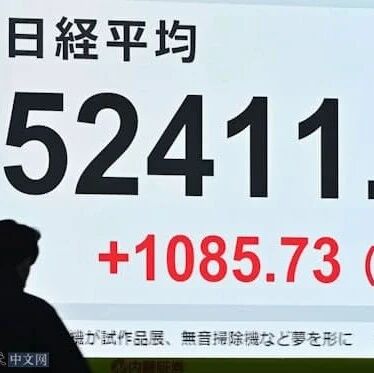
Core Viewpoint - The Nikkei average stock index rose significantly, supported by the depreciation of the yen and strong earnings reports from Japanese and American companies, marking a breakthrough above the 52,000-point level for the first time. Group 1 - On October 31, the Nikkei average closed at 52,411.34 points, an increase of 1,085.73 points (2.12%) from the previous day, surpassing the 52,000-point mark for the first time [2]. - Despite a decline in U.S. stocks the previous day and a significant drop in Meta's share price, the Japanese stock market remained buoyant due to the yen's depreciation and strong corporate earnings [4]. - The Nikkei index reached its highest point of the day at the close, indicating robust buying interest in the market [4].
美元涨人民币跌,这事对咱老百姓影响大不大?
Sou Hu Cai Jing· 2025-10-13 00:02
Core Insights - The recent depreciation of the Chinese yuan against the US dollar has significant implications for both consumers and exporters, with the exchange rate affecting the cost of imports and the revenue from exports [1][3][7]. Exchange Rate Dynamics - The exchange rate operates like a seesaw, where a stronger dollar results in a weaker yuan, influenced by economic stability, interest rates, and investment flows [3][4]. - The US dollar's strength is attributed to multiple interest rate hikes and positive economic data, attracting global capital, while the yuan remains relatively stable due to slower domestic consumption and investment recovery [3][4]. Impact on Consumers - The depreciation of the yuan means higher costs for consumers purchasing imported goods, such as electronics and education expenses, which have increased significantly in yuan terms [3][4]. - For individuals holding dollar-denominated financial products, the appreciation of the dollar translates to gains from currency exchange [3][4]. Export Opportunities - A weaker yuan can benefit domestic exporters, as their products become cheaper for foreign buyers, potentially increasing sales and revenue when converted back to yuan [1][7]. - The current exchange rate scenario presents opportunities for savvy exporters to capitalize on favorable currency conditions [7][8]. Long-term Outlook - The yuan's value is not solely determined by current exchange rates but is a reflection of broader economic conditions, including trade balances and investment flows [6][8]. - The increasing use of the yuan in global trade indicates growing confidence in its stability, suggesting that as long as the domestic economy remains robust, the yuan will maintain its value over the long term [6][8]. Consumer Strategies - Consumers are advised to be strategic about currency exchange, particularly when planning international purchases, and to consider diversifying their investments to mitigate risks associated with currency fluctuations [6][8].