
M0

Search documents
专家预测:全年还有降准空间,最高可达50BP
21世纪经济报道· 2026-03-13 12:50
Core Viewpoint - The financial data released by the People's Bank of China indicates a stable growth in M2 and social financing scale, creating a favorable monetary environment for economic recovery [1][2]. Monetary Supply and Financing - As of the end of February 2026, the broad money (M2) balance reached 349.22 trillion yuan, with a year-on-year growth of 9.0%, maintaining the same growth rate as the previous month and 2.0 percentage points higher than the same period last year [1]. - The social financing scale stock was 451.4 trillion yuan, with a year-on-year growth of 8.2%, consistent with the growth rate from the previous year [1]. - In the first two months of 2026, the net cash injection was 1.05 trillion yuan, indicating a proactive monetary policy [1]. Credit Growth and Structure - In the first two months, RMB loans increased by 5.61 trillion yuan, maintaining a reasonable growth trend, with the loan balance reaching 277.52 trillion yuan, a year-on-year increase of 6% [4]. - The structure of credit showed positive changes, with household loans decreasing by 194.2 billion yuan, while corporate loans increased by 5.94 trillion yuan [5]. - The balance of inclusive small and micro loans reached 37.31 trillion yuan, growing by 11.6% year-on-year, indicating a focus on supporting small enterprises [5]. Government Financing and Debt Issuance - Government bond financing has seen significant growth, with the balance reaching 97.3 trillion yuan, a year-on-year increase of 16.6% [11]. - The issuance of government bonds in the first two months of the year has increased significantly, with a year-on-year growth of 12.2% for national bonds and 8.5% for local government bonds [12]. - The overall financing structure shows that direct financing, including government bonds, is increasingly contributing to the social financing scale [11]. Policy Outlook - Analysts expect that monetary policy will continue to be moderately loose, with potential for further reserve requirement ratio cuts and interest rate reductions throughout the year [2][12]. - The collaboration between monetary and fiscal policies is anticipated to effectively support economic growth, particularly through structural policy tools aimed at expanding domestic demand and supporting small and medium-sized enterprises [13].


金融数据点评:信贷开门红成色不足
SINOLINK SECURITIES· 2026-02-25 14:13
Report Industry Investment Rating - Not provided in the content Core Viewpoints - In January 2026, the social financing increased slightly year-on-year, mainly supported by the earlier issuance and higher net financing scale of government bonds compared to the same period in 2025. The credit performance was in line with market expectations, with a year-on-year decrease in January for the first time since 2018. Both corporate and household medium - and long - term loans were weak, relying mainly on short - term loans. It is expected that this month's social financing will have little impact on the bond market, and it is recommended to continuously track high - frequency credit indicators [1][5][30] Summary by Related Content Social Financing Situation - In January 2026, the new social financing was 7.22 trillion yuan, a year - on - year increase of 1654 billion yuan, reaching a record high for the same period. Direct financing supported the social financing, with a year - on - year increase of 3228 billion yuan to 1.51 trillion yuan. On the contrary, on - balance - sheet financing dragged down the social financing, with a year - on - year decrease of 2334 billion yuan to 4.95 trillion yuan, while off - balance - sheet financing increased slightly year - on - year [1][7] - Among direct financing, government bonds had a net financing scale of 1.18 trillion yuan in January 2026, a year - on - year increase of 2831 billion yuan, reaching a record high for the same period. Corporate bonds increased by 579 billion yuan year - on - year to 5033 billion yuan, the second - highest since 2020 [12] RMB Credit Situation - In January 2026, RMB credit decreased by 4200 billion yuan year - on - year to 4.71 trillion yuan, the first year - on - year decrease in the "good start" month since 2018. The corporate sector decreased by 3300 billion yuan year - on - year, while the household sector increased slightly by 127 billion yuan year - on - year [2][16] - In the corporate sector, only short - term corporate loans increased by 3100 billion yuan year - on - year to 2.05 trillion yuan, reaching a record high for the same period. Medium - and long - term corporate loans decreased by 2800 billion yuan year - on - year to 3.18 trillion yuan, with the growth rate dropping by 0.5 percentage points to 7.58%. Bill financing decreased by 3690 billion yuan year - on - year to - 8739 billion yuan, and the growth rate of bill financing balance dropped to 9.17% [2][19] Money Supply and Deposit Situation - Due to the late Spring Festival in 2026 (falling in February), the cash - withdrawal demand of residents and enterprises in January was low, resulting in limited growth of M0 and a significant drop in the M0 growth rate to 2.7% [3][24] - In January 2026, the growth rates of M1 and M2 rebounded, rising from 3.8% and 8.5% in December 2025 to 4.9% and 9% respectively. The maturity of a large amount of time deposits and the increase in corporate foreign exchange settlement surplus may have contributed to the rebound of M1 and M2 [4][24] - In January 2026, corporate deposit increments were significantly higher than the same period in previous years, while household deposit increments were lower. Fiscal deposit increments were also higher than the same period in previous years, possibly due to the higher net financing scale of government bonds. Non - bank deposit increments were high because the stock market was still rising, attracting funds into the market [5][26]
每日债市速递 | 中国1月信贷数据重磅出炉
Wind万得· 2026-02-13 22:56
Group 1: Monetary Policy and Market Operations - The central bank conducted a 1,450 billion yuan reverse repo operation on February 13, with a fixed interest rate of 1.40%, resulting in a net injection of 1,135 billion yuan for the day after accounting for 315 billion yuan in reverse repos maturing [3][5] - In February, the central bank has conducted a total of 18,000 billion yuan in reverse repos, with a net injection of 600 billion yuan after considering 12,000 billion yuan in maturing repos, marking an increase of 300 billion yuan compared to the previous month [3] Group 2: Market Liquidity - The interbank market is experiencing a very loose liquidity environment, with the weighted average interest rate of DR001 declining nearly 10 basis points to a low of 1.26%, and similar declines observed in DR007 and DR014 [5] - The overnight financing rate in the U.S. is reported at 3.65% [6] Group 3: Financial Instruments - The latest transaction for one-year interbank certificates of deposit is around 1.58%, showing a slight decrease from the previous day [8] - The 30-year main contract for government bonds increased by 0.04%, while the 10-year, 5-year, and 2-year contracts decreased by 0.10%, 0.09%, and 0.03% respectively [13] Group 4: Credit and Financing Data - In January, the social financing scale increased by 7.22 trillion yuan, which is 166.2 billion yuan more than the same period last year, with a total social financing scale of 449.11 trillion yuan, reflecting a year-on-year growth of 8.2% [14] - The M2 money supply grew by 9% year-on-year, while M1 and M0 increased by 4.9% and 2.7% respectively, with a net cash injection of 519.1 billion yuan in January [14] Group 5: Regulatory Developments - The State-owned Assets Supervision and Administration Commission emphasized the importance of state-owned enterprises in contributing to high-quality economic development and social responsibility [14] - Recent notices from the Shanghai and Shenzhen Stock Exchanges address inaccuracies in investor education regarding bond repurchase agreements, outlining regulatory requirements and deadlines for rectification [15]


央行2026年1月重要金融数据一览:M2同比增长9%,社融规模增量累计为7.22万亿元
Sou Hu Cai Jing· 2026-02-13 12:48
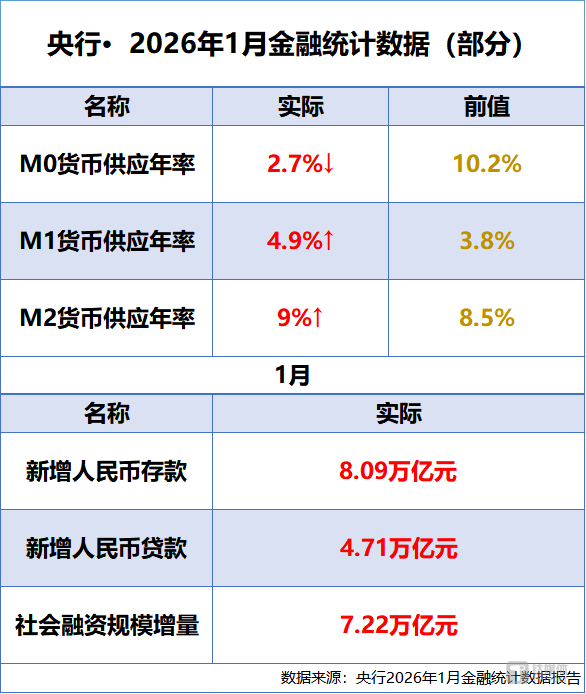
Core Insights - The central bank's financial data report for January 2026 indicates a year-on-year increase in M2 money supply by 9%, with a month-on-month rise of 0.5 percentage points [1] - M1 money supply also saw a year-on-year growth of 4.9%, up by 1.1 percentage points from the previous month [1] - The total social financing scale increased by 7.22 trillion yuan in January, which is 166.2 billion yuan more than the same period last year [1] Monetary Supply Data - M0 money supply year-on-year growth is reported at 2.7%, down from 10.2% [1] - M1 money supply year-on-year growth is at 4.9%, compared to the previous month's 3.8% [1] - M2 money supply year-on-year growth is at 9%, an increase from 8.5% in the prior month [1] Additional Financial Metrics - New RMB deposits in January amounted to 8.09 trillion yuan [1] - New RMB loans issued in January totaled 4.71 trillion yuan [1] - The increase in social financing scale for January stands at 7.22 trillion yuan [1]
流动性与同业存单跟踪:本次春节假期前后资金面的关注点
ZHESHANG SECURITIES· 2026-02-08 08:49
1. Report Industry Investment Rating No investment rating information is provided in the report. 2. Core Viewpoints - The key factors affecting the inter - bank capital situation during the Spring Festival holiday are the change in M0. The 9 - day Spring Festival in 2026 may lead to greater cash leakage and slower cash return to banks, resulting in a lower excess reserve level in the commercial banking system [2][12]. - The cash leakage (M0 month - on - month increase) caused by residents' cash withdrawals during the Spring Festival may exceed 1.7 trillion yuan, and with the 500 - billion - yuan 6M term repurchase "maturity - placement" misalignment, the pre - Spring Festival capital gap may exceed 2.2 trillion yuan [3][13]. - The central bank started to issue 14 - day reverse repurchase on February 5, and the start date and amount of the reverse repurchase across the Spring Festival holiday met expectations. The current low certificate of deposit spread and credit spread fully reflect the market expectation of stable and loose funds and remaining carry trade space [1][4]. - During the Spring Festival holiday, more attention should be paid to the speed of cash return to banks and the appreciation of the RMB. The 9 - day holiday may cause residents to return to work later, and RMB appreciation may consume commercial bank excess reserves [4][15]. 3. Summary by Directory 3.1 The Focus on the Capital Situation around the Spring Festival Holiday - The main factor affecting the inter - bank capital situation during the Spring Festival is the change in M0. The 9 - day Spring Festival in 2026 will lead to greater cash leakage and slower cash return to banks, resulting in lower excess reserves in the commercial banking system [2][12]. - The cash leakage (M0 month - on - month increase) during the Spring Festival may exceed 1.7 trillion yuan, and combined with the 500 - billion - yuan 6M term repurchase "maturity - placement" misalignment, the pre - Spring Festival capital gap may exceed 2.2 trillion yuan [3][13]. - The central bank issued 14 - day reverse repurchase on February 5, and the start date and amount of the reverse repurchase across the Spring Festival holiday met expectations. The current low spreads reflect the market expectation of stable and loose funds [1][4]. - Attention should be paid to the speed of cash return to banks and RMB appreciation during the holiday [4][15]. 3.2 Narrow - sense Liquidity 3.2.1 Central Bank Operations - Short - term liquidity: The central bank conducted peak - shaving and valley - filling operations. From February 2 to February 6, the net issuance of pledged reverse repurchase was - 756 billion yuan. Medium - and long - term liquidity: The 3M term repurchase was renewed with an excess of 100 billion yuan [16]. 3.2.2 Institution's Lending and Borrowing Situations - Capital supply (lenders): The net lending of large - scale banks reached a record high. Capital demand (borrowers): The absolute financing balance was high, and the relative leverage ratio increased [22][34]. 3.2.3 Repurchase Market Transaction Situation - Capital volume and price: The volume was abundant, and the price was stable. The capital sentiment index showed a gradual easing trend [42][45]. 3.2.4 Interest Rate Swaps - The cost of interest rate swaps decreased slightly, and the spread between CDs and IRS remained at a low level [49]. 3.3 Government Bonds 3.3.1 Next Week's Net Payment of Government Bonds - The net payment of government bonds next week will increase significantly. The net payment in the past week was 460.4 billion yuan, and it is expected to be 643.7 billion yuan next week [52]. 3.3.2 Government Bond Maturity Structure - The report presents the issuance and proportion of government bonds with different maturities in 2024, 2025, and 2026, including treasury bonds and local government bonds [57][58]. 3.4 Certificates of Deposit 3.4.1 Absolute Yield - The report shows the SHIBOR yield curve and the AAA - rated certificate of deposit yield curve and their changes compared with the previous week [62]. 3.4.2 Issuance and Stock Situations - As of February 6, the issuance and stock structures of certificates of deposit of different types of banks are presented, including the issuance and stock amounts and proportions of different maturities [66][67]. 3.4.3 Relative Valuation - The report analyzes the spreads of certificates of deposit, including the spreads between the 1 - year AAA - rated certificate of deposit yield and R007, DR007, and the 10 - year treasury bond yield, and their quantiles since 2020 [69].

如何看待M2与M1增速“剪刀差”?
Sou Hu Cai Jing· 2026-01-23 08:40
Group 1 - The latest financial data shows that by the end of December 2025, the broad money supply (M2) reached 340.29 trillion yuan, an increase of 8.5% year-on-year, while the narrow money supply (M1) was 115.51 trillion yuan, up 3.8% year-on-year [1] - M1 represents the money that is readily available for spending, indicating an increase in consumer spending power and market activity, while M2 reflects the overall increase in money supply and liquidity in the economy [2] - The "scissor difference" between M2 and M1 has been a focal point for the market; a widening gap suggests that businesses are opting to deposit funds in banks rather than invest, indicating a decline in investment willingness amid economic pressures [3] Group 2 - The narrowing of the "scissor difference" observed since last year indicates a reduction in corporate demand for liquid deposits, suggesting increased investment activities and a positive economic outlook [3]
宏观点评报告:企业发债规模继续增长-20251217
British Securities· 2025-12-17 07:14
Economic Indicators - As of November, M0 balance reached 13.74 trillion yuan, increasing by approximately 0.19 trillion yuan month-on-month, with a year-on-year growth of 10.6%[2] - M1 balance stood at 112.89 trillion yuan, up by 0.89 trillion yuan from the previous month, with a year-on-year growth of 4.9%, a slowdown of 1.3 percentage points compared to last month[2] - M2 balance was 336.99 trillion yuan, increasing by 1.86 trillion yuan month-on-month, with a year-on-year growth of 8%, a decrease of 0.2 percentage points from the previous month[2] Financing Trends - The total social financing stock was 440.07 trillion yuan, with a year-on-year growth of 8.5%, maintaining the same growth rate as the previous month[2] - New RMB loans in November amounted to 405.3 billion yuan, while new foreign currency loans were -22.2 billion yuan, totaling 383.1 billion yuan in new loans, which is 90.1 billion yuan less than the previous year[2] - New corporate bond financing reached 416.9 billion yuan, and new corporate stock financing was 34.2 billion yuan, totaling 451.1 billion yuan in corporate direct financing, an increase of 168.3 billion yuan year-on-year[2] Deposit Growth - Corporate deposit growth slowed to 3.63% in November, down from 3.79% the previous month, with a total corporate deposit balance of 79.34 trillion yuan, increasing by 0.65 trillion yuan[2] - Resident deposit growth decreased to 9.56%, down 0.13 percentage points from the previous month, with a total resident deposit balance of 163.31 trillion yuan, increasing by 0.67 trillion yuan[2] - Non-bank financial institutions' deposits grew by 0.08 trillion yuan, with a year-on-year growth rate of 16.09%, a decrease of 0.58 percentage points from the previous month[2]
X @外汇交易员
外汇交易员· 2025-11-13 09:08
Monetary Supply - M2 money supply increased by 82% year-on-year, exceeding expectations of 81% [1] - M1 money supply increased by 62% year-on-year, falling short of expectations of 70% [1] - M0 money supply increased by 106% year-on-year [1] Social Financing - The increment of social financing scale in the first 10 months was 309 trillion yuan, with a year-on-year increase of 383 trillion yuan [1] - New social financing in October was 081 trillion yuan [1] RMB Loans - RMB loans increased by 1452 trillion yuan in the first 10 months, with a year-on-year decrease of 116 trillion yuan [1] - RMB loans decreased by 20 billion yuan in October [1]
X @外汇交易员
外汇交易员· 2025-10-15 09:09
Monetary Supply - M2 money supply year-on-year rate is 84%, less than the expected 85% [1] - M1 year-on-year rate is 72%, exceeding the expected 61% [1] - M0 year-on-year rate is 115%, slightly lower than the previous value of 117% [1] Social Financing and Loans - The increment of social financing scale in the first nine months is 3009 trillion yuan, with 353 trillion yuan newly added in September, an increase of 442 billion yuan year-on-year [1] - RMB loans increased by 1454 trillion yuan, with an increase of 161 trillion yuan in September, a decrease of 8512 billion yuan year-on-year [1]
X @外汇交易员
外汇交易员· 2025-09-12 09:23
Monetary Supply - M2 money supply increased by 88% year-on-year, exceeding expectations of 86% [1] - M1 money supply increased by 60% year-on-year, aligning with expectations [1] - M0 money supply increased by 117% year-on-year [1] Social Financing and Loans - New social financing scale reached 2656 trillion (257 trillion in August), an increase of 466 billion year-on-year [1] - RMB loans increased by 1293 trillion (620 billion in August), a decrease of 4851 billion year-on-year [1]