
高股息

Search documents
丁二烯、丙烯腈等涨幅居前,建议关注进口替代、纯内需、高股息等方向 | 投研报告
Sou Hu Cai Jing· 2026-01-13 03:14
Group 1 - The core viewpoint of the report highlights significant price increases in certain chemical products such as butadiene and acrylonitrile, while others like sulfur and aluminum fluoride have seen substantial declines [1][2][4] - This week, the products with the largest price increases include butadiene (Shanghai Petrochemical, +10.09%), acrylonitrile (East China AN, +7.29%), nitric acid (Anhui 98%, +6.67%), and trichloroethylene (East China, +5.78%) [1][2][4] - Conversely, products with the largest price declines include liquid chlorine (East China, -21.55%), aluminum fluoride (Henan region, -9.58%), and natural rubber (Malaysian No. 20 standard rubber SMR20, -4.68%) [2][4] Group 2 - The chemical industry is currently experiencing a weak overall performance, with mixed results across different sub-sectors due to past capacity expansions and weak demand [4] - The report suggests focusing on investment opportunities in glyphosate, fertilizers, and high-dividend assets, particularly highlighting the potential for glyphosate to enter a favorable cycle as inventory decreases and prices begin to rise [4] - The report recommends specific companies such as Jiangshan Co., Xingfa Group, and Yangnong Chemical in the glyphosate sector, as well as companies like Ruifeng New Materials and Baofeng Energy in the lubricants and coal-to-olefins sectors, respectively [4]

丁二烯、丙烯腈等涨幅居前,建议关注进口替代、纯内需、高股息等方向
Zhong Guo Neng Yuan Wang· 2026-01-13 03:00
Group 1 - The core viewpoint of the report highlights significant price increases in certain chemical products such as butadiene and acrylonitrile, while others like sulfur and aluminum fluoride have seen substantial declines [1][2][4] - This week, the products with the largest price increases include butadiene (Shanghai Petrochemical, +10.09%), acrylonitrile (East China AN, +7.29%), and nitric acid (Anhui, +6.67%) [1][2] - Conversely, products with the largest price declines include liquid chlorine (East China, -21.55%), aluminum fluoride (Henan, -9.58%), and natural rubber (Malaysian No. 20 standard rubber SMR20, -4.68%) [2][4] Group 2 - The report suggests that the chemical industry is currently in a weak performance phase, with mixed results across different sub-sectors due to past capacity expansions and weak demand [4] - It emphasizes investment opportunities in glyphosate, fertilizers, and sectors benefiting from domestic demand and high dividend yields [4] - Specific recommendations include focusing on companies like Jiangshan Co. (600389) and Xingfa Group (600141) in the glyphosate sector, and China Heartland Fertilizer as a key recommendation [4]
息差稳定预期加强
Xiangcai Securities· 2026-01-11 13:46
Investment Rating - The industry rating is maintained at "Overweight" [10][37] Core Insights - The central bank's 2026 work meeting emphasized a stable interest margin expectation, indicating a shift in focus from reducing financing costs to maintaining them at low levels [7][34] - The meeting highlighted the importance of enhancing financial services for high-quality economic development, directing funds towards key areas such as technological innovation and small and medium enterprises [7][34] - The credit market is showing signs of stabilization, with a shift from quantity to quality in credit issuance, and a reduction in the pace of loan rate declines [8][34] Summary by Sections Market Review - The banking index fell by 1.90%, underperforming the CSI 300 index by 4.69 percentage points [12] - The performance of various banking sectors showed declines, with large banks down by 2.94% and regional banks performing relatively better [12] Monetary Policy - The central bank's monetary policy will remain moderately accommodative, focusing on both counter-cyclical and cross-cyclical adjustments [7][34] - The emphasis will be on stabilizing corporate financing cost expectations and preventing significant interest rate fluctuations [7][34] Investment Recommendations - The report suggests focusing on state-owned banks with stable asset deployment and regional banks with growth potential, recommending specific banks such as ICBC, Bank of China, and others [10][37]




精工钢构(600496):海外订单超预期 重视出海成长逻辑
Xin Lang Cai Jing· 2026-01-09 08:25
Group 1 - The company achieved significant growth in new contracts, with 698 new contracts signed in 2025, totaling 24.27 billion yuan, representing a year-on-year increase of 10.5% [1] - In Q4 2025, the company signed 165 new contracts, amounting to 6.3 billion yuan, which is a year-on-year growth of 30.8% [1] - The company has committed to a shareholder return plan for 2025-2027, promising to distribute at least 70% of the annual net profit attributable to shareholders or a minimum of 400 million yuan in cash dividends, whichever is higher [1] Group 2 - The company has rapidly developed its overseas business, signing new orders worth 7.2 billion yuan in 2025, a year-on-year increase of 140.1%, with public building projects growing by 302.5% [2] - In Q4 2025, the overseas business signed new orders of 2.2 billion yuan, reflecting a remarkable year-on-year growth of 568.4% [2] - Domestic business saw a decline of 10%, primarily due to a drop in public building and EPC projects, leading the company to shift focus towards private sector investments [2] Group 3 - The company’s industrial chain and strategic franchise business, along with BIPV business, continued to grow rapidly, achieving new orders of 1.28 billion yuan and 350 million yuan in 2025, with year-on-year growth of 51.7% and 60.8% respectively [2] - The BIPV business experienced a significant year-on-year growth of 117.2% in Q4 2025 [2] - The company’s steel structure sales reached 1.726 million tons in 2025, marking a year-on-year increase of 27.6%, with Q4 sales of 547,000 tons, up 14.6% [2]

平安人寿16次增持农行H股
2 1 Shi Ji Jing Ji Bao Dao· 2026-01-08 03:45
持股突破20% 数据显示,平安人寿对农业银行的青睐极为明显。其于2025年2月17日首次因持股比例达到5%而进行权 益披露,此举标志着其已成为农行H股的重要股东。 然而,这仅仅是个开始。在随后的10个月里,平安人寿开启了"扫货"模式。根据港交所记录,从2025年 2月至12月期间,平安人寿共计对农行H股进行了16次增持,几乎每月都有操作,增持步伐稳健而密 集。 记者丨张欣 林汉垚 编辑丨肖嘉 视频丨陈泽锴 2025年,中国平安人寿保险股份有限公司(下称"平安人寿")在港股市场展开了一场引人瞩目的银行 股"扫货"行动。其中,对农业银行H股的增持贯穿全年、力度空前。累计16次买入,推动持股比例在短 短一年内从5%,一路飙升至20.10%,大幅跃升超过15个百分点。 21世纪经济报道记者据港交所披露易公告整理发现,除农行外,平安人寿对工商银行、邮储银行、招商 银行H股也分别进行了2次、12次和15次增持。这一系列密集操作,清晰勾勒出国内险资巨头在长期利 率下行背景下,对高股息、低估值银行资产的战略性偏好与前瞻布局。 全年16次增持农行H股 平安人寿在2025年1月9日和2月12日分别增持了工行H股约5952万股和1 ...

平安人寿16次增持农行H股
21世纪经济报道· 2026-01-08 03:32
视频丨陈泽锴 2025年,中国平安人寿保险股份有限公司(下称"平安人寿")在港股市场展开了一场引人瞩目 的银行股"扫货"行动。其中,对农业银行H股的增持贯穿全年、力度空前。 累计16次买入 , 推动持股比例在短短一年内从5%,一路飙升至20.10%,大幅跃升超过15个百分点。 21世纪经济报道记者据港交所披露易公告整理发现,除农行外,平安人寿对 工商银行、邮储 银行、招商银行H股 也分别进行了2次、12次和15次增持。这一系列密集操作,清晰勾勒出国 内险资巨头在长期利率下行背景下,对高股息、低估值银行资产的战略性偏好与前瞻布局。 全年1 6次增持农行H股 持股突破2 0% 数据显示,平安人寿对农业银行的青睐极为明显。其于2025年2月17日首次因持股比例达到5% 而进行权益披露,此举标志着其 已成为农行H股的重要股东。 然而,这仅仅是个开始。在随后的10个月里,平安人寿开启了"扫货"模式。根据港交所记录, 从2025年2月至12月期间,平安人寿共计对农行H股进行了16次增持,几乎每月都有操作,增 持步伐稳健而密集。 从单次增持规模来看,5月12日增持约1.47亿股(持股比例达10.38%,触发10%举牌线), ...

月度策略:继续关注科技成长及高股息“哑铃”策略-20260107
Zhongyuan Securities· 2026-01-07 08:38
Macro Environment - The central economic work conference held on December 10-11 emphasized counter-cyclical and cross-cyclical adjustments, indicating a stable macro policy for 2026, focusing on structure and efficiency [10] - The manufacturing PMI for December was 50.1%, up 0.9 percentage points from the previous month, indicating an acceleration in manufacturing activities [12] - The non-manufacturing business activity index rose to 50.2%, returning to the expansion zone [12] Market and Industry Performance - In December, the bond market faced pressure, with the ten-year main contract down 0.05% and the thirty-year bond down 2.66% [50] - The equity market favored growth styles, with the advanced manufacturing sector rising by 5.97% and technology (TMT) by 4.55% [51] - The top five performing industries in December were defense and military (17.22%), non-ferrous metals (13.68%), and telecommunications (12.06%) [59] Monthly Allocation Recommendations - For January 2026, the report suggests focusing on technology sectors (such as electrical equipment and semiconductors), resource products, and high-dividend sectors due to ongoing policy support and a favorable liquidity environment [70]
主力连买16日!“进攻型红利”中证红利质量ETF(159209)持续获资金青睐
Sou Hu Cai Jing· 2026-01-07 02:46
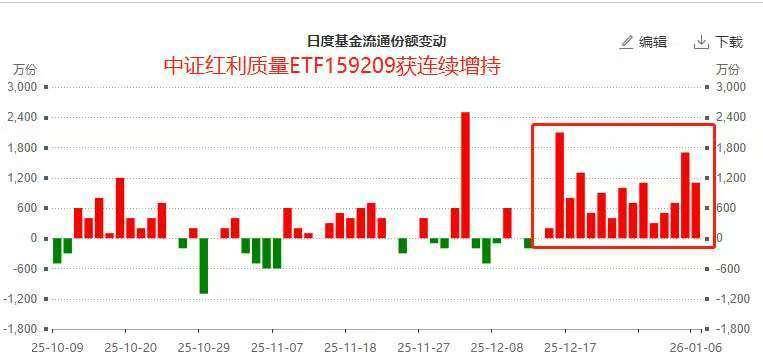
Group 1 - The market experienced fluctuations and a decline on January 7, with the CSI Dividend Quality ETF (159209) dropping by 0.40% as of 10:27 AM, indicating a clear intention for low-level capital allocation, with nearly 4 million net inflow during the day, marking 16 consecutive days of net inflow for the fund [1] - The ETF features a fee structure of "0.15% + 0.05%", which is the lowest in the market, providing a significant long-term cost advantage. Its monthly dividend assessment mechanism better meets investors' needs for regular cash flow, enhancing the holding experience [2] - The continuous pursuit of funds is attributed to the significant evolution of its strategy. The fund tracks the CSI Dividend Quality Index, which does not merely seek high dividend yields but integrates "high dividend" and "high quality" factors for rigorous selection. It emphasizes stable dividend capabilities while focusing on profitability, financial stability, and long-term growth potential, aiming to select the best from various industries, aligning with the philosophy of "buying great companies at reasonable prices" [4]
国海证券:煤价改善&高股息 煤炭板块攻守兼备
Zhi Tong Cai Jing· 2026-01-07 02:25
Group 1 - The core viewpoint of the report indicates that the supply constraints in the coal mining industry remain unchanged, while demand may experience fluctuations, leading to price volatility and dynamic rebalancing. By 2026, the supply-demand relationship is expected to improve, supported by policies, with coal prices potentially rising to a central level of around 750 CNY for thermal coal and 1550 CNY for coking coal, indicating a recovery in industry profitability [1][2]. Group 2 - The review of thermal coal shows a V-shaped price trend for the year, with the average price at the port expected to be 697 CNY/ton in 2025, down 158 CNY/ton year-on-year. The price fell to nearly 600 CNY/ton due to oversupply, but a recovery began in July with production constraints leading to a price peak of 834 CNY/ton in November [1]. - The review of coking coal also reflects a V-shaped price trend, with the average price at the port projected to be 1513 CNY/ton in 2025, down 509 CNY/ton year-on-year. The price rebounded quickly due to supply constraints and strong demand, despite fluctuations in the fourth quarter [2]. - For 2026, the supply-demand balance is expected to tighten, with thermal coal prices projected to rise to 750 CNY/ton and coking coal prices to 1550 CNY/ton. The demand for thermal coal is expected to grow by 0.6%, while coking coal demand may decline by 0.5% due to real estate drag but supported by resilient demand in construction and manufacturing [2].

沪指13连阳创历史,业内人士:在向更均衡的全面牛市演进
Xin Lang Cai Jing· 2026-01-07 00:56
Core Viewpoint - The A-share market has set two historical records on January 6, with the Shanghai Composite Index closing at 4083.67 points, marking a nearly ten-year high, and achieving a record 13 consecutive trading days of gains, breaking a 33-year-old record [1][3][19]. Market Performance - On January 6, all three major A-share indices rose, with the Shanghai Composite Index up by 1.50%, the Shenzhen Component Index up by 1.4%, and the ChiNext Index up by 0.75% [3][19]. - The market volume reached 2.83 trillion yuan, indicating strong buying enthusiasm among investors [2][17]. - The brain-computer interface sector saw a surge, with nearly 20 stocks hitting the daily limit, while the commercial aerospace sector also performed well, with several stocks reaching their daily limit [3][19]. Fund Inflows - The main driving force behind the current market rally is the continuous inflow of funds from insurance, financing, and foreign investments [2][18]. - As of January 5, 2026, the financing balance reached 2.54 trillion yuan, a historical high, while insurance funds allocated to stocks and funds increased by 1.49 trillion yuan since the beginning of the year [8][23]. - The market anticipates significant inflows from financial institutions due to the "opening red" effect, with a large amount of new premium funds available for market allocation [6][22]. Sector Performance - On January 6, sectors such as non-ferrous metals, non-bank financials, basic chemicals, and defense industries led the market [4][20]. - The Wenke Brain-Computer Interface Theme Index surged by 12.97%, while the Commercial Aerospace Theme Index rose by 9.49% over the first two trading days of 2026 [3][19]. Investment Strategies - Institutions recommend a balanced allocation strategy in response to the market's historic performance, focusing on sectors such as AI, resilient external demand, domestic consumption, and high dividend stocks [11][27]. - The "dumbbell strategy" is suggested, emphasizing technology growth sectors like AI and semiconductors for offensive positions, while defensive positions should focus on cyclical assets like non-ferrous metals and chemicals [27][29]. - Investors are advised to avoid short-term speculation and focus on long-term industry directions and value from dividend assets [29].