
AI技术应用

Search documents
中集集团:公司每年都会通过一定的固定资产投入,以合作外租等方式提升产能
Zheng Quan Ri Bao· 2025-11-24 09:44
Core Viewpoint - The company is enhancing its production capacity and efficiency through fixed asset investments, project management improvements, and digital transformation initiatives [1] Production Capacity Enhancement - The company invests in fixed assets annually and collaborates with external partners to boost production capacity while improving construction efficiency in shipbuilding processes [1] - Specific measures include compressing dock time, enhancing management capabilities, and increasing capacity utilization [1] Project Management Improvements - The company conducts thorough feasibility assessments during the project initiation phase and leverages extensive pre-research and resource reserves to support project acquisition [1] - Establishing long-term stable partnerships with key equipment suppliers ensures advantages in critical equipment procurement, effectively safeguarding overall project timelines [1] Digital Transformation and Innovation - The company is actively pursuing digital transformation and the application of AI technologies, focusing on continuous optimization of existing technologies and deep integration with practical scenarios [1] - Initiatives include the introduction of collaborative robots in shipbuilding and semi-automated process improvements, showcasing strong situational application capabilities [1] - The establishment of the "Zhongji Zero Carbon Intelligent Manufacturing Industrial Park" aims to attract leading global enterprises, fostering collaborative innovation and reducing operational costs across the supply chain [1]

中集集团(000039) - 000039中集集团投资者关系管理信息20251124
2025-11-24 01:50
Group 1: Market Outlook and Order Status - As of June 2025, the offshore engineering segment has a backlog of approximately $5.55 billion, with production scheduled until 2027/2028 [3] - The company focuses on high-quality, high-end equipment orders, primarily in FPSO/FLNG projects, while non-oil and gas orders are pursued through existing client relationships [3] - Investment in offshore oil and gas projects has been delayed due to macroeconomic uncertainties and high interest rates, with a forecasted release of delayed projects in 2026 and sustained investment peaks through 2027-2028 [3] Group 2: Capacity Planning and Efficiency - The company enhances capacity utilization through fixed asset investments and external collaborations, aiming to improve construction efficiency in segment cutting and welding assembly [3] - A proactive approach in project initiation includes thorough feasibility assessments and leveraging pre-researched project resources to support order acquisition [3] - Establishing long-term partnerships with key equipment suppliers ensures advantages in procurement, safeguarding project timelines [3] Group 3: Digital Transformation and Innovation - The company is advancing digital transformation and AI applications, introducing collaborative robots in shipbuilding and achieving semi-automated process improvements [4] - A comprehensive smart manufacturing plan is being developed to enhance operational efficiency across all processes [4] Group 4: Competitive Advantages - The company boasts a design capability with nearly 4,000 employees, including a dedicated R&D team of about 1,200, and four research centers located in key regions [5] - A one-stop delivery capability is supported by a robust manufacturing and supply chain system, enabling significant advantages in modular construction and cost control [5] - A responsive global supply chain system allows for real-time data sharing with clients, ensuring transparency and collaboration throughout the project lifecycle [6] Group 5: Asset Management and Market Strategy - The offshore asset management business has successfully executed lease contracts, with the sixth-generation semi-submersible drilling platform "Xianjing Yantai" signing five well leases [7] - Future bidding for drilling platforms will focus on global hotspots such as the North Sea, Australia, Brazil, and the Middle East, while also monitoring emerging markets in Asia-Pacific and Latin America [7] - The company aims to leverage its strengths in core equipment, asset management, and market resources to secure high-quality orders and promote healthy business growth [7]
地产链:扭转预期,需要踏出那一步
2025-11-24 01:46
Summary of Conference Call Records Industry Overview - The real estate market is currently experiencing a downturn, particularly in first-tier cities where second-hand housing prices have fallen more than the national average, negatively impacting market confidence [1][2][4] - Despite a stable overall performance in the first half of 2025, prices have accelerated downward since the third quarter, with a significant decline in sales and investment data in October [2][3] Key Points and Arguments Market Performance - In the first half of 2025, the real estate market was stable, with good sales of new and second-hand homes, but began to decline in the third quarter [3] - The average price drop in second-hand homes across 70 cities has raised concerns about market confidence [4] Policy Environment - Administrative easing policies have not fully reversed the market downturn; the main expectation is a reduction in mortgage rates [5] - The LPR (Loan Prime Rate) saw only a slight decrease in 2025, limiting banks' ability to lower rates further due to net interest margin pressures [5] - There are discussions about implementing fiscal subsidies to alleviate the burden of mortgage loans, which could cost between 50 to 60 billion yuan annually [6] Stock Market Outlook - There is a relatively optimistic outlook for the real estate stock market, as policy advancements could improve market liquidity and company performance [7] - Companies with low debt pressure, ample cash flow, and attractive valuations are recommended for investment, particularly in Hong Kong real estate and commercial properties [7] Company-Specific Insights: Beike (贝壳找房) - Beike's revenue is affected by the price decline in first-tier cities, but its brokerage business is expected to show resilience as market demand recovers [8] - The company anticipates a net profit increase from approximately 5 billion yuan in 2025 to 7 billion yuan in 2026, driven by improved efficiency, AI technology application, and profit release from home decoration and rental businesses [9][11] - Beike's current stock price has significant upside potential, estimated at 40%-50% based on its cash reserves and low P/E ratio [12] Additional Insights Related Sectors - The kitchen appliance and integrated stove sectors are closely tied to the real estate cycle and have faced valuation pressures due to market weakness [13][14] - The central air conditioning sector is also linked to real estate, with potential for valuation recovery if market expectations shift [15] - White and black goods sectors are less correlated with real estate cycles, relying more on their own industry dynamics [16] Building Materials Market - The building materials industry has seen fluctuations in volume and price since 2021, with signs of stabilization in certain segments like coatings [17][18] - Future demand in the building materials sector is expected to decline but at a slower rate, with potential price stabilization due to supply-side adjustments [19] - Investment opportunities are seen in the renovation of existing homes, particularly in coatings and board materials, with a projected 5% compound annual growth rate in renovation area from 2025 to 2026 [21] Risk Assessment - Risks related to accounts receivable and asset impairment from the real estate sector have been effectively controlled, although attention is needed for potential asset devaluation from unsold properties [20] Investment Recommendations - Focus on companies with strong market positions and potential for recovery, such as Beike, and sectors like coatings and engineering materials that are less affected by the real estate downturn [22][24]
拆解百胜中国的三万店野心:路径、效率与回报
Hua Er Jie Jian Wen· 2025-11-21 10:57
Core Viewpoint - Yum China has set an ambitious target to open 30,000 stores by 2030, marking the beginning of an unprecedented expansion phase for the largest chain restaurant group in China [1] Expansion Strategy - The company aims to reach 20,000 stores by 2026, with a total exceeding 25,000 by 2028, primarily driven by KFC, which is expected to grow to over 17,000 locations [2] - The expansion will also include Lavazza and other brands, with a projected total of over 6,000 new stores in the next three years [2] - Currently, Yum China's services cover about one-third of China's population, with a goal to expand to half by 2028 [2] Market Adaptation - Yum China has validated its store model for lower-tier markets, focusing on resilience, growth, and strategic advantages through its RGM strategy [3] - The "WOW model" for Pizza Hut has rapidly developed since its launch in May 2024, helping to penetrate 40 new cities [3] Sales and Pricing Strategy - Same-store sales growth is conservatively projected at 0-2%, necessitating a more thorough mass-market approach [4] - KFC has maintained stable pricing since 2016, while Pizza Hut has strategically reduced prices since 2019, with current prices at about 70% of a decade ago [4][5] Future Growth Drivers - Future same-store growth will rely on increasing order volumes, with successful models like the "shoulder-to-shoulder" store type enhancing customer reach [6] - New initiatives include introducing burgers at Pizza Hut and affordable meal options at KFC targeting budget-conscious consumers [7] Operational Efficiency - The extensive store network supports centralized operations and collaborative innovation [8] - The RGM 3.0 strategy emphasizes resource integration across stores and brands, enhancing operational efficiency [9][10] Supply Chain Optimization - The focus on maximizing the value of key products, such as chicken, is aimed at reducing operational losses [12] - Yum China is advancing integrated industrial park construction to streamline supply chain operations [13][14] Financial Performance and Shareholder Returns - The company aims to increase ROIC from 16.9% in 2024 to approximately 20% by 2028, driven by enhanced profitability and controlled capital expenditures [17] - By 2028, the target operating profit margin is set to be no less than 11.5%, with KFC aiming for 17.3% and Pizza Hut for 14.5% [19] - Yum China plans to return approximately $1.5 billion to shareholders annually from 2024 to 2026, with a goal of distributing nearly all free cash flow from 2027 onwards [23][24]
爱奇艺(IQ):关注行业新周期中的基本面改善趋势
HTSC· 2025-11-20 01:29
Investment Rating - The report maintains a "Buy" rating for the company [1] Core Insights - The company reported total revenue of 6.7 billion yuan in Q3 2025, a year-on-year decline of 7.8%, which was slightly better than the consensus expectation of a decline of 8.6% [1] - Non-GAAP net profit was -150 million yuan, compared to the consensus expectation of -120 million yuan [1] - Management indicated that new regulations from the National Radio and Television Administration have positively impacted the company, and they are exploring innovative content production models [1] - Membership services showed a positive trend due to improvements in content quality and sales strategies, with expectations for revenue growth in Q4 [1] Revenue and Membership Performance - Membership service revenue for Q3 2025 was 4.2 billion yuan, down 3.5% year-on-year but up 3% quarter-on-quarter, driven by popular self-produced series and films [2] - The company maintained the leading market share in long video series, with significant viewership for titles like "Chao Xue Lu" and "Sheng Wan Wu" [2] Profitability and Cost Structure - The company's gross margin was 18.2%, a decrease of 3.8 percentage points year-on-year, with content costs at 4.04 billion yuan, down 0.7% year-on-year [3] - Non-GAAP operating expenses totaled 1.27 billion yuan, with an expense ratio of 19.0%, an increase of 1.6 percentage points year-on-year [3] - Management is leveraging a unique IP reserve to enhance user experience and is developing both IP-based consumer products and offline experiences [3] AI and International Business Growth - The company is utilizing AI to produce high-quality original micro-animations at lower costs and to enhance user experience through AI-driven features [4] - International business revenue outside mainland China grew by over 40% year-on-year in Q3 2025, marking the highest growth in nearly two years [4] Financial Forecast and Valuation - The revenue forecast for 2025-2027 has been adjusted to 27.3 billion, 28.5 billion, and 29.8 billion yuan, respectively [5] - Non-GAAP net profit estimates for the same period are adjusted to 0.9 billion, 6.7 billion, and 10.1 billion yuan [5] - The target price is set at $2.92, reflecting a valuation of 0.7x 2026 PS, which is at a discount compared to the industry average of 5.3x [5]

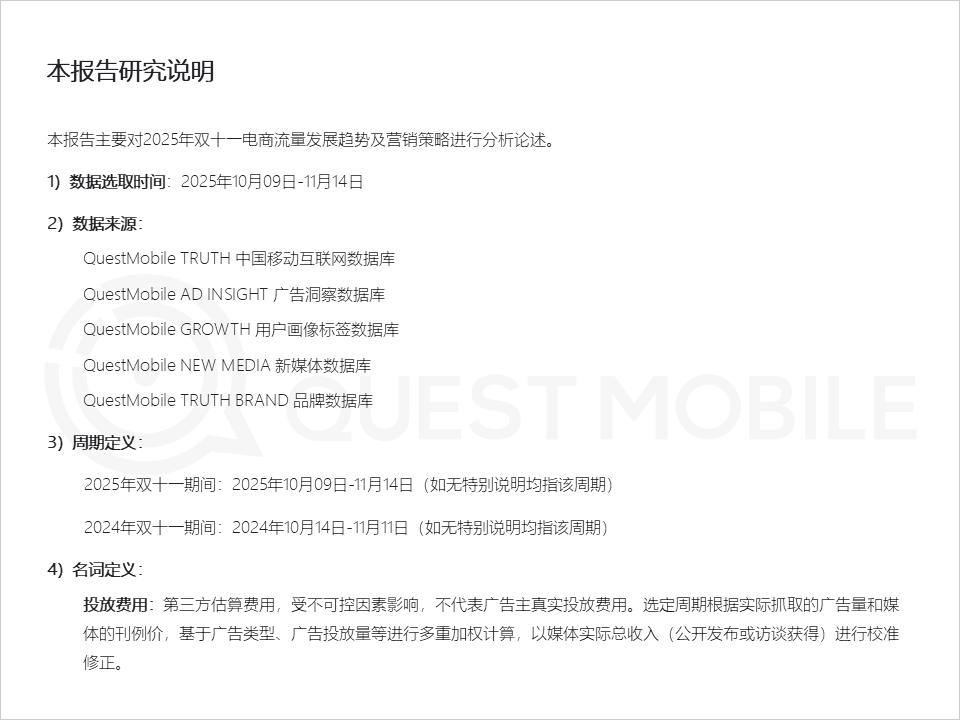
QuestMobile2025年双十一洞察报告:内容互动量、快递业务量、下单量飙升,平台间用户争夺战激烈
3 6 Ke· 2025-11-19 02:29
Core Insights - The 2025 "Double Eleven" shopping festival shows a significant increase in mobile shopping penetration and user engagement, indicating a shift towards a more mature consumer behavior in e-commerce [1][8][11]. Industry Insights - The active penetration rate of the mobile shopping industry reached 87.5% in October 2025, a 0.6% increase from the previous year [8]. - The content interaction volume during "Double Eleven" experienced explosive growth, reaching 1.12 times the peak of the 618 shopping festival [1]. - The logistics sector saw a year-on-year increase of 8% in collection volume and 6.6% in delivery volume during the promotional period [1]. - Major e-commerce platforms like Taobao, Tmall, JD.com, and Pinduoduo saw daily active user growth on "Double Eleven," with Taobao reaching 508 million users, a 4.2% increase year-on-year [23]. Platform Strategies - E-commerce platforms are shifting from "traffic dividends" to "retention operations," focusing on deepening user engagement and simplifying promotional rules [6][27]. - The overlap of users among Taobao, Pinduoduo, and JD.com exceeded 50 million, marking a 19.9% year-on-year increase [2]. - Platforms are utilizing diverse marketing strategies, including media advertising, content preheating, and brand collaborations to attract users [2][36]. User Behavior - The user base is expanding to include more male, middle-aged, and lower-tier market consumers, with notable growth in users over 41 years old on Taobao [1][2]. - The competition for users is intensifying, with platforms like Douyin and Xiaohongshu attracting younger demographics, while comprehensive e-commerce platforms are focusing on retaining existing users [2][46]. Brand Marketing - Brands are adjusting their marketing strategies to focus on conversion, with significant differences in marketing rhythms across industries [50]. - The beauty and personal care sector continues to rely heavily on hard advertising, while the food and beverage sector balances hard and soft advertising for effective marketing [57][61]. - The home appliance industry is increasingly investing in hard advertising to drive direct conversions, with top brands like Midea and Haier dominating ad exposure during the festival [68].




【大麦娱乐(1060.HK)】IP业务收入翻倍,关注大麦国际&IP零售业态进展——FY26H1业绩点评(付天姿/杨朋沛)
光大证券研究· 2025-11-16 23:03
Core Viewpoint - The company reported strong revenue growth in FY26H1, driven by performance in live events and IP derivative businesses, despite some challenges in profit margins and specific segments [4][5][6]. Group 1: Financial Performance - The company achieved revenue of 4.05 billion RMB in FY26H1, representing a year-over-year increase of 33% [4]. - Gross profit reached 1.44 billion RMB, with a year-over-year growth of 9.7%, resulting in a gross margin of 35.7%, which is a decline of 7.4 percentage points compared to the previous year [4]. - Adjusted EBITA was 550 million RMB, down 14% year-over-year, but up 14% compared to FY25H1 after excluding a one-time gain of 160 million RMB [4]. - Net profit attributable to shareholders was 520 million RMB, reflecting a significant year-over-year increase of 54% [4]. Group 2: Business Segments - Revenue from performance content and technology business was 1.339 billion RMB, up 15% year-over-year, with segment performance at approximately 754 million RMB, a 5% increase [5]. - The ticketing business saw a 17% increase in user engagement, with over 2,500 large events serviced, a 19% increase in the number of events compared to the previous year [5]. - The IP derivative business generated 1.16 billion RMB in revenue, a remarkable year-over-year growth of 105%, with segment performance at 235 million RMB, up 44% [5]. - The film content and technology business reported revenue of 1.064 billion RMB, down 15% year-over-year, as the company adopted a cautious strategy focusing on low-risk, high-quality content [5]. - The drama production segment achieved revenue of 484 million RMB, with a significant increase of 423 million RMB year-over-year, turning a profit [5]. Group 3: Cost Management - The company reported a gross profit of 1.444 billion RMB, with sales and marketing expenses of 332 million RMB, reflecting a 1% year-over-year increase and a decrease in expense ratio from 11% to 8% [6]. - Management expenses were 669 million RMB, up 12% year-over-year, primarily due to increased operational costs associated with business growth [6].

这个双11,线上奢侈品开始抓牢年轻人
36氪· 2025-11-14 09:07
Core Insights - The luxury goods market in China is experiencing a significant shift towards online purchasing, particularly among younger consumers who prefer the convenience and exclusivity of e-commerce platforms [4][5][11] - The 2023 Double 11 shopping festival saw luxury brands like Balenciaga, Canada Goose, and Coach achieve high double-digit growth on platforms like Tmall, indicating a strong demand for luxury items [5][13] - The rise of functional luxury items, particularly winter apparel, has become a key driver of sales, with brands launching exclusive collections tailored for the season [7][8] Group 1: Online Shopping Trends - More young consumers are opting for online purchases of luxury goods, with platforms offering a wide range of exclusive and limited-edition items [4][5] - Over 200 luxury brands launched new collections on Tmall ahead of Double 11, showcasing a trend towards unique and exclusive online offerings [5] - The winter apparel category has become a significant growth driver for luxury sales on Tmall, with brands like Moncler and Canada Goose introducing new lines [7] Group 2: Consumer Behavior and Preferences - The Z generation is purchasing luxury goods at a younger age, integrating them into their self-expression rather than waiting for career stability [11][12] - Brands like Coach have successfully engaged Z generation consumers by understanding their lifestyle and emotional needs, leading to substantial sales growth [12] - The luxury market is shifting from a focus on brand symbols to a more subjective approach based on lifestyle and design details [16][21] Group 3: E-commerce Platform Evolution - E-commerce platforms like Tmall are evolving from mere sales channels to emotional mediators that foster long-term relationships between brands and consumers [21][22] - The platform's role is to help brands convey meaning to the right audience rather than just increasing sales volume [22] - Tmall is implementing a tiered membership structure to enhance the shopping experience for high-net-worth individuals, offering exclusive access to new products and events [23] Group 4: Digital Transformation in Luxury Retail - The luxury industry is entering a new phase of digitalization, focusing on smart and content-driven experiences rather than just product listings [27][28] - Initiatives like the "Little Red Star" and "Red Cat Plan" are helping brands target specific consumer groups more effectively, resulting in significant sales conversions [28] - AI technology is being integrated into luxury retail, with brands utilizing AI hosts for live streaming and personalized shopping experiences, enhancing engagement and reducing costs [30]

补涨行情要来?券商股被吐槽“业绩炸裂 股价躺平” 机构:交投保持热度 行情不会缺席
Hua Xia Shi Bao· 2025-11-14 00:04
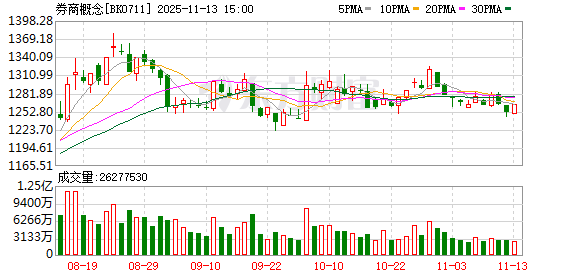
Core Viewpoint - The A-share market has recently reached new highs, but brokerage stocks have underperformed despite strong earnings growth, leading to investor frustration [2][5][8]. Group 1: Market Performance - On November 13, the A-share market fluctuated around 4000 points, with the ChiNext Index rising over 5% [2]. - The brokerage sector has seen a significant divergence between performance and stock price, with a net profit growth rate of 64% in the first half of the year, ranking 4th among 34 Shenwan industry indices, while the sector's cumulative increase was only 7% in the first three quarters, ranking 22nd [2][8]. - As of November 13, the brokerage sector experienced a net inflow of 490 million yuan, but over the previous three days, there was a net outflow of 5.791 billion yuan [2]. Group 2: Brokerage Stock Performance - Among the brokerage stocks, only Guosheng Securities and Xiangcai Securities saw significant price increases of 85% and 83%, respectively, while major firms like CITIC Securities and CITIC Jiantou had less than 5% growth [4]. - The performance of brokerage stocks has been described as "too slow" compared to the rising Shanghai Composite Index, which has crossed the 4000-point mark [5]. - The brokerage sector is currently viewed as a tool for asset allocation rather than a high-return investment, with expectations that it will not easily replicate past performance [5]. Group 3: Earnings and Valuation - In the first three quarters of 2025, 42 listed brokerages reported a total operating income of 419.56 billion yuan and a net profit of 169.05 billion yuan, representing year-on-year increases of 42.6% and 62.4%, respectively [7]. - The cost management ratio for these brokerages decreased by 7.2 percentage points to 48.6%, indicating a potential turning point in cost efficiency [7]. - The current price-to-book (PB) ratio for the brokerage sector is 1.53, which is at the 41.48 percentile of the past decade, suggesting potential for valuation recovery [11]. Group 4: Market Dynamics and Future Outlook - The number of new A-share accounts opened from January to October 2025 reached 22.4588 million, a year-on-year increase of 10.57%, although October saw a significant drop in new accounts compared to previous months [10]. - Analysts suggest that the brokerage sector's performance will improve if the Shanghai Composite Index reaches around 4500 points by 2026 [6]. - The capital market is expected to see a more balanced funding structure, with increased participation from retail and institutional investors, which could support steady market growth [12].
证券业明年业务成长有支撑 板块价值回归有空间
Zheng Quan Ri Bao· 2025-11-13 16:54
Core Viewpoint - Securities firms are optimistic about the industry outlook for 2026, focusing on valuation recovery and structural opportunities, with a shift in market drivers from valuation to earnings fundamentals [2][4]. Group 1: Industry Development Trends - The securities industry is expected to see core growth areas in wealth management, investment banking, internationalization, and technology empowerment [2]. - Wealth management is entering an upward trend, with strong new account openings and record-high financing balances, while A-share daily trading volume is projected to stabilize at 2 trillion yuan [2]. - The construction of product platforms is crucial for the transformation of wealth management, requiring alignment of product supply and sales channels [2]. Group 2: International Business Development - Developing international business is essential for securities firms to become leading investment banks, driven by increasing demand from overseas investors for Chinese assets [3]. - The international business revenue of securities firms has seen significant growth, with historical highs in the first half of 2025, supported by strong cross-border investment demand [3]. - The focus on AI technology applications and cross-border business will enhance service efficiency and asset pricing capabilities, helping to escape the homogenization of competition [3]. Group 3: Valuation Recovery Potential - The current valuation of the securities sector remains relatively low, with a projected net asset return of around 7.2% for 2026, indicating significant room for valuation recovery [4]. - The capital market is undergoing profound changes, with increased attractiveness of equity assets in a low-interest-rate environment, suggesting a positive development cycle ahead [4]. - Improved liquidity and favorable policies are expected to further enhance the valuation of securities stocks as the market improves [5]. Group 4: Investment Opportunities - The securities sector is anticipated to undergo a reshaping of its landscape, with a focus on leading firms with international capabilities and comprehensive service advantages [5]. - Mid-sized and large securities firms that can achieve leapfrog development through mergers and acquisitions are also expected to present investment opportunities [5].


