
量子计算

Search documents
【VIP机会日报】市场放量反弹 算力硬件再度爆发 栏目追踪行业动态提及相关公司大涨
Xin Lang Cai Jing· 2025-10-24 09:21
Core Insights - The market experienced a rebound with the Shanghai Composite Index reaching a new high for the year, driven by strong performances in sectors like storage chips and semiconductors [3][5]. Group 1: Market Performance - The Shanghai Composite Index closed at 3950.31, up 2.02%, while the Shenzhen Component and ChiNext Index rose by 0.71% and 3.57%, respectively [2]. - The total trading volume in the Shanghai and Shenzhen markets was 1.97 trillion, an increase of 330.3 billion from the previous trading day [3]. Group 2: Computing Hardware - The Ministry of Science and Technology emphasized the need for continued development in artificial intelligence (AI) and high-performance computing chips, indicating a strong focus on new model algorithms and chip design [5]. - Companies like Nvidia are ramping up production of their Blackwell chips, with significant demand expected for AI-related printed circuit boards (PCBs), leading to strong order volumes and potential high growth for companies in this sector [6][8]. Group 3: Storage Chips - Major memory suppliers, including Samsung and SK Hynix, are set to increase DRAM and NAND flash prices by up to 30% in Q4 to meet surging AI-driven demand [10]. - Micron Technology has indicated that the supply-demand imbalance for DRAM will worsen by 2026, with AI driving exponential growth in storage needs [10][13]. Group 4: Commercial Aerospace - The recent Fourth Plenary Session highlighted the importance of strengthening the real economy and advancing the manufacturing sector, which includes commercial aerospace [19]. - Companies in the commercial aerospace sector, such as Shanghai Huguang, saw stock price increases following positive analyst reports on policy support and innovation potential [19]. Group 5: Quantum Technology - Google's quantum AI lab announced a breakthrough in quantum computing with its "Willow" chip, achieving the first verifiable quantum advantage [24][27]. - The advancements in quantum computing technology are expected to accelerate the commercialization of the quantum computing industry, benefiting companies like Keda Technology and Geer Software, which have seen significant stock price increases [27][29].


Why QUBT Stock Is A Bad Buy: Complete Analysis
Forbes· 2025-10-24 09:20
Core Insights - Quantum Computing Inc. (QUBT) experienced a 7% stock decline on October 22 due to broader market trends and uncertainties in U.S. technology export policies to China, followed by a recovery of 7% the next day [2] Financial Performance - QUBT reported an operating cash flow of negative $19 million against revenues of only $0.3 million, resulting in an OCF margin of negative 7,181% [5] - Revenue dropped 21.5% to $0.3 million over the past year, with quarterly revenue decreasing 66.7% to $61,000 in the latest quarter [6] - The company reported a net loss of $76 million, leading to a net income margin of negative 29,054%, indicating a loss of $290 for every dollar of revenue [9] Valuation Metrics - QUBT has a price-to-sales ratio of 8,790, significantly higher than the S&P 500's ratio of 3.2, suggesting extreme overvaluation [8] - The firm maintains a minimal debt load of $1.5 million, resulting in a debt-to-equity ratio of just 0.1%, with cash constituting 81.9% of total assets at $349 million [10] Market Behavior - QUBT's stock has shown weak resistance to market downturns, plummeting 93.1% during the inflation shock of 2022 and 72.9% during the COVID pandemic [12] - Recent performance indicates a 35% decline in just one week and a 26.5% drop over the last month as investors shift towards established tech firms [13] Future Outlook - Management suggests significant revenue from photonic chip operations may be "12 to 18 months away," but this remains uncertain [15] - Analysts have revised loss estimates for 2025, projecting losses ranging from 17 cents to 25 cents per share [15] Overall Assessment - QUBT is characterized by sluggish growth, poor profitability, and weak downturn resilience, trading at valuations disconnected from fundamental realities [16]

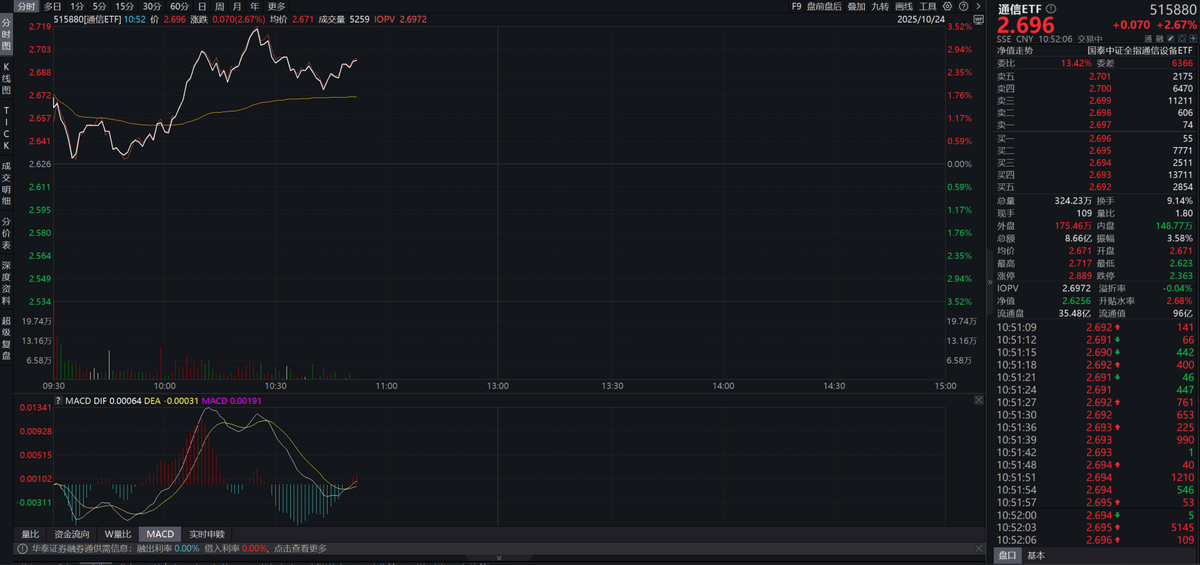
量子通信取得新突破,通信ETF(515880)涨超2%,光模块占比近50%
Mei Ri Jing Ji Xin Wen· 2025-10-24 08:33
Core Insights - China Telecom's Quantum Research Institute achieved a significant milestone in optical communication by successfully conducting a real-world experiment of over 80 kilometers for classical optical signal and quantum key distribution co-fiber transmission, with a transmission rate exceeding 10 Tb/s [1][3] - The advancements in quantum communication technology have garnered international recognition, as evidenced by the publication of these findings in the Journal of Lightwave Technology [3] - The quantum computing industry is transitioning from laboratory research to commercial applications, driven by technological breakthroughs, policy support, and market demand, with a projected market size reaching hundreds of billions by 2025-2030 [3] Optical Communication Market Dynamics - The optical communication sector is experiencing growth due to the dual catalysts of quantum communication advancements and increased demand for computing power [4] - The market for 100G+ data communication modules is expected to see significant growth, with projected increases of 54%, 69%, and 34% from 2025 to 2027, reaching market sizes of $14.4 billion, $24.4 billion, and $32.7 billion respectively [4] - The A-share market is witnessing a clear "shovel seller" logic, with leading companies expected to strengthen their market positions as demand for components from major chip manufacturers like Nvidia and Google rises [4] Investment Opportunities - The communication ETF (515880) is positioned to benefit from the ongoing technological breakthroughs in quantum communication and the rising capital expenditures in AI, maintaining a high level of market activity [5] - The ETF, which ranks first in its category with a scale of 9.317 billion yuan, has a significant allocation of nearly 79% in "optical modules, servers, copper connections, and optical fibers," with optical modules alone accounting for nearly 50% [6][5]
中美量子科技“抢滩战”,谁能率先登陆未来?
3 6 Ke· 2025-10-24 07:26
Core Viewpoint - Quantum technology is emerging as a pivotal field in global competition, encompassing quantum computing, quantum communication, and quantum precision measurement, each holding transformative potential for industries and daily life [1][4]. Group 1: Competition between China and the U.S. - The U.S. and China are engaged in intense competition in quantum technology, focusing on research investment, talent acquisition, technological breakthroughs, and industrial layout to secure a leading position [3][19]. - China has made significant strides in quantum communication, exemplified by the launch of the world's first quantum science satellite "Mozi" in 2016 and the establishment of the first long-distance fiber-optic quantum secure communication backbone network, the "Beijing-Shanghai Line," spanning over 2000 kilometers [7][8]. - The U.S. has a long-standing foundation in quantum technology, having initiated a national strategy as early as 2002, and continues to invest heavily in quantum computing and measurement, with major companies like Google achieving "quantum supremacy" in 2019 [9][10]. Group 2: Technological Advancements - Quantum computing leverages unique quantum phenomena such as superposition and entanglement, enabling exponential speed-ups in problem-solving, particularly in drug development, where it can reduce years of research to mere months [5][8]. - The "Zuchongzhi" quantum computer, launched in December 2024, features 105 qubits, marking a significant performance leap compared to Google's 72-qubit processor, showcasing China's advancements in quantum computing [8]. - The U.S. has made notable progress in quantum error correction and has a robust ecosystem of companies like IBM and Microsoft investing in quantum technology [9][10]. Group 3: Industry Developments - The 2024 Quantum Technology and Industry Conference held in Hefei, China, highlighted significant advancements and collaborations in quantum communication, computing, and precision measurement, showcasing the industry's growth and innovation [12][14]. - Key players in the quantum technology supply chain include companies like GuoDun Quantum, which leads in quantum key distribution devices with over 70% market share, and HuaGong Technology, the only mass producer of quantum dot laser chips [15][16]. - The application of quantum technology spans various sectors, including finance, government, and telecommunications, providing enhanced security and performance in information transmission [17]. Group 4: Future Outlook - The future of quantum technology appears promising, with expectations for breakthroughs in computing and communication, potentially revolutionizing fields such as climate modeling and materials science [18]. - The competition between the U.S. and China in quantum technology will likely drive further investment and innovation, while also posing challenges such as trade restrictions and technological barriers [19]. - International collaboration is essential for advancing quantum technology, as it requires a collective effort to harness global research resources and expertise for the benefit of humanity [19].


资讯日报:港股三大指数午后由跌转涨-20251024
Guoxin Securities Hongkong· 2025-10-24 06:04
Market Overview - Hong Kong stocks turned from decline to rise in the afternoon, with the Hang Seng Index closing up 0.72%[9] - The net inflow of southbound funds into Hong Kong stocks was HKD 5.345 billion[9] - Major technology stocks saw gains, with Meituan rising over 7% and Alibaba up 1.67%[9] Sector Performance - Large financial stocks contributed to the market's rise, with Agricultural Bank of China increasing approximately 2% for an 11-day consecutive rise[9] - Various sectors including gambling, sports goods, oil, mobile games, gas, and coal stocks showed active performance[9] - Biopharmaceutical, semiconductor, heavy machinery, building materials, steel, and lithium battery stocks performed poorly[9] U.S. Market Performance - Major U.S. indices closed higher, with the Nasdaq up 0.89% and the S&P 500 up 0.58%[9] - Intel's Q3 revenue was USD 13.65 billion, a year-on-year increase of 2.8%[9] - Quantum computing stocks saw significant gains, with IONQ up 7% and DWAVE up 14%[9] Japanese Market Performance - The Nikkei 225 index fell by 1.35%, with SoftBank Group leading in trading volume, down nearly 5%[12] - The Bank of Japan warned of early signs of overheating in the stock market[12] - Japan's largest labor union plans to seek a minimum 5% wage increase in the upcoming annual negotiations[12]
“科技自立自强”含量大幅提升!半导体板块全面上攻,规模最大的芯片ETF涨3.7%,科创半导体ETF近20日净流入超30亿元
Ge Long Hui A P P· 2025-10-24 05:22
Group 1 - The A-share market saw a strong performance in semiconductor stocks, with notable gains including a 20% limit up for Purun Co., over 11% increase for Shenkong Co., and over 10% rise for Huahong Group, leading to a 3.82% and 3.7% increase in the Sci-Tech Semiconductor ETF and Chip ETF respectively [1] - The "14th Five-Year Plan" emphasizes significantly enhancing technological self-reliance and strength, aiming to "lead the development of new quality productivity" and explicitly stating the need to "seize the high ground in technological development" [1] - The Minister of Science and Technology, Yin Hejun, announced the acceleration of innovation in artificial intelligence and digital technologies, focusing on enhancing the supply of computing power, algorithms, and data through the comprehensive implementation of the "AI+" initiative [1] - The consumer electronics market is experiencing a surge in new product releases, driven by demand from AI, data centers, and terminal storage, leading to a continuous rise in the storage market, with major manufacturers like Samsung and SK Hynix announcing a 30% price increase for memory [1] - Google has made a breakthrough in quantum computing with the launch of the "Willow" chip [1] - Financial reports from Cambrian, TSMC, and ASML indicate that the semiconductor industry is still in an upward cycle, with AI being a significant growth driver for the sector [1] Group 2 - The Sci-Tech Semiconductor ETF (588170) has seen a total net inflow of 3.13 billion yuan over the past 20 days, with constituent stocks covering domestic replacement equipment and materials, including companies like Zhongwei Co. (etching equipment), Tuojing Technology (thin film deposition equipment), and Huahai Qingke (CMP equipment) [2] - The largest chip industry ETF, Chip ETF (159995), has a current scale of 28.6 billion yuan, with a net inflow of 2.886 billion yuan over the past 20 days, covering the entire semiconductor industry chain including leading companies like SMIC, Cambrian, Changdian Technology, and Northern Huachuang [1]


科技股 全线爆发!
Shang Hai Zheng Quan Bao· 2025-10-24 05:00
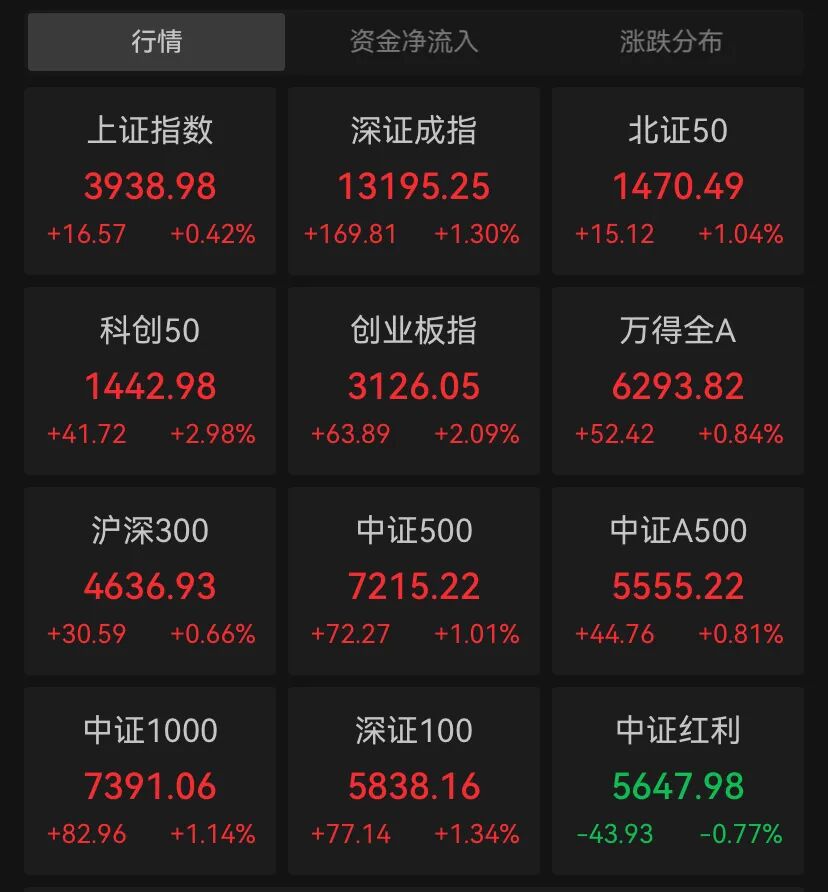
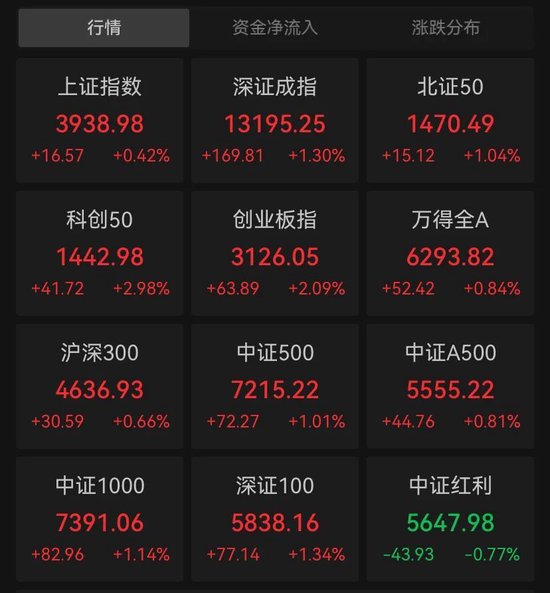
Market Performance - Major A-share indices experienced a strong rally, with the Shanghai Composite Index breaking previous highs and reaching a new high for the year at 3938.98 points, up 0.42% [1] - The Shenzhen Component Index rose by 1.3% to 13195.25 points, while the ChiNext Index increased by 2.09% to 3126.05 points [1] - The total trading volume in the Shanghai and Shenzhen markets reached 1.23 trillion yuan, indicating a significant increase in trading activity [1] Sector Performance - The technology growth sector showed strong performance across the board, with notable activity in storage chips, computing hardware, quantum technology, and commercial aerospace [2][5] - Specific stocks such as Shengyi Electronics surged by 20% to hit the daily limit, while other companies like Zhongji Xuchuang and Xiangnong Chip Innovation reached new highs [2][5] - The storage chip sector saw a collective rise in stock prices, driven by strong demand and supply constraints, with Zhongji Xuchuang increasing over 6% and Shengyi Electronics achieving a 20% limit up [5][8] Quantum Technology Developments - The quantum technology sector remained active, with companies like Dahua Intelligent and Geer Software achieving consecutive gains [10] - Recent advancements in quantum computing were reported, including Google's announcement of a verifiable quantum advantage and significant progress by China Telecom in quantum key distribution [13] - Analysts noted that quantum computing is becoming a disruptive frontier technology, with ongoing research and development expected to yield substantial progress in the next 5 to 10 years [13]


科技股,全线爆发!
Shang Hai Zheng Quan Bao· 2025-10-24 04:50
Market Performance - A-shares experienced a strong rally, with the Shanghai Composite Index breaking previous highs and reaching a new high for the year at 3938.98 points, up 0.42% [1] - The Shenzhen Component Index rose by 1.3% to 13195.25 points, while the ChiNext Index increased by 2.09% to 3126.05 points [1] - The total trading volume in the Shanghai and Shenzhen markets reached 1.23 trillion yuan, indicating a significant increase in trading activity [1] Sector Performance - The technology growth sector showed strong performance across the board, with notable activity in storage chips, computing hardware, quantum technology, and commercial aerospace [2][3] - Shengyi Electronics saw a 20% limit-up increase, while stocks like Zhongji Xuchuang and Xiangnong Chip Innovation reached new highs [2][3] - The storage chip sector experienced a collective surge, with multiple stocks in the computing hardware segment also showing significant gains [3] Company Highlights - Shengyi Electronics reported third-quarter earnings that exceeded expectations, with projected revenue between 6.6138 billion yuan and 7.0338 billion yuan, representing a year-on-year increase of 108% to 121% [5] - The company's net profit attributable to shareholders is expected to be between 1.074 billion yuan and 1.154 billion yuan, reflecting a year-on-year increase of 476% to 519% [5] Industry Trends - The storage market is experiencing a price surge due to supply constraints and rising production costs, particularly in NAND and DRAM segments [6][7] - The sentiment among storage manufacturers is leaning towards controlling inventory and holding back sales, which may lead to continued price increases in storage products [7] - Quantum technology remains a vibrant sector, with companies like Dahua Intelligent and Geer Software achieving consecutive gains, driven by advancements in quantum computing and communication technologies [10]
股指期货将偏强震荡,黄金、铜期货将偏强震荡,原油期货将震荡偏强,玻璃、纯碱期货将偏弱震荡
Guo Tai Jun An Qi Huo· 2025-10-24 02:31
Report Industry Investment Rating No relevant content provided. Core Viewpoints - Through macro - fundamental and technical analysis, the report predicts the trends of various futures on October 24, 2025, including the likely strong - side oscillations for stock index futures, gold, copper, etc., and weak - side oscillations for glass, soda ash, etc. [2][3][4] - The report also analyzes the market conditions of various futures on October 23, 2025, and gives the expected trends and support/resistance levels for the whole month of October 2025 [13][32][39] Summary by Directory 1. Futures Market Outlook - **Stock Index Futures**: On October 24, 2025, IF2512, IH2512, IC2512, and IM2512 are expected to have strong - side oscillations, with specific resistance and support levels provided [2][18] - **Treasury Bond Futures**: The ten - year T2512 and thirty - year TL2512 are likely to have wide - range oscillations on October 24, 2025, with corresponding resistance and support levels [3][34][36] - **Precious Metal Futures**: Gold futures AU2512 will likely have strong - side oscillations on October 24, 2025, and the continuous contract in October 2025 is expected to be strong - side oscillating and may reach new highs. Silver futures AG2512 will likely have oscillatory consolidation on October 24, 2025, and the continuous contract in October 2025 is expected to have strong - side wide - range oscillations [3][39][45] - **Base Metal Futures**: Copper, aluminum, and lithium carbonate futures are expected to have strong - side oscillations on October 24, 2025, while alumina futures will likely have weak - side oscillations. The continuous contracts of these metals in October 2025 also have corresponding expected trends [3][48][54][64] - **Building Materials Futures**: Rebar futures RB2601 and glass, soda ash futures are likely to have weak - side oscillations on October 24, 2025. Hot - rolled coil futures HC2601 will likely have oscillatory consolidation, and iron ore and coking coal futures will likely have wide - range oscillations [4][72][73][78] - **Energy Futures**: Crude oil futures SC2512 will likely have strong - side oscillations on October 24, 2025, and the continuous contract in October 2025 is expected to have weak - side oscillations. Fuel oil and natural rubber futures are expected to have strong - side oscillations on October 24, 2025 [5][91][95] 2. Macro News and Trading Tips - The Fourth Plenary Session of the 20th CPC Central Committee released a communiqué, setting the main goals for economic and social development during the 15th Five - Year Plan period [8] - China and the US will hold economic and trade consultations in Malaysia from October 24 - 27, 2025 [8] - Anshi China refuted the false remarks of the current management of Anshi in the Netherlands, and the issue of Anshi's supply may affect the global production of Japanese auto parts manufacturers [8] - The EU included Chinese enterprises in the 19th round of sanctions against Russia, and China urged the EU to stop this action [9] - The State - owned Assets Supervision and Administration Commission of the State Council held a symposium on the 15th Five - Year Plan for central enterprises, emphasizing industrial orientation [9] - The draft amendment to the Cybersecurity Law responds to the development needs of artificial intelligence, and the draft of the Ecological Environment Code will be reviewed for the second time [9] - In the first three quarters of 2025, the national electricity consumption reached 7.77 trillion kWh, a year - on - year increase of 4.6%, showing a quarterly recovery trend [9] - Russian President Putin said that new US sanctions on Russia would not have a major impact on the Russian economy, and the US may postpone a meeting [10] - The Trump administration is in early - stage discussions with quantum computing companies about potential financial support [10] - In September 2025, the sales of existing homes in the US increased slightly due to lower mortgage rates and slower price increases [10] 3. Futures Market Analysis and Outlook - **Stock Index Futures**: On October 23, 2025, the main contracts of CSI 300, SSE 50, CSI 500, and CSI 1000 stock index futures all showed a trend of first falling and then rising, with different degrees of increase. The overall A - share market rose slightly that day, and many foreign institutions are optimistic about the Chinese capital market [13][15][16] - **Treasury Bond Futures**: On October 23, 2025, treasury bond futures closed down across the board. The central bank conducted 2125 billion yuan of 7 - day reverse repurchase operations, with a net withdrawal of 235 billion yuan. The short - end Shibor varieties mostly declined [32][33] - **Precious Metal Futures**: Gold futures AU2512 declined on October 23, 2025, with increased downward pressure. Silver futures AG2512 rose slightly, showing signs of stabilizing and rebounding [39][45] - **Base Metal Futures**: Copper, aluminum, and alumina futures showed different degrees of increase on October 23, 2025, with different trends and support/resistance situations [48][54][58] - **Building Materials Futures**: Rebar, hot - rolled coil, iron ore, and coking coal futures all had certain increases on October 23, 2025, with different short - term trends and support/resistance levels [66][72][73][78] - **Energy Futures**: Crude oil futures SC2512 rose on October 23, 2025, with continued upward momentum. Fuel oil and natural rubber futures also showed upward trends [91][95]
量子深潜-计算篇:从比特到Qubit的范式转移 | 投研报告
Zhong Guo Neng Yuan Wang· 2025-10-24 02:28
金元证券近日发布电子行业深度报告:根据中国信通院统计,全球量子计算科研论文数 量从2015年的1000余篇增长至2024年的5000余篇。其中,2019年进入"加速期",2020-2021 年年增长量约500篇,2024年同比增长42%。从发文量区域划分来看,美国和中国占据前两 位,远超其他国家。 以下为研究报告摘要: 当前量子计算机包括量子退火机、量子模拟机、量子仿真机等专用量子计算机过渡至通 用NISQ,未来将发展至通用计算领域,技术路线上则包括超导、离子阱、光量子、中性/冷 原子等。超导技术路线最为成熟,且具有:量子逻辑门操作时间短、有机会凭借半导体行业 现有的知识和制造基础来帮助扩展量子比特数量等优势,但系统需要稀释制冷机来维持极低 的温度,并且量子态容易坍缩。代表企业包括IBM、Google、中电信量子集团、北京量子信 息科学研究院、本源量子、国盾量子、量旋科技等,其他技术路线中,量子阱、中性原子、 光量子空间仍大。 光子学(Photonics)对量子技术的发展至关重要,因为激光和其他光子器件被广泛应用 于离子阱、光量子及中性原子等技术领域。具体而言,离子阱、冷原子和金刚石氮空位色心 量子比特实现方 ...