人民币汇率升值

Search documents
杨德龙:2026年美联储可能降息两次 中国央行有望适时降息降准
Xin Lang Cai Jing· 2025-12-18 03:11
Group 1 - The core expectation is that the Federal Reserve will lower interest rates twice in 2026, driven by rising unemployment rates and economic slowdown [1][7] - The U.S. unemployment rate unexpectedly rose to 4.6% in November, the highest since September 2021, which is likely to influence the Fed's decision on rate cuts [1][6] - Following the release of the non-farm employment data, traders are betting on a reduction of the benchmark interest rate to between 3% and 3.25% [1][6] Group 2 - The acceleration of rate cuts by the Federal Reserve is primarily in response to a cooling job market, with revisions showing a decline in non-farm payrolls [7] - Economic indicators, such as retail sales remaining flat in October, suggest a slowdown in U.S. economic growth, raising concerns among economists [7] - The Fed's actions may set a precedent for other central banks globally, potentially leading to a broader trend of rate cuts [7] Group 3 - The Bank of Japan is expected to raise its benchmark interest rate to 0.75%, the highest in 30 years, reflecting confidence in achieving stable inflation targets [8][9] - The anticipated rate hike by the Bank of Japan could strengthen the yen, but market reactions will depend on the forward guidance provided by the central bank [8][9] - The potential for further rate increases exists, as current rates remain low compared to other major economies, despite inflation being stable [9] Group 4 - The Chinese central bank is likely to adopt a flexible monetary policy, including potential rate cuts, to support the capital market amid global monetary easing [7][10] - The Chinese government is focusing on boosting traditional industries while also supporting technological innovation sectors, which could create new investment opportunities [10] - The ongoing bull market in A-shares is expected to last for several years, driven by sectors such as technology, new energy, and consumer goods [9][10]
人民币汇率连续上行
Sou Hu Cai Jing· 2025-12-17 19:51
Core Viewpoint - The Chinese yuan is experiencing a strong upward trend against the US dollar, reaching its highest levels since October 2024, driven by a combination of factors including a declining US dollar index and increased demand for currency exchange by businesses at year-end [1]. Group 1: Exchange Rate Movements - On December 16, the offshore yuan broke the 7.04 mark against the US dollar, while the onshore yuan surpassed 7.05, both reaching new highs since October 8, 2024 [1]. - On December 17, the offshore yuan peaked at 7.03185 and the onshore yuan reached 7.0411, marking significant increases since October 4 and October 8, 2024, respectively [1]. Group 2: Contributing Factors - The recent appreciation of the yuan is attributed to two main factors: the decline of the US dollar index below 100 following the Federal Reserve's interest rate cut on December 11, and the seasonal increase in currency exchange demand from businesses at year-end [1]. - The yuan has been on a continuous upward trend since late November, achieving new highs for the year [1]. Group 3: Future Outlook - According to the research team at CITIC Securities, the trend of a weaker US dollar index is expected to continue into 2026, suggesting a potential for moderate appreciation of the yuan [1].
多因素共振推动人民币汇率创新高 明年有望温和升值
Xin Lang Cai Jing· 2025-12-16 23:48
记者 连润 700个基点 此轮人民币对美元汇率升值从11月下旬拉开帷幕。在岸人民币对美元汇率从7.11元附近升至7.04元附 近,升值超700个基点。 热点栏目 自选股 数据中心 行情中心 资金流向 模拟交易 客户端 12月16日,人民币对美元汇率继续大涨。在岸人民币对美元汇率逼近7.04元关口,离岸人民币对美元汇 率升破7.04元关口,双双创14个月以来新高。 专家表示,近期,受益于美元整体偏弱的外部环境、国内权益市场表现良好吸引外资流入等因素影响, 人民币对美元汇率呈现稳中有升态势。展望未来,短期内人民币对美元汇率仍将处于偏强运行状态,并 有望在2026年保持温和升值。 创14个月以来新高 12月16日,人民币对美元汇率再度走强。Wind数据显示,截至16时30分,在岸人民币对美元汇率即期 收盘价报7.0425元,较前收盘价上涨80个基点,盘中最高报7.0416元,创2024年10月8日以来新高。 更多反映国际投资者预期的离岸人民币对美元汇率则升破7.04元关口。Wind数据显示,截至16时30分, 该市场汇率报7.0382元,较前收盘价上涨52个基点,盘中最高报7.0371元,创2024年10月2日以来 ...

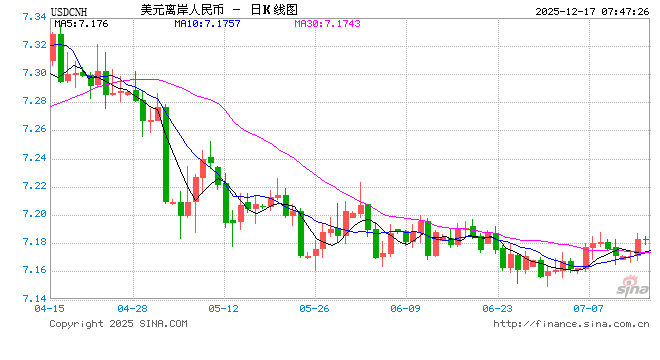
全球资本“用脚投票”:攻破7.05,人民币拿下“关键一战”
Sou Hu Cai Jing· 2025-12-16 16:38
Core Viewpoint - The recent surge in both onshore and offshore RMB exchange rates, breaking through the 7.05 mark against the USD, reflects a significant vote of confidence from global capital regarding China's economic outlook [1][3]. Exchange Rate Breakthrough - On December 15, the RMB continued its upward trend against the USD, with the onshore rate peaking at 7.0497 and the offshore rate reaching 7.0460, marking a notable recovery from earlier lows [1][3]. - The RMB's midpoint rate was reported at 7.0656, a decrease of 18 basis points from the previous trading day, while intra-day gains for the onshore and offshore RMB were nearly 200 and over 150 basis points, respectively [3]. Capital Flow Shift - The improvement in China's economic fundamentals and policy environment has led international investors to reassess the value of RMB-denominated assets, contributing to the recent appreciation of the currency [4]. - Goldman Sachs forecasts approximately $200 billion in capital inflows into the Chinese stock market over the next 12 months, indicating renewed global confidence in China's economic resilience [5]. Weakening Dollar - The depreciation of the USD has created favorable conditions for non-USD currencies, including the RMB, to appreciate [6]. - Since the beginning of 2025, the USD index has fallen by over 8%, with concerns over U.S. fiscal policy and debt further diminishing the dollar's attractiveness [6]. Policy Support - The stability and gradual appreciation of the RMB are supported by prudent and effective management from Chinese monetary authorities, aiming to maintain the currency at a reasonable and balanced level [7]. - The People's Bank of China has issued offshore RMB central bank bills to guide offshore market interest rates and stabilize market expectations [7]. Economic Resilience - The RMB's strong performance is underpinned by solid economic fundamentals, with China's GDP growth in Q1 2025 reaching 5.4%, surpassing both the previous year's growth and market expectations [9]. - Active fiscal policies and moderately accommodative monetary policies have provided robust support for economic stability, with key indicators such as fixed asset investment and retail sales showing positive growth [9]. Future Outlook - Market analysts maintain a cautiously optimistic view on the RMB's future trajectory, with predictions of a stronger exchange rate in the short term [10]. - The RMB is gradually shifting from being an optional asset to a necessary one in global reserve asset allocation, with its share in global foreign exchange reserves rising to around 3% [10].

交通银行“沃德财富万里行”全国巡回路演(广州站)启动
Shang Hai Zheng Quan Bao· 2025-12-16 14:07
Group 1 - The core initiative of the Bank of Communications is the establishment of a Wealth Management Department to enhance its wealth management services and align with the national strategy for common prosperity [1][3] - The "Wode Wealth Nationwide Tour" is the first marketing project following the organizational restructuring, aiming to expand wealth management services from key regions to the entire country [1][6] - The tour will connect major economic zones including the Yangtze River Delta, Guangdong-Hong Kong-Macao Greater Bay Area, and Beijing-Tianjin-Hebei, promoting the bank's wealth management services [1][3] Group 2 - The bank's branches in the Guangdong-Hong Kong-Macao area have developed strong cross-border financial service capabilities, aiming to support the region's development as a world-class city cluster [3][6] - Experts at the event discussed macroeconomic outlooks, with insights on the long-term appreciation of the RMB against the USD due to various economic factors [4][6] - The event featured discussions on cross-border wealth management, emphasizing the need for lower account opening thresholds to facilitate global asset allocation for clients [5][6] Group 3 - The bank plans to conduct over 50 events nationwide in the next six months, including product strategy meetings and investment report sessions, to foster wealth growth and economic development [7][8] - The Hong Kong branch reported a 13% year-on-year increase in managed assets, highlighting the growing demand for offshore family trusts among clients in the Greater Bay Area [7][8] - The bank will collaborate with over 80 financial institutions to provide insights on macro trends and asset allocation strategies to clients [8]


人民币兑美元,刷新逾一年来新高
Feng Huang Wang· 2025-12-16 05:54
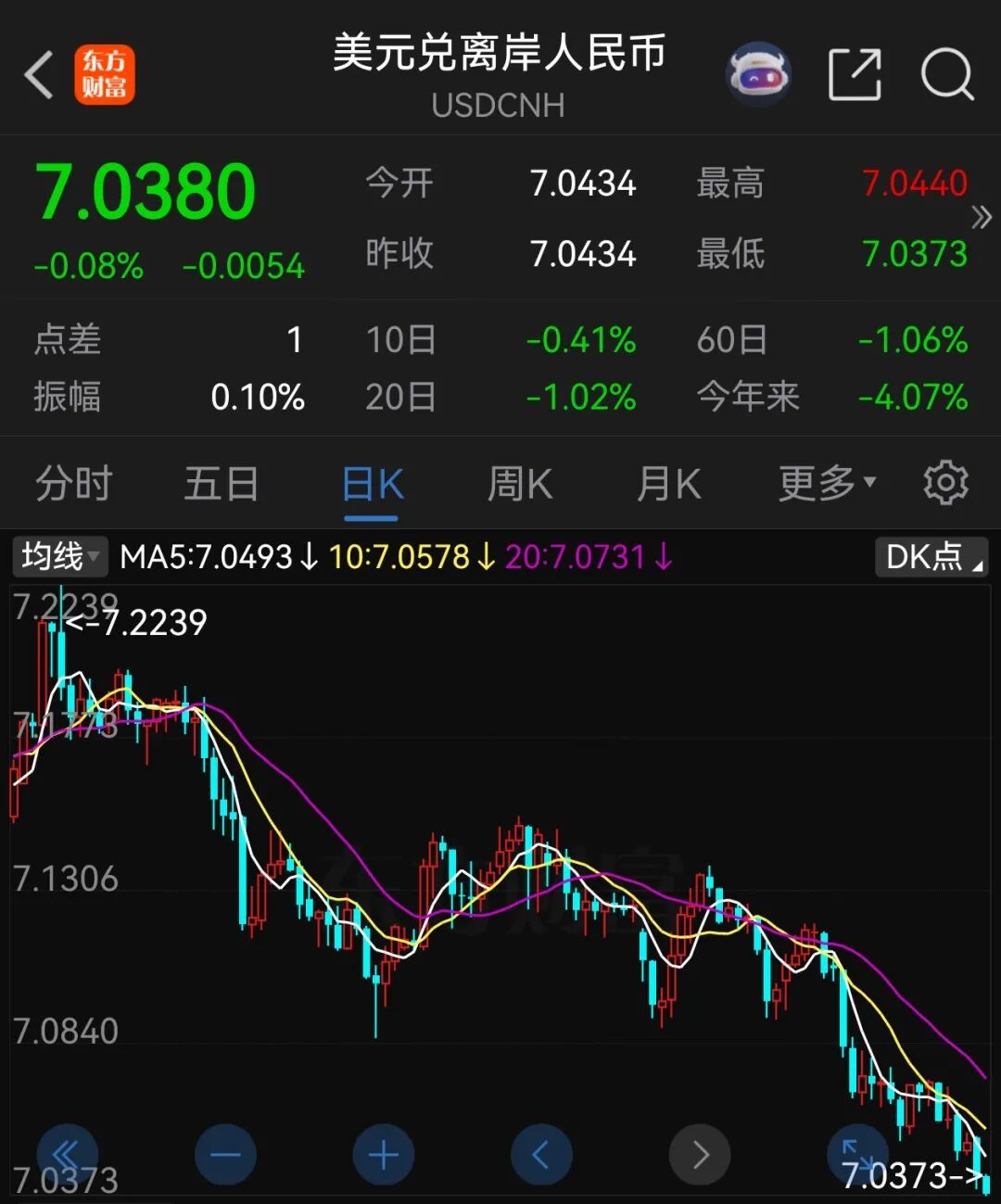
Core Viewpoint - The offshore RMB to USD exchange rate reached a high of 7.04, marking the highest level since October 4, 2024, while the onshore RMB also peaked at 7.04, the highest since October 8, 2024 [1] Group 1: Exchange Rate Movements - The offshore RMB opened at 7.0380 and reached a maximum of 7.0434, with a minimum of 7.0373, reflecting a daily fluctuation of 0.10% [2] - The RMB has shown a year-to-date depreciation of 4.07% against the USD, with a 60-day decline of 1.06% [2] Group 2: Market Analysis - Wang Qing, Chief Macro Analyst at Dongfang Jincheng, stated that a stronger RMB would boost confidence in the capital markets and attract more foreign investment into domestic markets, creating a positive feedback loop with the currency market [2] - The short-term outlook suggests that the RMB will continue to operate in a strong state, with key factors to monitor including USD trends, RMB midpoint adjustment efforts, and domestic growth stabilization policies [2] Group 3: Future Projections - Deutsche Bank forecasts that by the end of 2026, the RMB will appreciate to 6.7 against the USD, and further strengthen to 6.5 by the end of 2027 [3]
美联储如期降息 降息周期下汇率升值引市场连锁反应
Sou Hu Cai Jing· 2025-12-11 23:34
Group 1 - The Federal Reserve has lowered the federal funds rate by 25 basis points to a target range of 3.50%-3.75%, marking the third rate cut of the year [1] - The Chinese yuan is approaching the important 7.0 level against the US dollar, with the central parity rate set at 7.0686 yuan per dollar, reflecting a rise of 67 basis points from the previous trading day [1] - Analysts expect the yuan to perform strongly towards the end of the year, with a possibility of temporarily breaking the 7.0 level due to seasonal effects in foreign exchange settlements [1] Group 2 - Gold and silver prices have risen due to the Fed's rate cut and increased risk aversion, with spot gold reaching $4247 per ounce before retreating, and silver hitting a historical high of $62.88 per ounce [2] - The A-share precious metals sector has also seen gains, with a closing increase of 0.51%, and specific stocks like Shanjin International rising by 6.06% [2] - Factors such as the Fed's rate cut, ongoing regional conflicts, and the Bank of Japan's interest rate hike are supporting a bullish outlook for gold prices amid global political and economic uncertainties [2] Group 3 - The US dollar index has fallen over 8% this year, leading to an appreciation of the yuan, with onshore yuan trading at 7.0601 and offshore yuan reaching a 14-month high of 7.0538 [3] - Over 30 A-share companies have announced plans to engage in foreign exchange hedging to manage risks associated with currency fluctuations, driven by concerns over shrinking export revenues [3] - Companies are increasingly prioritizing currency risk hedging as a response to the volatility in exchange rates, which threatens profit margins [3] Group 4 - Institutions are generally optimistic about the medium to long-term outlook for the yuan, with predictions of a continued weak dollar index providing a favorable external environment for the yuan [4] - Analysts forecast that the yuan may appreciate moderately, potentially breaking the 7.0 level against the dollar by 2026, supported by a structural weakness in the dollar and net inflows of investment funds [4] - If the annual exchange rate volatility remains between 3.0%-4.0%, the yuan could reach a range of 6.70-6.80 by the end of 2026 [4]
美联储如期降息 人民币对美元中间价上调67个基点 业内预测美元持续走弱将推动人民币升值
Sou Hu Cai Jing· 2025-12-11 04:15
智通财经12月11日 (记者 曹韵仪)12月11日凌晨,美联储宣布降息25个基点,将联邦基金利率目标区 间下调至3.5%至3.75%,符合市场预期。美联储同时宣布,将启动短期国债购买计划,以此调节市场流 动性水平,确保其对自身利率目标体系保持稳定控制。 今日凌晨美联储宣布降息25个基点后,人民币对美元中间价报7.0686元,上调67个基点。离岸人民币盘 中触及7.0538,汇率创14个月新高。 在人民币汇率方面,多位专家对智通财经记者表示,2026年人民币兑美元汇率"破7"的可能性非常大。 市场普遍预测人民币将在明年6月份走向7的点位,并认为这背后是结构性变化,增强了市场对人民币的 信心。 有专家也对智通财经记者表示,这次降息打开了更充裕的"操作窗口",但我国政策核心还是"以我为 主",最终看的还是国内经济的需求。"美联储降息会减轻外部因素对国内货币政策灵活调整的掣肘,在 这一有利的外部窗口下,2026年我国货币政策在适度宽松方向上有充足的空间。" 美联储如期降息 缩窄人民币利率差 前海开源基金首席经济学家杨德龙对智通财经记者表示,美联储降息压缩了美元和人民币的利率差距, 这有助于推动人民币汇率升值。"202 ...
港股速报 | 港股小幅高开 内资券商股全线上扬
Mei Ri Jing Ji Xin Wen· 2025-12-08 02:09
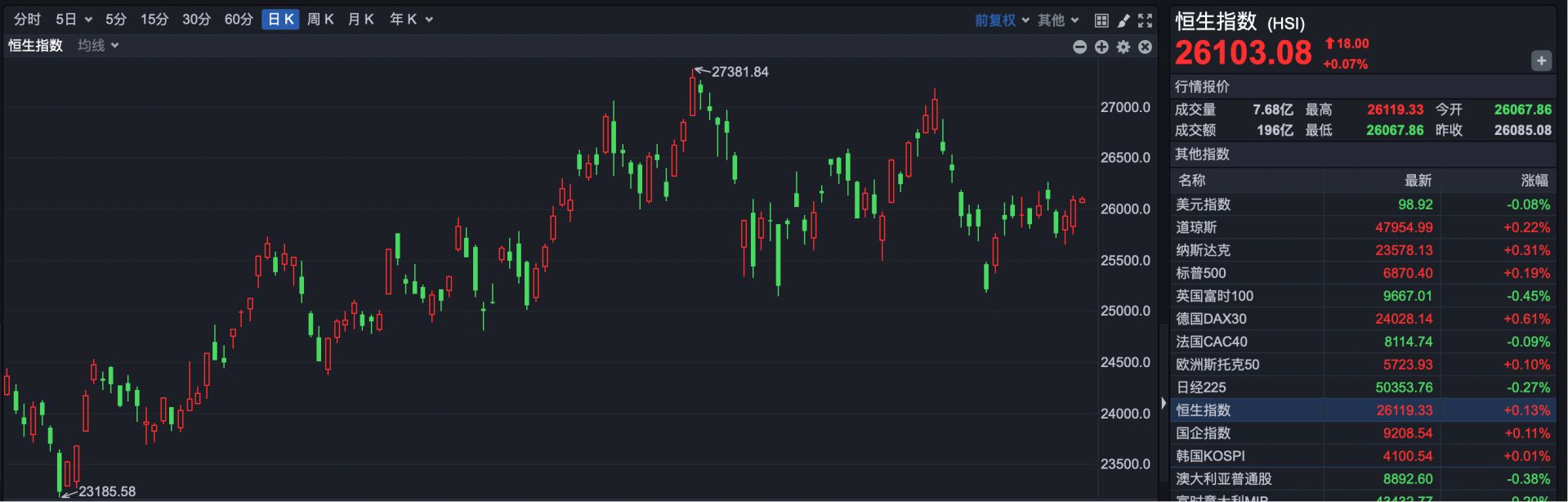
Core Viewpoint - The Hong Kong stock market showed a slight increase, with the Hang Seng Index rising by 0.07% to 26,103.08 points, reflecting a positive market sentiment influenced by recent developments in the securities industry [1][2]. Group 1: Securities Industry Developments - The Chairman of the China Securities Regulatory Commission, Wu Qing, emphasized the critical role of the securities industry during the "14th Five-Year Plan" period, outlining nine key requirements for the sector [2]. - Wu highlighted the securities industry as a major "service provider" for direct financing, an important "gatekeeper" for capital markets, and a professional "manager" of social wealth, indicating significant growth potential [2]. Group 2: Market Performance - Domestic brokerage stocks experienced a notable rise, with Hongye Futures (HK03678) increasing over 8%, and other firms like Guotai Junan (HK02611) and Huatai Securities (HK06886) rising more than 5% [2][4]. - The Hong Kong Securities ETF also saw an increase of over 3% in early trading [2]. Group 3: Sector Highlights - The Hang Seng Technology Index rose by 0.50% to 5,690.54 points, indicating a positive trend in technology stocks [3]. - Mixed performance was observed in the tech sector, with Baidu increasing over 4% and Meituan rising over 1%, while Lenovo saw a decline of 0.7% [6]. - Semiconductor stocks gained, with companies like SMIC and Hua Hong Semiconductor rising over 2% [6]. - The innovative drug sector showed strength, with Kangfang Biotech increasing over 2% [6]. - Domestic insurance stocks also performed well, with China Ping An and China Life both rising over 2% [6]. Group 4: Market Outlook - Huatai Securities noted that the recent appreciation of the RMB is a positive sign in domestic economic and financial data, suggesting that moderate appreciation could benefit corporate performance despite common beliefs about its negative impact on export companies [7]. - The firm indicated that the current market sentiment remains pessimistic, but it is viewed as a potential opportunity for investment, particularly in technology and pharmaceuticals, while also suggesting a focus on consumer goods for alpha opportunities [7].
华泰证券梁红:当前经济增长源于效率提升,为人民币资产重估与汇率走强奠定基础
Sou Hu Cai Jing· 2025-12-07 09:50
Core Viewpoint - The current economic growth in China is primarily driven by improvements in production efficiency, which lays the foundation for the revaluation of RMB assets and a stronger exchange rate [3]. Group 1: Economic Growth and RMB Valuation - The majority of the approximately 5% economic growth in China over the past two years has come from enhanced production efficiency rather than simple capital expansion [3]. - The improvement in the quality of growth is expected to lead to a revaluation of RMB assets, providing solid fundamental support for the appreciation of the RMB exchange rate [3]. Group 2: Policy Recommendations - Short-term focus should be on stabilizing the real estate market and local finances to prevent deterioration that could drag down the economy, requiring corresponding policy support [3]. - In the long term, it is essential to utilize the current adjustment period in the real estate market to address housing issues for certain groups, thereby stimulating domestic demand and alleviating pressure in the real estate sector [3]. - A critical task is to "activate the stock," meaning effectively utilizing existing state-owned asset stock to support low-income group consumption and fill social security funding gaps [3]. Group 3: Expected Outcomes - Progress in the aforementioned areas is anticipated to not only achieve actual economic growth but also restore "nominal growth" to normal levels, promoting a more resilient and sustainable appreciation phase for the RMB exchange rate [3].