
拉尼娜

Search documents
大豆与棕榈市场:加菜籽出口降,巴西产量增
Sou Hu Cai Jing· 2025-07-12 13:40
Group 1 - The domestic and international protein meal and oil futures markets have experienced significant dynamics recently, particularly in soybean and rapeseed meal and oil sectors [1] - Canadian canola seed exports sharply decreased by 72.1% in the week of July 6, dropping from 173,500 tons to 48,400 tons [1] - The USDA's latest drought report indicates that approximately 9% of the U.S. soybean planting area was affected by drought as of July 8, up from 8% the previous week and the same as last year [1] Group 2 - The Brazilian Ministry of Agriculture's CONAB forecasts a soybean production of 169.4879 million tons for the 2024/25 season, an increase of 21.766 million tons year-on-year [1] - The USDA reported that net sales of U.S. soybeans for the 2024/25 season increased to 503,000 tons, with cumulative sales reaching 50.44 million tons, a year-on-year increase of 5.62 million tons [1] - The U.S. imposing an additional 50% tariff on Brazilian products will raise farm costs, impact the soybean supply chain, and pose risks to international markets [1] Group 3 - In the palm oil sector, Malaysia's palm oil exports in June were 1,259,354 tons, a month-on-month decrease of 10.52% [1] - Malaysia's palm oil production fell to 1,692,310 tons in June, a month-on-month decline of 4.48%, marking the first decrease in four months [1] - Palm oil inventories in Malaysia rose to 2,030,580 tons, a month-on-month increase of 2.41%, reaching the highest level since December 2023 [1]
2025年大豆期货半年度行情展望:供需双增,震荡为主
Guo Tai Jun An Qi Huo· 2025-06-23 12:12
Report Summary 1. Report Industry Investment Rating No information provided on the industry investment rating. 2. Core View of the Report - In the second half of 2025, the US soybean futures will maintain a range - bound pattern, with the core operating range between 900 - 1150 cents per bushel [2]. - The supply is loose, which suppresses the upper limit; the cost provides support at the lower limit; and there is a structural differentiation in the inventory - to - consumption ratio [3]. 3. Summary by Relevant Catalogs 3.1 2025 H1 US Soybean Futures Trend Review - January - February: South American weather factors and Sino - US trade friction expectations jointly pushed up prices. Adverse weather in Argentina and Brazil affected supply, and Chinese crushers' concentrated purchases of US soybeans due to potential trade risks increased demand [7]. - March: The market showed "expected - realization" characteristics, and the improvement of Brazil's harvesting progress led to price corrections. After the tariff announcements, the price first declined and then rebounded, and later entered a sideways - shock pattern [7]. - April: The downward adjustment of the new - crop area estimate and the end of the trade - war negative news led to a V - shaped reversal in price and then maintained a shock. The expected reduction in the US soybean planting area and the market's expectation of tariff reduction drove the price movement [8]. - May: The easing of trade tensions led to narrow price fluctuations. The Sino - US agreement improved the trade outlook and increased the market's expectation of China's demand recovery [8]. 3.2 Supply - Demand Framework: A Volatile Pattern under the Game of Bulls and Bears 3.2.1 Supply Side: Structural Contradictions in the Loose Pattern - Global oilseeds: In the 2025/26 season, the global oilseed market will see a mild increase in both supply and demand. The total output of seven core oilseed varieties is expected to reach 692.1 million tons (+2.2% year - on - year), and the total consumption is expected to reach 687.65 million tons (+2.9% year - on - year). The inventory - to - consumption ratio will remain at 20.8%. The market is expected to continue the range - bound trend [13]. - Global soybeans: In the 2025/26 season, the global soybean output and consumption will both increase. The output is expected to reach 426.82 million tons, and the consumption will reach 424.05 million tons. The inventory - to - consumption ratio will drop to 20.3%, but it is still at a relatively high level, indicating an overall supply - surplus situation [20]. - Brazil: The soybean harvesting area is expected to increase to 48.8 million hectares, and the output is expected to reach a record 175 million tons. Domestic consumption and exports are also expected to increase. However, the final output depends on the weather during the growing season [22][23]. - US: The soybean harvesting area is expected to decrease by about 1.35 million hectares. The output is expected to be 111.8 million tons, a slight decrease. Exports are expected to decrease, while domestic consumption is expected to increase. The inventory - to - consumption ratio will drop to 6.7%, indicating a tight - balance supply - demand situation [26]. - Argentina: In the 2025/26 season, the soybean output is expected to be 48.5 million tons, and the domestic consumption is expected to be 50.5 million tons. The inventory - to - consumption ratio is 13.2%, indicating a balanced supply - demand relationship [29]. 3.2.2 Demand Side: The Rigid Growth of Protein Meal Consumption - The feed protein raw material supply pattern is diversified, with soybean meal accounting for 70% of the market share. In the 2025/26 season, the global protein raw material consumption will maintain a steady growth trend. The total consumption is expected to exceed 394.78 million tons, an increase of 14.82 million tons (+3.9% year - on - year) [33][34]. - Since 2020, the global protein meal consumption has shown a differentiated growth trend. Rapeseed meal has the highest consumption growth rate, and emerging economies have become the main driving force for the growth of protein meal consumption [40]. 3.3 Trading Strategies: Trading Opportunities in a Volatile Market 3.3.1 US Soybean Prices in H2 2025: Mainly Sideways - Shocking - The global oilseed market shows a pattern of increasing supply and demand, and the overall supply is relatively loose. The high - yield pressure in South America and the cost support in North America form a game of bulls and bears. It is expected that the US soybean prices will maintain a range - bound trend in the second half of 2025 [42]. 3.3.2 Trading Strategies - Strategy 1: Band - buying based on cost support. Buy at the level of 900 - 950 cents per bushel, set the stop - loss at around 880 cents per bushel, and the target price at 1100 - 1150 cents per bushel [44]. - Strategy 2: A positive spread strategy of buying January and selling May. Due to the tight US soybean balance sheet and the probability of Brazil's continued expansion of planting, this strategy is highly feasible, and the better buying times are July and October [45].
橡胶周报:留意低位支撑-20250622
Hua Lian Qi Huo· 2025-06-22 13:35
1. Report Industry Investment Rating No relevant content provided. 2. Core Viewpoints of the Report - The market is optimistic about the increase in rubber production in 2025, but the rebound after the low - level of rubber prices is weak. It is recommended to pay attention to the low - level support, and aggressive investors can hold long positions. Also, pay attention to the arbitrage strategy of going long on br and short on ru [6]. - The macro - environment is complex, with intensified Middle - East geopolitical conflicts, domestic reserve requirement ratio and interest rate cuts, and the Fed's stance on interest rates. Trade negotiations between China and the US may be volatile. Real - estate data is poor, and the automobile market is highly competitive [6]. 3. Summary by Relevant Catalogs 3.1 Main Views - Macro: Middle - East geopolitical conflicts intensify. China cuts reserve requirement ratio and interest rates, while the Fed keeps rates unchanged with two expected cuts this year. Sino - US trade negotiations may be volatile. Real - estate data is worse than expected, and the automobile market is highly competitive [6]. - Supply: The market is optimistic about 2025 rubber production increase. The large - cycle production capacity inflection point has arrived, but production inertia remains. The warming of the equatorial central and eastern Pacific Ocean weakens negative factors [6]. - Inventory: Qingdao dry - rubber inventory has stopped accumulating at a low level and slightly decreased, possibly due to downstream restocking. Exchange ru and nr warehouse receipts are at low levels. Cis - polybutadiene rubber inventory has rebounded to a high since 2017, and Shandong semi - steel tire finished - product inventory is much higher than last year [6]. - Demand: The domestic passenger - car price war has intensified, raising concerns about inventory pressure and weak demand. Real - estate and infrastructure construction are saturated. Heavy - truck sales have marginally improved, with a 6% year - on - year increase in May and a 1% cumulative increase from January to May 2025. Construction machinery sales are low, and cement production has a deeper year - on - year negative growth as of May. Passenger - car sales are strong but may have over - consumed [6]. - Strategy: Pay attention to low - level support, aggressive investors hold long positions. Focus on the arbitrage of going long on br and short on ru [6]. 3.2 Futures and Spot Markets - Rubber prices rebounded and then declined, with some varieties having large declines. The upstream oil price rebounded, but the price of butadiene, the raw material for synthetic rubber, was weak. The absolute price of old whole - latex spot is lower than last year and near the median of recent years [8][12]. - The ru basis has strengthened marginally. The month - spread has also strengthened but remains in a contango structure, which is unfavorable for long positions. The Ru9 - 1 month - spread is around - 800 in contango, the Nr consecutive 1 - consecutive 3 month - spread is around 50 and continues to weaken, and the br consecutive 1 - consecutive 3 month - spread has reversed to around 120 and is weakening marginally [15][20]. - The spot whole - latex to 20 - grade rubber spread has fallen to a low level again, and the 20 - grade rubber has a high virtual - to - real ratio. Synthetic rubber Br has rebounded relative to natural rubber [25]. - Thai raw material prices have declined marginally, and the spread between latex and cup lump has increased. Currently, rubber is being tapped globally with normal weather conditions [29]. - Processing profits have declined again recently [36]. 3.3 Inventory End - Qingdao dry - rubber inventory decreased rapidly from August 2023 to mid - October 2024 to a low since 2017, and now the low - level accumulation has stopped with a slight decrease. Butadiene port inventory has rebounded [40][45]. - The ru delivery product inventory is at a low level; the nr warehouse receipts dropped rapidly from a 5 - year high to the median level after the third quarter and are now rebounding from an extremely low level [50][56]. - Cis - polybutadiene rubber factory and trader inventories have rebounded from low levels. Tire factory and downstream trade inventories are high [59][61]. 3.4 Supply End - According to ANRPC adjusted data, the cumulative natural rubber production of member countries from January to December 2024 decreased by less than 0.5% year - on - year. China's natural rubber production from January to December 2024 was 911,400 tons, a 10% increase from the previous 854,000 tons [64]. - In 2024, rubber imports were lower than previous years due to eudr diversion, overseas restocking, and reduced arbitrage demand. In 2025, the import data of natural and synthetic rubber increased significantly, with a 17% year - on - year increase in March and a 21% increase in the first three months [68]. - The large - cycle inflection point of supply - side production capacity has arrived, and the bottom support is becoming stronger. However, production is affected by weather, pests, and profit margins, and demand affected by macro and policies determines the upper limit. There are signs of aging rubber tree age structure in production areas, especially in Indonesia [80]. 3.5 Demand End - The full - steel tire operating rate has rebounded to the median of the multi - year range, exceeding last year's level, while the semi - steel tire operating rate has rebounded slightly lower than last year and is at a high in the multi - year range [87]. - As of May 2025, the cumulative year - on - year growth of tire outer - tube production is about 3% and is marginally declining, with a much slower growth rate than last year. The cumulative year - on - year growth of tire exports as of May is about 9%, performing relatively well but lower than last year [92]. - Heavy - truck sales have marginally improved, with a 6% year - on - year increase in May and a 1% cumulative increase from January to May 2025 [97]. - Domestic passenger - car sales (including exports) are strong due to policy incentives, domestic substitution, and overseas market expansion. However, the price war has intensified, and exports face challenges such as tariffs. The support from passenger cars may be limited due to the weak real - estate and infrastructure [101]. - Overseas automobile sales are generally average, with the US and Japan seeing rebounds, but the EU performing poorly. Trade wars have disrupted consumption patterns [105]. - Cement production had negative growth last year and has marginally improved this year, but the cumulative year - on - year negative growth has deepened as of May [111]. - Transportation investment is a key measure for stable growth but has limited effect due to infrastructure saturation. Excavator sales rebounded and then softened [115]. - Real - estate data from January to May 2025 has deteriorated, bringing pessimism. Given the long real - estate cycle and unfavorable population situation, a turnaround will take time [121]. - Road freight volume is stable but lower than in 2019, reflecting a decline in demand and substitution by railway and waterway transportation [124].
日本气象厅:目前没有发生厄尔尼诺或拉尼娜现象。未来秋季正常天气模式继续的可能性为60%。
news flash· 2025-06-10 05:05
Core Viewpoint - The Japan Meteorological Agency reports that there are currently no El Niño or La Niña phenomena occurring, with a 60% probability of normal weather patterns continuing into the autumn [1] Summary by Relevant Categories Weather Patterns - The likelihood of normal weather patterns persisting into the autumn season is estimated at 60% [1]
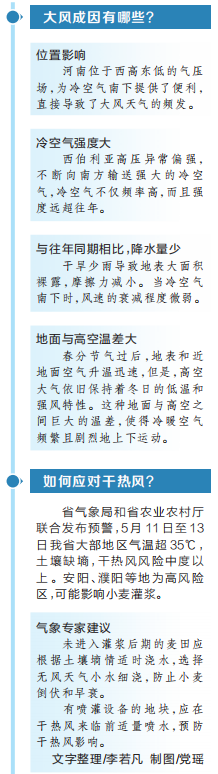
今春河南省为何大风频发
He Nan Ri Bao· 2025-05-06 23:25
Core Viewpoint - The article discusses the unusual frequency of strong winds in Henan Province during April, attributed to climatic factors such as the La Niña phenomenon and abnormal cold air activity [3][4][5]. Group 1: Weather Patterns - Henan Province has experienced strong winds exceeding level 10, with occurrences 2.9 times higher than the average of the past five years [3]. - The La Niña phenomenon, although weakening, has contributed to unstable weather patterns, leading to strong winter winds and delayed precipitation [4]. - The Siberian high pressure has been unusually strong, facilitating the southward movement of cold air, resulting in frequent strong winds in North China [5]. Group 2: Wind Speed and Impact - The strongest winds were recorded between April 11 and 13, with gusts reaching levels 10 to 12, and some areas experiencing winds as high as 15 levels, with a maximum speed of 46.8 meters per second [6]. - The article provides a scale of wind levels, indicating the potential damage and effects associated with different wind speeds, emphasizing the dangers of winds above level 6 [7]. Group 3: Agricultural Risks - As of May 4, 51% of monitoring stations in Henan reported drought conditions, with soil moisture deficiency worsening, particularly in five cities where over 70% of stations indicated low moisture [8]. - A warning was issued regarding the risk of dry hot winds affecting wheat during its grain-filling period, with temperatures expected to exceed 35°C from May 11 to 13 [8].

广西气象干旱有望5月中旬末解除
Guang Xi Ri Bao· 2025-04-28 01:59
Core Viewpoint - Guangxi is experiencing significant meteorological drought, impacting water supply for residents, livestock, and agricultural production, with the fire risk level in forest areas elevated [1] Group 1: Current Drought Situation - From November 1, 2024, to April 26, 2025, Guangxi's average precipitation was 142.8 mm, which is over 60% less than the normal level, marking the lowest since 1961 for the same period [1] - The drought began to develop at the start of the year, with some alleviation in February and March due to natural rainfall and artificial precipitation efforts, but it intensified again in April [1] - Between April 19 and 25, Guangxi experienced three instances of moderate rain accompanied by severe convective weather, which provided varying degrees of relief from the drought, although some areas remain severely affected due to uneven rainfall distribution [1] Group 2: Causes of Drought - The ongoing La Niña phenomenon in the equatorial central Pacific from December 2024 to February 2025 is contributing to the drought conditions, as historically, La Niña years have led to consecutive dry seasons in Guangxi [1] - The strong East Asian trough during La Niña years results in abnormal northerly winds over Guangxi, leading to high temperatures, low rainfall, and increased evaporation [2] Group 3: Future Weather Predictions - The meteorological department forecasts three instances of moderate rain before May 10, with localized heavy rain and severe convective weather expected on specific dates [2] - By the end of early May, the meteorological drought is expected to significantly ease, with a potential complete resolution by mid-May [3]
棉花:美棉触及历史低位,郑棉大跌跌下13100
Jin Shi Qi Huo· 2025-04-07 11:00
1. Report Industry Investment Rating - No information provided in the documents. 2. Core View of the Report - The Zhengzhou cotton (Zhengmian) is expected to maintain a weak trend in the short - term, oscillating around the 13,000 - yuan mark. Attention should be paid to downstream and order situations, as well as domestic and tariff policies [2][17]. 3. Summary by Relevant Catalogs 3.1 Market Overview - The closing price of the main 2505 contract of Zhengzhou cotton dropped 3.11% to 13,090 yuan/ton, a decrease of 420 yuan/ton from the previous trading day. ICE US cotton fell 2.27% overnight to 63.33 cents/pound. Affected by tariff policies, US cotton hit a four - year low, and Zhengzhou cotton futures opened and closed lower. The commodity market had many varieties hitting the daily limit down, with the chemical sector being severely affected and most of the agricultural products sector declining [2]. 3.2 Macroeconomic and Industry News - On April 3, the US announced a 34% "reciprocal tariff" on Chinese goods, and on April 4, China imposed a 34% tariff on all US imports. This tariff escalation may reshape the global cotton textile production and sales structure, leading to a bearish market sentiment. Cotton prices are likely to continue their weak performance in the short term [3][4]. - In the 2025/26 season (August - July), Brazil's cotton planting area is expected to increase by 2.9% to 2.13 million hectares, with a record - high output of 17.8 million bales (3.87 million tons). Exports are expected to reach 13.9 million bales (3 million tons), a 3.7% increase from the 2024/25 season [4]. - As of April 4, 2025, the total commercial cotton inventory in China was 4.4201 million tons, a week - on - week decrease of 133,700 tons (2.94%). Xinjiang's commodity cotton inventory decreased by 157,600 tons (4.31%) to 3.5 million tons, while the inland inventory increased by 26,100 tons (7.17%) to 389,900 tons. The downstream textile mills' operation is stable, with mostly rigid - demand purchases and limited large orders. The cotton bale delivery volume is relatively stable, and the inventory is expected to continue to decline next week [5][6]. - On April 7, 2025, the total cotton warehouse receipts in Zhengzhou Commodity Exchange were 12,702 (- 51) sheets, including 9,390 (+ 127) registered warehouse receipts and 3,312 (- 178) effective forecasts [5]. 3.3 Data Charts - The report includes charts on CZCE and ICE cotton futures prices, cotton spot prices and basis, 9 - 1 spread, textile profit, cotton import profit,棉纱 import profit, warehouse receipt quantity, and non - commercial positions [8][12][13][15]. 3.4 Analysis and Strategy - The US tariff - imposing measures have led to a protectionist resurgence, causing other countries to reduce trade with the US. Domestically, the impact of tariff policies will continue, and the weak trend of Zhengzhou cotton will not change in the short term. It is uncertain whether Zhengzhou cotton can hold the 13,000 - yuan mark. Overall, it is expected to oscillate around this mark in the short term, and attention should be paid to domestic and tariff policies [17].
2025消费者趋势
上海奥美广告· 2025-04-01 01:20
Investment Rating - The report does not explicitly provide an investment rating for the industry Core Insights - The report emphasizes the need for brands to adapt to changing consumer behaviors and preferences, highlighting seven major trends that will redefine consumer interactions and brand relevance in 2025 [9][10][42] Summary by Sections Consumer Experience - Macro forces influencing consumer behavior in 2025 include increased optimism among marketers, selective consumption patterns, potential impacts of climate phenomena like La Niña, seamless integration of AI in daily life, and political-economic effects of large-scale displacement policies [9] Redefining Latin American Consumers - Latin American consumers are shifting focus from North American influences to their roots, prioritizing authentic narratives driven by community over globalization [11][12] Generational Paradox - Attitudes and behaviors are blurring traditional generational boundaries, with younger consumers adopting more conservative spending habits while older generations pursue youthful activities [16] Duality of Connection - Consumers are seeking a balance between digital integration and meaningful offline interactions, emphasizing the importance of personal boundaries and community engagement [20][23] New Consumption Patterns - Consumers are rethinking their spending habits, favoring products that provide long-term benefits and meaningful experiences over luxury items [25][27] Holistic Health - Health is evolving into an integrated lifestyle concept, with consumers prioritizing emotional, mental, and physical well-being in their purchasing decisions [29][30] Connection with Nature - The relationship with nature is being redefined, focusing on personal growth and immersive experiences rather than just ecological responsibility [35][37] Substance Over Form - Consumers demand substantial and transparent social actions from brands, moving away from superficial commitments to genuine, measurable impacts [40][41]
石化周报:海外天然气价格明显增长
Tai Ping Yang· 2025-03-17 12:23
Investment Rating - The industry is rated as "Positive," expecting an overall return exceeding 5% above the CSI 300 index in the next six months [59]. Core Viewpoints - Natural gas prices have increased out of season due to geopolitical changes and strong consumption in Europe, with EU natural gas consumption rising by 38.66% year-on-year and inventory decreasing by 39.27% [3][5]. - Brent crude oil prices have shown a slight increase of 0.28% this week, but the average price has decreased by 6.46% year-on-year [4][15]. - The price spread of refined oil remains low, influenced by domestic economic conditions and competition from natural gas and new energy vehicles [4][24]. Summary by Sections 1. Industry and Product Tracking - **Natural Gas Price Increase**: Domestic LNG ex-factory price index is 4557 CNY/ton, down 3.06% week-on-week but up 8.68% year-on-year. NYMEX natural gas futures price is $4.09 per million BTU, down 1.82% week-on-week but up 133.26% year-on-year [10]. - **Crude Oil Price Decline**: Brent oil price has increased by 0.28% this week, with U.S. commercial crude oil inventory increasing by 0.33% week-on-week but down 2.63% year-on-year [4][15]. - **Refined Oil Price Spread**: Shandong independent refinery operating rate is at 52%, showing a slight increase but down 6.48% year-on-year [24]. - **Chemical Fiber Prices**: Polyester price is 7288 CNY/ton, down 0.87% week-on-week and down 7.05% year-on-year [28]. - **Potash Fertilizer Prices**: Domestic potash fertilizer spot price is 3240 CNY/ton, with an average price increase of 16.05% year-on-year [34]. 2. Market Performance - The petrochemical sector has increased by 1.34%, ranking 20th among 30 major industries [40]. - Notable stock performances include Keli Co., which rose by 10.10%, and Dongfang Shenghong, which fell by 4.90% [43][44]. 3. Key Company Announcements and Industry News - **Key Company Announcements**: Companies like *ST Haiyue and Zhongman Petroleum have made significant announcements regarding legal actions and investment plans [48]. - **Industry News**: The U.S. plans to cancel the sale of strategic petroleum reserves, and a CCUS project has commenced in North China [49][51]. 4. Changes in Major Downstream Consumption Areas - Domestic fuel vehicle sales decreased by 1.3% year-on-year, while highway freight traffic increased by 4.50% year-on-year [52]. 5. Key Targets - The report includes a forecast for key companies, indicating potential growth in earnings per share (EPS) and price-to-earnings (PE) ratios for the upcoming years [57].