
AI泡沫论

Search documents
资金凶猛抄底宽基ETF!规模最大科创50ETF(588000)近16日净流入34亿元,A500ETF基金(512050)近20日净流入27亿
Ge Long Hui A P P· 2025-11-21 05:15
Core Viewpoint - The A-share market experienced a significant decline, with the ChiNext Index dropping by 3.18% and the STAR 50 Index falling by 2.7%, amid external pressures such as the "AI bubble theory" and tightening US dollar liquidity [1] Group 1: Market Performance - As of midday, the total estimated net inflow into deep market ETFs reached 7.9 billion yuan, with specific net subscriptions for various ETFs: 2.621 billion yuan for the ChiNext Index, 1.157 billion yuan for the CSI 1000, 982 million yuan for the CSI A500, 601 million yuan for the CSI 300, and 312 million yuan for the CSI 500 [1] - Since October 30, there has been a shift from growth to value style in the Hong Kong and A-share markets, with significant net inflows into ETFs tracking the Hang Seng Technology Index and STAR 50 [1] Group 2: ETF Insights - The largest STAR 50 ETF saw a total net inflow of 3.46 billion yuan over the past 16 days, while the A500 ETF had a net inflow of 2.7 billion yuan over the past 20 days [1] - The core configuration significance of broad-based ETFs lies in their ability to mitigate uncertainties in a volatile market through "diversification + low cost + high flexibility" [1] - Notable products include the STAR 50 ETF (588000) with a latest scale of 71.8 billion yuan and an average daily trading volume of 4.197 billion yuan, and the A500 ETF (512050) with an average daily trading volume of 4.128 billion yuan [1] Group 3: Sector Focus - The创业板 ETF (159957) is highlighted as a low-fee representative of new economy sectors, encompassing four high-growth industries: new energy, pharmaceuticals, computing power, and brokerage [2]
英伟达的“引力”与“孤岛”:业绩增速再度抬头,中国市场仍是缺口
Hua Xia Shi Bao· 2025-11-21 04:10
Core Viewpoint - Nvidia's recent financial report indicates a significant recovery in revenue and net profit growth, driven primarily by strong demand in the data center business, despite challenges in the Chinese market [3][4]. Financial Performance - For the third quarter of fiscal year 2026, Nvidia reported revenue of $57 billion, a 22% increase from the previous quarter and a 62% increase year-over-year; net profit reached $31.9 billion, up 65% year-over-year and 21% quarter-over-quarter [4]. - The revenue growth rate had previously slowed down, but this quarter marks the first simultaneous increase in both revenue and net profit after several quarters of decline [4]. - The data center segment remains the primary revenue driver, generating $51.215 billion, a 66% increase year-over-year; gaming revenue was $4.265 billion, up 30%; professional visualization revenue was $760 million, up 56%; and automotive revenue was $592 million, up 32% [5]. Market Dynamics - Nvidia's CEO Jensen Huang dismissed concerns about an "AI bubble," asserting that the company is well-prepared to succeed in all stages of AI development [6][7]. - The demand for Nvidia's Blackwell architecture GPUs has exceeded expectations, contributing significantly to revenue growth [5][7]. - Despite Nvidia's strong performance, major stakeholders, including SoftBank and Huang himself, have sold off significant shares, raising concerns about potential market bubbles [6][7]. Strategic Investments - Nvidia continues to invest strategically in companies like Intel, OpenAI, and Nokia to expand its AI ecosystem and ensure optimal performance across its product range [8]. - The company aims to maintain a robust cash flow management approach while pursuing these investments [8]. Challenges in the Chinese Market - Nvidia's market share in China has plummeted from 95% to 0% for high-end AI chips due to U.S. export controls, leading to a complete withdrawal from the Chinese market [10]. - The company expressed disappointment over missed large purchase orders in China due to geopolitical issues and increased competition [10]. - Nvidia's absence in the Chinese market has created opportunities for local AI chip manufacturers, such as Cambrian, which reported a 1332.52% year-over-year revenue increase [11].


恒生科技指数ETF、恒生互联网ETF连续16日获资金净申购
Sou Hu Cai Jing· 2025-11-21 02:53
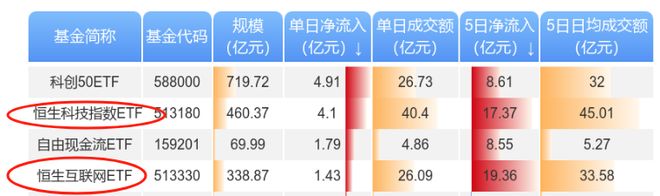
Group 1 - The Hong Kong stock market opened lower today, with the Hang Seng Technology Index dropping by 2.21% and the Hang Seng Internet ETF and Hang Seng Technology Index ETF falling by 2% and 1.6% respectively, influenced by unexpected strong U.S. non-farm payroll data and a decline in U.S. stocks [1] - Despite the market downturn, there has been a significant net inflow into the Hang Seng Technology Index ETF, totaling 4.472 billion yuan over 16 trading days from October 30 to November 20, even as the index fell by 10.11% during this period [1] - The Hang Seng Internet ETF also saw a net inflow of 2.518 billion yuan over the same 16 days, with a decline of 10.24% [1] Group 2 - The recent adjustment in the Hong Kong stock market is attributed to factors such as the "AI bubble theory," tightening liquidity in the U.S. market, and profit-taking by institutions after a more than 20% increase in the Hang Seng Technology Index this year [1][2] - The Hang Seng Technology Index has experienced a cumulative decline of over 18% since October 3, indicating a potential buying opportunity [2] - Positive developments include strong Q3 financial results and Q4 guidance from Nvidia, which may help alleviate concerns regarding the "AI bubble," alongside Alibaba's upcoming earnings report on November 25 [2] Group 3 - The Federal Reserve's decision to pause balance sheet reduction on December 1, coupled with rising unemployment rates over the past three months, suggests a cautious approach to monetary policy [3] - The Hang Seng Technology Index ETF has a current scale of 46.49 billion yuan, including major Chinese tech companies such as SMIC, Alibaba, Tencent, Baidu, Xiaomi, and Lenovo [4] - The Hang Seng Internet ETF, with a scale of 34.284 billion yuan, has over 80% weight in leading internet stocks, with an AI content exceeding 90% [4]




越跌越买!规模最大的恒生科技指数ETF、恒生互联网ETF连续16日获资金净申购
Ge Long Hui· 2025-11-21 01:56
Group 1 - The Hong Kong stock market opened lower today, with the Hang Seng Technology Index dropping by 2.21%, and the Hang Seng Internet ETF and Hang Seng Technology Index ETF falling by 2% and 1.6% respectively [1] - Despite the declines, there has been a net inflow of funds into the Hang Seng Technology Index ETF totaling 4.472 billion yuan over 16 trading days from October 30 to November 20, during which the index fell by 10.11% [1] - The Hang Seng Internet ETF also saw a net inflow of 2.518 billion yuan over the same period, despite a 10.24% decline [1] Group 2 - Recent adjustments in the Hong Kong stock market are attributed to factors such as the "AI bubble theory," tightening liquidity in the US market, and profit-taking by institutions after a more than 20% increase in the Hang Seng Technology Index this year [1] - The Hang Seng Technology Index has experienced a cumulative decline of over 18% since October 3, which may present a buying opportunity [1] - Positive factors include strong Q3 financial results and Q4 guidance from Nvidia, which may help alleviate concerns regarding the "AI bubble," along with Alibaba's upcoming financial report on November 25 [1] Group 3 - The Hang Seng Internet ETF has a weight of over 80% in leading internet stocks, with an AI content exceeding 90%, including major companies like Alibaba, Tencent, NetEase, JD.com, and Baidu [2]

英伟达财报炸场,“AI泡沫论”能否就此平息
Di Yi Cai Jing· 2025-11-20 12:54
Core Insights - Nvidia has successfully calmed the anxious market with its recent earnings report, showing a significant year-over-year revenue growth of 65% for Q3, marking the first acceleration in two years [1][6] - The company's data center revenue reached a historic high, growing by 66% year-over-year, and its Q4 revenue guidance of $65 billion exceeded Wall Street's expectations of $62 billion [1][6] Nvidia's Market Position - Nvidia is considered the cornerstone of the AI capital expenditure chain, with its orders reflecting the total global AI investment [1] - CEO Jensen Huang emphasized the strong demand for cloud GPUs, indicating that both training and inference computing needs are growing exponentially [2][7] AI Capital Expenditure Trends - Major tech companies like Google, Amazon, Meta, Microsoft, and Oracle are projected to increase their annual capital expenditures in AI and data centers to $450 billion [4] - The overall AI capital expenditure is expected to continue rising, with estimates reaching $5 trillion for related infrastructure and facilities [11][14] Concerns and Market Dynamics - Despite Nvidia's strong performance, concerns remain regarding the sustainability of AI investments, particularly in light of OpenAI's significant capital requirements and the potential for a valuation bubble [4][12] - The market is witnessing a sell-off in AI stocks, driven by fears of overvaluation and the sustainability of revenue growth in the face of high capital expenditures [4][16] Future Outlook - The AI arms race is expected to accelerate over the next two years, with capital expenditures in the AI sector likely to continue increasing [10] - Investors are advised to focus on long-term winners in the AI space, particularly those with strong cash flows and sustainable business models [19]
今天内容有点多
Sou Hu Cai Jing· 2025-11-20 11:26
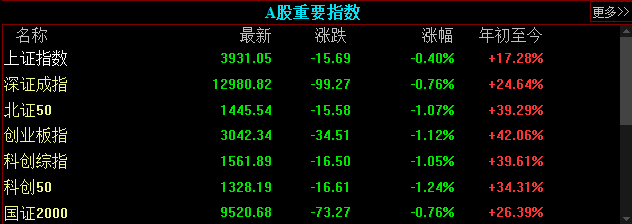
其次是AI泡沫论。这个咱们在前面文章也讲过了,科技巨头投入了数万亿美元建设数据中心和AI能力,可何时能真正看到这些投入 带来的回报?英伟达则是那个关键,不夸张地说全球AI个股的表现都会受英伟达影响,甚至于美股的涨跌也要系英伟达于一身。不 过英伟达财报还是很给力的,无论是营收、利润还是对下一季度的展望,均显著高于市场预期,盘后股价也受影响大涨。今天日韩 股市能暴涨两三个点,也是因为深度绑定了英伟达产业链。不过财报虽然超出了华尔街预期,但不及陆家嘴预期,国内相关产业链 个股全都高开低走。虽然有不少分歧,但是美股看起来短期仍有支撑的逻辑。 来源:财经林妹妹 美股,日股,黄金,虚拟货币,大宗品过去的一周几乎全军覆没,A股走势也一言难尽,看起来又要触碰3900了。咱们今天主要来 分析一下原因,再说说对未来市场的判断。 | | | A股重要指数 | | | | --- | --- | --- | --- | --- | | 名称 | 最新 | 涨跌 | 涨幅 | 年初至今 | | 上证指数 | 3931.05 | -15.69 | -0.40% | +17.28% | | 深证成指 | 12980.82 | -99.27 ...
较10月高点回撤超15%,恒生科技怎么了?资金为何逆势流入?
Xin Lang Cai Jing· 2025-11-20 09:09
Core Insights - Since 2025, the Hong Kong stock market, led by technology and innovative pharmaceuticals, has been on the rise, with the Hang Seng Technology Index reaching a recent high of 6715.46 on October 2, and the Hang Seng Index showing a gain of over 30% [1][3] - However, in less than two months, the Hang Seng Technology Index has experienced a continuous adjustment, with a maximum drawdown exceeding 15%, and a recent five-day losing streak [1][3] - Despite the market pullback, southbound capital has accelerated its inflow, with a net purchase exceeding 1.3 trillion HKD this year, and cumulative net inflow surpassing 5 trillion HKD, setting a historical record [1][7] Market Dynamics - The recent pullback in the Hong Kong stock market's technology sector is attributed to multiple factors, including persistent concerns over an "AI bubble," a cooling concept of interest rate cuts by the Federal Reserve, and escalating tariff conflicts, which have led to a systematic devaluation of technology stocks [3][4] - Additionally, as the year-end approaches, there is a shift in investment focus towards dividend-paying assets like banks and non-bank financials, rather than high-volatility technology stocks [4] Financial Performance - Nvidia's strong Q3 earnings report, showing a revenue of 57 billion USD (up 62% year-on-year) and a Q4 revenue outlook of approximately 65 billion USD, may help alleviate market concerns regarding the "AI bubble" [5] - Major Hong Kong technology companies have also reported robust Q3 earnings, indicating resilience in the face of global economic disruptions, with highlights including Tencent's revenue of 192.9 billion CNY (up 15%) and Xiaomi's revenue of 113.12 billion CNY (up 22.3%) [6][5] Investment Outlook - Looking ahead to 2026, several institutions remain optimistic about the mid-to-long-term prospects of the Hong Kong technology and internet sectors, driven by the AI wave and supportive policies [7] - The inflow of southbound capital is unprecedented, with insurance and public funds driving a dual strategy of "technology growth + high dividend yield" [7][8] - The Hang Seng Technology Index is currently at a historical low valuation, with a PE ratio of 23.09, significantly lower than the Nasdaq's 42.5, indicating a strong value proposition for long-term investors [9][8] ETF Performance - The inflow of funds has led to a rise in the scale of related ETFs, with the Hang Seng Technology Index ETF exceeding 46 billion CNY and the Hang Seng Internet ETF nearing 34 billion CNY [8][9] - The current market environment, characterized by improving liquidity and low valuations, presents a favorable opportunity for long-term investment in Hong Kong's technology sector [10]



爆单,黄仁勋:卖光了
Mei Ri Jing Ji Xin Wen· 2025-11-20 08:33
Core Viewpoint - Nvidia is seen as a bellwether for the AI industry, with its performance reflecting the true demand and prosperity of the sector. The company reported better-than-expected Q3 FY26 earnings, indicating strong growth in AI-related revenues [1]. Financial Performance - Nvidia's Q3 FY26 revenue reached $57.006 billion, exceeding market expectations of $54.92 billion, and representing a 62% year-over-year increase [2][4]. - Net income for the quarter was $31.910 billion, a 65% increase compared to the previous year, with adjusted earnings per share at $1.30, surpassing the forecast of $1.25 [1][2]. - The gross margin was reported at 73.4% under GAAP and 73.6% under non-GAAP, showing slight declines from the previous year [3]. Business Segments - The data center business, Nvidia's core growth engine, generated $51.2 billion in revenue, significantly above the analyst forecast of $49.09 billion, marking a 66% year-over-year increase [4]. - Within the data center revenue, the "compute business" (GPUs) contributed $43 billion, while the networking business added $8.2 billion [5]. - Other business segments also showed growth, with gaming revenue at $4.3 billion (up 30% year-over-year), professional visualization revenue at $760 million (up 56%), and automotive and robotics revenue at $592 million (up 32%) [6][7]. Future Outlook - Nvidia expects Q4 revenue to be approximately $65 billion, exceeding analyst expectations of $61.66 billion, indicating continued strong demand [8]. - The company repurchased $12.5 billion in stock and paid $243 million in dividends during the quarter, reflecting confidence in its financial position [9]. Market Position and Strategy - Nvidia's CEO Jensen Huang emphasized the ongoing demand for AI infrastructure, stating that cloud GPUs are sold out and highlighting the company's partnerships with major tech firms like OpenAI, Google Cloud, and Microsoft [6][10]. - Huang also noted that the AI ecosystem is rapidly expanding, with more foundational model builders and startups emerging across various industries [10]. - Nvidia is actively investing in AI companies to support ecosystem growth, with a focus on maintaining a flexible supply chain and robust balance sheet [11]. Stock Performance - Following the earnings report, Nvidia's stock rose by 2.85% to $186.52 per share, with a market capitalization of $4.53 trillion, maintaining its position as the highest-valued company globally [11].

中国银行、工商银行再创历史新高,银行ETF基金涨1.85%,自由现金流ETF上演9连“吸金”14.95亿
Sou Hu Cai Jing· 2025-11-20 03:50
Group 1 - The A-share market has seen a significant increase, rising over 4% and reaching a historical high for the second consecutive day, with a market capitalization surpassing 20 trillion [1] - The banking ETF fund has increased by 1.85%, indicating strong investor interest in this sector [1] - The free cash flow ETF recorded a net subscription of 35.7 million, marking the ninth consecutive day of inflows, totaling 1.495 billion [1] Group 2 - The technology sector experienced a pullback after a strong performance, reflecting a shift in year-end funding towards stability and securing annual returns [3] - The probability of a Federal Reserve interest rate cut in December has decreased to 30%, alongside concerns about an AI bubble, leading to a decline in market risk appetite [3] - Weakening domestic credit and retail sales data for October have increased attention on public utilities, banking, and dividend sectors [3]


中行、工行再创历史新高,银行ETF基金涨1.85%,自由现金流ETF上演9连“吸金”14.95亿
Ge Long Hui A P P· 2025-11-20 03:36
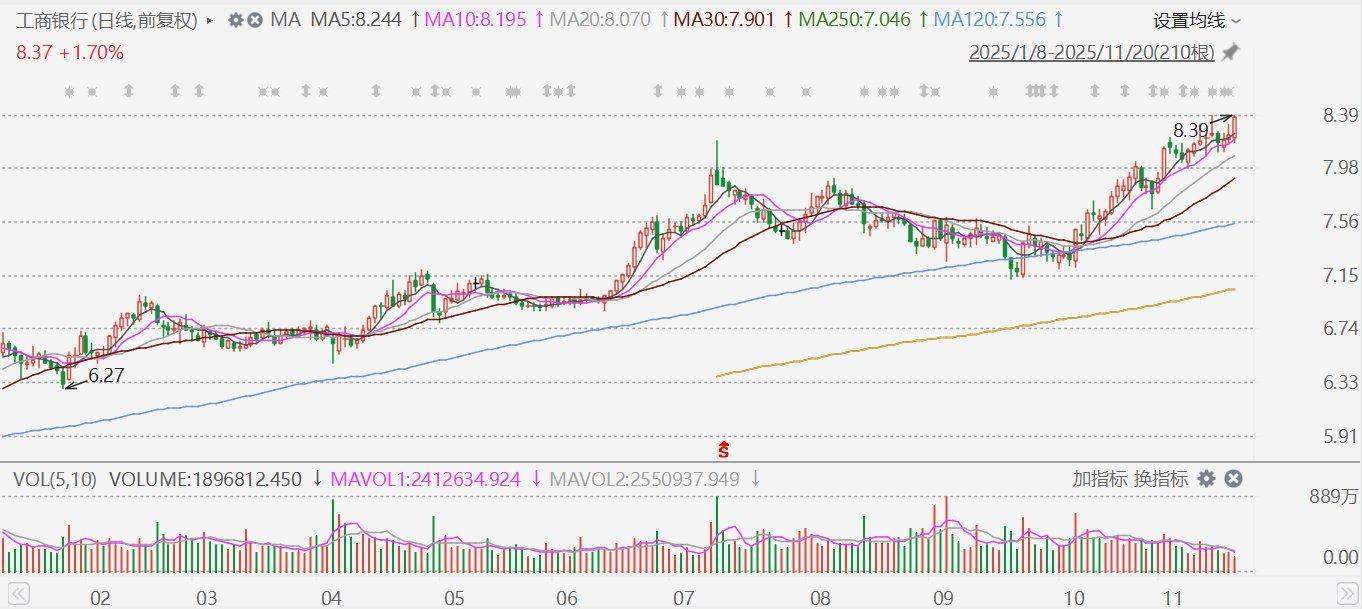
Core Viewpoint - The A-share banking sector is experiencing significant gains, with notable increases in stock prices and market capitalization, indicating a shift in investor preference towards stability as year-end approaches [1][2] Group 1: Banking Sector Performance - China Bank A-shares rose over 4%, reaching a historic high with a market capitalization exceeding 2 trillion [1] - Industrial and Commercial Bank of China (ICBC) increased by 1%, also hitting a historic high, surpassing Agricultural Bank of China to reclaim the top position in market capitalization [1] - The banking ETF fund rose by 1.85%, reflecting strong investor interest in the sector [1] Group 2: Market Trends and Investor Behavior - The technology sector experienced a pullback, while banking stocks continued to rise, indicating a preference for stability and securing annual returns as year-end approaches [1] - The probability of a Federal Reserve rate cut in December has decreased to 30%, alongside prevalent discussions about an AI bubble in the U.S. stock market, leading to a decline in market risk appetite [1] - Weakening domestic credit and retail sales data in October have increased focus on public utilities, banking, and dividend-paying sectors [1] Group 3: Related Products and Fund Flows - The banking ETF fund (515020) saw a net inflow of 183 million over the past 20 days, including major state-owned and joint-stock banks [2] - The Free Cash Flow ETF (159201) reported a slight decline of 0.08%, with a total size of 6.999 billion, and a net inflow of 2.422 billion from October 14 to November 19 [2] - The Free Cash Flow ETF has the lowest fee rate in the market at 0.2%, making it an attractive option for investors [2]