人民币国际化

Search documents
黄金行业动态跟踪:央行连续12个月增持,看好黄金中期上涨
Orient Securities· 2025-11-10 01:18
Investment Rating - The report maintains a "Positive" outlook for the industry, indicating a relative strength of over 5% compared to market benchmarks [8][12]. Core Insights - The People's Bank of China has increased its gold reserves for 12 consecutive months, with a total of 7.409 million ounces as of October, reflecting a significant increase in value to $297.209 billion, up by $13.918 billion from the previous month [8]. - The proportion of gold in China's foreign exchange reserves has risen to 8.89%, an increase of 0.5 percentage points from the previous month, indicating potential for further growth compared to other major countries [8]. - The ongoing trend of de-dollarization and the internationalization of the Renminbi is expected to drive gold prices upward, with projections suggesting a potential rise to $4,500 to $5,000 per ounce in the medium term [8]. Summary by Sections Industry Overview - The report highlights the tightening supply expectations in the non-ferrous and steel sectors, suggesting potential investment opportunities in these segments [7]. Market Dynamics - The recent public consultation on the new "Steel Industry Capacity Replacement Measures" indicates that supply-side reforms may be imminent, which could positively impact the market [7]. Investment Recommendations - The report recommends focusing on leading global copper and gold mining companies, particularly Zijin Mining (601899), which is expected to see significant growth in copper production in 2026 [8].

人民币变得越来越“好用”
Sou Hu Cai Jing· 2025-11-09 22:55
Core Insights - The internationalization of the Renminbi (RMB) has reached a new level, becoming the largest settlement currency for China's foreign receipts and payments, the second largest trade financing currency globally, and the third largest payment currency [1][2] Group 1: RMB Usage and Growth - The RMB cross-border payment amount reached 35 trillion yuan in the first half of 2025, a year-on-year increase of 14%, with goods trade accounting for 6.4 trillion yuan, representing 28% of total cross-border payments [1] - The network effect of RMB international usage is gradually becoming evident due to improved policy frameworks and high-level trade investment facilitation trials [1] Group 2: Offshore RMB Market Development - The offshore RMB market is developing healthily, with over 10 trillion yuan of RMB financial assets held by foreign entities and more than 80 countries including RMB in their foreign exchange reserves [2] - Major offshore markets have RMB deposits totaling 1.6 trillion yuan, and the stock of offshore RMB bonds and Panda bonds issued by foreign institutions is approximately 2 trillion yuan [2] Group 3: Policy Recommendations for RMB Internationalization - To better serve the real economy, there is a need to optimize cross-border trade and investment RMB settlement policies and enhance the financial service capabilities of commercial banks [3] - Continued improvement of RMB financing support policies and tools is essential, along with encouraging more eligible foreign institutions to issue Panda bonds in China [3] Group 4: Support for Offshore RMB Market - There is a focus on enhancing cross-border RMB liquidity supply arrangements and optimizing the layout of clearing banks to support the development of the offshore RMB market [4] - Strengthening the position of Hong Kong as an international financial center and offshore RMB business hub is a priority [4]
中国银行连续12个月增持黄金,黄金储备增至7409万盎司!
Sou Hu Cai Jing· 2025-11-09 17:51
Core Insights - China's foreign exchange reserves reached $33,433.43 billion by the end of October 2025, marking an increase of $4.685 billion from September and the highest level since December 2015 [2] - The People's Bank of China (PBOC) increased its gold reserves to 7.409 million ounces by the end of October, adding 30,000 ounces, continuing a trend of gold accumulation for 12 consecutive months [2][4] Group 1: Central Bank Actions - Since November last year, the PBOC has been in a "gold buying mode," with a notable increase of 330,000 ounces in December 2024, followed by a gradual slowdown in purchases, indicating a long-term strategic vision [4] - In the first quarter of 2025, China, Poland, and Turkey were the top three central bank gold buyers, collectively accounting for over 50% of global purchases, reflecting a broader trend of central banks increasing gold holdings [6] Group 2: Strategic Considerations - Central banks are increasing gold reserves to optimize foreign exchange reserve structures, as gold is a non-sovereign credit reserve asset that is less affected by unilateral sanctions and has different price dynamics compared to other currencies [8] - The accumulation of gold is also seen as a crucial part of the internationalization strategy of the Renminbi, enhancing its role in the global monetary system and boosting international confidence in the currency [8] Group 3: Market Context - As of October 2025, international gold prices reached a historical high of $4,294 per ounce, with a monthly increase of 4.9%, marking the fifth consecutive month of price rises [10] - Historical trends indicate that central bank gold purchases do not guarantee continuous price increases, as seen during the 2008 financial crisis when gold prices fell despite increased purchases [10] Group 4: Broader Implications - The ongoing accumulation of gold by the PBOC symbolizes not only the resilience of the Chinese economy but also reflects significant changes in the international financial landscape, as the era of dollar dominance is gradually shifting [12]



中国发行美元债,属于顶级阳谋,一鱼多吃,利用美元潮汐虹吸全世界资产的游戏,中国人开始当玩家了
Sou Hu Cai Jing· 2025-11-09 14:31
Core Viewpoint - The issuance of US dollar bonds by the Ministry of Finance is a strategic move to leverage global capital markets rather than a sign of financial distress [3][5][9] Group 1: Issuance of US Dollar Bonds - The Ministry of Finance recently issued several billion dollars in sovereign bonds in Hong Kong, which raises questions about the need for borrowing amidst high foreign exchange reserves [3][5] - The high interest rates in the US, with the federal funds rate exceeding 5%, make borrowing expensive, suggesting that the decision to issue dollar bonds is not merely about cost [3][5] - This strategy allows the country to use its credit to borrow dollars from global markets, indicating a shift in approach from traditional methods of accumulating dollars through trade surpluses [5][9] Group 2: Investment Strategy - The funds raised from issuing dollar bonds are likely to be used for investments in high-quality overseas assets, such as mines, ports, or technology, rather than being held in banks for interest [5][9] - This approach mirrors strategies employed by Wall Street players, where borrowed funds are used to generate returns through investments [5][9] Group 3: Global Capital Dynamics - The issuance of dollar bonds allows the country to capture capital that might otherwise flow to the US, thereby redirecting global liquidity towards its own financial instruments [7][9] - The high subscription rates and lower interest rates compared to US Treasury bonds indicate strong global demand for these bonds, reflecting confidence in the country's creditworthiness [7][9] Group 4: Currency Strategy - The issuance of dollar bonds also addresses the challenge of limited international circulation of the Renminbi, as it provides a mechanism to offer Renminbi to international investors upon bond maturity [9][11] - This strategy effectively facilitates the internationalization of the Renminbi, allowing foreign investors to engage in the Chinese market, thus enhancing the currency's global presence [11][13] Group 5: Strategic Implications - The success of this strategy relies on maintaining strong national credit and military strength, as it positions the country to capitalize on vulnerabilities in the global financial system [13] - The approach represents a calculated move to assert influence in international finance, potentially leading to significant geopolitical ramifications [13]

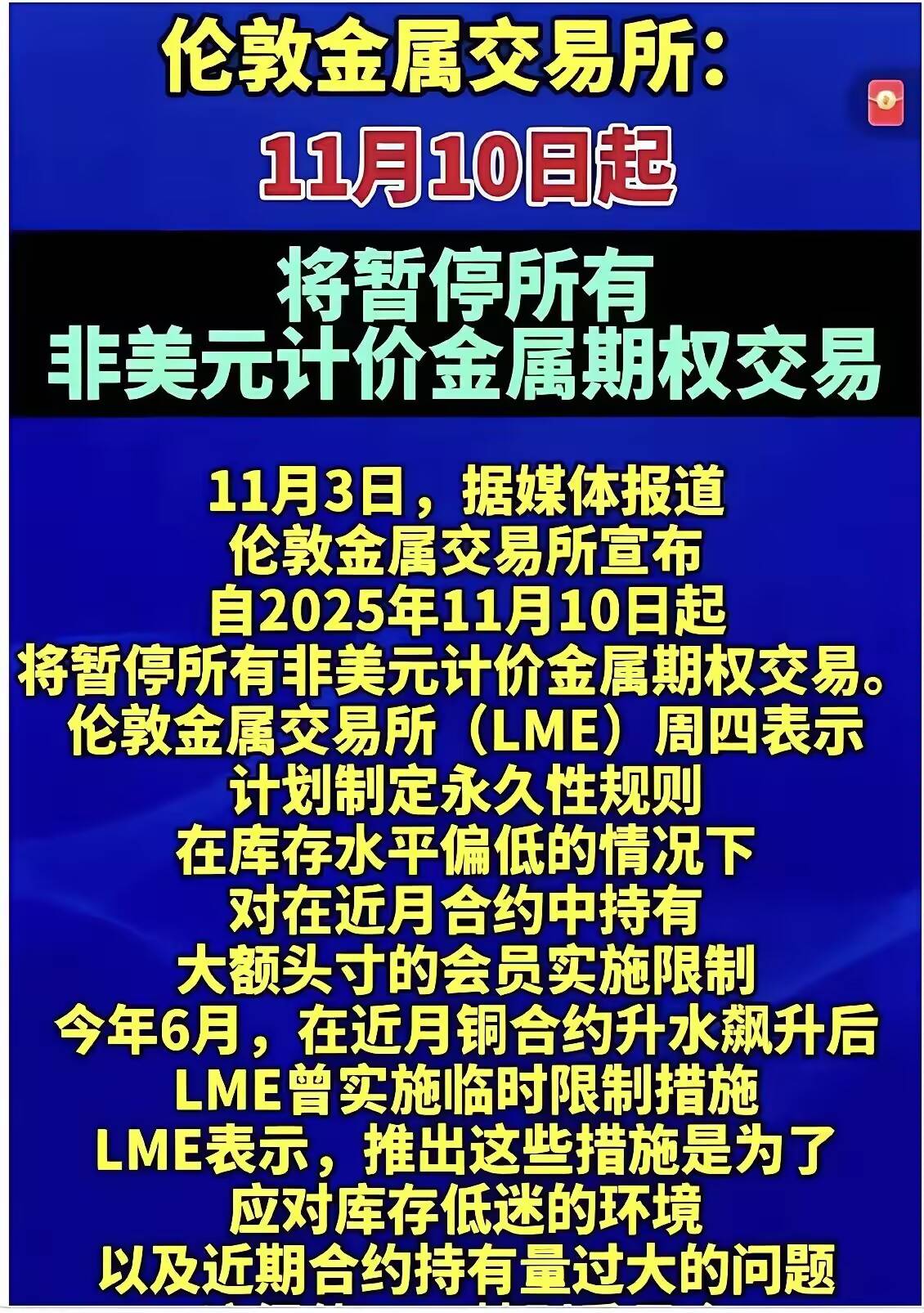
伦敦金属交易所突然停交易,美元慌了?人民币悄悄上位!
Sou Hu Cai Jing· 2025-11-09 08:42
Core Viewpoint - The London Metal Exchange (LME) is taking measures to restrict non-USD metal options trading starting November 10, 2025, due to concerns over the increasing influence of other currencies, particularly the Chinese yuan, in global commodity transactions [1][3]. Group 1: Market Stability and Regulatory Actions - The LME's decision to halt non-USD trading is framed as a move to stabilize the market, but it is widely understood to be a reaction to the growing use of the yuan in commodity pricing and settlement [3][4]. - The LME's actions are reminiscent of past market disruptions, such as the nickel market crisis caused by sanctions on Russia, which led to a temporary trading suspension and regulatory penalties [3]. Group 2: Impact of Currency on Commodity Trading - By 2024, 14.2% of global commodity transactions are expected to be settled in yuan, indicating a significant shift away from USD dominance [3]. - The LME's measures are seen as an attempt to maintain the USD's leading position in the face of increasing yuan adoption by global traders and manufacturers [3][4]. Group 3: Comparison with Other Exchanges - Other exchanges, such as the Shanghai Futures Exchange, Singapore SGX, and Dubai DXB, have adopted more flexible approaches, allowing the market to self-regulate rather than imposing strict trading restrictions [4]. - The LME's rigid approach is criticized as being out of touch with market dynamics, contrasting with the more adaptive strategies employed by other exchanges during past market fluctuations [4].
美元的困境与人民币的机遇|国际
清华金融评论· 2025-11-09 08:11
Core Viewpoint - The article discusses the significant challenges facing the US dollar's credibility in the long term, highlighting a potential restructuring of the international monetary system if allied nations collectively lose confidence in the dollar [1][6][7]. Group 1: Federal Reserve's Interest Rate Decisions - In September, the Federal Reserve restarted interest rate cuts, lowering rates by 25 basis points, which is not directly indicative of a weakening dollar credit [3][4]. - The Fed's dual mandate of price stability and maximum employment is under pressure, particularly with deteriorating employment data and inflation concerns stemming from Trump's tariffs [3][4]. - The Fed's decision to cut rates was made despite external pressures for larger cuts, indicating a commitment to its established policy path [4]. Group 2: Challenges Facing the Dollar - The Federal Reserve is facing a triple dilemma: policy indecision, confusion in monetary policy expectations, and threats to its independence [1][5]. - Trump's interventions in Fed policy and potential changes in leadership could further undermine the Fed's independence and the dollar's credibility [5][6]. - The ongoing trade policies and tariffs under Trump's administration are eroding the dollar's international standing and could lead to a reconfiguration of the global monetary order [6][7]. Group 3: Global Monetary System Dynamics - The article notes a significant increase in gold prices, reflecting a shift towards a multipolar international monetary system, with emerging markets increasing their gold reserves [6][12]. - The decline in the dollar's share of global reserves does not automatically benefit other non-dollar currencies, as they face their own structural challenges [12][13]. - The potential for a "de-dollarization" trend is highlighted, particularly if allied nations lose faith in the dollar due to ongoing US economic policies [6][7]. Group 4: Implications for China - China is encouraged to recognize the opportunity presented by the US's declining global economic leadership and to enhance the international status of the renminbi [13][14]. - Strengthening the domestic economy and improving the financial market system are crucial for increasing the attractiveness of renminbi assets [14][15]. - Historical lessons from the euro and yen's internationalization processes emphasize the importance of economic strength and the establishment of a robust currency settlement function [16][17].
上海国际金融中心一周要闻回顾(11月3日—11月9日)
Guo Ji Jin Rong Bao· 2025-11-09 04:50
Group 1 - The eighth Hongqiao International Economic Forum held multiple sub-forums focusing on financial support for global trade, supply chain stability, and cross-border trade development, highlighting the importance of financial cooperation in international markets [1][2][3] - China Bank and the Hong Kong Trade Development Council signed a strategic cooperation memorandum to assist enterprises in expanding into international markets [1] - The launch of the "Digital Trade" ecological alliance by the Bank of Communications aims to enhance cross-border trade quality [2] Group 2 - The Shanghai Futures Exchange revised its guidelines for using government bonds as margin, facilitating futures companies in managing collateral [7] - Shanghai banks are innovating in financial services, such as the launch of the "Xinyu" cross-border products by Shanghai Rural Commercial Bank to support enterprises in global markets [11] - The signing of a strategic cooperation framework agreement between Shanghai United Assets and Macau Financial Assets Exchange aims to enhance cross-border asset trading and technological collaboration [9] Group 3 - The China Export-Import Bank introduced a tailored financial service plan for the eighth China International Import Expo, focusing on providing efficient cross-border financial services [14] - The Shanghai Financial Regulatory Bureau reported a total asset balance of 28.59 trillion yuan in the banking sector as of September 2025, reflecting a year-on-year growth of 6.25% [30] - The Shanghai Stock Exchange successfully recorded the first cross-border share pledge registration, enhancing the efficiency of cross-border transactions [20]


不缺外汇,为何要发美元债、欧元债?误解背后是我国“精明布局”
Sou Hu Cai Jing· 2025-11-09 03:43
Core Viewpoint - The issuance of foreign currency bonds by China, despite having substantial foreign exchange reserves, is a strategic move aimed at establishing a pricing benchmark for domestic enterprises, enhancing global trust, and expanding financial networks [2][3][5][6]. Group 1: Foreign Currency Bond Issuance - China recently issued $4 billion in bonds in Hong Kong and plans to issue €4 billion in Luxembourg, raising questions about the necessity of such actions given its ample foreign exchange reserves [1]. - The total external debt of China, as of June, stands at approximately $24,368 billion, with RMB debt constituting 52% of this total, indicating a significant presence of RMB in the external debt structure [2]. - The issuance of foreign currency bonds serves to set favorable interest rates for Chinese enterprises in international markets, thereby reducing their financing costs [2][3]. Group 2: Strategic Considerations - Issuing foreign currency bonds is a method of credit management and gaining global trust, as evidenced by the high demand for recent bond offerings, including over $100 billion in subscriptions for the Hong Kong bonds [3][5]. - The choice of locations for bond issuance, such as Hong Kong and Luxembourg, is intended to deepen connections with local financial markets and attract diverse international investors [5][6]. - The issuance of foreign currency bonds is also a strategic gesture to facilitate the internationalization of the RMB, as it helps to gain acceptance in major financial centers [5][6]. Group 3: Long-term Implications - Regular issuance of foreign currency bonds maintains cooperation with the international financial ecosystem, ensuring that China remains relevant in global capital markets [6][8]. - The trust established through foreign currency bonds can be leveraged to promote RMB-denominated products in the future, creating a pathway for the internationalization of the RMB [8][9]. - The long-term goal is to convert the established trust into demand for RMB assets, potentially leading to a gradual process of currency substitution [11].

锚定实体经济!建行广东省江门分行激活全球资源赋能高质量发展
Sou Hu Cai Jing· 2025-11-08 14:50
Core Viewpoint - The "14th Five-Year Plan" emphasizes the acceleration of building a financial powerhouse and promoting the internationalization of the RMB, guiding financial services towards high-level openness [1] Group 1: Cross-Border Settlement - Digital technology is enhancing cross-border payment efficiency, addressing the slow and costly traditional remittance processes faced by foreign trade enterprises [3] - The first transaction using the digital currency bridge involved a cross-border remittance of 1.31 million yuan to Bank of China Hong Kong, completed within the same day, significantly faster than traditional methods, saving the enterprise over 1,400 yuan in intermediary fees [3] - The service has expanded to cover international trade settlements and cross-border e-commerce fund transfers, effectively meeting the core need for faster capital turnover in overseas operations [3] Group 2: Financing Collaboration - The bank is addressing the financing challenges faced by foreign trade and foreign-funded enterprises by integrating domestic and international market resources and leveraging policy benefits from free trade zones [4] - By introducing customized cross-border financing products, the bank has helped 10 enterprises secure 327 million yuan in low-cost funding, with financing costs lower than domestic counterparts [4] - The "Cross-Border Direct Loan" service allows domestic branches to directly lend to overseas entities, meeting operational needs while providing access to lower-cost RMB funds, receiving positive feedback from clients [4] Group 3: Future Outlook - The bank plans to focus on five major financial initiatives during the "14th Five-Year Plan," enhancing the integrated development of domestic and foreign currencies [5] - By leveraging a global response system, the bank aims to facilitate the flow of funds and information, integrating financial collaboration into the dual circulation strategy of Jiangmen, thereby supporting high-quality development of the real economy [5]

中国外储连续三月超3.3万亿美元,央行买金节奏有变
凤凰网财经· 2025-11-08 12:18
Core Viewpoint - As of October 2025, China's foreign exchange reserves reached $33,433 billion, marking a $47 billion increase from September, the highest level since December 2015, while gold reserves also saw a continuous increase for the 12th month in a row [2][3]. Foreign Exchange Reserves - China's foreign exchange reserves stood at $33,433 billion at the end of October 2025, up by $47 billion or 0.14% from the end of September [2][3]. - The increase in reserves is attributed to the rise in the dollar index and the overall increase in global financial asset prices, which counterbalanced the depreciation of non-dollar assets [4][5]. - The dollar index rose by 1.9% in October, but significant increases in global stock indices, such as a 16.6% rise in the Nikkei 225, contributed to the valuation effect that supported the foreign reserves [4][5]. Gold Reserves - As of the end of October 2025, China's gold reserves increased to 7,409 million ounces (approximately 2304.457 tons), with a month-on-month increase of 3,000 ounces [2][9]. - The value of gold reserves rose to $297.2 billion, accounting for 8.89% of total foreign exchange reserves, marking a historical high [9][10]. - The pace of gold accumulation by the central bank has slowed down this year, with a total increase of 139,000 ounces from January to October 2025, reflecting a strategy of buying on dips rather than chasing high prices [9][10]. Economic Outlook - The recent "14th Five-Year Plan" emphasizes the importance of high-level opening-up, which is expected to stabilize cross-border capital flows and support the foreign exchange reserves [8]. - The strong economic fundamentals of China, including its resilience and potential, are seen as key factors for maintaining stable foreign exchange reserves [8][11]. - The central bank's strategy of increasing gold reserves is viewed as a response to global uncertainties and a means to optimize the international reserve structure, with a focus on enhancing the credibility of the yuan [11].