全球化布局

Search documents
港股新股折价发行惯例已破 A股龙头企业赴港上市加速
Zheng Quan Ri Bao· 2025-07-28 17:07
Group 1: A-share Companies Going Public in Hong Kong - A-share companies are accelerating their listing process in Hong Kong, with 10 companies successfully listed this year, accounting for approximately 70% of the total fundraising in the Hong Kong IPO market [1] - A total of 78 A-share companies have either submitted applications to the Hong Kong Stock Exchange or announced plans to pursue listings, covering industries such as pharmaceuticals, power equipment, food and beverage, and finance [1] Group 2: Industry Leaders and Globalization Strategy - Industry leaders like Heng Rui Medicine, Ningde Times, and Hai Tian Flavoring have taken the lead in this wave of listings, indicating a strong trend among top companies [2] - Factors driving this trend include policy support, the companies' globalization strategies, and an expanding need for financing [2] - Semiconductor and consumer electronics companies are notably increasing their submissions for Hong Kong IPOs, with Suzhou Naxin Microelectronics aiming to enhance its competitiveness in the global automotive chip market [2] Group 3: Supportive Policies and Market Dynamics - The Hong Kong Stock Exchange has introduced new communication platforms to optimize interactions with listing companies, which is expected to facilitate the listing process [3] - The influx of foreign capital into Hong Kong IPOs has been significant, with international institutional investors showing strong interest, leading to a record high in cornerstone investments [4] Group 4: Changes in IPO Pricing Logic - The pricing logic for IPOs in Hong Kong has fundamentally changed, with the AH premium rate narrowing, and some stocks even showing sustained premiums [5] - Notably, companies like Ningde Times have achieved premium pricing for their Hong Kong listings, breaking the long-standing trend of discounted pricing [5] Group 5: Market Trends and Future Outlook - The market capitalization of the information technology sector in Hong Kong has surpassed that of traditional finance, indicating a rapid rise of new economy sectors [6] - UBS maintains a positive outlook on the Chinese capital market, particularly for AI-related technology stocks, which are expected to attract more foreign investment [6]
研判2025!中国氯丁橡胶(CR)行业产量、开工率及进出口分析:行业需求持续增长,多领域应用推动发展潜力释放[图]
Chan Ye Xin Xi Wang· 2025-07-28 01:03
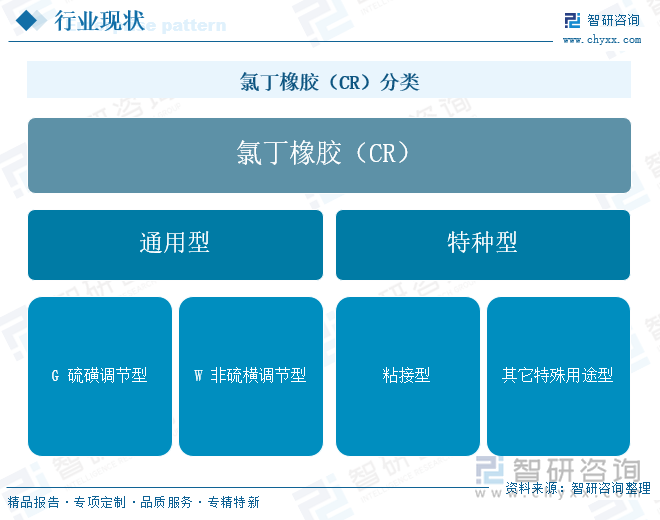
内容概况:作为全球最大的氯丁橡胶生产国和消费国之一,中国氯丁橡胶(CR)行业在汽车、建筑、 电子、医疗等多个下游领域需求持续增长的推动下,展现出较强的发展潜力。2025年1-5月,中国氯丁 橡胶(CR)产量为2.72万吨,同比增长15.80%;氯丁橡胶(CR)消费量为2.17万吨,同比增长 30.67%。 相关上市企业:中策橡胶(603049)、中化国际(600500)、海南橡胶(601118) 相关企业:中国石油化工股份有限公司、中国石油天然气股份有限公司、华新树脂(惠州)有限公司、 深圳市宝昌隆树脂有限公司、天津科恩建筑技术有限公司、北京鼎固伟业工程材料有限公司、常州强力 电子新材料股份有限公司、圣奥化学科技有限公司、山东尚舜化工有限公司、四川国光农化股份有限公 司、常州天晟新材料股份有限公司、河北华密新材科技股份有限公司、浙江仙通橡塑股份有限公司、中 策橡胶集团股份有限公司 关键词:氯丁橡胶(CR)、氯丁橡胶(CR)市场规模、氯丁橡胶(CR)行业现状、氯丁橡胶(CR) 发展趋势 一、行业概述 起步阶段(1951年至1959年)。1951年,东北科学院(中国科学院长春应用化学研究所前身)在实验室 合成出氯 ...

三千万辆中国车利润真不如丰田吗
Jing Ji Ri Bao· 2025-07-25 21:59
Core Viewpoint - The comparison of profits between 30 million Chinese cars and Toyota's 9 million cars highlights the imbalance between production capacity and profitability in China's automotive industry [1] Group 1: Profit Comparison - In 2022, China's automotive sales reached 31.436 million units with a total profit of 462.26 billion yuan, while Toyota's global sales for the 2024 fiscal year were 10.27 million units with a net profit of 4.765 trillion yen (approximately 237.62 billion yuan) [1] - The total net profit of 18 major listed Chinese car companies was less than 80 billion yuan, only about one-third of Toyota's profit [1] Group 2: Causes of Profit Imbalance - The large number of car manufacturers in China, exceeding 200, leads to intense competition and a mix of quality, with some underperforming companies surviving through low-price strategies, which pressures the profitability of better companies [2] - The transition from fuel vehicles to electric and intelligent vehicles is not synchronized, leading to compressed profits from fuel vehicles while investments in new technologies do not yield immediate returns [2] Group 3: Market Structure and Product Positioning - The majority of Chinese car exports are concentrated in lower-end markets, with over 60% going to Southeast Asia and the Middle East, and less than 5% in high-end markets in Europe and the US, indicating a need for Chinese brands to move up the value chain [3] - Most Chinese car companies, except for a few like BYD and Li Auto, are still in the investment phase in the new energy sector, making short-term profitability challenging [3] Group 4: Industry Trends - The global profits of major multinational car companies, including Toyota, Volkswagen, and General Motors, have been declining, particularly in the Chinese market, which is seen as a significant factor affecting their overall performance [4] - China's automotive industry is undergoing a historic shift from traditional fuel vehicles to leading in new energy vehicles, indicating a structural change in profitability from reliance on foreign investment to self-creation and from fuel vehicles to intelligent electric vehicles [4]

36氪出海·行业|车企出海的上半年:建厂、本地化、赴港上市
3 6 Ke· 2025-07-25 09:56
Core Insights - The Chinese automotive industry is experiencing a significant global expansion, with companies like Chery, BYD, and Great Wall Motors leading the charge in exports and establishing production facilities abroad [2][3][4]. Group 1: Export Performance - In the first half of 2025, China's automotive exports reached 3.083 million units, marking a year-on-year increase of 10.4% [2]. - Chery maintained its position as the top exporter with 548,000 units, accounting for 17.8% of total exports [4][6]. - BYD's exports surged by 130% to 470,000 units, making it the second-largest exporter [7][9]. - Great Wall Motors sold approximately 30,000 pickup trucks overseas, with a total overseas sales figure of 198,000 units [10][12]. - Geely's overseas exports reached 184,000 units, with a strong focus on electric vehicles [13][14]. - Xpeng Motors achieved overseas sales of about 19,000 units, expanding its presence in 46 countries [15][18]. - Leap Motor exported around 20,000 units, leveraging its partnership with Stellantis to enter the European market [19][21]. Group 2: Strategic Initiatives - Chery is pursuing a dual strategy of capital and production globalization, with plans for a Hong Kong IPO to fund further expansion [4][6]. - BYD is establishing a European headquarters and a new R&D center in Hungary to enhance its market presence [7][9]. - Great Wall Motors is focusing on its pickup truck segment, which has seen a 24.3% increase in overseas sales [10][12]. - Geely is expanding its production capabilities in key emerging markets like Egypt and Indonesia [14]. - Xpeng is prioritizing Southeast Asia and Europe for its global strategy, with plans to establish a local production facility in Indonesia [15][18]. - Leap Motor is implementing localized production in Malaysia to cater to the Southeast Asian market [19][21]. Group 3: Market Positioning - Chery's global strategy includes a multi-brand approach tailored to different market needs, with a strong presence in over 100 countries [4][6]. - BYD has outperformed Tesla in the European market for electric vehicles, particularly in Spain [7][9]. - Great Wall Motors is leveraging its historical strength in the pickup truck segment to establish a foothold in various international markets [10][12]. - Geely is focusing on high-end markets with its Zeekr brand, achieving significant sales in multiple countries [14]. - Xpeng is rapidly building a service network in Indonesia, aiming to cover 70% of core urban areas by the end of the year [15][18]. - Leap Motor's collaboration with Stellantis is facilitating its entry into high-potential markets, enhancing its brand recognition and distribution channels [19][21].





新能源“反内卷”显效:硅料碳酸锂齐涨,车企叫停价格战
Xin Jing Bao· 2025-07-25 07:55
Core Viewpoint - The "anti-involution" policy is reshaping the Chinese new energy industry, focusing on eliminating low-price competition and promoting product quality improvement, which has begun to show positive effects in the photovoltaic, lithium battery, and new energy vehicle sectors [1][4]. Group 1: Industry Challenges - The new energy sector has faced severe "involution" competition, primarily manifested through price wars, which have eroded profit margins and threatened innovation and sustainable development [2]. - In the photovoltaic sector, silicon material prices dropped over 70% in 2023, leading to significant profit declines, with 39 out of 121 listed photovoltaic companies reporting net losses in the first three quarters of 2024 [2]. - The lithium battery industry is also struggling, with prices for lithium iron phosphate materials falling below 40,000 yuan/ton, and some low-end products dropping to 30,000 yuan/ton, resulting in a paradox of technological upgrades without profit growth [2]. Group 2: Policy Initiatives - The central government has initiated a series of "anti-involution" policies since mid-2024, focusing on industry self-discipline and preventing malicious competition, which has begun to yield positive results [4][6]. - Key measures include addressing below-cost competition and promoting capacity consolidation and industry self-regulation in the photovoltaic sector, with recent price increases observed in polysilicon and n-type silicon materials [5]. - The lithium battery sector is implementing diverse strategies, including raising technical standards and limiting disorderly capacity expansion, which are expected to facilitate the exit of outdated capacities and improve profitability [5][6]. Group 3: Market Trends - The new energy vehicle market is projected to maintain rapid growth, with sales expected to reach 15.73 million units by 2025, a 29% year-on-year increase [3]. - However, the automotive manufacturing industry's profit margins have declined from 7.8% in 2017 to 5.0% in 2023, further dropping to 4.4% in the first eleven months of 2024, largely due to price wars [3]. Group 4: Future Directions - The industry is transitioning from price competition to value creation, emphasizing technological innovation, market mechanisms, and global collaboration [7]. - Supply-side reforms and capacity reductions are seen as immediate solutions to address short-term supply-demand mismatches, with major photovoltaic companies announcing collective production cuts [7]. - The lithium battery sector is encouraged to enhance recycling systems and improve resource efficiency, while the new energy vehicle market should shift from purchase subsidies to usage incentives [7][8]. Group 5: Global Strategy - Chinese new energy companies are urged to accelerate globalization efforts, optimizing production and sales layouts to navigate global trade barriers and expand into emerging markets [8]. - The shift from global exports to global manufacturing is underway, with policies in regions like Europe and North America encouraging local investments, which will further drive overseas expansion of Chinese new energy firms [8].
淳厚基金调研万通智控,旗下淳厚欣享A(009931)近一年回报达57.35%
Xin Lang Cai Jing· 2025-07-25 07:26
Group 1: Company Overview - The company, 万通智控, was recently researched by 淳厚基金 on July 7, 2025, where the board secretary, 李滨, introduced the company's history, development strategy, and main business operations [1] - The company is a supplier of TPMS and valve stems for 春风动力's motorcycles and has secured contracts with 上海本田 and 五羊本田 [1] Group 2: Impact of Tariffs - The company is monitoring the potential impact of the U.S. tariffs announced by President Trump, which will impose 25% to 40% tariffs on imports from 14 countries starting August 1 [1] - The company noted that Thailand will face a 36% tariff but has a 20-day grace period, and it will continue to track policy developments to respond proactively [1] - The company has established factories in Germany, Czech Republic, the U.S., and Thailand, allowing it to effectively mitigate risks from trade disputes through its globalized production and supply chain [1] Group 3: Product Value - The estimated value of the NLP product per heavy truck is between 2,000 to 3,000 yuan, which includes components such as NLP sensors (typically 16-22 per vehicle), receivers, and T-Box [1]
2025年中国海上浮式基础平台行业产业链全景、发展现状、竞争格局及发展趋势研判:深远海资源开发提速,海上浮式基础平台迈向规模化商业应用[图]
Chan Ye Xin Xi Wang· 2025-07-25 01:11
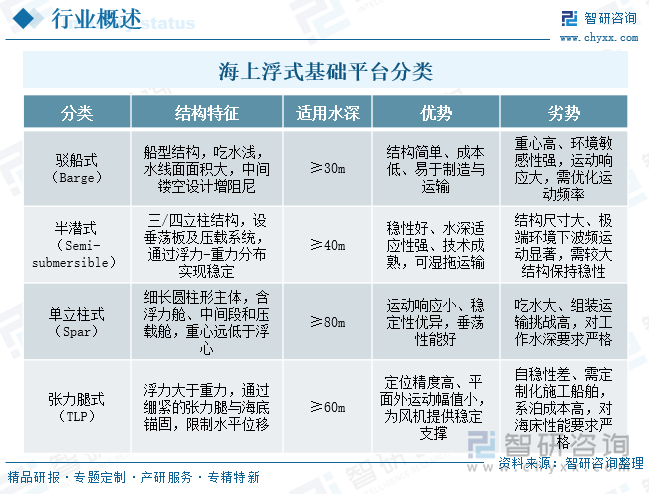
Core Viewpoint - The Chinese floating foundation platform industry is experiencing a dual opportunity period driven by policy dividends and industrial transformation, with a market scale projected to grow from 12 billion yuan in 2020 to 30 billion yuan in 2024, reflecting a compound annual growth rate of 26.3% [1][14][22] Industry Overview - The floating foundation platform is a marine engineering structure supported by buoyancy, primarily used for deep-sea oil and gas extraction, wind power generation, and ocean observation [2] - The main technical types include semi-submersible, barge-type, spar-type, and tension leg platforms, with semi-submersible platforms dominating the market due to their superior motion performance [2][16] Policy Environment - The "14th Five-Year Plan" for renewable energy development emphasizes the promotion of floating wind turbine foundations and aims to start construction on China's first commercial floating wind power project during this period [5][7] - A series of policies have been introduced to support the development of offshore wind power projects, marking a transition from technical demonstration to commercialization [5][7] Market Dynamics - The market size of the floating foundation platform industry is expected to reach 38 billion yuan by 2025, indicating a shift towards large-scale development [1][14] - The cumulative installed capacity of China's offshore wind power leads globally, accounting for 49.6% of the total, with significant projects like the "Haiyou Guanjing" platform further solidifying this position [1][10] Industry Chain - The industry chain features high collaboration and specialization, with upstream focusing on key materials and equipment supply, midstream on platform design and manufacturing, and downstream on project development and operation services [9][10] - The integration of technology, finance, and resources is crucial for the successful implementation of demonstration projects and the operation phase [9][10] Competitive Landscape - The industry is characterized by a competitive landscape where state-owned enterprises lead, while private enterprises specialize in specific technologies [18][20] - Semi-submersible technology accounts for over 60% of the market, with significant innovations in tension leg and concrete floating body designs [18][20] Future Trends - The industry is expected to evolve towards deep-sea development, intelligent operations, green transformation, and global collaboration, with a projected domestic production rate of 75% by 2030 [22][23] - Technological advancements will focus on extending operations to depths exceeding 300 meters and increasing the capacity of floating wind turbines to over 20 MW [22][23]
新股前瞻|歌尔微二递表:中国传感龙头如何破解大客户依赖与全球化挑战?
智通财经网· 2025-07-24 08:38
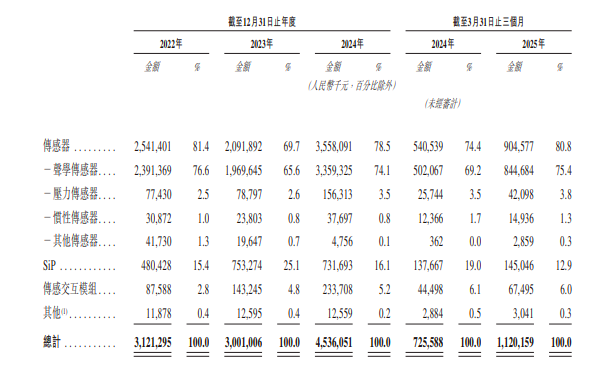
Group 1 - The core viewpoint of the articles is that companies in the consumer electronics supply chain, including Goer Microelectronics, are increasingly pursuing listings in Hong Kong to enhance their global presence and competitiveness amid complex global trade dynamics and rising local service demands [1][13] - Goer Microelectronics has submitted its listing application to the Hong Kong Stock Exchange for the second time this year, with several major financial institutions acting as joint sponsors [1][2] - The company is recognized as the fifth largest provider of intelligent sensing interaction solutions globally, with a market share of 2.2%, and the largest provider in China [2][3] Group 2 - Goer Microelectronics focuses on sensor technology, particularly acoustic sensors, and has developed a comprehensive platform called UniSense for integrated technology capabilities [2][3] - The company has experienced revenue fluctuations, with reported revenues of approximately 3.12 billion RMB in 2022, 3.00 billion RMB in 2023, and projected revenues of 4.54 billion RMB in 2024 [4][6] - The sensor business is the primary revenue source, contributing 81.4% of total revenue in 2022, 69.7% in 2023, and 78.5% in 2024 [4][5] Group 3 - The company has a high dependency on major clients, with the top five clients accounting for 75.5% of total revenue in 2022, and the largest client (presumably Apple) contributing 56.1% of revenue [6][8] - Goer Microelectronics has a strong cash reserve of 2.4 billion RMB as of May 31, 2025, and a low level of liabilities, with current liabilities totaling 1.36 billion RMB [7][8] - The global market for intelligent sensing interaction solutions reached 186 billion RMB in 2023 and is expected to grow at a compound annual growth rate of 9.6% to 151.7 billion RMB by 2028 [10][12] Group 4 - The competitive landscape for intelligent sensing interaction solutions is intense, with Goer Microelectronics ranked as the eighth largest globally and facing competition from established players in the US, Europe, Japan, and South Korea [12][13] - The company plans to continue developing high-performance sensors and expand its solution offerings to maintain its competitive edge in consumer electronics while exploring new applications in automotive electronics, smart homes, and healthcare [13]
新能源强势拉升,盛新锂能涨停,新能源汽车ETF(516390)午后涨超3%,“反内卷”行情持续,新能源产业链快速反弹
Xin Lang Cai Jing· 2025-07-24 06:14
Group 1 - The core viewpoint of the articles highlights the strong performance of the new energy vehicle (NEV) sector, with significant increases in stock prices and ETF values, indicating a bullish market sentiment [1][2][3] - The China Passenger Car Association reported that from July 1 to 20, 2025, retail sales of new energy vehicles reached 537,000 units, a year-on-year increase of 23%, while wholesale sales were 514,000 units, up 25% year-on-year [2] - The NEV market penetration rate reached 54.9% for retail and 53.6% for wholesale, with cumulative retail sales for the year at 6.006 million units, reflecting a 32% increase [2] Group 2 - The Ministry of Industry and Information Technology and other regulatory bodies are working to standardize competition in the NEV industry, marking a shift from being a "new energy powerhouse" to a "new energy strong country" [2] - The "anti-involution" policy is expected to benefit the NEV and photovoltaic supply chains, leading to price rebounds in key materials like lithium carbonate and silicon materials [3] - The NEV ETF (516390) is noted for its low management and custody fees, making it an attractive investment option for those looking to invest in the entire NEV supply chain [3]





一代锂电设备霸主难逃周期轮回|深度
24潮· 2025-07-23 23:48
Core Viewpoint - The lithium battery industry is experiencing a significant downturn, impacting even leading companies like XianDao Intelligent, which has seen a dramatic decline in revenue and profit [1][3][6]. Financial Performance - XianDao Intelligent's revenue has decreased for four consecutive quarters, with a net profit of 286 million yuan in 2024, down 83.88% year-on-year, and continuing to decline by 35.30% in Q1 2025 [1][3]. - The overall revenue of 108 Chinese lithium battery companies fell by 11.87% in 2024, with net profit dropping by 67.27%, marking two consecutive years of significant decline [3][4]. - Key financial metrics for 2024 include total assets of 29,092.41 million yuan (up 6.17%), total liabilities of 16,721.07 million yuan (up 7.31%), and a net profit of 651.92 million yuan (down 67.27%) [5]. Industry Trends - The lithium battery industry's rapid growth phase is over, with a historic downturn affecting both domestic and international players [3][6]. - Major international battery manufacturers, including LG Energy Solution and SK On, reported losses in Q4 2024, indicating widespread challenges across the sector [6]. - The global lithium battery market is projected to grow significantly, with a compound annual growth rate of 25.2% expected from 2024 to 2030 [28]. Company Strategy - XianDao Intelligent is focusing on high-end production capabilities, particularly in solid-state batteries, which are seen as the future of battery technology [12][15]. - The company has secured over 100 million yuan in orders for solid-state battery equipment in 2024, indicating a strategic pivot towards advanced technologies [12][13]. - XianDao Intelligent has established a global presence, with operations in multiple countries and a significant increase in overseas revenue, which reached 2.831 billion yuan in 2024, accounting for 23.88% of total revenue [30][31]. Customer Relationships - The relationship with major clients, particularly CATL, has been crucial for XianDao Intelligent, although recent share reductions by CATL have raised concerns about future collaboration [16][17]. - The company has faced challenges with customer payment cycles, as evidenced by an increase in accounts receivable turnover days to 278.98 days in 2024, indicating delayed payments [21][22]. Market Dynamics - The lithium battery industry is witnessing a wave of project cancellations and delays, with significant investments being halted or re-evaluated due to market conditions [36][37]. - The competitive landscape is shifting, with domestic companies facing overcapacity issues while international players are more cautious in their expansion strategies [39][40].