
硬科技

Search documents
上峰水泥5000万参设基金,投资鑫华半导体切入半导体材料赛道
Xin Lang Cai Jing· 2025-10-14 02:28
Core Viewpoint - The company, Shangfeng Cement, is strategically investing in the semiconductor industry by acquiring a significant stake in Jiangsu Xinhua Semiconductor Technology Co., Ltd., positioning itself as a major player in the electronic-grade polysilicon market [1][3]. Group 1: Investment Details - Shangfeng Cement announced the establishment of Hefei Guocai No. 3 Enterprise Management Partnership (Limited Partnership) to invest in Jiangsu Xinhua Semiconductor, which is the largest domestic producer of electronic-grade polysilicon [1]. - Upon completion of the transaction, Guocai No. 3 will become the largest shareholder of Xinhua Semiconductor, allowing Shangfeng Cement to strategically position itself in the core segment of semiconductor materials [1]. Group 2: Company Profile - Jiangsu Xinhua Semiconductor is recognized as the only company in China capable of mass-producing electronic-grade polysilicon in full sizes, with a production capacity of 15,000 tons in 2024, ranking among the top globally [2]. - The company has a significant market presence, supplying major domestic silicon wafer manufacturers and exporting to international clients, achieving a revenue of 1.2 billion yuan in 2023 and holding the largest market share in China [2]. Group 3: Strategic Rationale - The investment aligns with Shangfeng Cement's strategic development plan to diversify its business and mitigate risks associated with single-industry cycles, enhancing its overall competitiveness [3]. - The involvement of national funds, such as the National Integrated Circuit Industry Investment Fund, highlights the strategic importance placed on the autonomy of semiconductor materials by the government [3]. Group 4: Industry Challenges and Opportunities - Despite Xinhua Semiconductor's technological leadership, the industry faces cyclical volatility, with projected price pressures on photovoltaic silver paste and semiconductor materials in 2025 [4]. - Shangfeng Cement must balance cash flow from its core building materials business with investments in new sectors, maintaining a healthy financial position with a debt-to-asset ratio of 45.08% and a current ratio of 1.15 as of mid-2025 [4]. - This transaction signifies a deep transformation of traditional building material companies into the "hard technology" sector, providing a model for the transition of China's manufacturing industry [4].

国开行苏州分行前三季度发放先进制造业和科技贷款同比增长44%
Su Zhou Ri Bao· 2025-10-14 00:33
Group 1 - The National Development Bank Suzhou Branch has actively supported the development of new quality productivity enterprises by introducing various policy financial resources since signing a memorandum with Suzhou city last year [1] - In the first three quarters of this year, the bank issued loans totaling 12.84 billion yuan for advanced manufacturing and technology, an increase of 44% compared to the same period last year, with over 90% of the loans going to private enterprises [1] - The bank has also facilitated over 2 billion yuan in industrial equipment updates and investments, helping enterprises reduce financing costs and obtain interest subsidies exceeding 20 million yuan [1] Group 2 - The artificial intelligence industry is experiencing robust growth, and Suzhou is accelerating its development to become an internationally influential "AI+" city [2] - The bank has provided 500 million yuan in special loans for technological innovation to a high-end computing communication device manufacturer, extending the loan term to 5 years to support the company's competitive edge [2] - The bank has introduced national-level investment funds, with over 6.5 billion yuan in equity investments in Suzhou, and continues to provide long-term loan credit to promising "hard technology" enterprises [2] Group 3 - The bank's focus is on supporting the development of new quality productivity and enhancing technology finance, with initiatives targeting technological innovation, strategic emerging industries, and the transformation of traditional industries [3] - The bank has launched ten special actions for high-quality development of key industrial chains, aiming to provide superior policy financial services in Suzhou [3]
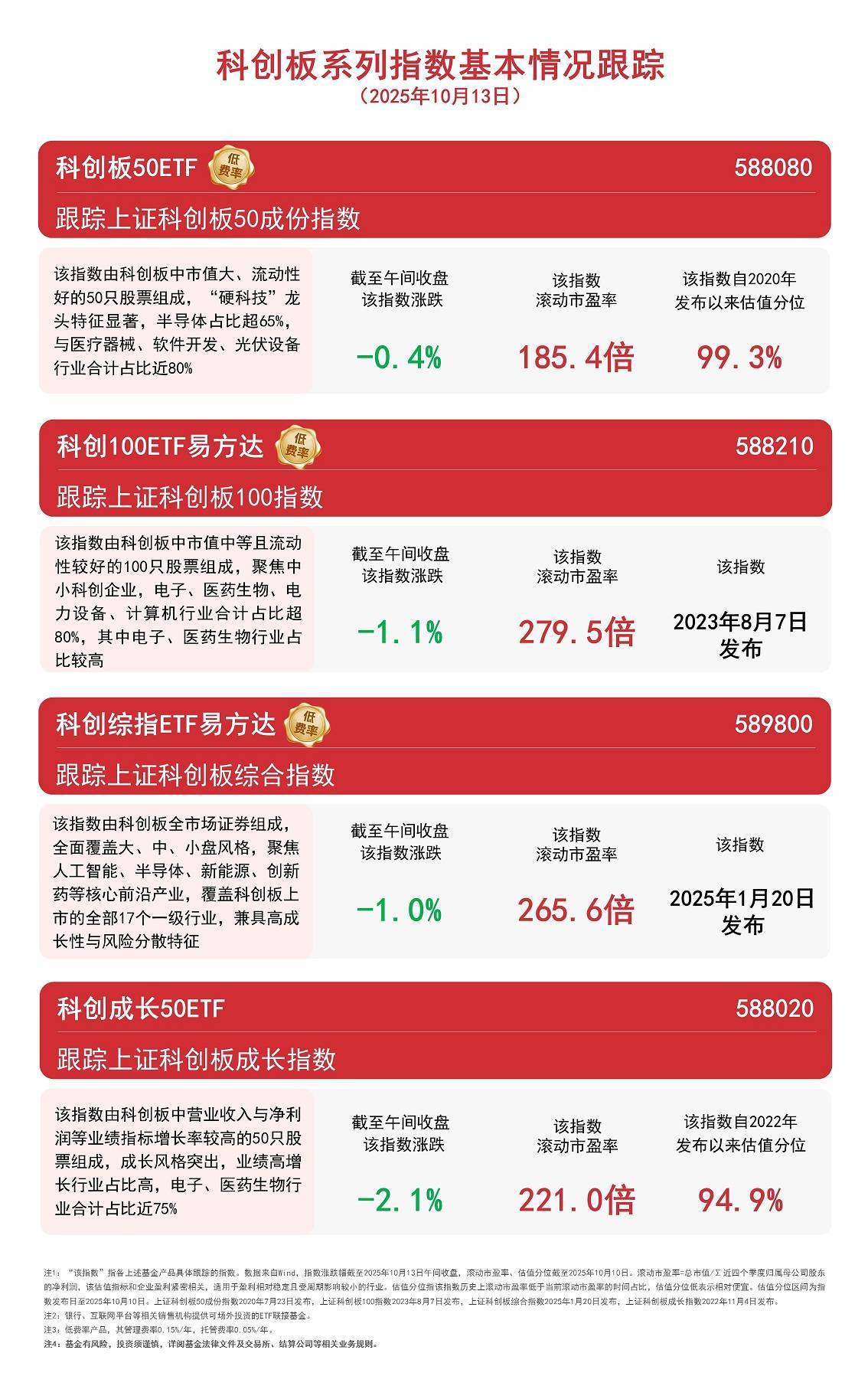
科创板50指数冲高回落下跌0.4%,关注科创板50ETF(588080)等产品投资机会
Sou Hu Cai Jing· 2025-10-13 05:18
Core Insights - The article discusses various ETFs tracking the STAR Market indices, highlighting their composition and performance metrics [2]. Group 1: STAR Market ETFs - The STAR Market 50 ETF tracks the STAR Market 50 Index, consisting of 50 large-cap and liquid stocks, with a significant focus on "hard technology" sectors, particularly semiconductors, which account for over 65% of the index [2]. - The STAR Market 100 ETF follows the STAR Market 100 Index, comprising 100 mid-cap stocks, with a focus on small and medium-sized innovative enterprises, where electronics and biopharmaceuticals dominate, making up over 80% of the index [2]. - The STAR Market Comprehensive Index ETF tracks the STAR Market Comprehensive Index, covering all market securities and focusing on core industries such as artificial intelligence, semiconductors, and new energy, encompassing all 17 primary industries listed on the STAR Market [2]. Group 2: Performance Metrics - As of the latest trading session, the STAR Market 50 ETF experienced a decline of 0.4%, with a rolling price-to-earnings ratio of 185.4 times and a valuation percentile of 99.3% since its inception in 2020 [2]. - The STAR Market 100 ETF saw a decrease of 1.1%, with a rolling price-to-earnings ratio of 279.5 times [2]. - The STAR Market Comprehensive Index ETF reported a drop of 1.0%, with a rolling price-to-earnings ratio of 265.6 times [2].

“吸睛又吸金”,“新”能力引资本加速落子
Xin Hua Ri Bao· 2025-10-13 05:10
Core Insights - The private equity investment market in Jiangsu has seen a total of 1,139 financing events with a disclosed total amount of approximately 77 billion RMB from January to September this year, with a focus on hard industries like semiconductors and biomedicine [1] Investment Trends - Local investment firms such as Yuanhe Holdings, Jiangsu Gaotou, and Yida Capital are prominent in the market, alongside national top-tier venture capital institutions like Sequoia China and Hillhouse Capital, which have increased their investment projects in Jiangsu by over 30% year-on-year, particularly favoring biomedicine, new materials, and new energy sectors [2] - Yuanhe Holdings has invested in nearly 30 projects, focusing on semiconductors, new energy, healthcare, and artificial intelligence, and has issued the first technology innovation bond in Suzhou worth 600 million RMB [2][3] Semiconductor Sector - The semiconductor sector has emerged as the most favored investment area, accounting for over 30% of the total financing events with more than 350 occurrences [4] - Companies like Wuxi Xingwei Technology have successfully raised over 100 million RMB through multiple funding rounds, supported by local industry funds [4] - New industry funds have been established in Jiangsu, such as a 5 billion RMB fund dedicated to the integrated circuit industry, focusing on key projects and avoiding capital dispersion [5] Investment Ecosystem - A dual-driven model is forming in Jiangsu's investment ecosystem, combining large funds targeting current challenges with smaller, specialized funds nurturing early-stage technologies [5] - The introduction of measures to promote high-quality development in private equity investment aims to enhance the evaluation system and encourage long-term capital to support innovative enterprises [7] Investment Strategy Evolution - The investment strategy of venture capital firms is shifting from chasing short-term trends to focusing on full-chain integration and cross-sector collaboration [8] - For instance, Yida Capital's investments in the semiconductor sector cover the entire supply chain, enhancing the resilience and collaborative value of their investment portfolio [8]
科创板50ETF(588080)标的指数率先反弹,机构称市场有效突破还需科技引领
Mei Ri Jing Ji Xin Wen· 2025-10-13 03:23
Core Viewpoint - The market showed a mixed performance with major indices opening lower, while the semiconductor and software sectors experienced gains, leading to a rebound in the STAR Market 50 Index [1] Group 1: Market Performance - The STAR Market 50 Index rose by 1.0% as of 10:55 AM, with notable increases in component stocks such as Jinghe Integrated and Kingsoft, which surged over 9%, and SMIC, which rose over 5% [1] - The STAR Market 50 ETF (588080) saw a net inflow of 1.2 billion yuan in the previous trading day, with a year-to-date growth in scale of nearly 17 billion yuan, significantly outpacing similar ETFs [1] Group 2: Industry Insights - According to Shenwan Hongyuan Securities, the current index midpoint is higher compared to the adjustment on April 7, indicating a cumulative market learning effect; however, a sustained adjustment in technology is not expected, and a breakthrough in the overall market is anticipated to wait for technology to lead [1] - A recent national conference on industrial and information technology emphasized the importance of technological innovation in enhancing high-quality supply and promoting the development of key industries such as artificial intelligence to improve core competitiveness and accelerate new industrialization [1] Group 3: Index Composition - The STAR Market 50 Index consists of 50 stocks with large market capitalization and good liquidity from the STAR Market, prominently featuring "hard technology" leaders, with the semiconductor sector accounting for 66% of the index weight [1] - The management fee rate for the STAR Market 50 ETF (588080) is only 0.15% per year, which supports low-cost investment in leading technology companies [1]
科创板业绩研发双高增 多维度展现板块活力
Zhong Guo Xin Wen Wang· 2025-10-13 02:55
Group 1 - The core viewpoint highlights the vibrant development of the Sci-Tech Innovation Board (科创板) since September 2025, with significant corporate buybacks and increases in shareholdings reflecting strong confidence among companies [1] - Seven companies, including灿瑞科技 and 上海谊众, have announced buyback plans with a total upper limit of 225 million yuan, while 惠泰医疗 and 深科达 plan to increase holdings with a total upper limit exceeding 166 million yuan, showcasing financial commitment [1] -芯原股份 is expected to achieve a record high quarterly revenue of 1.284 billion yuan in Q3 2025, with substantial growth of 119.74% quarter-on-quarter and 78.77% year-on-year, indicating strong growth momentum [1] Group 2 - In the first half of 2025, the Sci-Tech Innovation Board's 589 companies collectively generated revenue of 701.4 billion yuan, a year-on-year increase of 5%. Excluding four major photovoltaic companies, the revenue reached 616 billion yuan, growing by 12% [2] - The net profit for these companies was 35.6 billion yuan, reflecting an 11% year-on-year increase. Additionally, 54 unprofitable companies reported revenues of 99.9 billion yuan, an 8% increase, while their net losses shrank by 70% to 1.5 billion yuan [2] - The board's focus on "hard technology" is evident, with R&D investment exceeding 84.1 billion yuan, 2.8 times the net profit, and a median R&D investment ratio of 12.61% [2] Group 3 - The buyback and increase in holdings have boosted investor confidence, with 72 companies disclosing 76 buyback plans in 2025, totaling over 6.6 billion yuan [3] - Notable companies like广大特材 and 澜起科技 have announced multiple buyback plans, each with an upper limit of 400 million yuan, demonstrating their commitment to long-term growth [3] - In 2025, 26 companies have disclosed 29 increase plans, with a cumulative upper limit of nearly 2 billion yuan, indicating strong management confidence in corporate value [3]
聚焦“硬科技+新经济”,港股通科技ETF招商(159125)10月13日发行
2 1 Shi Ji Jing Ji Bao Dao· 2025-10-13 02:34
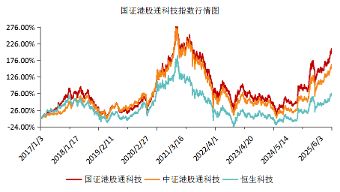
Core Viewpoint - The launch of the China Securities Hong Kong Stock Connect Technology ETF (code: 159125) aims to closely track the China Securities Hong Kong Stock Connect Technology Index, which includes leading technology companies in the Hong Kong market with core competitiveness [1] Group 1: Index Composition and Focus - The China Securities Hong Kong Stock Connect Technology Index selects 30 leading technology companies based on market capitalization, R&D investment, and revenue growth, focusing on "hard technology" and "new economy" sectors [2] - The index requires constituent stocks to have a compound revenue growth rate exceeding 10% over the past two years or an R&D expense ratio above 5%, ensuring a balance between scale and growth potential [2] - As of September 30, the index's sector weightings include 43% in consumer discretionary, 42% in information technology, and 12% in healthcare, with the top ten constituents accounting for 79% of the index [2] Group 2: Performance Metrics - The China Securities Hong Kong Stock Connect Technology Index has shown strong long-term performance, with a cumulative return of 209.77% and an annualized return of 14.03% since 2017, outperforming similar indices [3] - The index exhibits high elasticity, with an annualized volatility of 33.78%, indicating relatively high fluctuations [4] Group 3: Valuation and Market Trends - As of September 30, the index's price-to-earnings ratio stands at 26.45, positioned at the 39th percentile since inception, suggesting a favorable valuation compared to global tech indices like NASDAQ and ChiNext [6] - Hong Kong's technology companies have become significant players in stock buybacks, with a total buyback amount of 136.7 billion HKD in the first nine months of the year, indicating strong institutional confidence in long-term opportunities [8] - The influx of mainland capital into the Hong Kong market has reached a record high of 1.17 trillion HKD in net inflows this year, with technology stocks being a primary focus for investment [8]
逆风而行,柳暗花明,自强者胜 - 关税应对三部曲
2025-10-13 01:00
Summary of Conference Call Notes Industry or Company Involved - The discussion primarily revolves around the impact of U.S.-China trade relations on the stock markets, particularly focusing on A-shares, Hong Kong stocks, and U.S. stocks, as well as the broader implications for the technology and resource sectors. Core Points and Arguments 1. **Market Reaction to Trade Tensions** The U.S. threat to increase tariffs has led to significant market pullbacks across A-shares, Hong Kong stocks, and U.S. stocks, with A50 futures and the Hang Seng Tech Index experiencing declines of approximately 4-5% [3][4][6] 2. **Investor Sentiment Improvement** Compared to April, the current market sentiment regarding U.S.-China relations has improved, with investors showing increased confidence in the ongoing negotiations and the resilience of Chinese exports [4][5][6] 3. **Key Upcoming Dates** Important upcoming events include a U.S.-China meeting in the next two weeks and a tariff expiration date in early November, which could influence market dynamics [6][7] 4. **Market Position and Valuation** Current market positions and valuations are higher than in April, but the impact of recent events is expected to be less severe due to the strengthening of the Chinese economy and increased capital support [7][8] 5. **Investment Strategy Recommendations** A contrarian investment strategy is advised, focusing on increasing allocations in the technology sector, particularly in hard tech areas such as AI computing power and energy storage, as well as precious metals like gold and resource metals such as copper and aluminum [8][9] 6. **Short-term and Long-term Focus** In the short term, sectors like telecommunications, coal, oil, and agriculture are recommended for risk mitigation, while long-term excess returns may be challenging. Attention should also be given to sectors with recovering demand, such as certain chemicals, lithium batteries, and base metals [9] Other Important but Possibly Overlooked Content 1. **Trade Friction as a Short-term Disturbance** The current trade friction is viewed as a short-term disturbance rather than a long-term trend, suggesting that the underlying industrial trends and economic recovery should be trusted [2][9] 2. **Potential for Market Recovery** There is an expectation that Trump's negotiation tactics may lead to a retreat from aggressive tariff increases, providing opportunities for market recovery [6][7] 3. **Confidence in Chinese Export Resilience** The resilience of Chinese exports across technology, consumption, and manufacturing sectors has been validated, contributing to a more optimistic outlook [5][6]
业绩研发双高增!板块活力多维展现科创板利好频传
Zhong Guo Jing Ying Bao· 2025-10-12 15:28
Group 1: Market Performance and Growth - The STAR Market has shown significant vitality since September, with companies like Chipone Technology (688521.SH) expected to achieve a record quarterly revenue of 1.284 billion yuan in Q3 2025, marking a substantial increase of 119.74% quarter-on-quarter and 78.77% year-on-year [1] - In the first half of 2025, 589 companies on the STAR Market collectively generated revenues of 701.4 billion yuan, reflecting a year-on-year growth of 5%. Excluding four major photovoltaic companies, the revenue growth was 12% [3] Group 2: Research and Development Advancements - Multiple companies have reported significant R&D breakthroughs, including DiAo Microelectronics (688381.SH) with its eUSB repeater product, and Guoxin Technology (688262.SH) successfully testing a new generation automotive electronic chip [1] - The STAR Market's overall R&D investment exceeded 84.1 billion yuan in the first half of 2025, which is 2.8 times the net profit, with a median R&D investment ratio of 12.61% [3] Group 3: Biopharmaceutical Innovations - In the biopharmaceutical sector, companies like Sunshine Nuohuo (688621.SH) and Baike Biotechnology (688276.SH) received clinical trial approvals for innovative projects, enhancing their product pipelines [2] - BeiGene (688235.SH) is projected to achieve nearly 19 billion yuan in global sales for its drug Zebrutinib in 2024, indicating strong market potential [4] Group 4: Corporate Confidence and Share Buybacks - Seven companies, including Canray Technology (688061.SH), announced share buyback plans totaling up to 225 million yuan, reflecting strong corporate confidence [2] - Since the beginning of 2025, 72 companies have disclosed 76 buyback plans with a total proposed amount exceeding 6.6 billion yuan, indicating a robust trend in corporate buybacks [4] Group 5: Industry Structure and Competitive Landscape - The STAR Market has established a "chain-group" development pattern, with over 120 companies in the integrated circuit sector covering the entire industry chain, representing more than 60% of A-share companies in the same field [2] - The hard technology sector is transitioning from a follower to a leader, with significant breakthroughs in key areas such as semiconductor equipment and biopharmaceuticals [4]
科创板利好频传:业绩研发双高增 市场信心持续提振
Zheng Quan Ri Bao Wang· 2025-10-12 13:51
Core Insights - The Science and Technology Innovation Board (STAR Market) has shown significant vitality since September, with multiple companies announcing share buybacks and increases in shareholdings, reflecting strong corporate confidence [1][5]. Group 1: Corporate Actions - Seven companies, including Shanghai Canrui Technology Co., Ltd. and Shanghai Yizhong Pharmaceutical Co., Ltd., have announced buyback plans with a total upper limit of 225 million yuan [1]. - Two companies, Shenzhen Huitai Medical Equipment Co., Ltd. and Shenzhen Shenkeda Intelligent Equipment Co., Ltd., have disclosed shareholding increase plans with a total upper limit exceeding 166 million yuan [1]. - Since the beginning of 2025, 72 companies have announced 76 buyback plans with a total upper limit exceeding 6.6 billion yuan [5]. Group 2: Industry Performance - In the first half of 2025, 589 companies on the STAR Market achieved a total revenue of 701.4 billion yuan, representing a year-on-year growth of 5% [2]. - The integrated circuit sector has over 120 companies, covering more than 60% of the A-share industry, establishing a strong "self-controllable" force [2]. - The biopharmaceutical sector has 113 companies focusing on difficult diseases, positioning the STAR Market as a major global listing venue for biopharmaceuticals [2]. Group 3: R&D Developments - The STAR Market has seen significant R&D breakthroughs, with companies like Jiangsu Diaowei Microelectronics Co., Ltd. and Suzhou Guoxin Technology Co., Ltd. achieving key technological advancements [3]. - In the first half of 2025, the overall R&D investment of the STAR Market exceeded 84.1 billion yuan, which is 2.8 times the net profit, with a median R&D investment ratio of 12.61% [4]. - 138 companies have received national-level science and technology awards, with 60% of companies achieving core technologies at an internationally advanced level [4]. Group 4: Market Confidence - The buyback and shareholding increase activities are seen as a strong signal of confidence in long-term corporate development [5][6]. - Companies like Guangda Special Materials Co., Ltd. and Lankai Technology Co., Ltd. have successfully executed their buyback plans, with Guangda's first phase reaching nearly 400 million yuan [6]. - Since the beginning of 2025, 26 companies have disclosed 29 shareholding increase plans with a cumulative upper limit of nearly 2 billion yuan [6].