
人民币国际化

Search documents
外储连续三月超3.3万亿美元,央行购金节奏放缓
2 1 Shi Ji Jing Ji Bao Dao· 2025-11-07 12:33
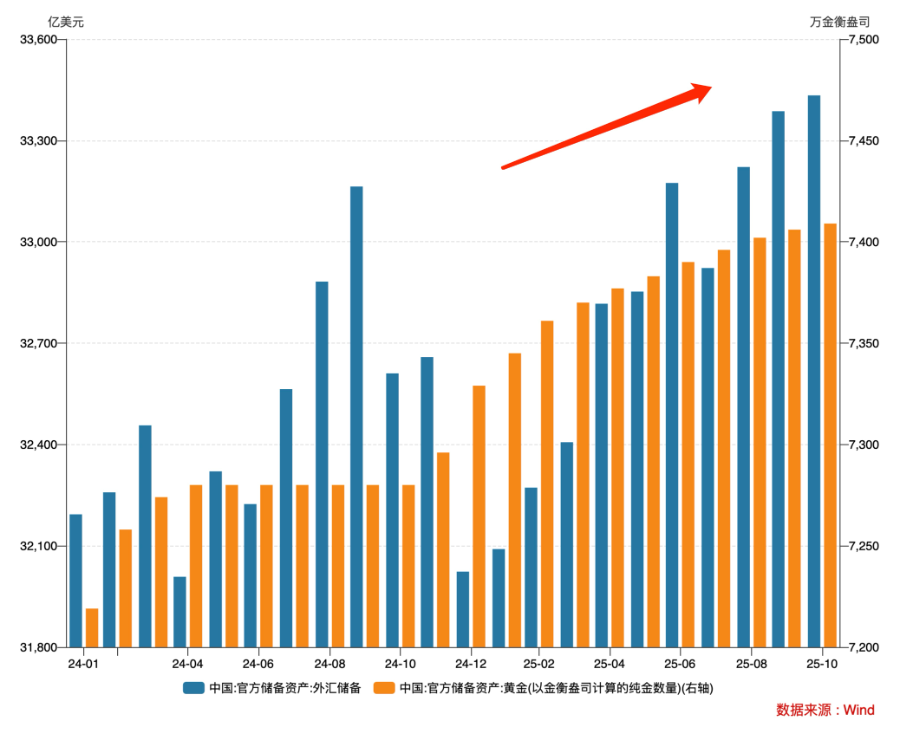
东方金诚首席宏观分析师王青告诉记者,汇率和资产价格变化带来的估值效应形成对冲,是10月外汇储备小幅回升的主因。一 方面,10月美元指数上涨1.9%。这会导致我国外汇储备中非美元资产贬值,导致外汇储备规模下降。另一方面,10月以日经225 指数为代表的全球主要股指普遍出现较大幅度上涨,其中日经225指数大幅上涨16.6%,美债收益率走低,美债价格上扬,共同 带动我国外储投资的金融资产估值增加。 全球资产价格上涨支撑外储 综合受访人士观点来看,汇率折算和资产价格变化是10月外汇储备继续回升的原因,且资产价格变化的影响更为显著。一般而 言,只要当月美元指数出现明显上升,多个国家的外汇储备通常都会因非美资产折算成美元后的金额减少,出现环比下降的状 况,但今年10月却打破了这一传统规律,原因是资产价格变化形成了对冲。 "在资产价格方面,全球股债双强对外储形成了强劲支撑。"温彬表示,10月份,美联储降息推动以美元标价的已对冲全球债券 指数上涨0.8%,美国标普500指数上涨2.3%。日本财政政策蓄势待发,刺激日经指数上涨16.6%,创历史新高。欧元区经济缓慢 修复,欧洲斯托克指数上涨2.6%。 中银证券全球首席经济学家管 ...

友国战略抉择,数十吨黄金运往深圳!更多国家排队,形势悄然大变
Sou Hu Cai Jing· 2025-11-07 12:14
Core Viewpoint - Cambodia's decision to store part of its gold reserves in China signifies a strategic shift towards the Chinese financial system, reflecting a growing trust in China's financial security and a move away from reliance on the Western dollar system [1][3][10] Group 1: Cambodia's Gold Reserves - Cambodia's central bank is moving newly acquired gold reserves to China while keeping its existing stock intact, indicating a cautious yet strategic approach [3] - The country holds 56 tons of gold, which constitutes a quarter of its foreign exchange reserves, highlighting the importance of this decision for national financial security [3] Group 2: Trust in China's Financial System - Storing gold in China is seen as a dual insurance strategy, protecting against potential asset freezes by the West and aligning with China's rising financial influence [3][5] - China's gold market is recognized for its large scale, strong liquidity, and robust legal framework, making it an attractive option for other nations [5][7] Group 3: De-dollarization Movement - Cambodia's actions represent a tangible step in the global trend of "de-dollarization," as it moves gold to China without formal announcements or meetings, demonstrating a practical approach to reducing dependence on the dollar [5][9] - Other countries in Southeast Asia, Africa, and the Middle East are observing Cambodia's move, with some already exploring China's gold storage systems [5][9] Group 4: Shift in Global Financial Dynamics - The transfer of gold to China signals a potential reconfiguration of global financial dynamics, where gold trading, pricing, and storage may no longer be solely reliant on Western systems [9] - As more countries consider moving their reserves to China, the international status of the renminbi is likely to rise, reflecting a shift in financial trust from the West to the East [7][9]

LME:11月1日起 提高离岸人民币作为抵押品的利率
Zhi Tong Cai Jing· 2025-11-07 12:10
Core Viewpoint - The London Metal Exchange (LME) is increasing the interest rate for offshore Renminbi (CNH) used as collateral starting November 1, 2025, to encourage more market participants to utilize CNH as cash collateral [1][2] Group 1: Interest Rate Changes - LME Clear will raise the interest rate for CNH as collateral from CDIR-30 bps (T) to CDIR-0 bps (T-1) [1] - This change aims to enhance the attractiveness of using CNH in the collateral framework [1] Group 2: Importance of Renminbi - The Renminbi is recognized as one of the major world currencies by the International Monetary Fund (IMF) and is the first emerging market currency included in the IMF's Special Drawing Rights (SDR) basket [1] - The significance of the Renminbi in international markets is increasing, particularly with the growing number of Chinese enterprises trading on the LME [1] Group 3: Historical Context and Liquidity Management - Since July 2015, LME Clear members have been able to use CNH as qualified cash collateral to meet margin requirements [1] - In March 2017, LME Clear reduced the notice period for members to deposit or withdraw Renminbi to two working days, enhancing liquidity management efficiency [1] Group 4: Collaboration and Opportunities - LME Clear will continue to collaborate with its members to seize opportunities arising from the internationalization of the Renminbi and to promote interaction between Chinese market participants and those from other regions [2]
外汇储备创2015年11月以来最高!人民银行连续第12个月增持黄金
Bei Jing Shang Bao· 2025-11-07 11:21
北京商报讯(记者刘四红)最新一期外储数据公布。11月7日,据人民银行官网公布的官方储备资产,截至2025年10月末,我国外汇储备规模为 33433亿美元,较9月末上升47亿美元,升幅为0.14%。另外,10月末黄金储备报7409万盎司(约2304.457吨),环比增加3万盎司(约0.93吨),为连续 第12个月增持黄金。 东方金诚首席宏观分析师王青同样称,10月末外储规模变化不大,主要是当月美元指数上行与全球金融资产价格上涨形成对冲效应,带动外储规 模微幅上升。10月末我国外储规模已连续三个月升至3.3万亿美元之上,创2015年11月以来最高,较上年末也大幅增加1409.9亿美元。背后主要是 受年初以来美元大幅贬值、美债收益率显著下行,以及全球主要股指上涨带动。 "考虑到当前外储规模已处于3.3万亿美元以上的偏高水平,且当月人民银行增持黄金规模有限,不排除10月人民银行实施一定规模的外汇净卖出 的可能,这能够将外储规模控制在适度水平区间。"王青说道。按不同标准测算,当前我国略高于3万亿美元的外储规模都处于适度充裕状态。综 合考虑各方面因素,未来外储规模有望保持基本稳定。在外部环境波动加大的背景下,适度充裕的外 ...

中国需持续增持黄金储备 适度减持美债
Jing Ji Guan Cha Wang· 2025-11-07 11:00
Core Viewpoint - The strategic function of China's foreign exchange reserves is shifting from traditional liquidity support to asset structure optimization and currency credit support in the context of a changing global economic landscape and ongoing geopolitical risks [1][3]. Group 1: Foreign Exchange Reserves - As of the end of October, China's foreign exchange reserves stood at $33,433 billion, remaining above $3.3 trillion for three consecutive months, marking the highest level since November 2015 [1]. - The People's Bank of China (PBOC) has increased its gold reserves to 7.409 million ounces, marking the twelfth consecutive month of gold accumulation since November 2024 [1][3]. - The increase in foreign reserves is attributed to a slight rise in the dollar index and a corresponding increase in global financial asset prices, which offset potential declines in reserves due to non-dollar asset depreciation [2]. Group 2: Gold Reserves and Strategy - China's gold reserves account for only 8.0% of its official international reserves, significantly lower than the global average of 15%, prompting a strategy of increasing gold reserves while reducing U.S. Treasury holdings [2][3]. - The PBOC's recent gold purchases, amounting to 3,000 ounces (approximately 1 ton), reflect a cautious approach due to high gold prices, contrasting with previous months' larger purchases [1][3]. - The ongoing global trend of central banks increasing gold reserves, with a net purchase of 1,089 tons in 2024, indicates a reevaluation of the traditional dollar-dominated reserve system [4]. Group 3: Economic Context and Future Outlook - The U.S. federal debt has surpassed $38 trillion, and the frequent political interference in monetary policy is diminishing the "risk-free" status of dollar assets, necessitating a shift in reserve asset allocation [3][4]. - The strategic increase in gold reserves is seen as essential for enhancing national financial security and supporting the internationalization of the renminbi [3][5]. - The future strategy will likely involve a gradual increase in gold holdings while reducing the concentration of U.S. Treasury securities, ensuring liquidity and yield without significantly raising costs [4][5].
不只是涨价!黄金税改的逻辑,国家在为你规划一条安全的投资赛道
Sou Hu Cai Jing· 2025-11-07 10:59
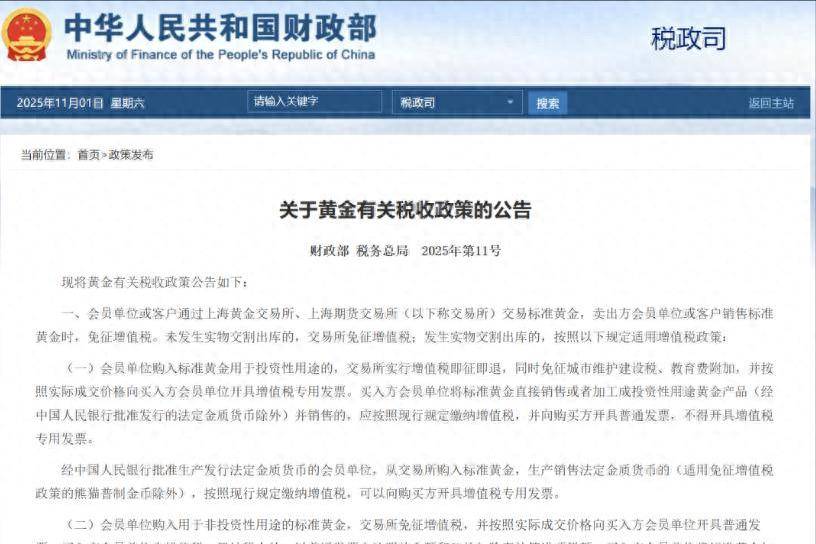
Core Viewpoint - The recent tax policy changes regarding gold are part of a broader strategy by the Chinese government to enhance its global financial influence and establish a more regulated gold market [3][24]. Group 1: Tax Policy Changes - The new tax policy separates the "investment" and "consumption" attributes of gold, applying different VAT rules to each [3][10]. - Only standard gold transactions through the Shanghai Gold Exchange and Shanghai Futures Exchange will enjoy VAT exemptions, encouraging institutional and bulk traders to engage in compliant trading [5][6]. - Consumption gold, such as jewelry and industrial gold, will incur VAT during transactions, while businesses can deduct input tax when processing and selling these gold products [9][10]. Group 2: Market Implications - The policy aims to increase the liquidity and scale of on-exchange trading, thereby establishing the authority of "Shanghai Gold" [7][12]. - The shift towards compliant trading channels indicates a future where non-compliant trading options will diminish, leading to a more regulated gold market [12][26]. - The tax reform is closely linked to China's goal of becoming a financial powerhouse as outlined in the "14th Five-Year Plan" [12][24]. Group 3: Internationalization of the Renminbi - The changes are a significant step in the strategy to internationalize the Renminbi, as China seeks to establish its own gold pricing mechanism rather than relying on Western markets [14][18]. - The recognition of "Shanghai Gold" in global markets will enhance the credibility and attractiveness of the Renminbi, reducing dependence on the US dollar [18][20]. - This process is gradual but essential for China's long-term financial strategy, aiming to challenge the existing global monetary system [20][24]. Group 4: Investor Guidance - Investors are advised to utilize compliant channels such as bank paper gold, products from the Shanghai Gold Exchange, and compliant gold ETFs, avoiding non-regulated options that carry higher risks [22][24]. - Understanding the different value logic between investment gold and consumption gold is crucial for investors to avoid losses [22][24]. - The new tax policy represents a significant transformation from broad regulation to precise governance, reflecting the ambition to secure global gold pricing authority and strengthen the foundation for Renminbi internationalization [24][27].
10月外汇储备继续环比上升,央行连续12个月增持黄金
Zheng Quan Shi Bao· 2025-11-07 10:59
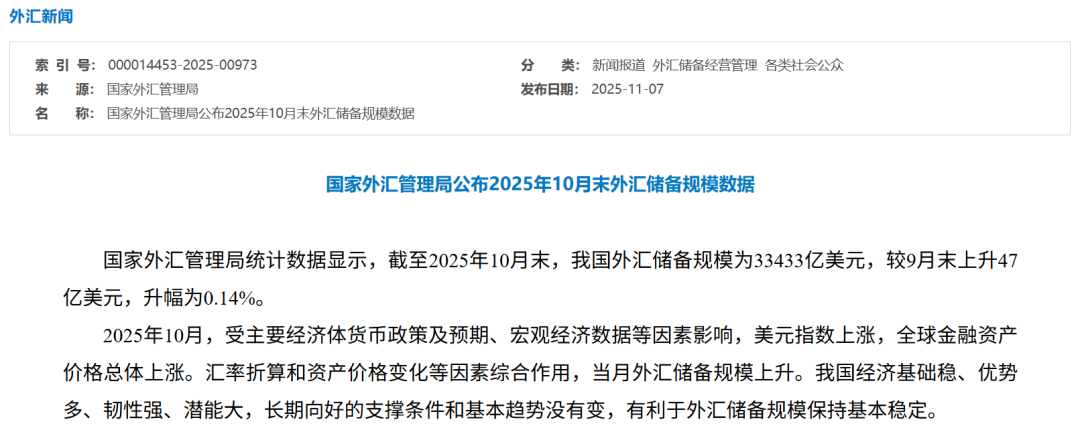
Core Insights - As of October 2025, China's foreign exchange reserves reached $33,433 billion, marking an increase of $47 billion from September, the highest level since December 2015 [1] - The increase in reserves is attributed to the rise in the US dollar index and overall global financial asset prices [1][5] - The People's Bank of China has been increasing its gold reserves for 12 consecutive months, with the latest figure at 7,409 million ounces, reflecting a modest increase of 3,000 ounces [1][9] Foreign Exchange Reserves - China's foreign exchange reserves have remained above $3.3 trillion for three consecutive months [1] - The dollar index rose by approximately 1.95% in the past month, while major currencies like the euro, yen, and pound depreciated against the dollar [5] - The strengthening of the dollar is influenced by the Federal Reserve's interest rate decisions and geopolitical uncertainties [5][6] Asset Prices and Market Conditions - Global stock and bond markets showed strength in October, supporting the increase in China's foreign exchange reserves [6] - The yield on 10-year US Treasury bonds fell by about 5 basis points due to the Federal Reserve's rate cuts, leading to increased liquidity in the market [6] - Major stock indices, including the S&P 500 and Nikkei, experienced gains during this period [6] Gold Reserves - The increase in gold reserves by the People's Bank of China is seen as a strategy to optimize international reserves amid fluctuating gold prices [9][10] - Recent fluctuations in gold prices have seen them rise above $4,000 per ounce before retreating below $3,900 [10] - Analysts suggest that the central bank's gold purchases may slow down due to various market factors, but the long-term demand for gold remains strong [10]
很好!俄罗斯发行“人民币主权债”,激活沉睡资金,全球第一次
Sou Hu Cai Jing· 2025-11-07 10:58
Core Insights - Russia plans to issue RMB bonds domestically for the first time to activate dormant RMB reserves and supplement government finances [1][5] - This move is significant as it marks a shift from traditional offshore RMB bond issuance to onshore issuance, reflecting Russia's pivot away from Western currencies [5][8] Group 1: RMB Bond Issuance - Other countries issue RMB bonds as "Panda bonds" in mainland China or "Dim Sum bonds" in offshore markets, primarily in Hong Kong [3][5] - Indonesia's recent issuance of RMB Dim Sum bonds indicates a growing acceptance of RMB assets in international markets [5][6] Group 2: Strategic Implications for Russia - Russia's decision to issue RMB bonds domestically is a strategic response to its economic isolation from Western nations post-Ukraine conflict, aiming to utilize the substantial RMB reserves accumulated through trade with China [5][8] - The planned issuance includes up to four bonds totaling 400 billion rubles (approximately 35 billion RMB), with maturities ranging from 3 to 10 years, addressing both short-term liquidity and long-term development needs [6][9] Group 3: Impact on RMB Internationalization - The issuance of RMB bonds in Russia signifies a qualitative leap in the international status of the RMB, transitioning from a trade settlement currency to an investment and reserve currency [8][9] - This initiative may encourage other countries with close trade ties to China to adopt similar practices, contributing to a more diversified and resilient international financial ecosystem [9][11] Group 4: Broader Financial Trends - The diversification of RMB bond issuance models, including Panda bonds, Dim Sum bonds, and now domestic RMB sovereign bonds, reflects a trend towards a more flexible and multi-faceted integration of the RMB into global finance [9][11] - Russia's pioneering move not only provides an outlet for dormant funds but also offers a new strategy for other nations to mitigate single currency risks in a multipolar economic landscape [11]

香港40亿美债引1182亿疯抢!全球资本“弃美投中”,美元霸权瓦解
Sou Hu Cai Jing· 2025-11-07 10:55
Core Viewpoint - The issuance of $4 billion in sovereign bonds by China in Hong Kong on November 3 has shifted the dynamics of global finance, indicating a potential decline in confidence in the dollar's dominance [1][4]. Group 1: Dollar Dominance and Market Reaction - The confidence in the dollar's supremacy is beginning to waver, as evidenced by the quietness in the Federal Reserve trading floor [3]. - China's 3-year and 5-year dollar bond yields of 3.646% and 3.787% respectively are lower than those of comparable U.S. Treasury bonds, suggesting that Chinese credit is perceived as more secure [4]. - The $4 billion bond attracted $118.2 billion in subscriptions, a 30-fold oversubscription, indicating a significant shift in capital preferences towards Chinese assets [6]. Group 2: Strategic Implications of China's Bond Issuance - The issuance is part of a broader strategy to establish China as a key player in global finance, leveraging its $3 trillion in foreign reserves and trade surpluses to enhance the credibility of the yuan [8][10]. - Hong Kong's role as an international financial hub facilitates the rapid influx of global capital into China, a competitive advantage over other emerging markets [10]. - The geopolitical landscape has shifted, with China's military capabilities providing a counterbalance to U.S. influence, reducing the effectiveness of U.S. military power in maintaining dollar hegemony [12]. Group 3: Threefold Strategic Approach - The first strategy involves creating an "Eastern safe haven" for capital, offering stability through sovereign bonds while providing financial assistance to struggling nations, thereby altering the traditional capital flow dynamics [15]. - The second strategy aims to promote the internationalization of the yuan by using dollar bonds as a bridge, allowing investors to convert dollars into yuan, which could enhance the yuan's global circulation [17]. - The third strategy seeks to constrain U.S. monetary policy by attracting global dollars to China, potentially increasing inflationary pressures in the U.S. and complicating its economic management [19]. Group 4: Future Financial Landscape - The $4 billion bond issuance is a small yet significant step towards reshaping global financial rules, moving from U.S.-centric dominance to a more collaborative financial governance model [20]. - The erosion of dollar hegemony could force the U.S. to raise Treasury yields to retain capital, exacerbating its fiscal pressures given its existing $30 trillion debt [22]. - The emergence of a multi-currency credit system will provide investors with alternatives to dollar assets, reducing reliance on the dollar for safe-haven investments [24].
商务部部长王文涛:缩减外资准入负面清单
Jin Rong Shi Bao· 2025-11-07 10:33
Core Viewpoint - The article emphasizes the importance of expanding high-level openness in China's economy, advocating for a comprehensive leadership role in open policies, and promoting international cooperation for shared development opportunities [1] Group 1: Expanding Self-Initiated Openness - The focus is on aligning with international high-standard economic and trade rules while expanding market access, particularly in the service sector [2] - Plans include expanding pilot programs in telecommunications, biotechnology, and foreign-invested hospitals, as well as enhancing educational and cultural openness [2] - The strategy involves accelerating regional and bilateral trade agreements, promoting high-standard free trade zones, and advancing the internationalization of the Renminbi [2] Group 2: Promoting Trade Innovation - The goal is to enhance the quality and efficiency of foreign trade, with an emphasis on optimizing goods trade and expanding green and digital trade [3] - There is a push for increased imports and the establishment of national import trade innovation demonstration zones [3] - The development of service trade is prioritized, encouraging exports of knowledge-intensive services and improving cross-border service trade management [3] Group 3: Expanding Investment Cooperation - The initiative aims to create a strong "Invest in China" brand and enhance international cooperation in supply chains [4] - Efforts include reducing the negative list for foreign investment and improving the service guarantee system for foreign enterprises [4] - The focus is on fostering a transparent and stable institutional environment for foreign investments [4] Group 4: High-Quality Belt and Road Initiative - The strategy seeks to strengthen mutual trust and benefit with partner countries, expanding win-win development opportunities [5] - Emphasis is placed on aligning strategies with partner countries and enhancing connectivity through major projects [5] - The initiative aims to diversify investment and financing systems while protecting overseas interests and providing legal support for enterprises [5]