
数字经济

Search documents
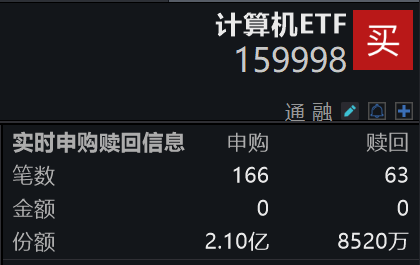
我国首个金融气象AI模型“熵机”发布!计算机ETF(159998)半日净申购已超1.2亿份居深市同类第一,连续8日“吸金”近5亿元
Sou Hu Cai Jing· 2026-01-13 05:06
Core Insights - The Computer ETF (159998) has seen active trading with a turnover of 13.75% and a transaction volume of 446 million yuan, while the tracked CSI Computer Theme Index (930651) decreased by 0.33% [1] - The ETF has experienced a net subscription of over 120 million shares during the trading session, indicating strong investor interest [1] - As of January 12, the Computer ETF reached a new high with a total scale of 3.217 billion yuan and a total share count of 2.777 billion [2] - The ETF has recorded continuous net inflows over the past eight days, totaling 488 million yuan, with a peak single-day inflow of 302 million yuan [2] - The ETF focuses on the hard technology sector, covering various sub-sectors such as software, hardware, and cloud computing, aligning with trends in the digital economy and AI development [2] Related Events - The launch of China's first financial meteorological AI model "Entropy Machine" on January 11 aims to explore the impact of meteorological factors on financial asset pricing, providing innovative tools for risk management and investment decisions [2] - Apple and Google announced a long-term partnership to upgrade Siri using Google's Gemini model, which boasts 1.2 trillion parameters, significantly enhancing Siri's capabilities in natural language understanding and complex task planning [3] Institutional Perspectives - Domestic AI large model technology is entering a critical breakthrough period, with expectations for increased commercialization of AI applications. The release of the V4 version of the DeepSeek plan is intensifying competition among leading general-purpose large models [4] - The advancements in AI programming tools, exemplified by Cursor and GitHub Copilot, are showing promising commercial prospects, and similar domestic products are expected to accelerate their development [4]



厦门信达涨2.02%,成交额1.42亿元,主力资金净流入306.68万元
Xin Lang Cai Jing· 2026-01-13 04:03
Group 1 - The core viewpoint of the news is that Xiamen Xinda's stock has shown significant price increases and trading activity, indicating positive market sentiment and potential investment interest [1] - As of January 13, Xiamen Xinda's stock price increased by 7.76% year-to-date, with a 28.73% increase over the past 60 days [1] - The company operates primarily in the electronic information industry, with 97.70% of its revenue coming from trade, and has a market capitalization of 4.732 billion yuan [1] Group 2 - As of September 30, the number of shareholders decreased by 27.21% to 48,300, while the average number of circulating shares per person increased by 37.38% to 13,810 shares [2] - For the first nine months of 2025, Xiamen Xinda reported a revenue of 26.921 billion yuan, a year-on-year decrease of 21.35%, while net profit attributable to shareholders increased by 104.75% to 6.6375 million yuan [2] - The company has not distributed any dividends in the past three years, with a total payout of 341 million yuan since its A-share listing [3]

我爱我家涨2.01%,成交额2.97亿元,主力资金净流入2447.01万元
Xin Lang Cai Jing· 2026-01-13 03:59
Group 1 - The core viewpoint of the news is that I Love My Home (我爱我家) has shown a positive stock performance with a 2.01% increase in share price on January 13, reaching 3.04 yuan per share, with a total market capitalization of 7.161 billion yuan [1] - The company has experienced a net inflow of main funds amounting to 24.47 million yuan, with significant buying activity from large orders, indicating strong investor interest [1] - Year-to-date, the stock price has increased by 4.11%, with a 5-day increase of 2.36%, a 20-day increase of 4.47%, and a 60-day increase of 5.19% [1] Group 2 - As of December 31, the number of shareholders for I Love My Home reached 81,900, an increase of 3.79% from the previous period, while the average circulating shares per person decreased by 3.65% to 27,541 shares [2] - For the period from January to September 2025, the company reported an operating income of 8.165 billion yuan, a year-on-year decrease of 6.81%, while the net profit attributable to the parent company was 42.327 million yuan, reflecting a significant year-on-year growth of 398.75% [2] Group 3 - The company has distributed a total of 530 million yuan in dividends since its A-share listing, with cumulative distributions of 10.1287 million yuan over the past three years [3] - Among the top ten circulating shareholders as of September 30, 2025, Huashan Media Internet Mixed A (华安媒体互联网混合A) is the fourth largest shareholder with 48.098 million shares, while Hong Kong Central Clearing Limited is the sixth largest with 36.634 million shares, having increased its holdings by 11.6772 million shares [3] - The Southern CSI Real Estate ETF Initiated Link A (南方中证房地产ETF发起联接A) is the ninth largest shareholder with 20.86 million shares, having decreased its holdings by 167,200 shares [3]

海康威视跌2.02%,成交额14.31亿元,主力资金净流出1.16亿元
Xin Lang Zheng Quan· 2026-01-13 03:52
Group 1 - Hikvision's stock price decreased by 2.02% on January 13, reaching 31.00 CNY per share, with a trading volume of 1.431 billion CNY and a turnover rate of 0.50%, resulting in a total market capitalization of 284.111 billion CNY [1] - Year-to-date, Hikvision's stock has increased by 3.89%, with a 2.01% rise over the last five trading days, a 4.62% increase over the last 20 days, and a 6.23% decline over the last 60 days [1] - The company reported a revenue of 65.758 billion CNY for the first nine months of 2025, reflecting a year-on-year growth of 1.18%, and a net profit attributable to shareholders of 9.319 billion CNY, which is a 14.94% increase year-on-year [2] Group 2 - Hikvision has distributed a total of 68.502 billion CNY in dividends since its A-share listing, with 25.048 billion CNY distributed over the past three years [3] - As of September 30, 2025, the number of shareholders for Hikvision was 387,200, a decrease of 6.45% from the previous period, while the average circulating shares per person increased by 6.10% to 23,362 shares [2][3] - The company's main business revenue composition includes 70.00% from core products and services, 7.50% from robotics, 6.58% from smart home products, 5.63% from automotive electronics, 4.80% from thermal imaging, 2.47% from storage, 1.87% from construction engineering, and 1.15% from other innovative businesses [1]

信心的种子,不怕任何冬寒
Ren Min Ri Bao· 2026-01-13 03:02
Group 1 - As of June 2025, there will be 161 million internet users aged 60 and above in China, indicating a significant growth potential for the silver economy and digital economy [1] - By November 2025, a total of 611 generative AI services will have completed registration, with 306 related applications or functions also registered, showcasing the rapid development of domestic AI models [1] - The new generation of digital technologies, including big data, cloud computing, AI, blockchain, and IoT, is continuously creating new industries, models, and driving forces, expanding the sources of development confidence [1] Group 2 - China's economy is undergoing a profound transformation in its growth dynamics, shifting from reliance on factor input and scale expansion to new productive forces that drive quality, efficiency, and power changes [2] - The potential of China's economy is being continuously released through regional coordinated development, rural revitalization, and the ongoing improvement of human capital quality [2] - The unique ecosystem formed by China's super-large market allows innovations to quickly achieve scale effects once they gain market recognition, as evidenced by the rapid growth of sectors like new energy vehicles and live-streaming commerce [2] Group 3 - Many Chinese entrepreneurs are building technological "moats" and enhancing value through persistent efforts, demonstrating that success comes from hard work and dedication [3] - The successful test flight of domestically produced high-bypass turbofan engines illustrates China's ability to overcome technological challenges and break through external constraints, reflecting a strong sense of confidence [3] - The 2025 Central Economic Work Conference emphasizes the importance of internal strengthening to address external challenges, advocating for strategic determination and a stable industrial system to navigate uncertainties [3]
平安证券(香港)港股晨报-20260113
Ping An Securities Hongkong· 2026-01-13 02:51
Market Overview - The Hong Kong stock market experienced fluctuations, with the Hang Seng Index closing at 23,831 points, down 145 points or 0.61% [1] - The market turnover decreased to 82.799 billion HKD, with net inflows of 484 million HKD recorded in the Hong Kong Stock Connect [1] - The US stock market saw the Dow Jones and S&P 500 indices reach new highs, with the Dow closing at 49,590 points, up 0.2% [2] Key Insights - The report highlights the sustained net inflow of southbound funds through the Hong Kong Stock Connect, with a projected annual net inflow of 1,404.8 billion HKD by 2025 [3] - The focus on "technological self-reliance" and AI applications is expected to be a core theme for the future performance of Hong Kong stocks, with leading companies in these sectors likely to benefit from long-term growth opportunities [3] - The report suggests continued attention to sectors supported by policies aimed at expanding domestic consumption, such as sports apparel and non-essential services [3] Company Performance - TSMC, the world's largest advanced AI chip manufacturer, is expected to see a 27% increase in net profit in Q4, driven by surging demand for AI infrastructure [8] - Analysts predict TSMC's net profit could reach 475.2 billion TWD (approximately 15.02 billion USD), marking a record high for a single quarter [8] - The report recommends focusing on leading companies in the domestic semiconductor foundry industry, such as Hua Hong Semiconductor (1347.HK) and SMIC (0981.HK), which are expected to benefit from favorable domestic policies [8] Stock Recommendations - China Unicom (0762.HK) is highlighted for its strong performance in digital technology services, with a projected revenue of 45.4 billion CNY for its smart network business in the first half of 2025, reflecting a 4.3% year-on-year growth [9] - The company is also expected to maintain a high dividend yield, with a mid-2025 interim dividend of 0.2841 CNY per share, up 14.5% year-on-year [9] - The report emphasizes the company's advantages in cloud computing, IoT, big data, and AI, positioning it well to capitalize on the growth of China's digital economy [9]
AI医疗+互联网医疗+NFT概念联动2连板!浙数文化9:45再度涨停,背后逻辑揭晓
Sou Hu Cai Jing· 2026-01-13 02:12
Core Insights - Zhejiang Shuculture has experienced a consecutive two-day trading limit increase, indicating strong market interest and momentum [1] - The stock reached a trading limit at 9:45 AM with a transaction volume of 1.605 billion yuan and a turnover rate of 7.55% [1] Company Developments - The company is actively involved in the multi-modal AI sector, with applications in AI healthcare, internet healthcare, and NFTs [1] - Zhejiang Shuculture's subsidiary, Chuanbo Brain Technology, has developed a large model for media that has been successfully registered with the National Internet Information Office, marking it as the first media-specific large model developed by a media technology company in China [1] - The company is investing in infrastructure such as the Fuchun Cloud Internet Data Center and the Zhejiang Big Data Trading Center, establishing a comprehensive digital business ecosystem [1] Market Trends - The recent performance of the multi-modal AI concept sector has been robust, aligning with the company's strategic focus on AI and the digital economy [1]

商务部发布关于中欧电动汽车案磋商进展的通报……盘前重要消息还有这些
Zheng Quan Shi Bao· 2026-01-13 00:41
2.1月12日,外交部发言人毛宁主持例行记者会。在回答有关中方加强两用物项对日本的出口管制问题 时,毛宁表示,中方加强两用物项对日本的出口管制,是为了维护国家安全和利益,履行防扩散等国际 义务,完全正当、合理、合法。中方维护关键矿产全球产供链稳定与安全的立场没有变化,同时我们也 认为各方都有责任为此发挥建设性作用。 3.1月12日,国家发展改革委、财政部、科技部、工业和信息化部联合发布《关于加强政府投资基金布 局规划和投向指导的工作办法》(下称《工作办法》)。《工作办法》围绕政府投资基金"投向哪、怎 么投、谁来管"三方面提出多项政策举措。国家发展改革委相关负责人表示,这是首次在国家层面对政 府投资基金的布局和投向作出系统规范。在优化基金布局方面,《工作办法》要求基金支持重大战略、 重点领域和市场难以有效配置资源的薄弱环节,推动科技创新和产业创新深度融合,着力培育新兴支柱 产业,坚持投早、投小、投长期、投硬科技。在加强投向指导方面,《工作办法》指出基金投向须符合 国家重大规划和国家级产业目录中的鼓励类产业,不得投向限制类、淘汰类以及政策明令禁止的产业领 域。同时,《工作办法》还进一步明确由省级发展改革部门牵头制 ...
扩大高水平对外开放 促进普惠包容的经济全球化 ——访商务部党组书记、部长王文涛
Ren Min Ri Bao· 2026-01-12 23:21
Core Viewpoint - The report emphasizes the importance of expanding high-level opening-up to promote inclusive economic globalization and enhance China's modernization efforts [2][4][5]. Group 1: Significance of High-Level Opening-Up - High-level opening-up is seen as a strong driving force for high-quality development, with a focus on utilizing global resources and markets [2]. - It is crucial for meeting the people's needs for a better life, as it directly impacts employment and the availability of diverse consumer goods [3]. - The report highlights that high-level opening-up is essential for promoting inclusive and cooperative economic globalization, positioning China as a leader rather than a follower in global trade [4]. Group 2: Achievements in Opening-Up - Since the 18th National Congress, China has made historic achievements in opening-up, with significant growth in foreign trade and investment [6][7]. - In the first 11 months of 2025, China's goods trade reached 41.2 trillion yuan, a 3.6% increase year-on-year, maintaining its position as the world's largest trading nation [7]. - The report notes that China has become a major player in global service trade, with the total service trade expected to exceed 1 trillion USD in 2024 [7]. Group 3: Challenges and Opportunities - The current global environment presents both opportunities and challenges for expanding high-level opening-up, with increasing uncertainties [11]. - The report identifies a "pressure period" due to global economic slowdowns and geopolitical tensions, particularly in U.S.-China relations [12]. - However, it also highlights the potential for new growth in digital and green sectors, with significant market opportunities in these areas [12][13]. Group 4: Future Directions for Opening-Up - The report outlines four key areas for future focus: expanding autonomous opening-up, promoting trade innovation, enhancing two-way investment cooperation, and high-quality Belt and Road Initiative construction [14][15][16][17]. - Emphasis is placed on aligning with international standards and reducing barriers to trade and investment to foster a more open economic environment [14]. - The report also stresses the importance of protecting overseas interests and enhancing legal frameworks to support international investments [17].
践行科技金融使命 推动国产GPU产业链协同升级
Mei Ri Shang Bao· 2026-01-12 22:25
Group 1 - The core viewpoint of the news highlights the successful investment by PICC Life Insurance in the domestic GPU sector through strategic equity investments in Moer Thread and Muxi Co., which have recently listed on the STAR Market, showcasing the advantages of insurance capital in long-term investments [1][2] - PICC Life Insurance's early-stage equity investments in Moer Thread and Muxi Co. have yielded significant returns, with a floating profit exceeding 55 times on the day of the companies' listings, demonstrating the firm's expertise in technology finance [1] - Both Moer Thread and Muxi Co. are leading companies in the domestic GPU field, focusing on the independent research and development of high-performance general-purpose GPUs to address critical challenges in high-end computing power [1] Group 2 - The investment strategy of PICC Life Insurance effectively leverages "patient capital" to meet the high-quality development needs of the GPU industry, facilitating the companies' rapid growth through capital market access [2] - This investment not only supports the collaborative upgrade of the domestic GPU industry chain but also provides foundational computing power for the development of artificial intelligence and the digital economy, promoting synergy among related industries [2] - Looking ahead, PICC Life Insurance aims to continue focusing on national strategic needs, using capital as a link to empower high-quality hard technology enterprises and deepen the integration of financial resources with the real economy [2]