新能源

Search documents
美国银行上调金价至6000美元!有色矿业ETF招商(159690)盘中涨超6%!白银有色、中钨高新、兴业银锡纷纷涨停
Sou Hu Cai Jing· 2026-01-26 05:57
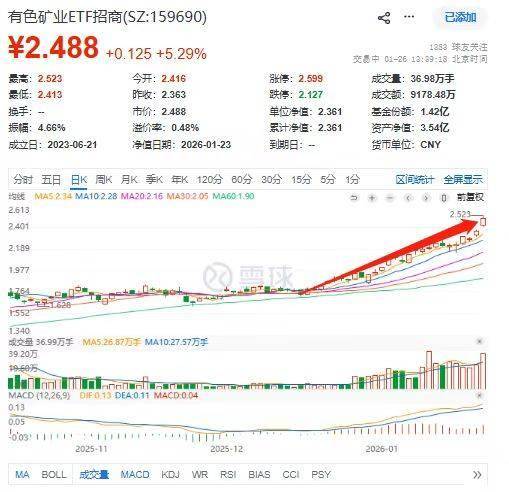
Group 1 - The core viewpoint of the news highlights a significant surge in the non-ferrous metals sector, with the non-ferrous mining ETF (招商, 159690) experiencing a rise of 5.21% and peaking at 6.77% [1] - Major stocks within the sector, such as 白银有色, 中钨高新, and 兴业银锡, reached their daily limit up, while 湖南白银 and 中金黄金 showed notable gains [1] Group 2 - Bank of America has raised its gold price target to $6,000 per ounce, marking the most aggressive forecast among major institutions [3] - Analyst Michael Hartnett noted that historically, gold prices have increased by an average of 300% over approximately 43 months during past bull markets, suggesting a potential peak in spring 2026 [3] - The top three weighted components of the non-ferrous mining ETF are copper (31%), gold (14%), and aluminum (12%), collectively accounting for 57%, indicating a high concentration in leading resources [3] - The ETF acts as a "non-ferrous amplifier," showing significant leverage effects as its net value can increase several times compared to the underlying commodity prices during price uptrends [3] - The mining sector's long-term investment value is expected to benefit from the recovery of the global manufacturing cycle and the ongoing demand from emerging industries such as renewable energy and artificial intelligence [3]


新能源周报:抢出口需求带动碳酸锂淡季去库-20260126
Guo Mao Qi Huo· 2026-01-26 05:21
1. Report Industry Investment Ratings - Industrial silicon: Oscillation [7] - Polysilicon: Wait - and - see [8] - Lithium carbonate: Bullish [79] 2. Core Views of the Report - The short - term supply disturbances of industrial silicon and the trend of demand contraction may increase inventory depletion, but it is difficult to reverse the oversupply situation in the short term, and the price is expected to oscillate. For polysilicon, due to poor contract liquidity, investors are advised to be cautious. Lithium carbonate inventory has been substantially depleted, and the fundamentals support the price, which is expected to continue to be strong [7][8][79]. 3. Summaries According to Relevant Catalogs Industrial Silicon (SI) Supply - The national weekly output is 7.62 tons, a week - on - week decrease of 2.78%; the number of open furnaces is 217, a week - on - week decrease of 4. The December output is 39.71 tons, a month - on - month decrease of 1.15% and a year - on - year increase of 19.75%; the January production schedule is 37.78 tons, a month - on - month decrease of 4.87% and a year - on - year increase of 24.26% [7]. Demand - For polysilicon, the weekly output is 2.04 tons, a week - on - week decrease of 7.40%. The December output is 11.55 tons, a month - on - month increase of 0.79% and a year - on - year increase of 18.71%; the January production schedule is 10.78 tons, a month - on - month decrease of 6.67% and a year - on - year increase of 14.19%. For organic silicon, the DMC weekly output is 4.29 tons, a week - on - week decrease of 1.61% [7]. Inventory - The explicit inventory is 51.78 tons, a week - on - week increase of 1.60% and a year - on - year decrease of 24.86%. The industry inventory is 45.30 tons, a week - on - week decrease of 0.22%. The warehouse receipt inventory is 6.49 tons, a week - on - week increase of 16.44% [7]. Cost and Profit - The national average cost per ton is 8998 yuan, a week - on - week decrease of 0.62%; the gross profit per ton is - 46 yuan, a week - on - week increase of 35 yuan/ton. The gross profit in the main producing areas is basically stable [7]. Investment View - The price is expected to oscillate, and the unilateral trading is bearish [7]. Polysilicon (PS) Supply - The national weekly output is 2.04 tons, a week - on - week decrease of 7.40%. The December output is 11.55 tons, a month - on - month increase of 0.79% and a year - on - year increase of 18.71%; the January production schedule is 10.78 tons, a month - on - month decrease of 6.67% and a year - on - year increase of 14.19% [8]. Demand - The silicon wafer weekly output is 10.95GW, a week - on - week increase of 4.79%. The December silicon wafer output is 43.9GW, a month - on - month decrease of 19.26% and a year - on - year decrease of 2.01%; the January production schedule is 45.2GW, a month - on - month increase of 2.96% and a year - on - year decrease of 1.74% [8]. Inventory - The factory inventory is 32.08 tons, a week - on - week increase of 1.25%. The registered warehouse receipts are 20550 tons, a week - on - week increase of 52.22% [8]. Cost and Profit - The national average cost per ton is 42969 yuan, a week - on - week increase of 0.41%; the gross profit per ton is 16241 yuan, a week - on - week decrease of 174 yuan [8]. Investment View - Due to poor contract liquidity, investors are advised to wait and see and be cautious about price fluctuations and liquidity risks [8]. Lithium Carbonate (LC) Supply - The national weekly output is 2.22 tons, a week - on - week decrease of 1.72%. The December output is 9.92 tons, a month - on - month increase of 4.04% and a year - on - year increase of 41.00%; the January production schedule is about 9.80 tons, a month - on - month decrease of 1.24% and a year - on - year increase of 56.78% [79]. Import - In December, the lithium carbonate import volume is 2.40 tons, a month - on - month increase of 8.77% and a year - on - year decrease of 14.43%. The lithium concentrate import volume is 62.80 tons, a month - on - month decrease of 7.31% and a year - on - year increase of 30.22% [79]. Material Demand - For iron - lithium materials, the weekly output is 9.86 tons, a week - on - week increase of 1.39%. The December output is 40.39 tons, a month - on - month decrease of 2.17% and a year - on - year increase of 46.00%; the January production schedule is 36.34 tons, a month - on - month decrease of 10.03% and a year - on - year increase of 44.29%. For ternary materials, the weekly output is 1.80 tons, a week - on - week decrease of 0.88% [79]. Terminal Demand - In December, the new energy vehicle production is 171.80 million, a month - on - month decrease of 8.60% and a year - on - year increase of 12.29%; the sales volume is 171.00 million, a month - on - month decrease of 6.18% and a year - on - year increase of 7.14%. From January to November, the cumulative winning bid power/scale of energy storage is 59.48GW/160.39GWh, a cumulative year - on - year increase of 70.53%/118.93% [79]. Inventory - The social inventory (including warehouse receipts) is 10.89 tons, a week - on - week decrease of 0.71%. The lithium salt factory inventory is 1.98 tons, a week - on - week increase of 0.54%. The warehouse receipt inventory is 2.82 tons, a week - on - week increase of 3.50% [79]. Cost and Profit - For lithium extraction from purchased ore, the cash production cost of lithium mica is 149738 yuan/ton, a week - on - week increase of 0.62%; the production profit is 9003 yuan/ton, a week - on - week increase of 4467 yuan/ton. The cash production cost of lithium spodumene is 154692 yuan/ton, a week - on - week increase of 2.87%; the production profit is 7644 yuan/ton, a week - on - week increase of 4163 yuan/ton [79]. Investment View - The price is expected to continue to be strong, and the unilateral trading is bullish [79].
装备制造行业周报(1月第3周):固态电池产业持续推进-20260126
Century Securities· 2026-01-26 05:17
Investment Rating - The report does not explicitly state an investment rating for the industry, but it suggests continued attention to investment opportunities in core equipment and materials segments related to solid-state batteries and inverters [1]. Core Insights - The solid-state battery industry is advancing, with companies like Geely and FAW making significant progress in developing and testing their own solid-state battery technologies, indicating a strong potential for commercialization in various applications [2][3]. - The photovoltaic inverter exports from China are on the rise, with a total export value of approximately $839 million in December 2025, reflecting a 26% year-on-year increase, driven by strong overseas demand and a favorable market environment [2][3]. - The automotive market is experiencing a temporary decline in retail sales, but the introduction of new subsidy policies is expected to support a gradual recovery in the market, particularly for smart and high-tech vehicles [2][3]. Summary by Sections Market Overview - In the past week, the indices for mechanical equipment, electric power equipment, and automotive sectors increased by 2.56%, 3.57%, and 2.51% respectively, outperforming the Shanghai Composite Index, which decreased by 0.62% [7][9]. Industry News and Key Company Announcements - Significant advancements in solid-state battery technology were reported, with Geely and FAW achieving important milestones in their development processes [2]. - The inverter export market is expected to maintain high growth, with record export numbers indicating robust demand from international markets [2]. - The automotive sector is facing challenges due to changes in subsidy policies, but long-term growth is anticipated as the penetration rate of new energy vehicles continues to rise [2]. Company Performance - Top-performing stocks in the mechanical equipment sector included Fenglong Co., Tianzhong Precision, and Deen Precision, with weekly increases of 61.08%, 33.66%, and 33.05% respectively [14]. - In the electric power equipment sector, companies like Aotewei and Maiwei also showed strong performance, with increases of 38.90% and 36.29% respectively [14]. - The automotive sector saw significant gains from companies such as Xinz坐标 and Tieliu Co., with increases of 36.30% and 32.97% respectively [14].
芯片半导体板块调整,关注科创200ETF易方达(588270)、科创50ETF易方达(588080)等中长期投资机遇
Sou Hu Cai Jing· 2026-01-26 05:07
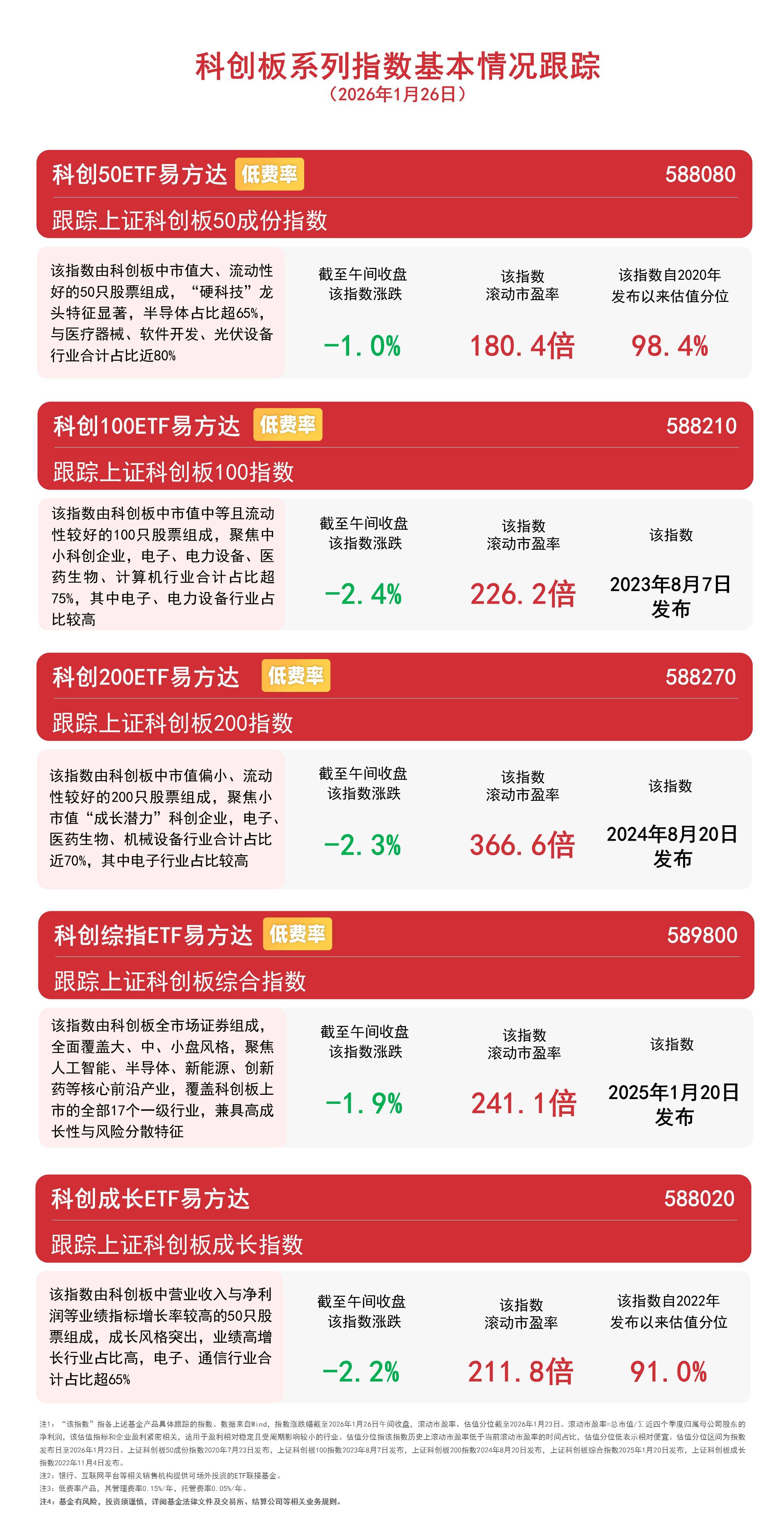
Group 1 - The technology sector, including software, storage chips, and semiconductor equipment, experienced a collective adjustment on January 26, with significant declines in various indices [1] - The STAR 50 Index fell by 1.0%, the STAR Composite Index decreased by 1.9%, the STAR Growth Index dropped by 2.2%, the STAR 200 Index declined by 2.3%, and the STAR 100 Index decreased by 2.4% [1] Group 2 - The STAR 200 Index consists of 200 stocks from the STAR Market that are smaller in market capitalization and have good liquidity, focusing on small-cap "growth potential" companies [7] - The electronic and medical biology sectors, along with machinery equipment, account for nearly 70% of the STAR 200 Index, with a high proportion in the electronic sector [7] - The STAR Composite Index ETF, managed by E Fund, tracks the STAR Composite Index, which covers the entire market of the STAR Board, focusing on artificial intelligence, semiconductors, new energy, and innovation [6][7]
A股午评 | 三大指数走势分化 大金融板块护盘 热门股集体跳水
智通财经网· 2026-01-26 03:46
Core Viewpoint - The A-share market shows a mixed performance with small-cap stocks underperforming, indicating a shift towards defensive strategies amid rising geopolitical risks and a declining US dollar index [1] Market Performance - As of the midday close, the Shanghai Composite Index rose by 0.12%, while the Shenzhen Component and ChiNext Index fell by 0.74% and 0.86%, respectively [1] - Over 3,800 stocks in the market were in the red, reflecting a significant retreat in speculative trading [1] Sector Highlights Precious Metals - The precious metals sector continues to surge, with stocks like Yuguang Gold Lead and Hunan Gold hitting the daily limit [2] - Spot gold prices have surpassed $5,000 per ounce for the first time, and silver futures have seen a 17% increase [2] Oil and Gas - The oil and gas sector is experiencing strong performance, with China National Offshore Oil Corporation (CNOOC) rising over 6% to reach a historical high [3] - The surge in natural gas prices in the US, driven by winter storms, has contributed to this sector's strength [3] Alcoholic Beverages - The liquor sector is facing declines, with Yanghe Brewery dropping over 8% to its lowest level since November 2017 [4] - Yanghe's profit forecast indicates a potential decline of 62.18% to 68.30% year-on-year for 2025, signaling a challenging environment for the industry [4] Institutional Insights CITIC Securities - CITIC Securities suggests that market confidence is gradually recovering, recommending to increase allocations in non-bank financials and certain domestic demand or high-growth sectors [6] - The focus is on sectors that can recover from low valuations, particularly in the consumer chain leading up to the Two Sessions [6] CITIC Jiantou - CITIC Jiantou emphasizes a dual focus on "technology + resource products," highlighting sectors like AI, semiconductors, and new energy as key areas of growth [5] - The firm notes that the economic environment remains weak but liquidity is ample, favoring investment in sectors with strong performance expectations [5] Dongfang Securities - Dongfang Securities observes that market panic is dissipating, with a structural rally driven by policy catalysts and industry trends [7] - Areas such as commercial aerospace, AI computing, and storage chips are identified as having dual support from policy and industry dynamics, suggesting long-term tracking value [7]

ETF盘中资讯|化工强势爆发!化工ETF(516020)上探1.32%,近20日吸金超24亿元!机构:继续看好大化工板块投资机会
Sou Hu Cai Jing· 2026-01-26 03:30
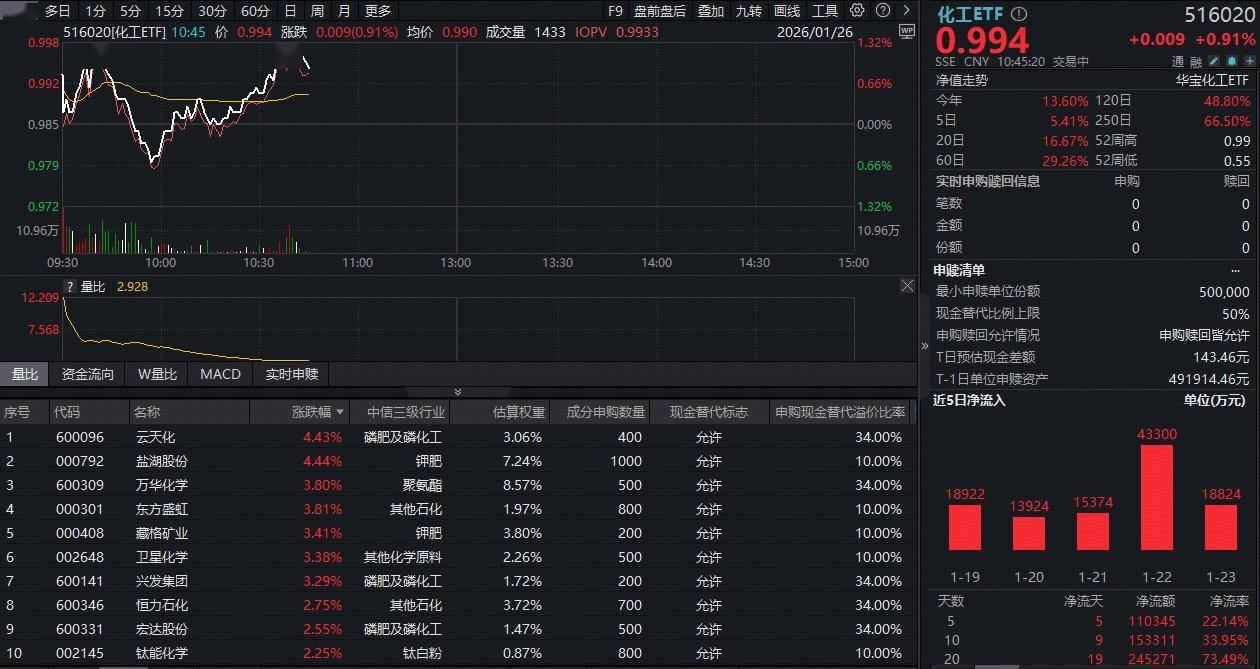
Group 1 - The chemical sector continues to strengthen, with the chemical ETF (516020) showing a maximum intraday increase of 1.32% and a current increase of 0.91% [1] - Key stocks in the sector, including Yuntianhua and Salt Lake Potash, have seen significant gains, with both rising over 4%, while Wanhuacheng, Dongfang Shenghong, and Cangge Mining have increased over 3% [1] - Recent data indicates that the chemical sector has attracted substantial capital, with the chemical ETF (516020) receiving a net subscription of over 1.1 billion yuan in the last five trading days and over 2.4 billion yuan in the last 20 trading days [3] Group 2 - The chemical industry is currently at the bottom of a four-year down cycle, with indicators suggesting it has nearly bottomed out, and 2026 is expected to be a turning point for a cycle reversal [3] - The China Chemical Product Price Index (CCPI) is at 3930 points as of December 31, 2025, a 39% decrease from its peak in 2021, indicating the industry is in a historical low range [3] - The basic chemical sector achieved a net profit of 112.7 billion yuan in the first three quarters of 2025, reflecting a year-on-year increase of 7.5%, indicating initial stabilization of the sector [3] Group 3 - The chemical ETF (516020) tracks the CSI sub-sector chemical industry theme index, covering popular themes such as AI computing power, anti-involution, robotics, and new energy [4] - Investors can also access the chemical ETF through linked funds (Class A 012537/Class C 012538) for more efficient exposure to the chemical sector [4]
化工板块反弹
Nan Hua Qi Huo· 2026-01-26 03:25
Report Summary 1. Report Industry Investment Rating No relevant content provided. 2. Core Viewpoints of the Report - After the technical adjustment of non - ferrous related varieties last week, there are signs of a rebound, and silver has reached a new high. The underlying logic is the demand logic of related commodities driven by the new economy, new energy, and AI economy, and there may be a risk of short - squeeze as the market progresses. The anti - involution logic of low - valued varieties is gradually advancing. Recently, chemical varieties have shown signs of a rebound and increased trading activity, which is worthy of attention. The national policy is determined to rectify involution - style competition and adjust the dynamic adjustment ability of the supply side. It is believed that anti - involution will be an inevitable theme in 2026 [2][5]. 3. Summary by Relevant Catalog 3.1 Week - long Market Viewpoint Summary - The strength - weakness structure of the commodity market in the past week remains unchanged, with non - ferrous metals and precious metals remaining strong. Chemical varieties have also shown strong performance recently. After a recent technical adjustment, non - ferrous commodities are strengthening again, and the upward trend continues [4]. - Gold and silver have broken through new highs after a short - term technical adjustment, and there are no signs of a trend reversal from the technical form [4]. - In the context of the easing of China - Canada trade relations, rapeseed oil has weakened, but soybean oil and palm oil are unaffected. The overall downside space for oils and fats is very limited, and they can be used as long - position allocations [4]. - The chemical sector will generally operate within the anti - involution framework in 2026. The national policy emphasizes the supply - demand adjustment of the petrochemical sector. The production capacity of glass has declined significantly recently, and the valuation of chemical products has reached an extreme level [4]. - Steel in the black sector is one of the key anti - involution varieties, and the downside space for coal is also limited. The coal supply - guarantee market is nearing its end. Recently, chemical varieties are showing signs of an upward trend [4]. 3.2 Data Tables - **Plate Capital Flow**: The total capital flow is 34.115 billion yuan. Among them, precious metals have a capital inflow of 5.764 billion yuan, non - ferrous metals 3.479 billion yuan, black metals - 0.594 billion yuan, energy 0.274 billion yuan, chemicals 4.047 billion yuan, feed and breeding 0.478 billion yuan, oils and fats 2.118 billion yuan, and soft commodities 0.259 billion yuan [9]. - **Black and Non - ferrous Weekly Data**: It shows price percentile, inventory percentile, valuation percentile, position percentile, open - interest change percentile, and annualized basis for various black and non - ferrous varieties such as iron ore, rebar, gold, silver, etc. For example, the price percentile of iron ore is 21.8%, and the inventory percentile is 100% [9]. - **Energy and Chemical Weekly Data**: It details price percentile, inventory percentile, valuation percentile, position percentile, open - interest change percentile, and annualized basis for energy and chemical products such as fuel oil, low - sulfur oil, asphalt, etc. For example, the price percentile of fuel oil is 7.5%, and the inventory percentile is 44.1% [11]. - **Agricultural Product Weekly Data**: It provides price percentile, inventory percentile, valuation percentile, position percentile, open - interest change percentile, and annualized basis for agricultural products such as soybean meal, rapeseed meal, soybean oil, etc. For example, the price percentile of soybean meal is 9.9%, and the inventory percentile is 91.9% [12].
5天疯狂加仓11亿元,“化工牛”再刷近三年新高
Mei Ri Jing Ji Xin Wen· 2026-01-26 03:16
Group 1 - The chemical sector is experiencing a strong momentum, with the Chemical ETF (516020) showing a significant price increase of over 1.2% and reaching a nearly three-year high [1] - As of January 23, the Chemical ETF (516020) has attracted a net subscription of over 1.1 billion yuan in the past five days and over 1.5 billion yuan in the past ten days, indicating strong capital inflow [1] - Professional institutions suggest that the "14th Five-Year Plan" emphasizes expanding domestic demand, which will drive the transition of new and old growth drivers, leading to expected growth in chemical product demand [1] Group 2 - The Chemical ETF (516020) and its linked fund (012537) track the CSI segmented chemical industry theme index, with nearly 50% of its holdings concentrated in large-cap leading stocks such as Wanhua Chemical and Salt Lake Industry [2] - The remaining 50% of the portfolio includes leading stocks in sub-sectors like phosphate fertilizers, fluorine chemicals, and nitrogen fertilizers, allowing for a comprehensive grasp of investment opportunities in the chemical sector [2] Group 3 - The chemical industry is expected to reach a cyclical turning point upward by 2026, transitioning from valuation recovery to earnings growth, driven by strong policy expectations and established supply-demand fundamentals [1] - According to Guangfa Securities, the chemical industry typically follows a five-year cycle, going through stages of profit growth, capacity expansion, profit bottoming, and demand expectation improvement [1]
澳元突破16个月新高,政策与商品共振推升强势
Jin Tou Wang· 2026-01-26 02:47
Core Viewpoint - The Australian dollar (AUD) has strengthened against the US dollar (USD), reaching a 16-month high of 0.6931, driven by hawkish expectations from the Reserve Bank of Australia (RBA), commodity support, and policy divergence between Australia and the US [1][2]. Group 1: Policy and Economic Factors - The RBA's hawkish stance is a key support factor, with the central bank maintaining a 3.6% benchmark interest rate and indicating no plans for rate cuts, even considering rate hikes in 2026 [2]. - Market expectations for rate hikes are rising, with a 27% probability for February and nearly 50% for March, with forecasts suggesting rates could rise to 3.85% [2]. - The divergence in monetary policy between the US and Australia enhances the AUD's appeal, as the US Federal Reserve is expected to cut rates by 75 basis points by 2025 and potentially 2-3 more times in 2026 [2]. Group 2: Commodity and Economic Support - Commodity prices, particularly copper and iron ore, are providing support for the AUD, with copper prices expected to rise due to demand from new energy and AI infrastructure [2]. - China's economic growth, projected at around 5%, continues to support Australian resource demand, benefiting the AUD [2]. - Australia's economy shows resilience, with over 60,000 full-time jobs added in December and improvements in unemployment and labor participation rates, despite pressures in consumption and construction sectors [2]. Group 3: Technical Analysis - The technical outlook for AUD/USD indicates a clear bullish trend, with a weekly inverted head and shoulders pattern and a breakout above short-term moving averages [3]. - Key resistance is identified at 0.6931, with a target of 0.7000 if this level is surpassed; support levels are at 0.6900, 0.6800, and 0.6712 [3]. - Goldman Sachs predicts the AUD/USD will reach 0.69 by the third quarter, with general expectations for the annual exchange rate to shift higher [3].
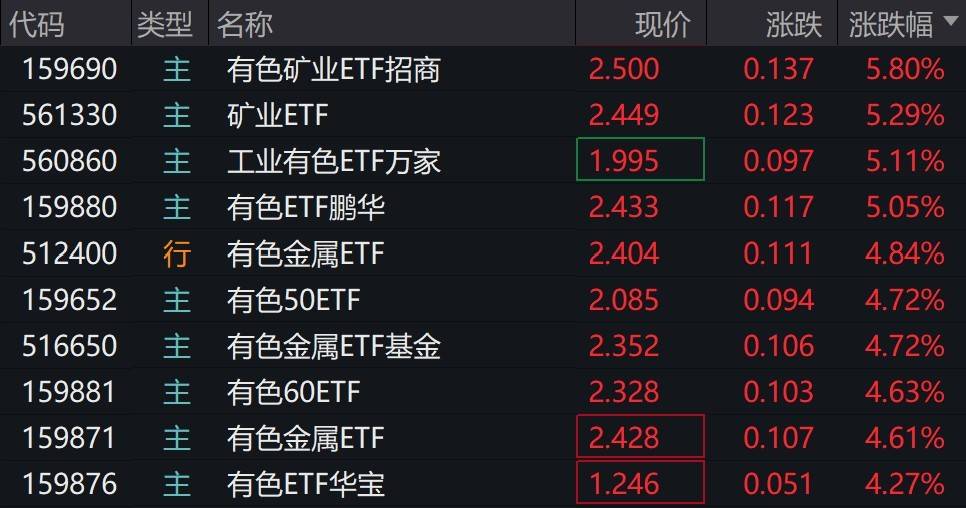
有色金属概念股走强,有色、矿业相关ETF涨约5%
Sou Hu Cai Jing· 2026-01-26 02:31
Group 1 - The core viewpoint of the news is that the non-ferrous metal sector is experiencing significant gains, with major stocks like Zhongjin Gold rising over 9%, and other companies such as Luoyang Molybdenum and Shandong Gold increasing by more than 7% [1] - Non-ferrous and mining-related ETFs have also seen an approximate increase of 5% due to market influences [1] Group 2 - Recent reports indicate that not only precious metals like gold and silver have risen significantly, but also industrial metals such as copper and aluminum, as well as energy metals like cobalt and lithium, have shown good growth, with multiple metals reaching historical or near-historical highs [2] - The super cycle in non-ferrous metals is attributed to three main factors: the weakening trend of the dollar due to the Federal Reserve's interest rate cuts, supply-demand gaps caused by declining ore grades and rising marginal costs in major mines, and domestic policies aimed at optimizing excess capacity [2]