
中国资产重估

Search documents
超88亿!跑了
Zhong Guo Ji Jin Bao· 2025-10-27 06:36
Core Insights - On October 24, the A-share market experienced a broad increase, with major indices rising significantly, yet stock ETFs saw a net outflow of over 8.8 billion yuan on the same day [1][2] - For the week, stock ETFs faced a total outflow of nearly 18 billion yuan, with significant losses observed in broad-based index ETFs such as the Sci-Tech 50, CSI 300, and ChiNext [1][5] ETF Market Overview - As of October 24, the total scale of 1,232 stock ETFs (including cross-border ETFs) reached 4.61 trillion yuan [2] - On October 24, 24 stock ETFs recorded net inflows exceeding 100 million yuan, with the top three being coal ETF, battery ETF, and the SSE 50 ETF, each with inflows over 300 million yuan [2][4] Fund Flow Analysis - The top three stock ETFs by net inflow were: 1. Coal ETF: 517 million yuan 2. Battery ETF: 384 million yuan 3. SSE 50 ETF: 336 million yuan [4] - Conversely, the top three stock ETFs by net outflow included: 1. Sci-Tech 50 ETF: 1.036 billion yuan 2. CSI 300 ETF: 782 million yuan 3. ChiNext ETF: 689 million yuan [7] Sector Performance - The outflow was particularly pronounced in broad-based index ETFs and sector-specific ETFs, with semiconductor and banking ETFs also experiencing significant losses [5] - Notably, four semiconductor-related ETFs saw a combined outflow of nearly 1.4 billion yuan [5] Market Sentiment - Fund managers expressed a cautious outlook, suggesting that while the market may face increased volatility, the downside potential appears limited, with a preference for large-cap blue-chip stocks over small-cap stocks [6]


超88亿!跑了
中国基金报· 2025-10-27 06:32
Core Viewpoint - On October 24, the A-share market experienced a broad increase, with major indices rising significantly, yet stock ETFs saw a net outflow of over 8.8 billion yuan on the same day [2][3]. Fund Flow Analysis - On October 24, stock ETFs had a net outflow exceeding 8.8 billion yuan, contributing to a total outflow of nearly 18 billion yuan for the week [3][6]. - The Shanghai Composite Index rose by 2.88% for the week, while the ChiNext Index surged over 8% [3]. - The outflow was primarily from broad-based indices such as the STAR 50 Index, CSI 300 Index, and ChiNext Index ETFs [3][11]. ETF Performance - As of October 24, the total scale of 1,232 stock ETFs (including cross-border ETFs) reached 4.61 trillion yuan [5]. - The top three ETFs with the highest net inflows included the Coal ETF, Battery ETF, and Shanghai 50 ETF, each with inflows exceeding 300 million yuan [6][9]. - The top 20 ETFs by net inflow included three related to dividend themes and four related to Hong Kong stocks, focusing on sectors like technology and internet [6][7]. Sector-Specific Trends - In terms of industry themes, ETFs related to robotics and batteries saw significant interest, with three and two respective ETFs showing inflows [7]. - Conversely, semiconductor, banking, and artificial intelligence ETFs experienced notable outflows, with the top 20 ETFs by outflow including the STAR 50 ETF and CSI 300 ETF [11][12]. Fund Manager Insights - Fund managers maintain a positive outlook on the revaluation of Chinese assets, with a focus on sectors like non-bank financials and manufacturing that possess global competitiveness [12]. - Despite the recent market rally, some managers have reduced holdings in certain stocks, shifting towards those with better valuation prospects [12].

外资转向,做多中国资产
Ge Long Hui· 2025-10-23 12:29
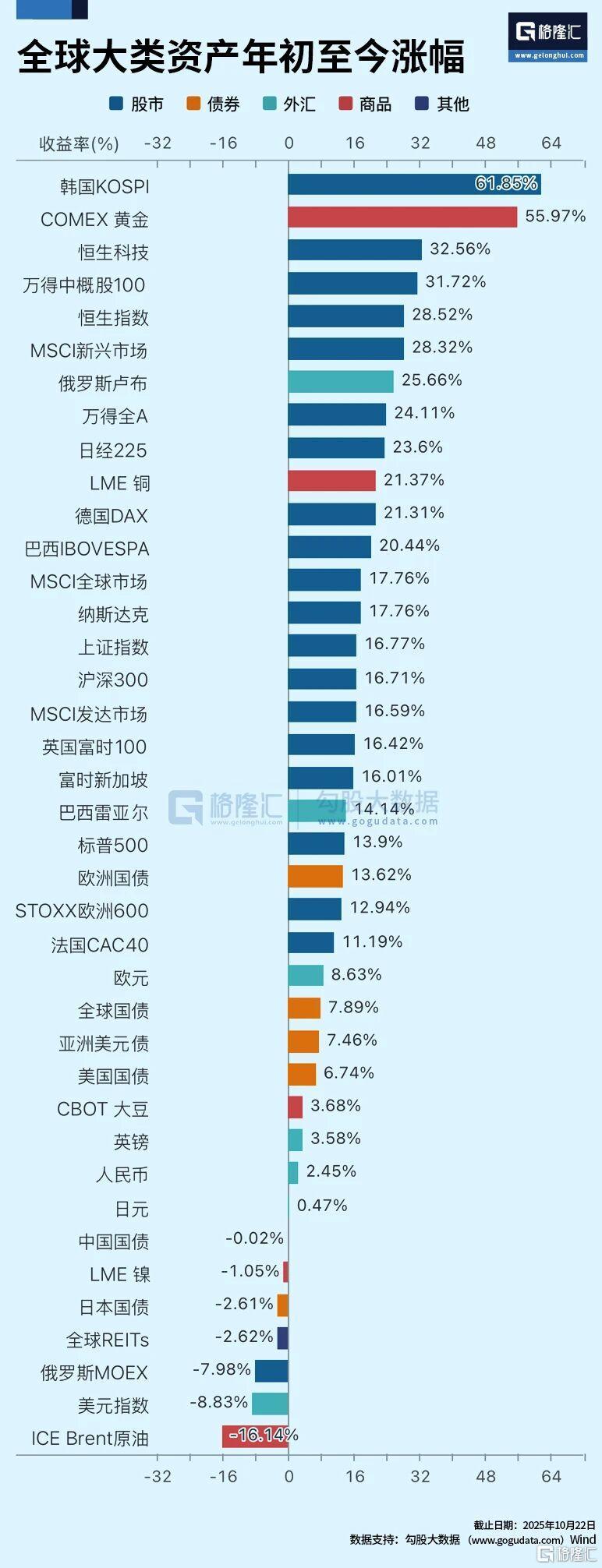
Core Viewpoint - Chinese assets have outperformed globally in 2024, with significant gains in major indices such as the Hang Seng Tech Index and the CSI 300, driven by a resurgence in foreign investment and favorable government policies [1][4][7]. Group 1: Market Performance - As of October 22, 2024, the Hang Seng Tech Index rose by 32.56%, the Hang Seng Index by 28.56%, and the CSI 300 by over 30% within a short period following policy changes [1][7]. - In September 2024, foreign capital inflow into the Chinese stock market reached $4.6 billion, marking a monthly high since November 2023, with a total of $18 billion net inflow from foreign passive funds in the first nine months of 2024 [4][8]. Group 2: Policy Impact - A series of significant policies introduced on September 24, 2024, aimed at stabilizing the market and promoting growth, led to a substantial recovery in market sentiment and capital inflow [7][11]. - The "924 New Policy" has created a complete cycle of policy shift, capital inflow, market rise, and earnings realization in both A-shares and Hong Kong stocks [11][27]. Group 3: Sector Performance - The technology sector, particularly in AI and robotics, has shown remarkable growth, with companies like Zhongji Xuchuang reporting a revenue increase of 36.95% and a net profit increase of 69.4% [9][10]. - Major players like Tencent and Alibaba have also reported significant revenue and profit growth, driven by their AI initiatives [10]. Group 4: Investment Strategies - Goldman Sachs predicts a slow bull market for Chinese stocks, with a potential 30% upside for the MSCI China Index over the next two years, driven by earnings growth and valuation re-rating [16]. - Morgan Stanley emphasizes the importance of focusing on high-tech sectors, including AI and automation, as they expect continued improvement in corporate earnings [17][22]. Group 5: Global Investor Sentiment - Global investors are increasingly viewing Chinese assets as essential components of their portfolios, moving from a cautious stance to a more favorable outlook on growth potential [29][30]. - The launch of the Rayliant-ChinaAMC China Technology Innovation ETF (CNQQ) provides a new avenue for global investors to access Chinese tech stocks, reflecting a shift in perception of China's tech industry [4][31]. Group 6: Valuation Metrics - The Hang Seng Tech Index is currently trading at a PE ratio of 22.76, significantly lower than global counterparts like the Nasdaq and S&P 500, indicating potential for further valuation recovery [24][25]. - Despite recent market corrections, the overall sentiment remains optimistic, with expectations of continued capital inflow and performance improvement in the Chinese market [14][18].


增持中国资产将是大势所趋!四位大咖把脉全球资产配置
券商中国· 2025-10-22 03:50
Core Viewpoint - The conference highlighted the optimistic outlook for Chinese assets, particularly in the technology sector, amidst a global trend of investment diversification and a consensus on the value of gold as a hedge [2][16]. Group 1: Market Performance and Economic Insights - The A-share market's strong performance is attributed to a decline in risk premiums rather than improvements in corporate earnings, indicating improved market expectations [4]. - The current bull market is believed to have entered its second phase, driven by fundamental improvements in technology sectors, with a focus on value sectors like real estate and consumer goods [7][9]. - The global economic outlook suggests a slowdown in GDP growth from 3.0% in 2025 to 2.8% in 2026, with inflation rates expected to remain stable, providing central banks with policy flexibility [12]. Group 2: Investment Strategies and Recommendations - Investment in Chinese assets is expected to increase, particularly in high-tech sectors such as AI, automation, and biotechnology, as global investors recognize the potential for growth [10][22]. - A diversified approach to global stock markets is recommended, with a preference for U.S. stocks due to their scale and quality, while being cautious of trade uncertainties that could impact market stability [19]. - The consensus among economists is to increase allocations in gold as a strategic asset, with expectations of at least a 5% price increase due to historical performance during rate cuts and geopolitical uncertainties [17][18]. Group 3: Regional Market Analysis - In the U.S. market, there is a preference for high-quality and cyclical stocks, while in Japan, companies benefiting from domestic inflation and governance reforms are favored [19][20]. - European markets face growth challenges, with a projected GDP growth of only 1% in 2025, suggesting a focus on resilient sectors like defense and banking [20]. - Emerging markets are viewed favorably for domestic-oriented companies and financial stocks, while exporters and semiconductor hardware firms are advised against [21].

公募观澜·把脉机遇 | 取势 重质 向未来 绩优基金经理详解投资“心法”
Sou Hu Cai Jing· 2025-10-21 00:03
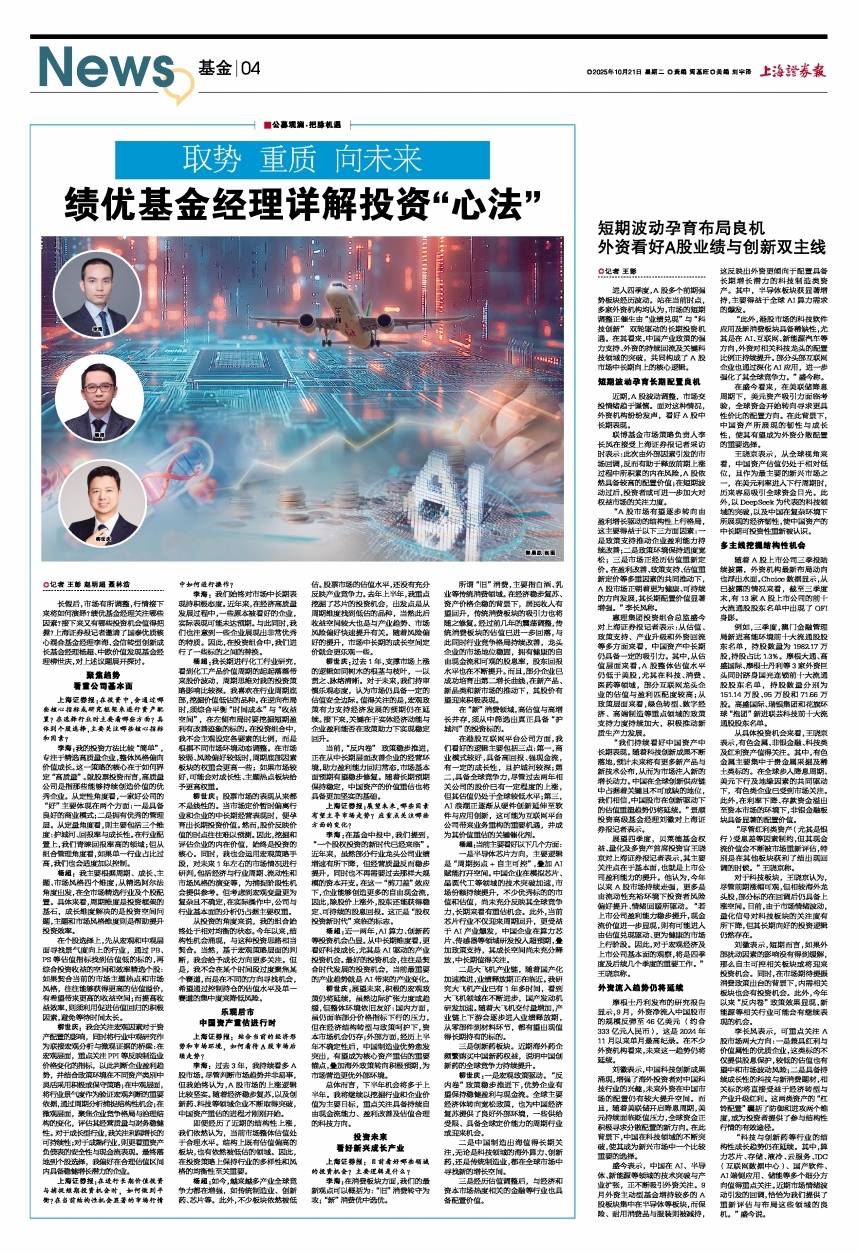
Core Viewpoint - The market has experienced adjustments post-holiday, prompting discussions among top fund managers about future market trends and investment opportunities [12]. Investment Strategies - Company A focuses on high-quality enterprises with strong business models and management, emphasizing metrics like economic moat, return rates, and growth potential for stock selection [14]. - Company B employs a framework based on cycles, growth, themes, and market styles to select industries and stocks, prioritizing cyclical trends as foundational [14]. - Company C analyzes macroeconomic indicators like PPI to gauge corporate profitability trends, using industry conditions to validate macroeconomic assessments [15]. Market Outlook - Company A maintains a positive long-term outlook for the A-share market, citing solid recovery and breakthroughs in sectors like innovative pharmaceuticals and technology [18]. - Company B highlights the increasing global competitiveness of various industries, suggesting that many sectors remain undervalued despite recent market gains [18]. - Company C expresses cautious optimism, noting that macroeconomic policies are expected to support economic development, which could stabilize corporate profitability [19]. Investment Opportunities - Company A identifies opportunities in traditional consumer sectors like liquor and dairy, expecting recovery as household incomes rise [22]. - Company B sees potential in the semiconductor industry, driven by cyclical recovery and advancements in AI technology [24]. - Company C emphasizes the importance of macro policies and the global expansion of Chinese manufacturing as key areas for long-term investment [25].
取势 重质 向未来 绩优基金经理详解投资“心法”
Shang Hai Zheng Quan Bao· 2025-10-20 18:10
Core Views - The market is experiencing adjustments post-holiday, with fund managers focusing on company fundamentals and potential investment opportunities [1][6][8] Investment Strategies - Investment strategies emphasize selecting high-quality companies with strong business models and management, focusing on metrics like economic moat, return rates, and growth potential [1][3] - The investment framework includes macroeconomic, cyclical, thematic, and market style dimensions to enhance investment efficiency [2][4] - A balanced approach is taken between long-term value investments and short-term opportunities, with a focus on maintaining a diversified portfolio [3][5] Market Outlook - The A-share market is viewed positively, with expectations of a solid upward trend supported by economic recovery and breakthroughs in sectors like innovative pharmaceuticals and technology [6][7] - The current market valuation is considered reasonable, with both overvalued and undervalued sectors present, necessitating a diverse investment strategy [6][7] Sector Focus - Traditional consumption sectors are expected to recover as economic conditions improve, with strong cash flow and dividend returns from leading companies [11] - In the "new" consumption space, companies with strong competitive advantages are prioritized, particularly in the internet sector [12] - Key investment areas include semiconductors, the large aircraft industry, and innovative pharmaceuticals, driven by domestic advancements and global competitiveness [13][14][15]
中金研究 | 本周精选:宏观、策略
中金点睛· 2025-10-18 01:08
中金点睛"本周精选"栏目将带您回顾本周深受读者欢迎的研究报告。 01 策略 Strategy "十五五"投资蓝图初探 >>点击图片查看全文<< 今年7月底召开的中央政治局会议指出,"'十五五'时期是基本实现社会主义现代化夯实基础、全面发力的关键时期"。从资本市场角 度,作为国民经济与产业发展的指南针,五年规划通过政策预期传导与资源优化配置对资本市场整体与结构表现产生深刻影响。时间节 奏来看,2025年10月即将召开的二十届四中全会有望审议"十五五"规划建议,结合历史经验,明年3月两会左右有望发布规划纲要。伴 随着"十五五"规划逐渐进入关键政策窗口期,市场关注度明显提升。本篇报告初步探索"十五五"期间可能的建设方向和投资机遇,结合 历史上五年规划期间资本市场表现特征,尝试构建五年规划对资本市场尤其是A股影响的分析框架,供投资者参考。 2025.10.12 | 李求索 伊真真等 02 策略 Strategy 关税再升级的影响与应对 >>点击图片查看全文<< 10月10日,中美贸易摩擦升级。市场短期难免会有波动,但投资者也会密切观望11月前的谈判进展。操作层面:1)如果投资者已经如 我们之前建议调降部分仓位,可以观 ...

开思基金陈京伟:重视港股龙头公司投资机遇
Zhong Guo Zheng Quan Bao· 2025-10-15 22:34
Group 1 - The Hong Kong stock market has experienced greater volatility compared to the A-share market in recent years, with 2020 marking a significant turning point [1] - Factors contributing to the underperformance of the Hong Kong market include high valuations of growth and consumer stocks, regulatory challenges for internet companies, continuous foreign capital outflow, and risks associated with leading real estate companies [1] - Recent trends indicate a reversal in these factors, with a surge in IPO financing, leading companies' stock prices surpassing those in A-shares, and increasing net purchases of Hong Kong stocks by southbound funds, suggesting a more active market [1] Group 2 - Over the past year, sectors such as technology, dividends, and pharmaceuticals in the Hong Kong market have significantly outperformed the A-share market, with the level of stock holdings becoming a key determinant for investment success among public and private equity institutions [2] - Hong Kong internet companies have benefited from advancements in artificial intelligence, while high-dividend stocks have thrived in a low-interest-rate environment; the innovative pharmaceutical sector has also seen explosive growth due to increased overseas business and improved domestic healthcare policies [2] - Despite the recent rebound in the Hong Kong market, major indices are still considered undervalued compared to other global markets, indicating potential for further price increases [2] Group 3 - The concentration of industries in China has increased over the past decade, and the next five to ten years may see a widening gap between industry leaders and followers, similar to trends observed in the U.S. market with its "Seven Sisters" [3] - A long-term investment approach focused on selecting understandable and quality companies aligns closely with value investing principles, emphasizing the importance of holding onto investments [3] - The investment philosophy is summarized as "select right, buy right, hold on," with the holding phase being the most challenging and critical [3]
重视港股龙头公司投资机遇
Zhong Guo Zheng Quan Bao· 2025-10-15 20:15
Group 1 - The Hong Kong stock market has experienced greater volatility compared to the A-share market in recent years, with 2020 marking a significant turning point [1] - Prior to 2020, the Hong Kong and US stock markets were positively correlated, but this changed post-2020 due to high valuations of growth and consumer stocks, regulatory challenges for internet companies, continuous foreign capital outflow, and risks associated with leading real estate companies [1] - Recent trends indicate a reversal in these factors, with a surge in IPO financing, leading companies' stock prices in Hong Kong surpassing those in A-shares, and a consistent increase in net purchases of Hong Kong stocks by southbound funds [1] Group 2 - Over the past year, sectors such as technology, dividends, and pharmaceuticals in the Hong Kong market have significantly outperformed the A-share market, with the level of stock holdings in Hong Kong becoming a critical factor for investment success [2] - Hong Kong internet companies have notably benefited from advancements in artificial intelligence, while high-dividend stocks have thrived in a low-interest-rate environment [2] - The innovative pharmaceutical sector, which faced substantial declines in previous years, is now experiencing explosive growth, driven by increased overseas business and improved domestic healthcare policies [2] Group 3 - Despite the recent rebound in the Hong Kong market, major indices are still considered to be undervalued compared to other global markets, indicating potential for further price increases [2] - The overall profitability of companies in the Hong Kong market has improved significantly, suggesting a need for re-evaluation of Chinese assets, starting with Hong Kong stocks [2] - Leading companies in the Hong Kong market are viewed as having better liquidity and higher potential returns, with capabilities to operate globally across various industries [2] Group 4 - Over the past decade, many industries in China have seen increased concentration, and the next five to ten years may witness a widening gap between industry leaders and followers [3] - Investment strategies focused on long-term holding and selecting understandable companies align closely with value investing principles [3] - The essence of successful investing is to "choose wisely, buy right, and hold on," with the holding phase being the most challenging and critical [3]