白酒行业深度调整

Search documents
金徽酒(603919):跟踪报告:西北之王,务实增长
Haitong Securities International· 2025-07-24 12:26
Investment Rating - The report maintains an "OUTPERFORM" rating for Jinhui Liquor with a target price of Rmb 22.00, indicating an expected upside from the current price of Rmb 18.92 [2][5]. Core Insights - The baijiu industry is undergoing a deep adjustment phase characterized by policy changes, consumption structure transformation, and intensified competition. The production in Q1 2025 saw a year-on-year decline of 7.1%, with a shift in consumer focus towards lower price bands [3][11]. - Jinhui Liquor has set a pragmatic growth target for FY25, aiming for total revenue of Rmb 3.28 billion (+8.6% year-on-year) and net profit of Rmb 410 million (+5.2% year-on-year), aligning with industry trends [3][14]. - The company's product structure is evolving, with a notable increase in the high-end segment (over Rmb 300) from less than 15% in FY22 to 18.8% in FY24, while the low-end segment is contracting significantly [4][12]. Financial Performance Summary - Revenue projections for Jinhui Liquor are Rmb 3.3 billion in 2025, Rmb 3.7 billion in 2026, and Rmb 4.3 billion in 2027, with corresponding net profits of Rmb 400 million, Rmb 500 million, and Rmb 500 million [5][14]. - The company’s gross profit margin is expected to remain stable around 60%, with a gradual increase in return on equity (ROE) from 11.7% in 2025 to 13.5% in 2027 [10][14]. - The dividend payout ratio for FY24 is projected at 64.0%, with a dividend yield of 2.6%, marking a record high since the company’s listing [5][14]. Market Dynamics - The provincial market for Jinhui Liquor showed a modest growth of 1.1% year-on-year in Q1 2025, significantly down from 16.1% in FY24, while the extra-provincial market grew by 9.5% [4][13]. - The company is focusing on refining its channel operations within the provincial market and expanding its presence in Gansu, Qinghai, and Xinjiang as core bases for growth [4][13].

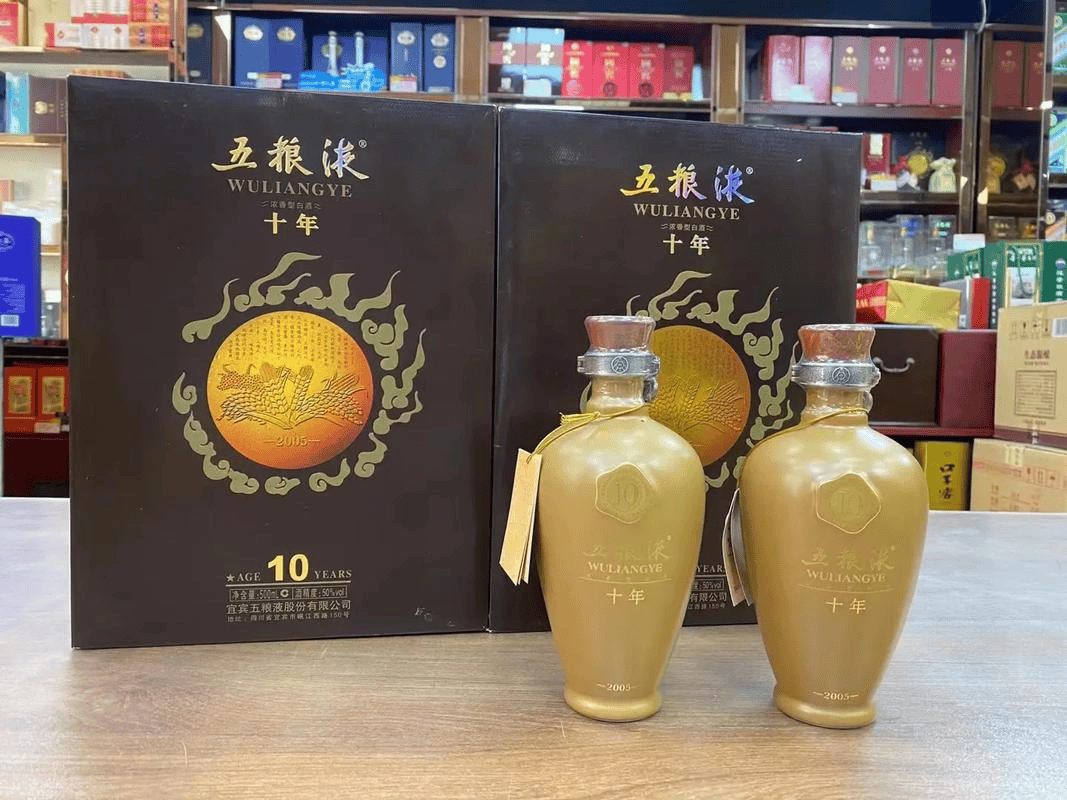
被茅台甩开,五粮液增长失速恐难短期翻身!
Sou Hu Cai Jing· 2025-07-17 01:25
Core Viewpoint - The liquor industry, particularly the leading company Wuliangye, is undergoing a significant adjustment period, facing unprecedented challenges and a slowdown in growth, with 2024 showing only single-digit increases in revenue and net profit [1][2][4]. Financial Performance - In 2024, Wuliangye achieved revenue of 89.175 billion yuan, a year-on-year increase of 7.09%, and a net profit of 31.853 billion yuan, up 5.44% [1]. - The first quarter of 2025 saw revenue of 36.94 billion yuan, growing 6.05%, and net profit of 14.86 billion yuan, increasing 5.80% [1]. - The company's revenue growth has reached historical lows, failing to meet the initial double-digit growth targets [1][2]. Market Position and Competition - Wuliangye's performance is lagging behind its competitor Moutai, which reported revenue of 170.899 billion yuan in 2024, with a growth rate of 15.71%, nearly double that of Wuliangye [4]. - The net profit margin for Wuliangye in 2024 was 37.22%, down 0.63 percentage points, while the sales expense ratio increased significantly to 11.99% [4]. Investor Sentiment - Institutional holding in Wuliangye has decreased from 79.26% in 2020 to 73.52% in the first three quarters of 2024, indicating cautious sentiment among professional investors [4]. - The company's market capitalization has dropped by over 500 billion yuan from its peak four years ago, with a current price-to-earnings ratio of around 15 times, significantly lower than its peers [4]. Dividend Policy - Wuliangye announced a record cash dividend of 22.3 billion yuan for 2024, with a payout ratio of 70%, exceeding the average A-share dividend rate of 30% [5]. - Despite the high dividend, market reaction has been muted, with the stock price remaining low [5]. Product and Channel Challenges - Wuliangye faces challenges in product structure and pricing, with a significant increase in promotional expenses, which rose by 49% to 6.76 billion yuan [4][6]. - The company reported a 5.99% increase in revenue from its distribution channels and a 12.89% increase from direct sales channels in 2024 [9]. Inventory and Supply Issues - As of the end of 2024, Wuliangye's inventory reached 18.23 billion yuan, a year-on-year increase of 4.86%, reflecting broader industry inventory challenges [9][11]. - The overall inventory crisis in the liquor industry has surpassed 1 trillion yuan, with significant overproduction issues [11]. Strategic Initiatives - Wuliangye has implemented a "only reduce, not increase" strategy to stabilize pricing, which has shown some short-term success [12]. - The company is attempting to diversify its product offerings to attract younger consumers, but current revenue from these initiatives remains low [14]. Future Outlook - The liquor industry is transitioning from "scale expansion" to "value cultivation," with Wuliangye's challenges reflecting broader structural adjustments within the industry [17]. - The company holds significant cash reserves and a commitment to dividends, providing a buffer for its transformation efforts [18].


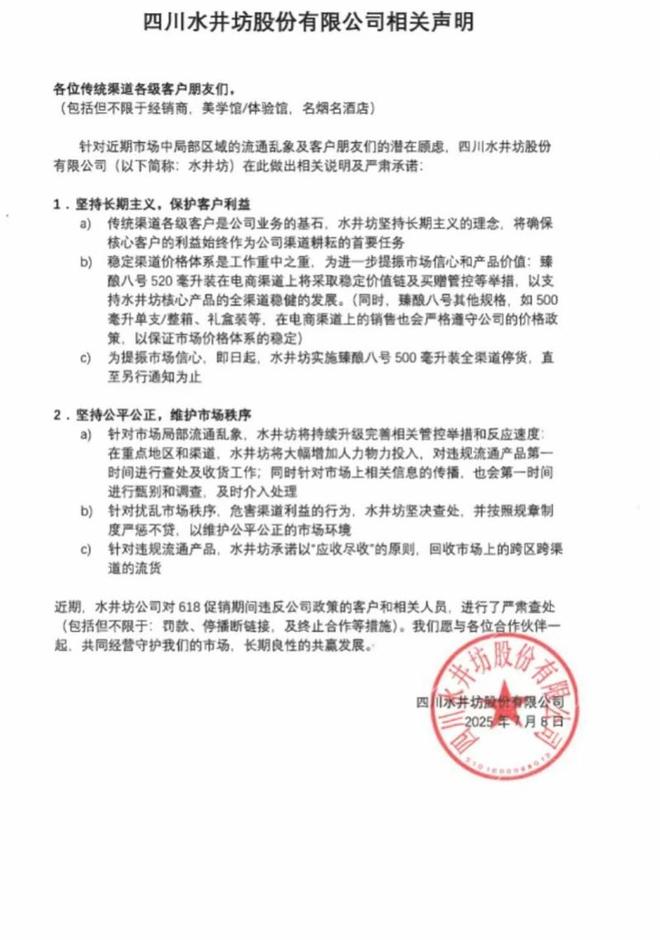
卖的越多、赚的更少?水井坊上半年净利润“腰斩”
Guan Cha Zhe Wang· 2025-07-16 13:50
Core Viewpoint - Sichuan Shui Jing Fang Co., Ltd. is experiencing a paradox of "selling more but earning less," as indicated by its financial performance in the first half of 2025, with significant declines in revenue and net profit [1][4]. Financial Performance - The company expects a revenue of 1.498 billion yuan for the first half of 2025, a year-on-year decrease of 12.84% [1]. - The net profit attributable to shareholders is projected to be 105 million yuan, down 56.52% year-on-year [1]. - In Q2, the company anticipates a net loss of 85 million yuan, a staggering decline of 251.24% year-on-year, with revenue of 539 million yuan, down 31.37% year-on-year [1]. Sales Volume and Market Dynamics - Despite the revenue decline, Shui Jing Fang expects a sales volume increase of 543,000 liters, a year-on-year rise of 14.54%, all from mid-to-high-end liquor [4]. - The increase in sales volume is attributed to strategic adjustments rather than merely price-driven volume growth, as the company focuses on channel management and consumer experience [4]. Industry Context - The overall liquor industry is undergoing a deep adjustment phase, with traditional consumption scenarios like business banquets facing ongoing pressure, leading to reduced revenue [4]. - The company's proactive measures to address market issues, such as controlling low-price dumping and streamlining distribution, reflect its commitment to maintaining brand integrity [5]. Future Outlook - Analysts suggest that with the easing of national policies and a potential recovery in consumption, Shui Jing Fang may see a gradual release of market potential in the second half of the year, possibly leading to a rebound and structural growth in the following year [5].


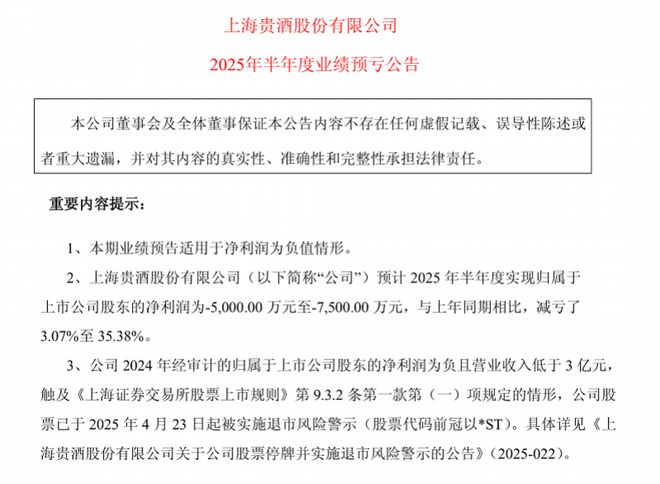
上海贵酒半年预亏最高7500万,退市警报拉响财务危机难解
Nan Fang Du Shi Bao· 2025-07-16 04:27
Group 1 - The white liquor industry is experiencing a "loss wave," with Shanghai Guijiu continuing to incur losses amid a financial crisis [1][4] - ST Yanshi expects a net profit loss of between 50 million to 75 million yuan for the first half of 2025, representing a year-on-year reduction in loss of 3.07% to 35.38% [1][4] - The company attributes its losses to three main factors: insufficient recovery in the white liquor industry, financial pressure leading to reduced market activity, and an increase in litigation costs due to overdue interest [4][5] Group 2 - Shanghai Guijiu is facing internal and external challenges, including the detention of its chairman and a significant reduction in its distributor network from 4,465 in 2023 to 772 by the end of 2024 [5][6] - The company has been involved in multiple lawsuits, with a total amount of 187 million yuan in disputes, and an accumulated 649 cases with unresolved amounts of 368 million yuan [5][6] - The white liquor industry is undergoing deep adjustments, with smaller brands facing increased survival pressure, as evidenced by 9 out of 17 recently disclosed performance forecasts indicating losses [6]

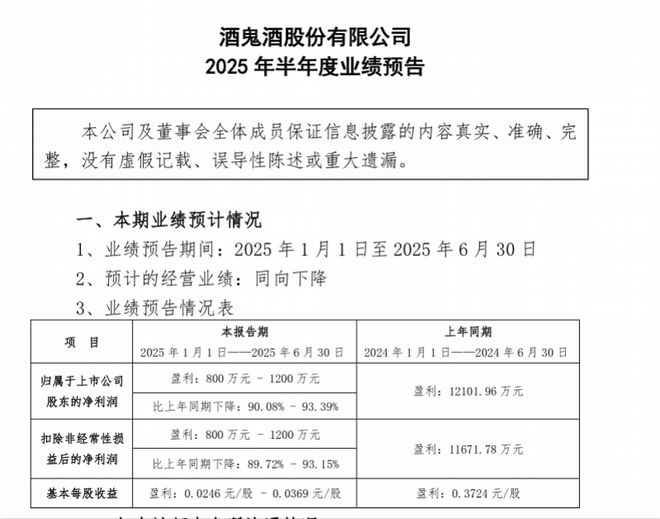
风口财报|酒鬼酒持续断崖式下滑:上半年归母净利润创10年新低
Sou Hu Cai Jing· 2025-07-15 17:27
Core Viewpoint - The liquor industry is undergoing a deep adjustment, leading to significant performance pressure on liquor companies, particularly for JiuGuiJiu, which has reported a substantial decline in revenue and profit for the first half of 2025 [1][2]. Financial Performance Summary - JiuGuiJiu expects revenue of approximately 560 million yuan for the first half of 2025, a year-on-year decrease of about 43% [1][2]. - The company's net profit attributable to shareholders is projected to be between 8 million and 12 million yuan, representing a decline of 90.08% to 93.39% compared to the same period last year [1][2]. - The first quarter of 2025 already showed a downward trend, with revenue of 344 million yuan, down 30.34%, and a net profit of 31.71 million yuan, down 56.78% [3]. - The first half of 2024 had a revenue of 994 million yuan, down 35.5%, and a net profit of 121 million yuan, down 71.3% [3]. Industry Context - The liquor industry is experiencing a prolonged adjustment phase, with increased pressure on operations, particularly for small and medium-sized enterprises [2][4]. - JiuGuiJiu's performance has been declining sharply since 2023, with a reported revenue of approximately 2.83 billion yuan in 2023, down 30.14%, and a net profit of about 548 million yuan, down 47.77% [8]. - In 2024, the company continued to see significant contraction, with revenue of 1.423 billion yuan, down 49.70%, and a net profit of 12.49 million yuan, down 97.72% [8]. Company Challenges - JiuGuiJiu's geographical limitations are evident, with 45.11% of revenue coming from Hunan province [9]. - The company relies heavily on offline sales channels, with online sales only reaching 186 million yuan compared to 1.229 billion yuan from offline channels in 2024 [9]. - The number of distributors has decreased significantly, from 1,774 at the end of 2023 to 1,336 by the end of 2024, indicating a contraction in sales channels [10].


卖得多却赚得少?水井坊:白酒行业仍处于深度调整期
Nan Fang Du Shi Bao· 2025-07-14 14:06
Core Viewpoint - Water Jiufang (600779.SH) expects a significant decline in net profit and revenue for the first half of 2025, despite a sales volume increase of over 10%, indicating a strategic adjustment during the industry's deep adjustment phase [1][2]. Financial Performance - The company anticipates a net profit of 105 million yuan for the first half of 2025, a decrease of approximately 137 million yuan, representing a 56.52% year-on-year decline [2]. - Expected revenue for the same period is 1.498 billion yuan, down 221 million yuan, or 12.84% year-on-year [2]. - The sales volume is projected to increase by 14.54%, totaling 543,000 liters, all from mid-to-high-end liquor products [2]. Market Conditions - The white liquor industry is undergoing a deep adjustment, with traditional consumption scenarios like business banquets facing significant pressure, leading to a slowdown in market recovery [2][3]. - The overall consumption performance during the Spring Festival was below expectations, resulting in higher-than-expected channel inventory levels, which affected post-holiday shipment volumes [3]. Strategic Adjustments - The company is implementing a "one city, one policy" approach for refined channel management to accelerate terminal sales, while also focusing on high-end cultural IP layout and brand investment [1][3]. - Water Jiufang has halted the sales of its "Zhen Niang No. 8" 500ml product across all channels to stabilize the market price system [6][7]. Industry Trends - Many leading liquor companies have announced supply halts or strict quota controls in response to the industry's adjustment cycle and unstable terminal prices [7]. - Analysts remain optimistic about the company's potential for a rebound in the second half of 2025, anticipating a gradual release of the synergistic effects of volume and price as consumption recovers and channel inventory is optimized [7].
上半年净利预计下降90%,酒鬼酒:白酒市场预期仍偏谨慎
Nan Fang Du Shi Bao· 2025-07-14 13:45
Core Viewpoint - The company, JiuGuiJiu, is experiencing a significant decline in net profit and revenue for the first half of 2025, attributed to ongoing challenges in the liquor industry and a cautious market environment [1][3][4]. Financial Performance - The expected net profit attributable to shareholders for the first half of 2025 is projected to be between 8 million and 12 million yuan, representing a decline of 90.08% to 93.39% compared to the same period last year [1][3]. - The anticipated operating revenue for the same period is approximately 560 million yuan, reflecting a year-on-year decrease of around 43% [1][3]. - Basic earnings per share are expected to be between 0.0246 yuan and 0.0369 yuan, down from 0.3724 yuan per share in the previous year [3]. Industry Context - The liquor industry continues to face deep adjustments, with increased pressure on smaller enterprises and cautious payment willingness from distributors [3][4]. - The company is focusing on strengthening market foundations and adjusting product pricing and channels to navigate the challenging environment [4]. Strategic Initiatives - The company plans to enhance performance through various strategies, including promoting consumer purchasing intent via events, expanding sales channels, and controlling costs while ensuring operational needs [4]. - A collaboration with the well-known brand "胖东来" is set to launch a co-branded product, which is expected to improve market coverage and brand influence for JiuGuiJiu [5][6].
白酒行业现人事巨震,高管加速离场,背后指向哪些行业困局?
Nan Fang Du Shi Bao· 2025-07-09 11:48
Core Viewpoint - The recent wave of high-level executive departures in the Chinese liquor industry reflects deep-seated challenges and transformation pains faced by the sector, driven by high inventory levels and price inversions impacting growth [2][11]. Group 1: Executive Changes - Recent resignations include the chairman and board members of Yanghe Co. and the general manager of Jinzhongzi Liquor, indicating a trend of leadership instability across major liquor companies [3][4]. - Guizhou Moutai has also seen personnel changes, with new appointments aimed at addressing internal management dynamics [4]. - The performance pressures, such as Jinzhongzi Liquor's revenue drop of 37.04% to 925 million yuan and a net loss of 258 million yuan, are significant catalysts for these executive changes [4][10]. Group 2: Industry Challenges - The liquor industry is grappling with high inventory levels, with total inventory among 20 listed liquor companies reaching 168.39 billion yuan, an increase of 19.29 billion yuan year-on-year [5][8]. - The prolonged inventory cycle and frequent price inversions are eroding profits and confidence among distributors, leading to increased pressure on sales targets for management [8][9]. - The younger generation's declining interest in traditional liquor, with less than 30% of Gen Z purchasing liquor, poses a significant challenge for the industry [9]. Group 3: Market Dynamics - The liquor market is undergoing a structural adjustment, with a shift from high-growth expectations to a focus on stable dividends, as evidenced by the stock price declines of 19 out of 20 listed liquor companies in 2024 [10][12]. - The industry is witnessing a shift towards consumer-oriented strategies, moving from reliance on government and business consumption to targeting the mass market [13][16]. - New management is increasingly emphasizing innovation and digital marketing to adapt to changing consumer preferences and market conditions [16].



金种子酒总经理辞职,曾是华润雪花啤酒河南负责人
Sou Hu Cai Jing· 2025-07-03 13:12
Core Viewpoint - The resignation of He Xiuxia as the general manager of Jinzhongzi Wine marks a significant leadership change amid ongoing financial struggles, with the company facing intensified competition and declining performance in the liquor industry [1][3][7]. Company Performance - Jinzhongzi Wine has experienced a substantial decline in revenue, with 2022 revenue dropping to 9.25 billion yuan, marking a five-year low and a year-on-year decrease of 37.04% [8][10]. - The company's net profit has been in continuous decline, with losses recorded for four consecutive years, culminating in a net loss of 2.58 billion yuan in the latest fiscal year [14][15]. - The company's sales expenses have remained high, reaching 2.95 billion yuan last year, a 25.58% increase year-on-year, contributing significantly to the overall losses [18][19]. Leadership Changes - He Xiuxia, who had been in the role for nearly three years, has stepped down due to work adjustments, and her departure raises questions about future leadership direction, particularly regarding the potential continuation of "China Resources" executives in key positions [1][3][7]. - Liu Fubi, the vice president, has been appointed to act as the general manager until a new appointment is made, and he also has a background with "China Resources" [7]. Market Challenges - The liquor industry is facing severe challenges, including deep adjustments, consumer downgrade, and intensified market competition, which have all contributed to Jinzhongzi's declining sales and profitability [10][11][13]. - The company's product lines, particularly in the white liquor segment, have seen widespread revenue declines across all categories, with high-end liquor sales dropping by 4.87% and low-end liquor sales decreasing by 29.08% [11][12]. Strategic Focus - Jinzhongzi Wine is attempting to refocus its strategy by potentially divesting its pharmaceutical business, which has seen significant revenue declines, with a 62.13% drop in the last two years [12][13]. - The company aims to strengthen its brand strategy around the "Fuhuo Xiang" series, which is intended to enhance its market presence despite the ongoing challenges [19][20]. Financial Health - The company's cash flow has been decreasing, with cash reserves dropping from 12.73 billion yuan to 3.67 billion yuan over the past few years, indicating a critical need for financial restructuring [14][24]. - Inventory levels have been rising, with total inventory reaching 15.39 billion yuan, which poses a risk of potential write-downs if market conditions do not improve [20][22].

白酒价格彻底崩了
投中网· 2025-07-02 04:07
Core Viewpoint - The Chinese liquor industry, particularly high-end liquor, is experiencing significant challenges, with prices declining and consumer preferences shifting towards lower-priced options [3][5][6]. Group 1: Market Trends - During the 2023 618 shopping festival, high-end liquor prices fell sharply, with Moutai's price dropping to as low as 1840 yuan per bottle, a significant decrease compared to the previous year [3][10]. - The sales volume of high-end liquor has remained stable, but the average transaction price has plummeted by nearly 60%, indicating a shift in consumer preferences towards products priced between 300-600 yuan [4][10]. - The overall market value of the liquor industry is being diluted due to prolonged economic slowdown and industry adjustments, leading to a collapse of the price defense line for high-end liquor [7][9]. Group 2: Inventory and Supply Issues - The liquor industry is facing a severe inventory crisis, with total inventory across 20 listed companies reaching 153.6 billion yuan, a 12.41% increase year-on-year [17][19]. - The average inventory turnover days have risen to 868 days, indicating that products are taking nearly two and a half years to sell [17][19]. - The total social inventory is estimated to exceed 300 billion yuan, with 396.12 million tons of inventory liquor valued at approximately 760.9 billion yuan, pushing the entire industry's inventory scale beyond one trillion yuan [19][20]. Group 3: Consumer Behavior Changes - The primary consumer demographic for liquor is shifting, with younger generations (born between 1985-1994) becoming the new main consumers, accounting for 34% of the market [35][36]. - Younger consumers prioritize taste and flavor over brand recognition and price, indicating a significant change in consumption patterns [36][37]. - The trend of "drinking less but drinking better" is leading to a decline in consumption frequency among older generations, further impacting the high-end liquor market [25][26]. Group 4: Industry Dynamics - The liquor industry is undergoing a structural transformation, with a shift from a focus on brand prestige to a more realistic valuation based on actual consumption [32][33]. - High-end liquor brands are struggling to maintain their market positions as they face increased competition and price pressures, leading to a potential loss of profitability [15][31]. - The industry's pricing structure is under severe strain, with many brands resorting to price cuts and promotional strategies to maintain sales, which may not be sustainable in the long term [28][29].