避险资产

Search documents
金价,再创新高!还会继续涨吗?专家解答
Hang Zhou Ri Bao· 2025-10-08 16:30
Core Viewpoint - The recent surge in gold prices is attributed to increased market uncertainty due to the U.S. government shutdown, leading to heightened demand for safe-haven assets like gold [1][2]. Short-term Factors - The U.S. government shutdown has significantly increased market risk aversion, causing a halt in various public services and the suspension of key economic data releases, which complicates the Federal Reserve's monetary policy decisions [1]. - Market expectations are leaning towards the Federal Reserve potentially implementing preemptive interest rate cuts in response to risks of a deteriorating job market and economic slowdown [1]. Long-term Trends - The global trend of central banks diversifying their asset allocations and increasing gold reserves has been a driving force behind the long-term upward trend in gold prices [2]. - Over the past three years, global central banks have added more than 1,000 tons of gold annually, significantly higher than the previous decade's average of 400 to 500 tons per year [2]. Investment Outlook - Major financial institutions like JPMorgan and UBS have raised their short-term gold price targets to $4,200 per ounce, while Goldman Sachs projects a price of $4,900 per ounce by December 2026 [3]. - The proportion of gold in global central bank asset allocations is currently 24.25%, while for private investors, it stands at only 2.24%, indicating substantial room for growth in private gold investments [3]. Market Dynamics - Year-to-date, gold prices have increased by 51.6% in New York and 51.8% in London, leading to potential overbought conditions in the market [3]. - The surge in speculative positions in the gold market has raised concerns about the sustainability of the recent price increases [3].
突破4000美元 国际金价缘何屡创新高
Sou Hu Cai Jing· 2025-10-08 16:23
来源:重庆晨报 日前,国际金价再创新高,突破每盎司4000美元历史关口,引发市场广泛关注。黄金究竟表现如何?国 际金价为何大幅飙升?面对诸多不确定因素,金价涨势能否持续? 国际金价走势如何 7日,纽约商品交易所黄金期货市场交投最活跃的2025年12月黄金期价突破每盎司4000美元,一度创下 每盎司4014.60美元的历史新高。8日,国际现货黄金价格突破每盎司4000美元关口,盘中一度攀升至每 盎司4039.14美元,再创历史新高。 今年以来,国际金价已累计上涨约50%,黄金成为全球表现最亮眼的主要资产之一。分析人士认为,黄 金市场"害怕错过"情绪比获利回吐情绪更为强烈,导致黄金虽然已经超买,但仍有足够买盘推高价格。 金价连创新高,反映出全球避险需求上升和美元信用度下降的双重信号。 第三,全球央行持续购入黄金及黄金交易所交易基金(ETF)的资金流入也成为推动金价创新高的重要 力量。世界黄金协会报告显示,8月各国央行恢复大规模购入黄金,当月净增持15吨黄金储备。强劲需 求推动9月黄金ETF持仓量增加360万盎司,年初至今上涨17%,达到9720万盎司,为2022年9月以来最 高水平。 此外,当前日本经济面临财政和 ...
比特币冲高后回落 超17万人爆仓
Bei Jing Shang Bao· 2025-10-08 15:36
Group 1 - Bitcoin experienced significant price fluctuations, reaching a high of $126,080 before dropping to around $122,444, with an overall increase of over 8% in October [1] - The price of Bitcoin has surged by 95.4% over the past year, following a series of increases from $9,500 at the beginning of 2025 to multiple key levels above $10,000 [1] Group 2 - Key factors influencing Bitcoin's price include the approval of Bitcoin spot ETFs, support from political figures like former President Trump, and the recent interest rate cuts by the Federal Reserve [2] - The recent U.S. government shutdown has led to increased investor interest in Bitcoin as a safe-haven asset, reflecting a shift in liquidity expectations [2] Group 3 - Bitcoin's price movements have shown a correlation with gold, as both are viewed as safe-haven assets amid rising market volatility [3] - The total liquidation amount due to market volatility reached approximately $645 million, indicating a significant number of liquidations, although the amount is lower compared to previous high-volatility periods [3] Group 4 - Market sentiment towards both gold and Bitcoin is bullish, with analysts predicting Bitcoin could reach $181,000 within 12 months, driven by ongoing investor demand [4] - The potential for further price increases in Bitcoin is supported by new ETF inflows and the impact of the government shutdown, with short-term predictions suggesting a rise to $135,000 [4]
全球乱成了一锅粥:关门、闪辞、女首相,黄金暴涨的原因找到了!
Sou Hu Cai Jing· 2025-10-08 14:10
美国政府关门进入第二周。 来源:市场资讯 (来源:ETF阅天下) "整个晋西北都乱成了一锅粥!" 《亮剑》里的这句经典台词,如今放在全球局势上居然毫无违和感。 4. 美国国债已经上升到37.8万亿美元。 日本迎来首位女首相。 法国总理上任27天就"闪辞"…… 这世界,俨然一个大型晋西北,而黄金价格却在这片混乱中一枝独秀,成为暗淡市场中最耀眼的那束光。 很多人无法理解黄金为什么要涨? 请记住一句话:乱世黄金!!! 所以黄金上涨,就是整个晋西北(全球)都乱成了一锅粥。 当然,还有其他劲爆新闻: 1.香港准备建设2000吨级的黄金储备中心; 2. 中国要求澳大利亚的必和必拓公司以人民币定价和交易铁矿石,否则就拒买; 3. 中国央行已连续11个月增持黄金储备,目前已持有约2300吨黄金; 01 全球戏台,你方唱罢我登场 当今世界局势,真可谓热闹非凡,政治明星们轮番上演精彩戏码。 美国政府关门大戏已进入第二周,由于两党就2026财年预算问题未能达成一致,美国政府时隔7年后再度关门。两党此次争议的焦点在《平价医疗法案》 的补贴问题,目前已进入第2周,但影响或可控。 大西洋彼岸,日本政坛则创造了历史。10月4日,高市早苗成 ...


布雷顿森林体系瓦解以来金价涨了102倍, 黄金缘何成为全球最“赚钱”大类资产?
Mei Ri Jing Ji Xin Wen· 2025-10-08 13:08
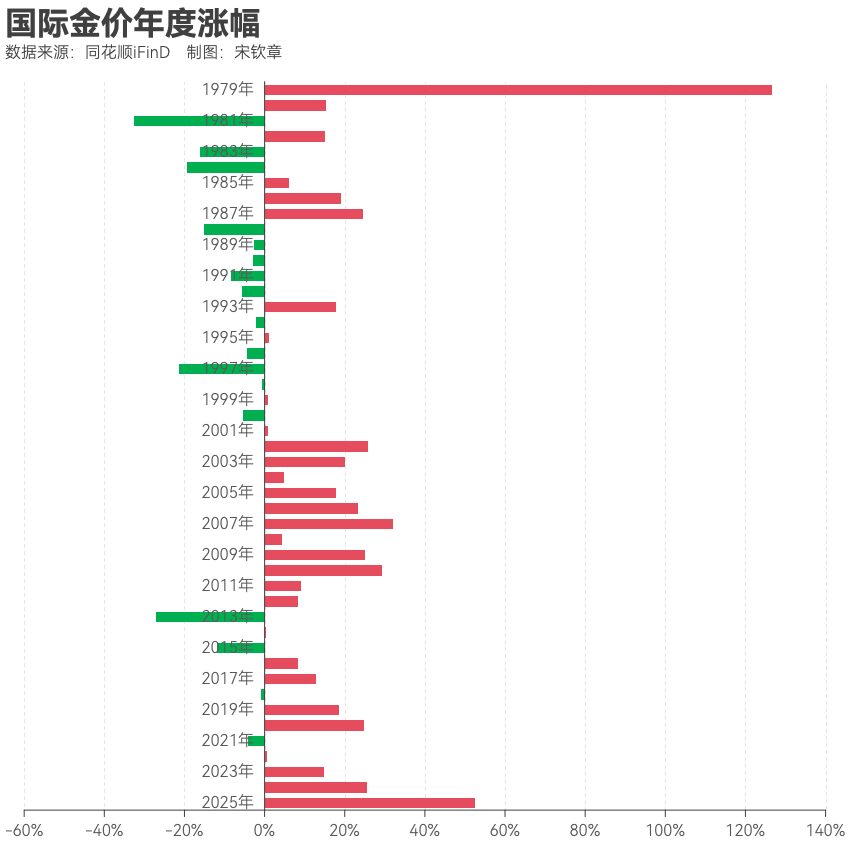
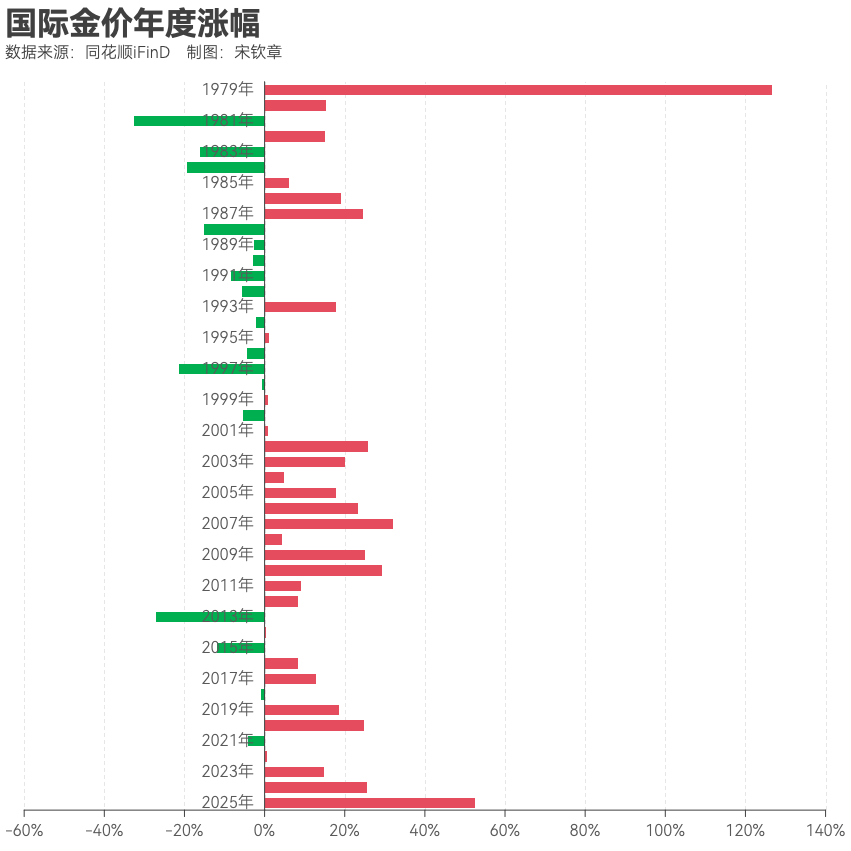
Core Insights - Gold prices have surpassed $4000 per ounce, driven by a weak dollar and geopolitical tensions, making it one of the most profitable asset classes globally [1][3] - Goldman Sachs attributes the recent surge in gold prices to increased purchases by three key buyers: rising Western ETF positions, potential acceleration of central bank purchases, and heightened speculative positions [1][3] - Emerging market central banks are expected to continue diversifying their foreign exchange reserves by increasing gold holdings, with net purchases projected to average 80 tons in 2025 and 70 tons in 2026 [1][3] Price Trends - Gold prices have seen a remarkable increase of 53% year-to-date, nearly doubling last year's growth of 27.26% [3] - Since the beginning of 2023, COMEX gold prices have risen from $2627.50 per ounce to over $4030 per ounce, marking a significant upward trend [3] - Historical data shows that gold has outperformed other major assets, with a cumulative increase of 866.87% since 1990, compared to WTI crude oil (172.74%) and LME copper (336.94%) [1][3] Long-term Performance - Since the collapse of the Bretton Woods system in the 1970s, gold prices have surged by 10204%, significantly outperforming the S&P 500 index, which rose by 7238% during the same period [2][5] - The long-term performance of gold is attributed to its status as a safe-haven asset during global economic and financial crises, which has led to its consistent outperformance against equities [7][8] Market Dynamics - The recent rise in gold prices is influenced by several factors, including the potential for U.S. Federal Reserve rate cuts, geopolitical instability, and increased central bank gold purchases [9][10] - Investment institutions are now allocating a higher percentage of their portfolios to gold, ranging from 10% to 20%, compared to only 5% two to three decades ago, reflecting a shift in risk management strategies [8][9] Future Outlook - The World Gold Council projects a 3% year-on-year increase in global gold demand for Q2 2025, with a significant rise in value-driven demand [17] - Analysts suggest that the underlying logic driving gold prices remains unchanged, influenced by monetary policy, economic conditions, liquidity, and geopolitical factors, indicating a strong likelihood of continued price increases [18]
Gold's record surge past $4,000 shows stock investors may be hedging their optimism
Yahoo Finance· 2025-10-08 12:59
Spot gold prices hit a record $4,000 per ounce, extending the precious metal's stunning rally. Gold's demand has jumped as geopolitical issues heat up and stocks stay hot. Western investors have led the gold rally, with significant ETF inflows and surging trading volumes. Gold prices smashed past $4,000 per ounce late Tuesday, hitting an all-time high that signals investors may be bracing for turbulence ahead. Spot gold rose to $4,022.87 per ounce at 12:50 a.m. ET on Wednesday, extending a rally fu ...
三大股指期货齐涨 美国政府停摆推动金价首破4000美元大关
Zhi Tong Cai Jing· 2025-10-08 12:55
Market Movements - US stock index futures are all up, with Dow futures rising by 0.27%, S&P 500 futures up by 0.13%, and Nasdaq futures increasing by 0.10% [1] - European indices also show positive movement, with Germany's DAX up by 0.75%, UK's FTSE 100 up by 0.92%, France's CAC 40 up by 0.90%, and the Euro Stoxx 50 up by 0.40% [2] Commodity Prices - WTI crude oil has increased by 1.72%, reaching $62.79 per barrel, while Brent crude oil is up by 1.50%, priced at $66.43 per barrel [3] Market News - EU officials express concerns that new US trade demands may undermine a recent agreement that helped avoid a trade war [4] - Gold prices have surged, reaching $4014.41 per ounce, marking a significant milestone as it surpasses the $4000 mark for the first time [4] - Ray Dalio of Bridgewater asserts that gold is a more reliable safe-haven asset than the US dollar, suggesting a strategic allocation of 15% of investment portfolios to gold [5] Company News - Nvidia is reportedly investing billions into Elon Musk's AI startup xAI, aiming for a total funding of $20 billion for its "Colossus2" project [8] - Amazon plans to invest €1 billion (approximately $11.6 billion) in Belgium from 2025 to 2027 to enhance its supply chain [8] - Teck Resources has lowered its copper production forecast for its flagship mine in Chile, adjusting the expected output to 170,000 to 190,000 tons from a previous estimate of 210,000 to 230,000 tons [9] - Toyota and Sumitomo Metal Mining have reached an agreement to collaborate on the mass production of solid-state battery cathode materials [9] - Intel is set to unveil details about its next-generation PC chip technology, "Panther Lake," which will utilize the new "18A" manufacturing process [10]



美股前瞻 | 三大股指期货齐涨 美国政府停摆推动金价首破4000美元大关
智通财经网· 2025-10-08 12:53
Market Movements - US stock index futures are all up, with Dow futures rising by 0.27%, S&P 500 futures up by 0.13%, and Nasdaq futures increasing by 0.10% [1] - European indices also show positive movement, with Germany's DAX up by 0.75%, UK's FTSE 100 up by 0.92%, France's CAC 40 up by 0.90%, and the Euro Stoxx 50 up by 0.40% [2] Commodity Prices - WTI crude oil has increased by 1.72%, reaching $62.79 per barrel, while Brent crude oil is up by 1.50%, priced at $66.43 per barrel [3] Market News - EU officials believe that new US trade demands may undermine a recent agreement that helped avoid a trade war, citing the demands as overly stringent [4] - Gold prices have reached a historic milestone, surpassing $4,000 per ounce, driven by concerns over the US economy and government shutdown [4] - Ray Dalio of Bridgewater Associates stated that gold is a more reliable safe-haven asset than the US dollar, suggesting a strategic allocation of 15% of investment portfolios to gold [4] - Goldman Sachs refuted concerns about a bubble in US tech stocks, indicating that the current rise is supported by strong earnings growth rather than speculation [4] Company News - Nvidia is reportedly investing billions into Elon Musk's AI startup xAI, aiming for a total fundraising of $20 billion for its "Colossus 2" project [7] - Amazon plans to invest €1 billion (approximately $11.6 billion) in Belgium from 2025 to 2027 to enhance its supply chain [7] - Teck Resources has lowered its production forecast for its flagship copper mine in Chile, adjusting the expected output to 170,000 to 190,000 tons from a previous estimate of 210,000 to 230,000 tons [8] - Toyota is collaborating with Sumitomo Metal Mining to mass-produce solid-state battery cathode materials for electric vehicles [8] - Intel is set to unveil details about its next-generation PC chip technology, "Panther Lake," which will utilize the new "18A" manufacturing process [9]

再创新高,金价突破4000美元,半年飙涨52%,央行连续11个月增持……还会再涨吗?
Sou Hu Cai Jing· 2025-10-08 12:48
新苏商梳理发现,目前继续看涨黄金的机构和分析师占多。 文/徐培琪 今年的十一黄金周,金价再破纪录。 10月8日,现货黄金升破4000美元/盎司关口,为史上首次,今年累计涨超52%。前一日,国际黄金期货已先一步突破4000美元/ 盎司大关。国内足金首饰价格也同步走高。10月8日,周大福足金饰品挂牌价为1162元/克,较前一日上调7元/克。 "国家队"持续跟进。10月7日,央行公布最新的官方储备资产情况,截至9月末,央行持有黄金7406万盎司,较上月末增加4万盎 司。这是自2024年11月以来,央行连续第11个月增持黄金。 金价涨得越猛,手心冒汗的投资者越多:既不想错过行情,又担心高位接盘。这里面最核心的问题就是:金价还会继续涨吗? 多位市场分析人士认为,这轮金价迅速攀升的背后,是地缘政治紧张、美联储政策预期摇摆及美国政府"停摆"危机叠加引发的 避险情绪爆发。尤其是在非农就业数据延迟、美联储沟通窗口模糊的背景下,黄金作为避险资产的独特价值再次凸显。 10月7日,高盛将2026年12月金价预估上调至4900美元/盎司,先前预估为4300美元。预计2025年和2026年各国央行的黄金净购 买量将分别平均为80吨和70 ...
黄金突破4000美元/盎司!布雷顿森林体系瓦解以来金价涨了102倍, 黄金缘何成为全球最“赚钱”大类资产?
Mei Ri Jing Ji Xin Wen· 2025-10-08 12:34
Core Viewpoint - Gold prices have surged past $4000 per ounce, driven by a weak dollar, geopolitical tensions, and increased demand from various buyers, including ETFs and central banks [1][3][9] Group 1: Price Trends - As of October 8, gold prices reached a high of $4030 per ounce, marking a nearly 15% increase since September [3] - Year-to-date, gold prices have risen by 53%, nearly double the previous year's increase of 27.26% [3] - Since the breakdown of the Bretton Woods system in the 1970s, gold prices have increased by approximately 10204%, significantly outperforming the S&P 500 index, which rose by 7238% during the same period [2][5][13] Group 2: Factors Driving Demand - High demand for gold is attributed to four main factors: the Federal Reserve's interest rate cuts leading to a weaker dollar, ongoing central bank purchases, geopolitical instability, and increased liquidity in the market [9][18] - Emerging market central banks are expected to continue diversifying their foreign exchange reserves by increasing gold holdings, with net purchases projected to average 80 tons in 2025 and 70 tons in 2026 [1][16] - The World Gold Council reported a 3% year-on-year increase in global gold demand in Q2 2025, with a significant 45% rise in value, reaching $132 billion [17] Group 3: Historical Context and Comparisons - Historical data shows that gold has consistently outperformed other commodities, including WTI crude oil and LME copper, due to its inflation-hedging properties [10][12] - The last time gold experienced such a significant annual increase was in 1979, during a global energy crisis that led to inflation [3][12] - The relationship between gold prices and the dollar index has shown a negative correlation, with gold prices rising significantly even as the dollar index fell by 19% over the past 55 years [13][15] Group 4: Future Outlook - Analysts predict that gold prices will continue to outperform the S&P 500 index due to ongoing geopolitical tensions and economic uncertainties [18] - The trend of increasing allocations to gold by investment institutions has risen from 5% to 10%-20% in response to global risks, further supporting gold's valuation [8][18] - The overall logic driving gold prices remains unchanged, influenced by monetary policy, economic conditions, liquidity, and geopolitical factors [18]