
绿色转型

Search documents
海马汽车(000572.SZ):依托海南自贸港资源禀赋与政策优势,推进在氢能汽车等领域的绿色转型与布局
Ge Long Hui· 2025-11-03 07:10
Core Viewpoint - The company is focusing on hydrogen energy as a long-term strategic plan, indicating a commitment to green transformation and development in the automotive sector [1] Group 1: Hydrogen Energy Business - The company has made progress in the hydrogen vehicle sector, achieving a full industry chain exploration from "photovoltaic power generation → electrolysis of water to produce hydrogen → high-pressure hydrogen filling → hydrogen vehicle operation" [1] - The company plans to leverage the resource endowment and policy advantages of Hainan Free Trade Port to advance its green transformation and layout in the hydrogen vehicle field [1]

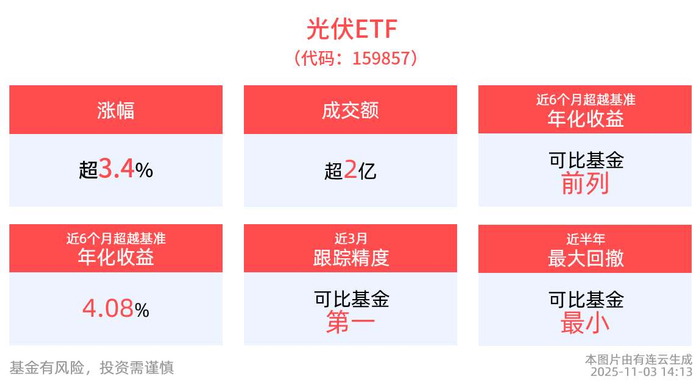
相信光的力量!直接受益反内卷的光伏ETF(159857)涨超3.5%,弘元绿能率先扭亏为盈
Xin Lang Cai Jing· 2025-11-03 06:30
Core Insights - The photovoltaic (PV) industry is experiencing a fundamental recovery, with signs of a turning point in market sentiment, particularly benefiting the photovoltaic ETF (159857) [2] - As of September 2025, China's installed photovoltaic capacity reached 1,125 million kilowatts, a year-on-year increase of 45.7%, with cumulative power generation of 9,163 billion kilowatt-hours, up 44.1% [2] - Hongyuan Green Energy reported a significant profit surge in Q3 2025, achieving a net profit of 532 million yuan, driven by rising product prices and increased shipment volumes, leading to an 85.5% revenue growth [3] - The "14th Five-Year Plan" emphasizes green transformation, with policies aimed at optimizing competition in the photovoltaic sector, transitioning from chaotic low-price competition to sustainable development [3] - The photovoltaic industry is undergoing profound changes, with N-type monocrystalline technology expected to dominate the market, surpassing 96.9% market share by 2025 [3][4] Industry Developments - The national photovoltaic installed capacity has seen exponential growth, with a projected 45% increase in new installations in 2024 compared to the previous year, marking a nearly 20-fold increase since 2015 [4] - The "anti-involution" policies are expected to enhance the competitive landscape, aiding in profit recovery within the industry [4] - The photovoltaic sector is transitioning from being a supplementary energy source to a primary incremental energy source, indicating a significant shift in its role in the energy market [4]


“十五五”规划建议发布,未来投资主线怎么把握?来看专家建议
Xin Lang Cai Jing· 2025-11-03 03:01
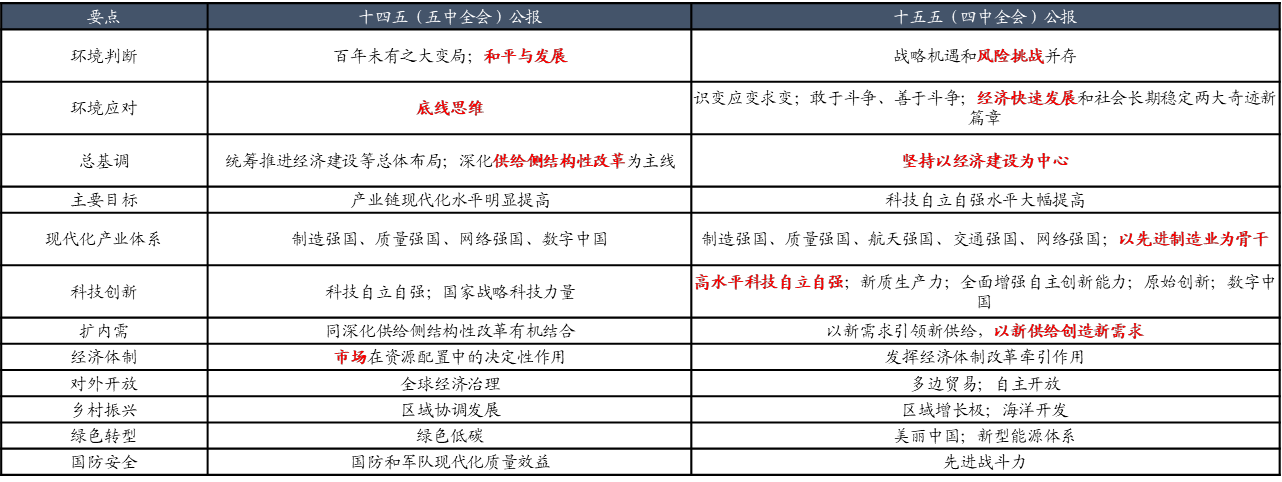
Core Insights - The "15th Five-Year Plan" emphasizes technological self-reliance and innovation as a core strategy, indicating a shift towards original technological innovation and integration with the real economy [1][4] - Key investment areas for the next five years include artificial intelligence, biomedicine, quantum technology, and high-end manufacturing, which are expected to receive policy support [1][4] Policy Direction Comparison - The "14th Five-Year Plan" focused on a comprehensive approach to economic construction, while the "15th Five-Year Plan" emphasizes economic construction as the central theme [1] - The "15th Five-Year Plan" aims for significant improvements in technological self-reliance and a modern industrial system that includes aerospace and transportation [1][3] - The approach to external openness has shifted from global economic governance to multilateral trade and autonomous openness [1][3] Market Structure and Investment Opportunities - Historical analysis shows that A-share market structure changes are closely linked to policy directions, with strategic industries identified in each plan becoming focal points for investment [3] - The current market is expected to focus on new quality productivity, with significant opportunities in AI and manufacturing sectors due to China's competitive advantages [3][4] - The "15th Five-Year Plan" highlights the importance of consumption and proposes policies to boost consumer spending, indicating potential for value reassessment in the consumer sector [5] Sector-Specific Insights - Key sectors expected to thrive include AI, digital economy, and green energy technologies, with specific opportunities in domestic supply chains for advanced chips and energy storage [4][5] - The automotive sector is poised for growth, particularly in intelligent vehicles, as consumer preferences shift towards high-quality products [5] - Investment strategies should focus on core AI-related stocks while being cautious of market volatility, suggesting a balanced approach to capital allocation [6]
“亚太地区保持长期繁荣的重要保障”——访秘鲁国立圣马科斯大学亚洲问题研究中心主任卡洛斯·阿基诺
Ren Min Ri Bao· 2025-11-03 02:45
Core Viewpoint - Open and cooperative approaches are fundamental drivers for the prosperity and development of the Asia-Pacific region, as emphasized by Carlos Aquino, Director of the Asia Issues Research Center at the National University of San Marcos in Peru [1]. Group 1: APEC's Role and Impact - APEC promotes trade liberalization, investment facilitation, regional connectivity, and innovative cooperation, contributing significantly to regional economic growth, social progress, and inclusive development [1]. - According to a survey report by People's Daily, 85% of respondents recognize APEC's positive role in promoting regional economic development, social progress, and improving livelihoods, indicating that openness, inclusiveness, and mutual benefit remain the main themes in the Asia-Pacific region [1]. - APEC enhances the ability of member economies to respond to global economic uncertainties and geopolitical risks [1]. Group 2: Climate Change and Cooperation - In addressing global challenges like climate change, APEC members have formed a close cooperation network in areas such as clean energy, ecological agriculture, and low-carbon technologies, achieving mutual benefits [1]. - APEC cooperation fosters consensus and action plans among member economies in resilience of supply chains, green transformation, and digital economy development, which are crucial for the long-term prosperity of the Asia-Pacific region [1]. Group 3: China's Role in APEC - China's advocacy for openness, inclusiveness, and mutual benefit aligns closely with APEC's cooperative philosophy, providing significant support for the development of the Asia-Pacific region through high-level opening up and initiatives like the Belt and Road [1]. - China's stable economic growth and commitment to openness are vital for the development of the Asia-Pacific region, offering important support for countries like Peru in areas such as green transformation, digital economy, and infrastructure construction [1]. - The cooperation between China and Peru serves as a model for South-South cooperation within the APEC framework, with strong complementarity in trade and investment [1]. Group 4: Future Expectations - With China set to host APEC in 2026, there are high expectations for China to lead the region towards higher quality and more sustainable development, enhancing confidence and momentum for global economic growth [2].
供应边际收缩,工业硅震荡上行
Tong Guan Jin Yuan Qi Huo· 2025-11-03 02:38
Report Industry Investment Rating - Not provided in the given content Core Viewpoints - Last week, industrial silicon prices fluctuated upwards. The 15th Five-Year Plan emphasizes accelerating the speed and comprehensiveness of green transformation, and the polysilicon industry conference discussed high-quality development in the photovoltaic industry next year, leading to optimistic market expectations for new polysilicon platforms. Supply side saw a marginal contraction as Xinjiang maintained over 80% capacity utilization, while Yunnan dropped to 54% due to the approaching dry season, and Sichuan's output also declined. On the demand side, the polysilicon industry conference boosted market optimism, but silicon wafer prices slightly decreased due to reduced overseas battery demand, and photovoltaic cells continued to weaken. Component demand improved, and inventory pressure eased. Industrial silicon social inventory decreased slightly to 55.8 million tons, and spot prices stabilized and rebounded with the upward fluctuation of futures contracts. Overall, prices are expected to remain strong in the short term [2][6][10]. Summary by Relevant Catalogs Market Data - From October 24th to October 31st, the industrial silicon主力 contract rose from 8,920 yuan/ton to 9,100 yuan/ton, a 2.02% increase; the oxygenated 553 spot rose 1.07% to 9,450 yuan/ton; the non-oxygenated 553 and 421 and 3303 spot prices remained unchanged; the organic silicon DMC spot fell 0.90% to 11,000 yuan/ton; the polysilicon dense material spot remained unchanged at 52 yuan/ton; and the industrial silicon social inventory decreased 0.18% to 55.8 million tons [4]. Market Analysis and Outlook - **Macro aspect**: In September, China's above-scale industrial enterprise profits increased 21.4% year-on-year, and from January - September, they increased 3.2% year-on-year, the highest cumulative growth rate since August last year. Profits in industries such as electricity, non-ferrous metals, and agriculture increased, while those in textiles and petroleum extraction decreased [7]. - **Supply and demand aspect**: As of October 30th, the weekly industrial silicon output was 98,700 tons, a 0.18% week-on-week and 3.34% year-on-year increase. The number of open furnaces in the three major production areas decreased to 312, with an overall capacity utilization rate of 39.2%. Xinjiang's open furnace number remained at 151, Yunnan decreased by 6 to 40, Sichuan and Chongqing decreased by 5 to 47, and Inner Mongolia increased by 4 to 32. On the demand side, the polysilicon industry conference boosted optimism, but silicon wafer prices declined, photovoltaic cells weakened, and component demand improved. The final list of photovoltaic specifications was released, with 129 enterprises passing verification, expected to lead the industry into a new supply - demand balance cycle [8]. - **Inventory aspect**: As of October 31st, the national industrial silicon social inventory decreased to 55.8 million tons, a 0.1 million - ton week-on-week decrease. High inventory was due to slowed terminal consumption. The exchange's registered warehouse receipts decreased to 47,253 lots, equivalent to 236,000 tons. After the exchange's new delivery standard, 5 - series warehouse receipts meeting the standard were actively registered, and the warehouse receipt inventory remained around 50,000 tons due to expected production cuts in the photovoltaic industry [9]. Industry News - The Ministry of Industry and Information Technology announced the list of 129 enterprises meeting the photovoltaic manufacturing industry standards, which is a dynamic management of the previous twelve batches [11]. - TCL Zhonghuan, a leading photovoltaic silicon wafer enterprise, saw a significant reduction in losses in Q3 this year compared to the same period last year, benefiting from the rebound in the upstream photovoltaic industry chain prices. In Q3, it achieved an operating income of 8.174 billion yuan, a 28.34% year-on-year increase, and a net loss of 1.534 billion yuan, a significant reduction from last year's 2.998 billion yuan loss. The photovoltaic industry chain upstream prices rose in Q3, and silicon wafer prices also increased. Although the short - term silicon wafer market is expected to be weak, the medium - to - long - term outlook is not pessimistic [12].
退役风机、报废车去哪儿了?被回收再利用
Yang Shi Xin Wen· 2025-11-03 02:27
Core Viewpoint - The circular economy industry is significantly reducing reliance on primary resources and environmental pollution by transforming waste into resources, fostering new business models such as recycling, remanufacturing, and green design [1][13]. Group 1: Wind Power Industry - The wind power industry in China is experiencing a wave of equipment upgrades, with over 30,000 wind turbines expected to be decommissioned by 2030, generating more than 3 million tons of solid waste [1]. - A decommissioned wind turbine consists of 86% steel, 10% fiberglass, 3.5% copper and aluminum, and 0.5% rare earth elements, with turbine blades being a significant challenge for recycling due to their hardness and size [1]. - Innovative technologies are being developed to repurpose decommissioned turbine blades into artificial board materials, which meet national E0-level standards for formaldehyde emissions [1]. Group 2: Automotive Recycling Industry - The automotive recycling industry is rapidly developing due to policies promoting vehicle trade-ins, with a significant increase in the recovery and remanufacturing of old vehicles [4][6]. - In Xinjiang, a recycling company has achieved a resource recovery rate of 95% through technological innovations, with last year's export value from remanufactured engines reaching 20 million yuan [4]. - The industry is moving towards more convenient and standardized practices, including electronic proof of vehicle recycling and online appointment systems for collection [6]. Group 3: Remanufacturing Technologies - Remanufacturing technologies are advancing across various sectors, with a company in Shandong applying over 20 patents to enhance the performance of mining machinery, achieving an old parts utilization rate of over 80% [8]. - The remanufactured equipment can reach 95% of new performance at only 30% to 45% of the cost of new equipment [8]. Group 4: Second-Hand Market and Green Consumption - The second-hand market is thriving as green and low-carbon lifestyles gain popularity, with a new 3,000 square meter store in Beijing offering over 30,000 second-hand items [9][10]. - The store's sales performance surged during the holiday period, with a 270% increase in foot traffic and a 165% increase in sales compared to the previous period [10]. Group 5: Circular Economy Growth - The resource recycling industry in China is expected to reach a value of 5 trillion yuan this year, driven by the "14th Five-Year Plan" for circular economy development [13]. - Significant improvements have been made in energy efficiency, with a reported 11.6% decrease in energy consumption per unit of GDP compared to the end of the previous five-year plan [13]. - The establishment of over 10,000 battery recycling service points nationwide supports the sustainable development of the new energy vehicle industry [13]. Group 6: Agricultural Green Governance - Agricultural green governance has shown remarkable results, with over 700 counties achieving an 88% utilization rate for straw and an 80% recovery rate for agricultural film [15]. - The government has fostered the development of 6,430 green factories and 491 green industrial parks, laying a solid foundation for the green and circular development of the economy [15].
港股概念追踪|反内卷持续推进 光伏行业价格和盈利修复明显(附概念股)
智通财经网· 2025-11-03 00:50
Core Insights - The photovoltaic industry in China is experiencing significant growth, with a projected 45% increase in new installed capacity in 2024 compared to the previous year, marking a nearly 20-fold increase since 2015, indicating a shift from supplementary energy to a primary energy source [1] - The "14th Five-Year Plan" emphasizes green transformation as a core goal, aiming to consolidate and expand the advantages of the wind and photovoltaic industries [1] - Recent "anti-involution" policies from the government aim to regulate competition within the photovoltaic sector, transitioning the industry from chaotic low-price competition to sustainable development, which is expected to bring substantial benefits to both supply and demand sides [1] - The photovoltaic industry is undergoing a technological transformation, with the market share of N-type monocrystalline silicon technology expected to exceed 96.9% by 2025, alongside advancements in TOPCon, HJT, and BC technologies, leading to improved efficiency and reduced costs [1] - The multi-crystalline silicon sector is addressing supply-side issues through the establishment of a joint platform involving 17 major companies, focusing on capacity coordination, quality grading, and self-discipline to curb disorderly expansion [2] - The multi-crystalline silicon industry has begun to increase prices in Q3 2025, moving above the comprehensive cost line under the new pricing regulations [2] Related Companies in the Photovoltaic Industry - GCL-Poly Energy (03800), New Special Energy (01799), Flat Glass Group (06865), Xinyi Solar (00968), Fuyao Glass (03606), and CAISSA New Energy (01108) are key players in the Hong Kong stock market related to the photovoltaic industry [3]

因地制宜培育特色产业
Jing Ji Ri Bao· 2025-11-03 00:07
Core Insights - The article emphasizes the importance of green transformation for sustainable development, using the example of Chicheng County in Hebei Province as a model for integrating ecological advantages into economic growth [1][2] - The shift from a resource-extractive economy to a sustainable model is highlighted as essential for long-term prosperity and environmental protection [1][2] Group 1: Economic Transformation - Chicheng County has transitioned from a mining-based economy to one focused on agriculture, tourism, and ecological industries, demonstrating the potential of sustainable development [1] - The closure of mines was a difficult but necessary decision that has led to the growth of industries such as ecological tourism and vegetable cultivation, which are now key to local prosperity [1][2] Group 2: Industry Development - The county has adopted a tailored approach to industry development, leveraging local resources such as climate and water quality to promote vegetable farming and renewable energy sectors like photovoltaics and hydrogen production [2] - Proximity to Beijing has been utilized to develop tourism, positioning Chicheng as a destination for outdoor activities and wellness retreats, enhancing its economic landscape [2] Group 3: Ecological and Social Benefits - The green transformation aligns with the public's expectations for improved living conditions, leading to increased happiness and retention of residents [2] - The synergy between environmental improvement and industrial upgrading is crucial for achieving economic, social, and ecological benefits, ultimately fostering a harmonious relationship between wealth generation and ecological preservation [2]
中泰证券:政策与技术双轮驱动 光伏产业迈向高质量发展
Zhi Tong Cai Jing· 2025-11-02 23:40
Core Viewpoint - The "14th Five-Year Plan" emphasizes green transformation as a core goal, aiming to consolidate and expand the advantages of the wind and solar industries, with a significant focus on optimizing the competitive landscape and promoting profitability recovery in the solar industry [1][2]. Policy and Technology Drivers - The dual drivers of policy and technology are propelling the solar industry towards high-quality development, with the "14th Five-Year Plan" leading the way and "anti-involution" policies optimizing both supply and demand sides [1]. - Since June 2025, the government has introduced multiple "anti-involution" policies to regulate competition, shifting the industry from chaotic low-price competition to sustainable development [1]. Technological Transformation - The solar industry is undergoing profound changes, with China expected to officially transition away from P-type technology by 2025, and N-type monocrystalline silicon technology projected to capture over 96.9% market share [2]. - Key technological routes such as TOPCon, HJT, and BC are driving improvements in battery efficiency and reductions in cost per kilowatt-hour [2]. Industry Growth - China's solar installation capacity is set to experience significant growth, with an anticipated 45% year-on-year increase in new installations for 2024, marking nearly a 20-fold increase since 2015 [2]. - The industry is showing signs of recovery after adjustments, with "anti-involution" policies expected to enhance the competitive landscape and support profitability recovery [2]. Index Investment Value - The CSI Photovoltaic Industry Index (931151.CSI) covers the entire solar industry chain, focusing on core manufacturing segments, with a weight of 68% in solar equipment and significant representation from key sectors like inverters and battery components [3]. - The index has delivered a cumulative return of 177% since its inception in 2012, with an annualized return of 8.53%, outperforming major market indices [3]. Valuation and Future Outlook - Despite recent adjustments due to supply-demand mismatches, the current valuation of the index is attractive, with a price-to-book ratio of 2.43, indicating a high margin of safety [3]. - Revenue and profitability are expected to gradually recover, with a projected 15.31% growth in total revenue by 2026 and a return on equity (ROE) potentially returning to around 10% [3]. Strategy for Investment - The solar industry index is characterized by concentration, high volatility, and strong elasticity, making it suitable for capturing excess returns through thematic investment strategies [4]. - A core-satellite strategy combining the solar index with broad-based ETFs can enhance returns while managing risk, with the core-satellite approach yielding an annualized return of 30.4% compared to 2.3% for the CSI 500 ETF [4].




“亚太地区保持长期繁荣的重要保障”
Ren Min Ri Bao· 2025-11-02 22:21
Core Insights - Open and cooperative approaches are fundamental drivers for prosperity and development in the Asia-Pacific region, as emphasized by Carlos Aquino, Director of the Asia Issues Research Center at the National University of San Marcos in Peru [1] - The Asia-Pacific Economic Cooperation (APEC) promotes trade liberalization, investment facilitation, regional connectivity, and innovative cooperation, contributing significantly to regional economic growth and social progress [1] - A recent survey indicated that 85% of respondents recognize APEC's positive role in promoting economic development and improving livelihoods in the region [1] Group 1 - APEC enhances the ability of member economies to respond to global economic uncertainties and geopolitical risks [1] - There is a strong collaborative network among Asia-Pacific countries in addressing global challenges such as climate change, focusing on clean energy, ecological agriculture, and low-carbon technologies [1] - The cooperation framework under APEC fosters consensus and action plans in areas like supply chain resilience, green transformation, and digital economy development, which are crucial for long-term prosperity in the region [1] Group 2 - China's role in APEC cooperation is highly regarded, with its advocacy for openness and mutual benefit aligning with APEC's cooperative philosophy [1] - China's commitment to high-level opening up and initiatives like the Belt and Road Initiative provide lasting momentum for regional cooperation [1] - The experience of China in green transformation, digital economy, and infrastructure development serves as an important reference for Latin American countries like Peru [1] Group 3 - The close cooperation between Peru and China is seen as a model for South-South cooperation within the APEC framework, with strong complementarity in trade and investment [1] - China's support for Peru's infrastructure and connectivity projects, particularly in ports, transportation, and logistics, aids Peru in expanding exports and integrating into global supply chains [1] - Collaborative efforts in energy transition and innovation development between the two countries are expected to achieve higher levels of mutual benefit [1] Group 4 - Aquino expresses optimism about China's upcoming role as the host of APEC in 2026, anticipating that it will drive higher quality and more sustainable development across the Asia-Pacific region [2] - There is an expectation for China to lead practical actions that maintain openness and vitality in the region, contributing to global economic confidence and momentum [2]