
AI泡沫

Search documents
美三大股指涨跌互现,纳指标普500再创新高,英伟达涨2.2%
Di Yi Cai Jing Zi Xun· 2025-10-08 23:57
Market Overview - The technology sector showed strong performance, with the Nasdaq and S&P 500 indices reaching all-time highs on Wednesday, October 8. The Dow Jones Industrial Average fell by 1.20 points to 46,601.78, while the Nasdaq rose by 255.02 points, a 1.12% increase, closing at 23,043.38. The S&P 500 increased by 39.13 points, or 0.58%, to finish at 6,753.72. [1] - The market reacted calmly to the release of the Federal Reserve's September meeting minutes, which indicated internal disagreements on future rate cuts after the first anticipated cut in 2025. [1] Semiconductor Sector - Nvidia's stock rose by 2.20%, with CEO Jensen Huang noting a significant increase in demand over the past six months, particularly for their Blackwell product. He described the current period as the beginning of a new industrial revolution. [2] - Nvidia is reportedly participating in a new funding round for xAI, an AI startup led by Elon Musk, which is seeking to raise approximately $20 billion, with Nvidia potentially investing $2 billion. [2] - The Philadelphia Semiconductor Index increased by 3.40%, with AMD rising by 11.37%, Arm Holdings up by 4.66%, and TSMC gaining 3.57%. [2] - Analyst Ross Mayfield emphasized that while AI capabilities are impressive, the demand for chips and the software built on strong computing power must be supported by market demand, which currently remains stable. [2] AI Market Concerns - There are growing concerns about an AI bubble reminiscent of the late 1990s internet bubble, prompting market observers to advise investors to rebalance their portfolios. [3] - Mayfield noted that despite potential corrections in tech stocks, there may still be room for further gains before reaching a market peak. [3] - Major tech stocks generally saw increases, with Netflix up 1.95%, Amazon rising 1.55%, Tesla gaining 1.29%, Meta increasing by 0.67%, Apple up 0.62%, and Microsoft rising by 0.17%. [3] Gold and Oil Prices - International gold prices continued to rise, with spot gold increasing by 1.44% to $4,042.14 per ounce, and COMEX gold futures up by 1.43% to $4,061.70 per ounce. [4] - International oil prices also saw an uptick, with WTI crude oil futures rising by $0.82, or 1.33%, to $62.55 per barrel, and Brent crude oil futures increasing by $0.80, or 1.22%, to $66.25 per barrel. [5]

今夜,暴涨!
中国基金报· 2025-10-08 16:10
Core Viewpoint - The article highlights the significant surge in AI demand and its impact on the stock market, particularly in the technology and semiconductor sectors, while also addressing concerns about a potential "AI bubble" similar to the internet bubble of the late 1990s [1][7]. Market Performance - U.S. stock markets experienced a notable rise, with major indices such as the Dow Jones increasing by over 100 points, the Nasdaq rising by more than 0.8%, and the S&P 500 gaining approximately 0.6% [1]. - The Philadelphia Semiconductor Index surged by over 2%, indicating strong performance in the semiconductor sector [3]. Company Highlights - Nvidia's stock rose nearly 2%, with CEO Jensen Huang noting a significant increase in computing demand over the past six months [1][9]. - Other semiconductor companies also saw gains, including AMD (+6.14%), Micron Technology (+4.98%), and TSMC (+3.98%) [4]. - Dell Technologies experienced a surge of over 7% after raising its revenue and profit forecasts due to strong demand for AI infrastructure [4]. AI Demand and Industry Outlook - Huang emphasized that AI models are transitioning from simple problem-solving to complex reasoning, leading to exponential growth in computing demand [9][10]. - Nvidia plans to invest $100 billion in building a large-scale data center for OpenAI, which will require significant energy resources [11]. - Concerns were raised about whether industry leaders can secure enough power to support their ambitious plans, with Huang suggesting the need for new power generation capabilities outside the grid [11]. Market Sentiment and Risks - Analysts express caution regarding the concentration of investments in the AI sector and the potential risks associated with a market that may be overly excited [7][8]. - The ongoing U.S. government shutdown has had limited immediate impact on the stock market, but prolonged uncertainty could affect market sentiment [8].


1万亿美元的大单,OpenAI的钱从哪来?
硬AI· 2025-10-08 08:13
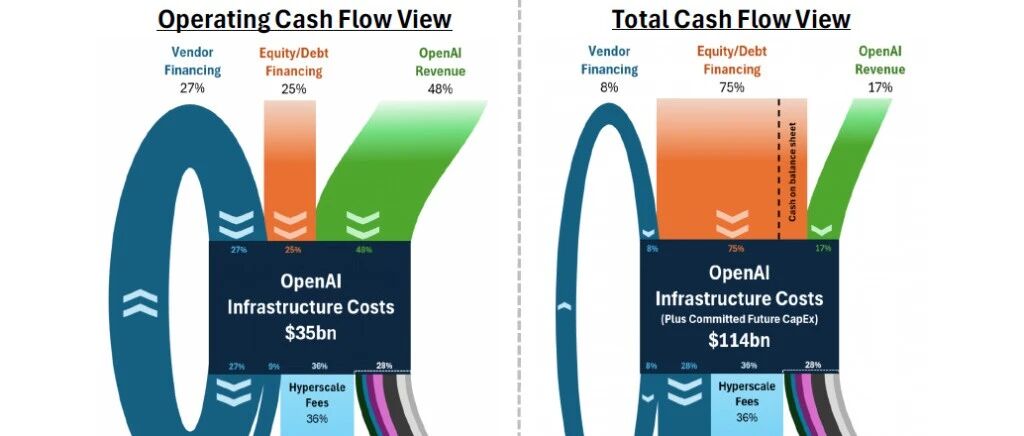
Core Insights - OpenAI is redefining capital rules in the AI era through innovative financing methods, specifically "circular financing" and "equity-for-purchase" models [4][10][26] - The company has signed nearly $1 trillion in computing power procurement agreements, significantly exceeding its revenue and financing capabilities [3][7] - OpenAI's total funding requirement for 2026 is projected to soar from $35 billion to approximately $114 billion, with external equity and debt financing needs rising to 75% [2][18][20] Group 1: Financing Models - The "equity-for-purchase" model with AMD allows OpenAI to purchase $90 billion worth of GPUs while receiving warrants to buy AMD stock at $0.01 per share, potentially worth $96 billion if AMD's stock rises [11] - The "circular revenue" model with NVIDIA involves a $100 billion investment from NVIDIA, which OpenAI can directly use to purchase NVIDIA chips, creating a cycle of funding and spending [12][13] - These innovative financing structures transform capital expenditures into financial instruments, allowing OpenAI to leverage its market position for funding [10][22] Group 2: Financial Reality - Despite the innovative financing, OpenAI is projected to face a significant cash burn, with estimates of a $10 billion loss this year [7][18] - High reliance on external financing raises concerns about the sustainability of OpenAI's growth and its ability to meet future capital commitments [22][25] - The financial structure is heavily dependent on the assumption of continuous exponential growth in AI applications, which poses risks if user growth or willingness to pay slows down [25][26] Group 3: Market Impact - The partnerships with AMD and NVIDIA have led to substantial increases in their market valuations, with Oracle and AMD seeing market cap increases of $244 billion and $63 billion, respectively [23] - The shift in customer structure for companies like NVIDIA is moving from traditional, financially stable cloud providers to riskier AI startups, increasing volatility and uncertainty in the industry [26] - OpenAI's capital operations represent a significant gamble on future technological breakthroughs and sustained market enthusiasm, raising questions about the long-term viability of this approach [27][28][29]


见证历史!刚刚,集体爆发!
券商中国· 2025-10-08 08:10
Core Viewpoint - The article highlights a significant surge in gold prices, which have surpassed $4000 per ounce for the first time, driven by global economic and geopolitical uncertainties, with notable institutional interest in gold as a safe-haven asset [1][2][3]. Group 1: Gold Price Surge - On October 8, gold prices reached a historic high, breaking the $4000 per ounce mark, with a year-to-date increase of 53.6% [2][3]. - The surge in gold prices has led to a substantial rise in gold stocks in the Hong Kong market, with companies like Chifeng Jilong Gold Mining seeing an increase of over 17% [1][2]. Group 2: Catalysts for Gold Price Increase - The U.S. government shutdown has been identified as a direct catalyst for the recent rise in gold prices, causing delays in key economic data releases and increasing market uncertainty regarding Federal Reserve interest rate decisions [4][5]. - Political instability in France and Japan has further fueled concerns about fiscal risks, contributing to the demand for gold as a safe-haven asset [6]. Group 3: Institutional Interest and Predictions - Ray Dalio, founder of Bridgewater Associates, emphasized that gold is a safer investment compared to the U.S. dollar, suggesting a strategic allocation of approximately 15% of investment portfolios to gold [7]. - Goldman Sachs has raised its gold price forecast for December 2026 to $4900 per ounce, citing strong demand from institutional investors and central banks [7][8]. Group 4: Recommendations and Market Sentiment - Investment strategies are shifting towards increasing gold allocations to hedge against dollar risks, with suggestions to raise gold holdings to around 5% of investment portfolios [9]. - Analysts caution about potential short-term corrections in gold prices due to the rapid increase, indicating that profit-taking by speculators may occur [9].




高盛版“AI叙事框架”:关于AI的五个关键争议
Hua Er Jie Jian Wen· 2025-10-08 07:57
Core Insights - The ongoing debate about whether the market has entered an AI bubble is intensifying, particularly following Goldman Sachs' recent report analyzing five key controversies in the AI sector [1][2]. Group 1: AI Adoption and Monetization - Consumer AI adoption is accelerating, with ChatGPT reaching a record of 700 million weekly active users in July, but monetization capabilities are lagging behind infrastructure investments [1][3]. - A significant disparity exists between the rapid growth of consumer AI usage and the slower monetization efforts by AI companies, as evidenced by only 40% of companies purchasing official LLM subscription services despite 90% of employees using personal AI tools [3][4]. Group 2: Corporate AI Deployment and ROI - Companies are expanding internal AI applications to enhance efficiency, yet the visibility of ROI remains low, with only 5% of firms reporting measurable impacts on their financial statements [5][6]. - The advertising sector is identified as a potential disruption area, with AI-driven platforms threatening traditional advertising agencies, which collectively represent a profit pool of approximately $161 billion [5][6]. Group 3: AI Infrastructure Investment - AI infrastructure investment is at an unprecedented level, with the five major cloud service providers expected to spend $381 billion in 2023, marking a 68% year-over-year increase [1][7]. - By 2025, total spending on AI-related capital is projected to reach around $1.4 trillion, driven by increasing consumer demand and significant partnerships announced recently [7][8]. Group 4: Power Infrastructure Demand - The rapid expansion of AI workloads is expected to increase global power demand for data centers by over 165% by 2030, necessitating substantial new power generation capacity [10][11]. - In the U.S., 60% of future power demand will require new generation facilities, primarily from natural gas, solar, and wind sources [10]. Group 5: Bubble Risk Assessment - While there are similarities between the current market and the late 1990s, the current valuation levels are significantly lower, with the Nasdaq 100 index trading at a 46% discount compared to the peak of the internet bubble [2][11]. - The IPO activity is also markedly lower than during the late 1990s, indicating a more cautious market environment [11].

深夜跳水,万亿巨头重挫!黄金再创新高,高盛看到4900美元/盎司!央行连续第11个月增持黄金...
雪球· 2025-10-08 01:52
↑点击上面图片 加雪球核心交流群 ↑ 甲骨文被爆料"云业务利润率低于预期",盘中一度跌近7%;特斯拉尾盘跳水,跌超4%。 黄金再创新高, 纽约期金则首次站上4000美元/盎司大关, 高盛最新将2026年12月金价预估上调至4900美元/盎司。 01 一则消息 深夜跳水 这一消息 拖累三大指数集体收跌。 截至收盘,标普500指数 下 跌0.38%,纳斯达克综合指数 下 跌0.67%,道琼斯工业平均指数 下 跌0.2%。 文件 显示,在截至8月的3个月里,甲骨文通过出租搭载英伟达芯片的服务器获得约9亿美元收入,录得1.25亿美元毛利润,毛利率只有不到 14%。同时,一些未列明的折旧费用还将吞噬7个百分点的利润率。云业务的迅猛扩张,将迅速拉低公司目前接近70%的毛利率。 受上述消息影响,甲骨文盘中一度下跌近7%,最终收跌2.52%。 美股科技股受挫,科技七巨头普跌。英伟达下跌0.27%,微软下跌0.87%,谷歌下跌1.74%。 特斯拉尾盘跳水,尽管发布了两款新车,最终股价大幅下跌4.45%。 美东10月7日(周二),美股三大指数开盘后不久,开始快速下跌。 消息面上, 甲骨文被爆料"云业务利润率低于预期" 。 这意味 ...

OpenAI“金手指”效应显现!多家被点名公司股价应声大涨
Zhi Tong Cai Jing· 2025-10-07 00:32
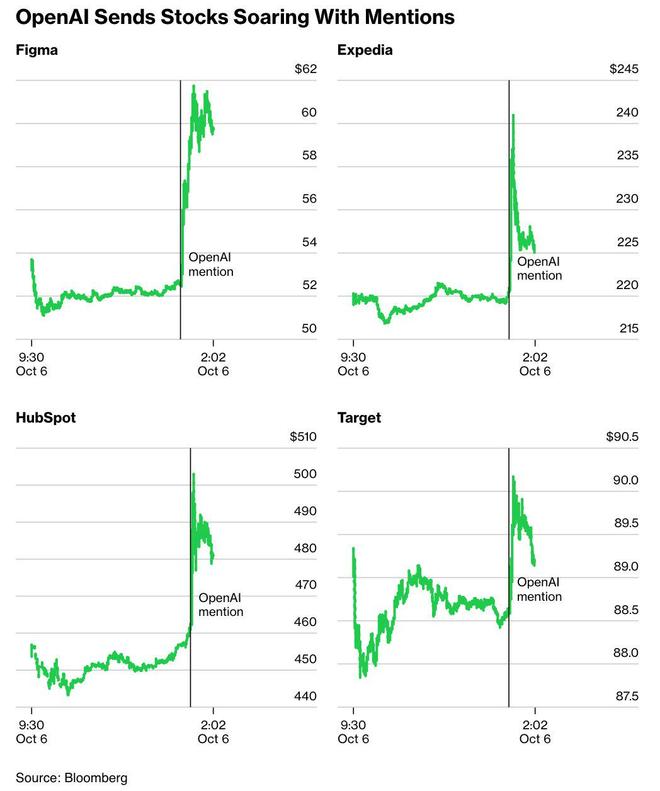
智通财经APP获悉,OpenAI已经证明了它在与其他科技公司合作推出人工智能产品方面的"金手指"效 应。然而,它对股市的影响力正迅速扩展到与之短暂讨论过合作的公司。 这家推出ChatGPT的公司于周一举行了年度开发者大会,演讲者仅仅提到了其他上市公司,其股票就迅 速飙升。其中包括:Figma(FIG.US)上涨7.4%,HubSpot(HUBS.US)上涨2.6%,赛富时(CRMUS)上涨 2.3%。在线旅游公司也出现了短暂的股价上涨,Expedia(EXPE.US)和TripAdvisor(TRIP.US)的股价一度 上涨了7%,然后有所回落。玩具制造商美泰(MAT.US)的股价也上涨了近6%,尽管最终收盘几乎持平, 该公司与OpenAI就Sora 2人工智能视频模型达成合作。 这些公司大多被提及为其应用程序将整合进ChatGPT。尽管这些集成与AMD(AMD.US)与OpenAI周一宣 布的协议相比相形见绌,但向散户和动量投资者、尤其是技术股投资者表明,OpenAI的合作效应能够 让这些公司股票的表现变得如此显著。 证券公司Themis Trading的合伙人Joe Saluzzi表示:"这是一个动量市场 ...
德银称长期持有AI是最佳策略
Ge Long Hui A P P· 2025-10-05 13:48
Core Insights - The discussion around the "AI bubble" has cooled down, suggesting a shift in market sentiment towards long-term investment strategies rather than timing the market [1] Group 1 - Deutsche Bank's latest research indicates that major tech companies are investing hundreds of billions of dollars in AI infrastructure, which raises concerns about potential bubble risks [1]
市场激辩“AI泡沫”,德银劝投资者:别试图“择时”,长期持有是最佳策略
Hua Er Jie Jian Wen· 2025-10-05 07:28
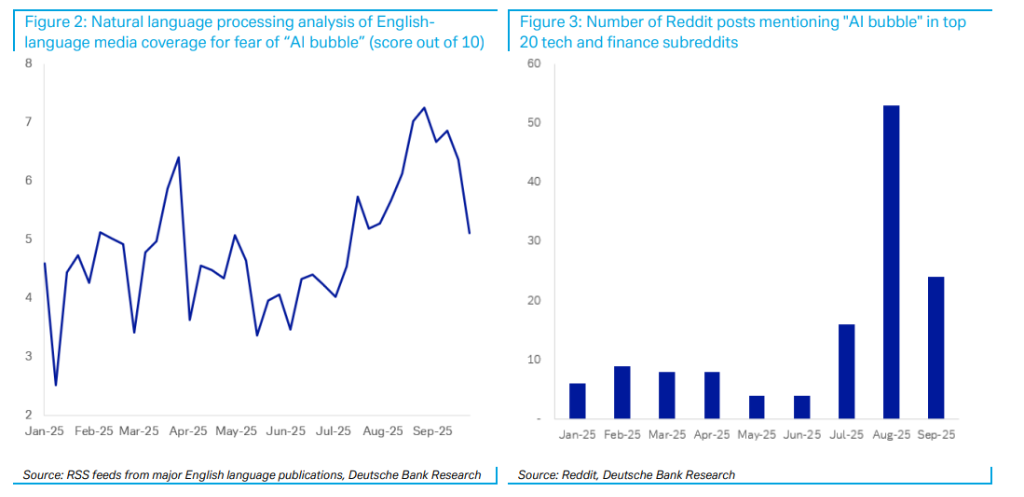
Core Insights - The discussion around the "AI bubble" has cooled down, with Deutsche Bank recommending a long-term investment strategy rather than attempting to time the market for optimal returns [1][13][19] Group 1: Investment Trends - Major tech companies are investing hundreds of billions in AI infrastructure, raising concerns about potential bubble risks [2][8] - OpenAI's CEO announced a $500 billion infrastructure plan called "Stargate," while Meta has committed to investing several hundred billion in data centers [2][11] - Bain & Company predicts that AI companies will need $2 trillion in annual revenue by 2030 to support required computing power, but actual revenue may fall short by $800 billion [1][2] Group 2: Market Sentiment - Deutsche Bank's research indicates that the search volume for "AI bubble" has significantly decreased, reflecting a typical pattern seen in previous market bubbles [13][15] - Concerns about AI investments are diminishing, with media sentiment dropping from 7.3 to 5.1 on a scale of 10 [13][15] Group 3: Financial Strategies - Deutsche Bank emphasizes the difficulty of accurately timing the market, citing historical examples where missing key trading days drastically reduced returns [17][19] - The bank advises investors to adopt a long-term holding strategy to capture the risk premium associated with equity investments [19][20] Group 4: Challenges in AI Development - AI technology faces challenges, including diminishing returns on increased computing power and data, as acknowledged by OpenAI's CEO [8][12] - A study from MIT found that 95% of organizations have not seen any returns on their AI investments [6][8]


2027年AI泡沫必破?英伟达4万亿市值连环套,OpenAI或成爆雷点!
Sou Hu Cai Jing· 2025-10-04 23:04
Core Viewpoint - The current AI hype resembles the internet bubble of the late 1990s, with significant speculation and inflated valuations, but lacking a sustainable business model and profitability [1][10]. Group 1: AI Market Dynamics - Nvidia's market capitalization has surpassed $4 trillion, making it the most valuable company in history, but this valuation is largely based on speculative growth rather than actual earnings [3]. - Oracle announced that OpenAI will spend $300 billion on computing power over the next five years, averaging $60 billion annually, despite OpenAI currently losing $5 billion each year [4]. - Nvidia has committed to investing up to $100 billion in OpenAI, which is essentially a mechanism for OpenAI to purchase Nvidia's chips, inflating Nvidia's revenue and market value [4][5]. Group 2: Financial Interdependencies - The financial relationship among Nvidia, Oracle, and OpenAI creates a closed-loop funding scheme where money circulates without genuine revenue generation, resembling a "money game" [5][6]. - Oracle and Nvidia are leveraging the narrative of high demand for AI computing power to boost their stock prices, while OpenAI benefits from investments without immediate financial obligations [6]. Group 3: Future Profitability Concerns - By 2027, OpenAI will need to start making substantial payments to Oracle for computing power, which raises concerns about its ability to generate profits given its current losses [7][9]. - The AI bubble's potential collapse could mirror the internet bubble burst, with significant financial repercussions for companies involved, including Nvidia and OpenAI, as well as related domestic firms [12]. Group 4: Investment Strategy Implications - The current AI landscape is characterized by speculative investments, similar to the internet boom, where companies are valued based on potential rather than actual profitability [10]. - Investors should be cautious and critically assess the underlying value of AI companies, especially as the 2027 deadline approaches for OpenAI's financial commitments [12].
