品牌转型

Search documents
娃哈哈内部文件流出!宗馥莉或另立门户
2 1 Shi Ji Jing Ji Bao Dao· 2025-09-14 07:54
Core Viewpoint - Wahaha Group, led by its head Zong Fuli, is planning to launch a new brand "Wah Xiaozong" starting from the 2026 sales year, following the founder's passing and ongoing trademark disputes [1][9]. Group 1: Brand Transition - The internal document from Hangzhou Wahaha Honghui Food and Beverage Co., Ltd. indicates the need to address historical issues related to the brand after the founder's death [1]. - The company will seek unanimous consent from all shareholders of Wahaha Group for the use of the "Wahaha" trademark, otherwise, no party can use it [1][9]. - The new brand "Wah Xiaozong" is set to replace the existing "Wahaha" brand, with the company actively communicating with distributors and shareholders regarding this transition [1][9]. Group 2: Trademark Ownership and Controversy - The "Wahaha" trademark, valued at over 90 billion, has been a subject of significant controversy, with ongoing transfer applications to move the trademark from Wahaha Group to Hangzhou Wahaha Food Co., Ltd. [9]. - As of February 2025, Wahaha Group is in the process of transferring 387 "Wahaha" series trademarks, with the application for transfer already submitted [9]. - The company has indicated that due to uncertainties in the trademark transfer process, it is prepared to launch a new proprietary brand [9]. Group 3: New Brand Development - The "Wah Xiaozong" trademark application was filed by Hongsheng Beverage, covering categories such as beer, convenience foods, and pharmaceuticals, with the application date being February 19, 2025 [9]. - Following the trademark application, Hongsheng Beverage has registered numerous "Wah Xiaozong" trademarks across various sectors, including dining, office supplies, and clothing [9]. - A new product under the "Wah Xiaozong" brand, a sugar-free tea drink named "Ningxiang Oolong," was revealed in May 2023 [10]. Group 4: Operational Changes - Since February 2023, Wahaha has closed 18 factories, including those in Shaanxi, while simultaneously investing 1 billion to establish a new beverage production base in Xi'an [12]. - Xi'an Hengfeng Beverage Co., Ltd., which is 90% owned by Hongsheng Beverage Group, has received approval for the new production base project, with Zong Fuli serving as the executive director [12].

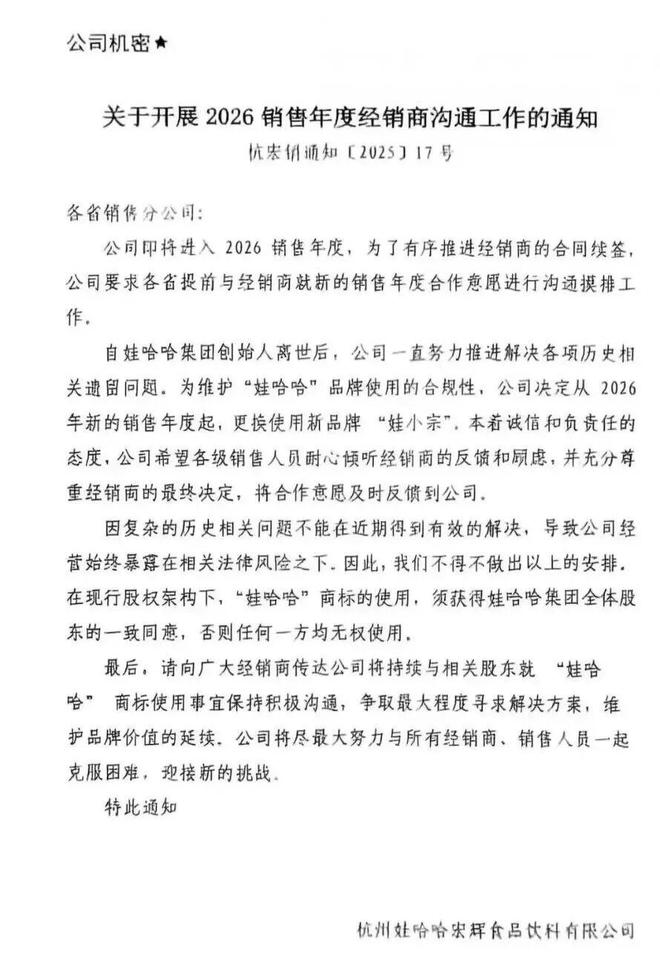
娃哈哈内部文件流出!宗馥莉或另立门户
21世纪经济报道· 2025-09-14 07:42
Core Viewpoint - Wahaha Group, led by Zong Fuli, is planning to launch a new brand "Wah Xiaozong" starting from the 2026 sales year, following the founder's passing and ongoing trademark disputes [1][7]. Group 1 - An internal document from Hangzhou Wahaha Honghui Food and Beverage Co., Ltd. indicates the decision to switch to the new brand "Wah Xiaozong" to address historical issues related to the brand's usage [1]. - The document states that the use of the "Wahaha" trademark requires unanimous consent from all shareholders of Wahaha Group, prompting the company to seek feedback from distributors [1][4]. - The trademark for "Wah Xiaozong" was applied for by Hongsheng Beverage, with applications covering various categories including beverages and food [7][8]. Group 2 - The "Wahaha" brand, valued over 900 billion, has been subject to controversy regarding its ownership, with ongoing trademark transfer processes initiated by Wahaha Group [7]. - In May, Wahaha Group hinted at launching a new proprietary brand due to uncertainties surrounding the trademark transfer [7]. - Zong Fuli has also initiated a significant investment of 1 billion to establish a new beverage production base in Xi'an, following the closure of 18 factories earlier this year [10][11].

若羽臣(003010):转型自有品牌业务进展顺利,业绩高增长
Xinda Securities· 2025-09-11 09:41
Investment Rating - The investment rating for the company is "Buy" [2][12]. Core Insights - The company has successfully transitioned from a brand operation model to a brand owner model, achieving significant growth in performance since 2024. The self-owned brand business has shown rapid growth, with revenues reaching 5.01 billion yuan in 2024, a year-on-year increase of 90.28%, and 6.03 billion yuan in the first half of 2025, a year-on-year increase of 242.42% [4][11][19]. Summary by Sections Company Overview - Founded in 2011, the company initially focused on brand operation. In late 2020, it launched its own home cleaning brand, Zhanjia, marking its transition to a brand owner. By July 2025, it had established a brand matrix centered around Zhanjia for home cleaning and Feicui & VitaOcean for health products [11][12]. Business Performance - The self-owned brand revenue accounted for 45.75% of total revenue in the first half of 2025, with Zhanjia generating 4.44 billion yuan (up 157.11% year-on-year) and Feicui generating 1.60 billion yuan [4][11][19]. The company expects revenues of 30 billion yuan, 42 billion yuan, and 54 billion yuan for 2025, 2026, and 2027, respectively, with corresponding growth rates of 70%, 40%, and 30% [12]. Zhanjia Brand - Zhanjia focuses on the home cleaning market, emphasizing "emotional fragrance" to create a mid-to-high-end brand. The brand launched its strategic flagship product, the Four Seasons Fragrance Laundry Liquid, in March 2024, which significantly boosted sales [11][44]. In 2024, Zhanjia's revenue reached 4.84 billion yuan, with a gross margin of 66.92% [4][11]. Feicui Brand - Feicui targets high-end female anti-aging products and has seen rapid growth since its launch in September 2024. The brand achieved 1.20 million yuan in revenue in 2024 and 1.6 billion yuan in the first half of 2025, with a gross margin of 86.81% [4][11][19]. The company has also launched VitaOcean, focusing on ruby oil, and aims to maximize the value of this ingredient through its brand matrix [11][12]. Market Trends - The home cleaning market in China is steadily growing, with e-commerce platforms being the primary source of information for consumers. The demand for home cleaning products is shifting from basic cleaning capabilities to longer-lasting fragrances and emotional value [29][36]. The health supplement industry also shows significant growth potential, particularly in areas like gut health and beauty [11][19]. Financial Projections - The company forecasts a compound annual growth rate (CAGR) of 36% for net profit from 2025 to 2027, which is higher than comparable companies in the A-share personal care sector. The target market capitalization is set at 154 billion yuan [12][19].

昔日浙江首富、美特斯邦威创始人,下场直播团舞
3 6 Ke· 2025-09-10 12:19
Core Viewpoint - The founder of Metersbonwe, Zhou Chengjian, is making a comeback by engaging in live streaming to revitalize the brand and connect with younger consumers, following a significant decline in the company's performance and store count [5][10][12]. Company Background - Zhou Chengjian, born in 1965, founded Metersbonwe in 1995 and grew it into a leading brand with a peak revenue of 9.954 billion in 2011 and a net profit of 1.206 billion [3][10]. - The brand became popular among young consumers through endorsements from top celebrities and expanded to over 5,000 stores by 2013 [3][10]. Challenges Faced - Metersbonwe has faced challenges due to changing consumer preferences and the rise of e-commerce, leading to a significant reduction in its store count from thousands to 607 by the end of 2024 [4][5]. - The company has accumulated losses exceeding 3 billion, and its market value has declined [10][12]. Strategic Shift - Zhou Chengjian has returned to lead the company and is implementing a transformation strategy focusing on youthfulness, trendiness, and quality to reconnect with the new generation of consumers [5][9]. - The company is adopting a 5.0 new retail model to integrate online and offline sales, enhancing customer experience and operational efficiency [10]. Live Streaming Initiative - Zhou Chengjian's entry into live streaming has garnered significant attention, achieving 3.78 million views and over 15 million in sales during his first session, with subsequent sessions surpassing 30 million in sales [8][9]. - The aim of this initiative is to build trust with consumers through professional product explanations rather than sensational performances [9]. Financial Performance - In the first half of 2024, Metersbonwe reported a revenue of 414 million, with a net profit increase of 648.07% to 76.78 million [12]. - The brand also saw substantial growth during promotional events, with sales increasing by over 437% and transaction numbers rising by 507% [12]. Future Outlook - There is growing optimism about Metersbonwe's potential to reclaim its status as a leading brand in the retail space, driven by product upgrades and a renewed focus on consumer engagement [12][13]. - The company is also exploring new growth points while maintaining its unique brand identity to adapt to the competitive apparel market [13].


60岁董事长跳团舞带货,该喝彩还是扼腕?
第一财经· 2025-09-10 11:35
Core Viewpoint - The article discusses the challenges faced by Meibang Fashion and the efforts of its chairman, Zhou Chengjian, to revitalize the brand through personal branding and live streaming, despite the company's declining performance over the years [3][10]. Group 1: Brand Strategy - Zhou Chengjian, the chairman of Meibang Fashion, has taken to live streaming to engage with consumers directly, reflecting a shift in brand communication strategies [3][6]. - The company previously collaborated with celebrities for promotions, but Zhou found these efforts to be ineffective, leading him to focus on building a personal brand instead [4][5]. - Zhou's live streaming sessions have garnered significant attention, with his first session attracting over 3.78 million views and generating a GMV of over 150 million yuan [6]. Group 2: Financial Performance - Meibang Fashion has experienced a dramatic decline in revenue, from 6.52 billion yuan in 2016 to just 1.36 billion yuan in 2023, marking a nearly 80% drop [7]. - The company's revenue for 2024 is projected at 681 million yuan, a nearly 50% decrease year-on-year, with a net loss of nearly 200 million yuan [9]. - The latest half-year report for 2025 shows revenue of only 227 million yuan, a 45.23% decline compared to the previous year, and a net profit drop of 87.07% [9]. Group 3: Market Position and Challenges - Meibang Fashion is currently facing intense competition in the apparel market, particularly in the outdoor segment, which has seen a surge in consumer interest [10]. - Zhou has acknowledged the challenges of the fashion industry, including inventory pressures and the need for a more agile supply chain to respond to rapidly changing trends [7][8]. - The company is attempting to pivot towards the outdoor apparel market, which is perceived to have a larger and more engaged consumer base [9].

迷你 Labubu 二手市场价格回落;雀巢中国与瑞幸共同研发新品;缺席“外卖大战”的霸王茶姬业绩受挫丨品牌周报
36氪未来消费· 2025-09-07 07:26
Group 1: Nestlé Leadership Change - Nestlé's former CEO Laurent Freixe was dismissed due to a violation of the company's code of conduct related to a romantic relationship with a subordinate [3] - Philipp Navratil, who has over 20 years of experience at Nestlé, has been appointed as the new CEO, effective immediately [3] - Navratil previously led Nestlé's coffee business, which generates nearly 200 billion yuan in sales and accounts for over 22% of the company's total revenue [3] Group 2: Challenges in Greater China - Nestlé's Greater China region reported a 6.5% decline in profits, amounting to a loss of 1.5 billion yuan, and a 1.8% drop in sales for the first half of 2025 [4] - The company's growth strategy in this region is shifting from channel-driven distribution to consumer demand-driven sales, while also reducing inventory [4] - The coffee business in China is a focal point, with ongoing collaboration with Luckin Coffee to enhance product development [4] Group 3: Bubble Mart's Mini Labubu Price Drop - The resale price of the Mini Labubu toy has decreased by 10% to 30% within a week of its launch, with the most popular "L" version dropping nearly 30% [7] - The rapid price decline is attributed to oversupply and consumer dissatisfaction with product quality [7][8] - Bubble Mart's production capacity has increased significantly, with plush product output exceeding ten times that of the previous year [8] Group 4: Bawang Tea's Performance - Bawang Tea reported a 23% decline in monthly GMV, the only negative growth among six listed tea brands [9] - The company is facing challenges from intensified price wars on delivery platforms, impacting customer retention [10] - Despite a strong expansion with 2042 new stores, the rapid growth has led to internal competition, diluting sales performance [10] Group 5: MaxMara's Pricing Strategy - MaxMara maintains prices in China that are over twice those in Europe, leading to consumer backlash and a thriving gray market [11] - The brand's pricing strategy aims to create a high-end image, but risks could arise from regulatory changes and increased competition [11][12] - Chinese consumers are increasingly price-sensitive, seeking value and transparency, which could challenge MaxMara's pricing model [12][13] Group 6: H&M's Expansion in China - H&M has opened two new stores in Shenzhen, including its largest flagship store in Southern China [19] - The brand is adapting to the Chinese market by enhancing its product offerings and entering new e-commerce platforms [20] - H&M's strategy focuses on maintaining affordability while transitioning towards a more fashionable and quality-oriented brand image [21] Group 7: Kweichow Moutai's Stock Performance - Kweichow Moutai regained its position as the highest-priced stock in A-shares, closing at 1476.1 yuan per share [23] - The stock's fluctuation was influenced by a brief surge in the price of another company, which was later corrected [23] Group 8: Elliott's Investment in PepsiCo - Elliott Investment Management has acquired a stake worth $4 billion in PepsiCo, becoming one of its largest investors [24] - The firm has proposed five major reform initiatives aimed at optimizing the beverage business and enhancing accountability [25] Group 9: GAP's Entry into Beauty Market - GAP announced its entry into the beauty market, testing products in 150 Old Navy stores [26] - The initiative aims to expand its product range and attract a broader customer base [26]

谁还在买都市丽人?国民品牌困在“老派”与“库存”里
Sou Hu Cai Jing· 2025-09-06 01:49
Core Insights - The article discusses the challenges faced by the company "都市丽人" (Urban Lady) in maintaining its market position and profitability amid changing consumer preferences and intense competition in the lingerie market [2][32]. Financial Performance - In 2024, the company reported total revenue of 30.10 billion yuan, a year-on-year increase of 9.18%, and a net profit of 1.26 billion yuan, up 197% [4]. - However, the core business of intimate apparel saw a revenue decline of 3.33% to 25.55 billion yuan, with actual product sales dropping approximately 6% [5]. - The company’s half-year report for 2024 showed a revenue of 14.36 billion yuan, down 5.19%, and a net profit of 57.8 million yuan, down 29.86% [2]. Revenue Sources - The significant profit increase was largely attributed to real estate sales, specifically from the 玉泉 project, which generated 3.23 billion yuan in property sales revenue [6][7]. - The project involved the transformation of an old warehouse into a modern logistics center, with a portion of the space being sold [6]. Market Position and Strategy - The company has struggled to connect with younger consumers, leading to a decline in brand growth despite previous successes [2]. - Urban Lady attempted to reposition itself in the mid-range market but has since shifted back to a focus on the mass market due to declining performance [13][32]. - The company opened 850 new stores in 2024, bringing the total to over 4,500, focusing on "strong counties" in major provinces [28]. Competitive Landscape - Urban Lady faces intense competition from both established brands and new entrants, leading to price sensitivity among consumers [28][32]. - The company has been criticized for its reliance on similar suppliers as competitors, raising concerns about brand differentiation [17][19]. Challenges and Future Outlook - The company’s inventory management remains a significant challenge, with a reported inventory value of 6.22 billion yuan in 2025, indicating ongoing pressure from unsold stock [28]. - Despite various strategic changes, including celebrity endorsements and product line adjustments, Urban Lady has yet to regain its competitive edge in the market [32].
The Gap, Inc.(GAP) - 2025 FY - Earnings Call Transcript
2025-09-04 14:37
Financial Data and Key Metrics Changes - The company reported significant margin expansion of 700 basis points from 2022 to 2024, achieving historical highs in its current margin profile [12] - Earnings per share (EPS) growth was the strongest in six years, indicating improved financial performance [13] - The balance sheet is strong, with total assets reported at $2.4 billion, reflecting a significant increase [13] Business Line Data and Key Metrics Changes - The company has achieved six consecutive quarters of comparable sales growth, indicating a positive trend in performance [11][33] - The flagship brand Gap has been reinvigorated with successful marketing campaigns, contributing to the overall growth [28][30] - Old Navy is positioned as the number one specialty apparel retailer in the country, with a strong focus on the active category [40] Market Data and Key Metrics Changes - The company is focusing on three strategic categories: active, denim, and kids and baby, which are expected to drive future growth [17][46] - The beauty and accessories categories are identified as high-potential areas for growth, with plans to invest and expand in these segments [51][56] Company Strategy and Development Direction - The company aims to become a high-performing house of iconic brands, focusing on brand reinvigoration and operational rigor [6][10] - The transformation journey includes a phased approach, moving from fixing fundamentals to building momentum and accelerating growth [14][50] - The company is enhancing the consumer experience through new store formats and improved merchandising strategies [59][63] Management's Comments on Operating Environment and Future Outlook - Management expressed confidence in the company's ability to continue comping the comp, driven by the execution of their playbook and brand relevance [21][23] - The company is optimistic about its market share leadership across categories and the potential for further growth in e-commerce [68][69] - Management emphasized the importance of consistency and accountability in delivering on promises to consumers and investors [15][70] Other Important Information - The company has closed over 350 underperforming stores as part of its fleet rationalization strategy, positioning itself for future growth [60] - The company is actively testing and rolling out new store formats that enhance the shopping experience and align with brand narratives [62][64] Q&A Session Summary Question: What opportunities can fuel continued growth in the business? - Management highlighted the importance of executing the playbook consistently to drive relevance and emotional connectivity with consumers [15][21] Question: What is the approach and strategy for category leadership? - The company is focusing on specific categories like active, denim, and kids and baby, where it believes it has a rightful place to win [17][39] Question: What are the high potential categories for long-term growth? - Management identified beauty and accessories as key areas for investment and growth, leveraging existing brand recognition [51][56]
The Gap, Inc.(GAP) - 2025 FY - Earnings Call Transcript
2025-09-04 14:35
Financial Data and Key Metrics Changes - The company reported significant margin expansion of 700 basis points from 2022 to 2024, achieving historical highs in its current margin profile [12] - Earnings per share (EPS) growth was the strongest in six years, indicating improved financial performance [13] - The balance sheet is strong, with total assets reported at $2.4 billion, reflecting a significant increase [13] Business Line Data and Key Metrics Changes - The company has experienced six consecutive quarters of comparable sales growth, outperforming the market [11] - The flagship brand Gap has been reinvigorated, with successful campaigns driving relevance and emotional connectivity with consumers [30][31] - Old Navy is recognized as the number one specialty apparel retailer in the country, with a strong performance in the active category [41] Market Data and Key Metrics Changes - The company is focusing on three strategic categories: active, denim, and kids and baby, which are expected to drive growth [17] - The beauty and accessories categories are identified as high-potential areas for future growth, with the beauty market expected to surpass $100 billion in 2025 [54][56] Company Strategy and Development Direction - The company aims to become a high-performing house of iconic brands, focusing on brand reinvigoration and operational rigor [6][10] - The transformation journey includes a phased approach: fixing fundamentals, building momentum, and accelerating growth [14][53] - The company is enhancing the consumer experience through new store formats and improved merchandising strategies [62][66] Management's Comments on Operating Environment and Future Outlook - Management expressed confidence in the company's ability to continue comping the comp, driven by the execution of their playbook [22][24] - The company is optimistic about its market share leadership across categories and the potential for further growth in e-commerce [71][72] - Management emphasized the importance of consistency and accountability in achieving their strategic goals [15][73] Other Important Information - The company has closed over 350 underperforming stores as part of its fleet rationalization strategy, positioning itself for future growth [61][62] - The company is actively investing in its omni-channel experience to enhance consumer engagement [18][19] Q&A Session Summary Question: What opportunities can fuel continued growth in the business? - Management highlighted the importance of executing the playbook consistently to drive relevance and emotional connectivity with consumers [15][16] Question: What gives confidence that brands can continue to comp the comp going forward? - Management stated that relentless repetition and focus within the playbook framework provide confidence for future growth [22][24] Question: Talk about the approach and strategy for category leadership. - Management discussed the strategic focus on active, denim, and kids and baby categories, emphasizing innovation and consumer engagement [40][44][47] Question: What high-potential categories can drive long-term growth? - Management identified beauty and accessories as key areas for growth, supported by consumer insights and market trends [53][56]
Urban Outfitters(URBN) - 2025 FY - Earnings Call Transcript
2025-09-03 13:55
Financial Data and Key Metrics Changes - The company reported a record Q2 revenue of $1.5 billion, achieving over 11% top-line growth [3] - Gross profit margin expanded by over 100 basis points, primarily due to a lower markdown rate and occupancy leverage from strong sales [3] - Earnings per share (EPS) grew by over 20%, marking a Q2 record [3][4] Business Line Data and Key Metrics Changes - Nuuly experienced robust growth with over 50% top-line growth [3] - The Urban Outfitters brand achieved positive comparable sales for the first time in a while, indicating a turnaround [4][20] - The Home category has seen three consecutive quarters of comparable sales increases, driven by customer interest in home decor [16] Market Data and Key Metrics Changes - All brands and geographies reported positive comparable sales, showcasing broad-based growth [3] - The company has successfully grown its customer base by 50% over the last five years, indicating effective customer acquisition strategies [9] Company Strategy and Development Direction - The company is focused on diversifying its product offerings and enhancing customer experiences, particularly through new sub-brands [7][11] - There is a strong emphasis on maintaining a full-price business model and reducing reliance on promotions [50] - The company is optimistic about its ability to navigate tariff headwinds through vendor negotiations and sourcing diversification [44][45] Management's Comments on Operating Environment and Future Outlook - Management expressed confidence in the macro environment and consumer spending, expecting similar performance in the second half of 2025 [39][41] - The company is prepared to adjust its strategies in response to market changes, leveraging its diversified business model [42][43] Other Important Information - The company is expanding its distribution capabilities, which is expected to enhance logistics efficiency and profitability in the future [36][38] - The Urban Outfitters brand is expected to continue its recovery, with a focus on maintaining margins and driving positive sales [21][24] Q&A Session Summary Question: What gives you confidence that the momentum at Anthropologie is sustainable? - Management highlighted a successful turnaround strategy focused on modernizing product assortments and enhancing customer experiences [5][9] Question: When do you expect new sub-brands to materially contribute to financial performance? - New sub-brands like Daily Practice and Celine D are already significant contributors, with expectations for continued double-digit growth [11] Question: What are the largest incremental profit drivers for the company moving forward? - Management identified margin improvements from brands like Anthropologie and Free People, along with operational efficiencies as key profit drivers [18] Question: How do you view the activewear category and Free People's FP Movement? - Management remains optimistic about the activewear category, citing market share opportunities and unique product offerings as growth drivers [30][31] Question: What are your expectations for the second half of 2025? - Management expects performance to remain strong, with all brands and geographies showing positive trends [39][41] Question: How important are tariff mitigation strategies? - Management emphasized the importance of vendor negotiations and sourcing diversification to mitigate tariff impacts [44][45]