
港股投资

Search documents
潮起香江,决胜港股!一图速览港股投资利器
Xin Lang Ji Jin· 2025-10-29 10:27
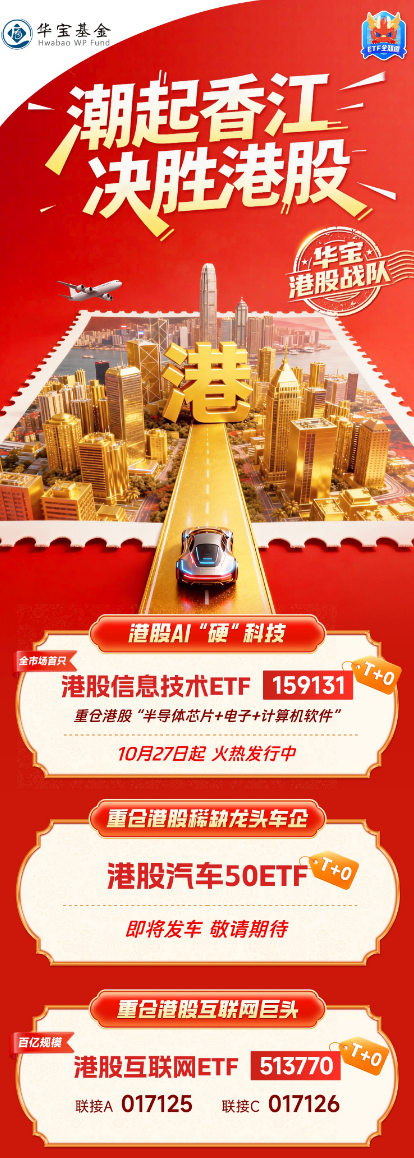
Group 1 - The first Hong Kong ETF focused on "hard" technology, specifically semiconductor chips, electronics, and computer software, is set to launch on October 27 [1][2] - The Hong Kong Automotive 50 ETF, which focuses on leading car manufacturers, is expected to be launched soon [1][2] - The Hong Kong Internet ETF is designed to invest in major internet giants in the region [1][2] Group 2 - The Hong Kong Innovation Drug ETF is 100% focused on innovative pharmaceuticals [1][3] - The Hong Kong Large Cap 30 ETF combines technology and dividend strategies [1][3] - The Hong Kong Dividend ETF offers high dividend yields with low volatility [1][3] Group 3 - The Hong Kong Small Cap LOF targets small and mid-cap assets [1][3] - The Value Fund LOF focuses on A+H shares with dividend characteristics [1][3] - The new consumption wave driven by Generation Z is highlighted through the Huabao CSI Shanghai-Hong Kong-Shenzhen New Consumption Index [1][3]

AH溢价上行意味着什么?为什么说当前是港股投资的好时机
Sou Hu Cai Jing· 2025-10-28 05:06
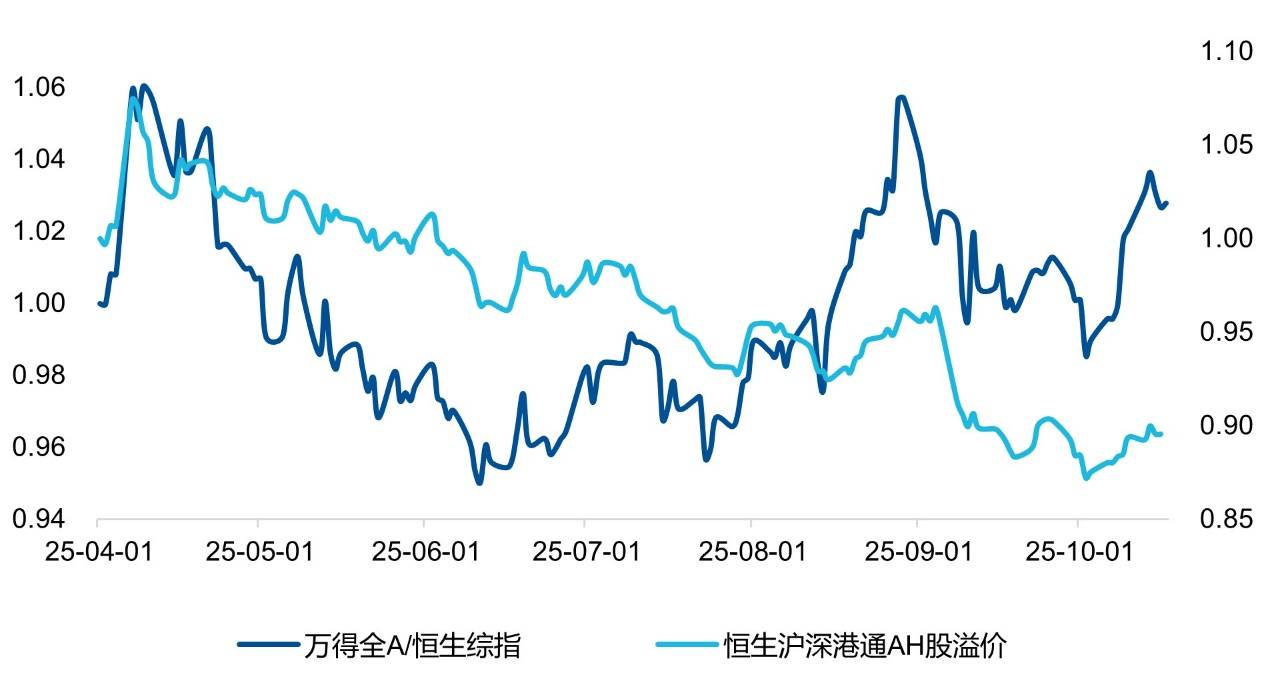
Group 1 - The valuation gap between A-shares and H-shares has widened, with the AH premium index rising since October, indicating that H-shares are becoming more attractive to investors [1][2] - The AH premium is defined as the price difference between the same company listed in both A-shares and H-shares, influenced by factors such as investor structure and liquidity [1] - Recent data shows that the AH premium index has been increasing, suggesting that A-shares are relatively overvalued compared to H-shares, driven by a recovery in risk appetite in the mainland market and a strengthening of the RMB [1] Group 2 - Over 100 companies are listed in both A-shares and H-shares, with A-shares generally having higher valuations; some leading stocks have price differences exceeding 40% [4] - The AH premium for leading stocks has mostly expanded, indicating that A-shares' valuation premium is still rising while H-shares are becoming more attractive [4] - H-shares are seen as having improved investment value due to lower valuations reflecting similar profit expectations compared to A-shares [4] Group 3 - The Hang Seng Index's equity risk premium (ERP) has recently rebounded from a three-year rolling -2 standard deviation position, indicating a shift in investor sentiment towards re-evaluating H-share assets [7][10] - The recovery in the ERP suggests that the valuation repair of H-shares is transitioning from being sentiment-driven to being supported by earnings and liquidity [7][10] - The Hang Seng China Enterprises Index is highlighted as having high valuation repair potential and strong liquidity, making it a focal point for investors during the current liquidity cycle [10]
广发基金樊力谨:以“翻石头”心态寻找港股优质增长机会
Shang Hai Zheng Quan Bao· 2025-10-26 15:37
Core Viewpoint - The Hong Kong stock market is expected to improve, with significant opportunities for quality growth companies, driven by unique selection logic and fundamental research [1][4]. Group 1: Investment Opportunities - The Hong Kong stock market has attracted over 1 trillion yuan in southbound capital inflows this year, with sectors like innovative drugs, new consumption, and hard technology gaining attention [1]. - The "quality growth" investment strategy focuses on three dimensions: domestic demand, international expansion, and unique institutional advantages of the Hong Kong market [2][5]. - Companies benefiting from domestic demand are showing solid fundamentals and wider competitive moats, with potential for valuation and profit "double boosts" as the economic cycle stabilizes [2]. - Companies actively expanding internationally are expected to elevate their growth ceilings, with the potential emergence of world-class brands and industry leaders [2]. - The unique institutional advantages of the Hong Kong market, such as flexible IPO and refinancing systems, provide a rich source of growth opportunities for innovative companies [2]. Group 2: Market Characteristics - The Hong Kong stock market is characterized by high volatility, often being the first to be sold off during market panic, which presents both risks and unique investment opportunities [3]. - Investors are encouraged to conduct in-depth fundamental research and maintain confidence in the long-term fundamentals of companies to achieve better performance [3]. - A stable investment framework and a calm mindset are crucial for successful investing, especially when there is a significant disconnect between a company's stock price and its intrinsic value [3]. Group 3: Future Market Trends - Investment strategies are shifting from external to internal focus, with the Chinese economic fundamentals and corporate profit cycles becoming the core drivers of the Hong Kong market [5]. - There is a growing emphasis on mid-level analysis, with in-depth research on industry cycles and leading companies being key to achieving excess returns [5]. - The market is expected to see opportunities in sectors that may currently be overlooked, with a focus on identifying mispriced assets through a "turning stones" approach [5].
主动量化周报:港股或已进入击球区-20251026
ZHESHANG SECURITIES· 2025-10-26 12:35
- The report constructs a "Hot Money Activity Indicator" based on the data from the Dragon and Tiger List, which shows the participation enthusiasm of hot money traders. The indicator has been marginally rising but the slope of the rise has been slowing down, indicating that the enthusiasm of hot money traders is peaking[12] - The "Retail Investor Activity Indicator" constructed in the report shows that since September 11, the activity of retail investors has been fluctuating and has not significantly increased even when the Shanghai Composite Index reached a new high for the year on October 25[12] - The report suggests that the recent marginal cooling of both hot money and retail investor sentiment can be verified by the continuous shrinkage of market turnover[12] - The "Insider Trader Activity Indicator" constructed in the report shows that the activity of insider traders is in sync with the market trend, with the equity market rising and the indicator maintaining a warming trend[15] - The report uses the "Price Segmentation System" to analyze the Shanghai Composite Index, showing that the daily line of the index maintains a marginal upward trend, and the weekly line is basically coincident with the daily line[14] - The "Hot Money Activity Indicator" value as of October 24 is close to leveling off[12] - The "Retail Investor Activity Indicator" has been fluctuating since September 11[12] - The "Insider Trader Activity Indicator" shows a warming trend in sync with the market[15] - The "Price Segmentation System" shows a +2.88% range fluctuation for the Shanghai Composite Index from October 20 to October 24[14]
越跌越买?港股回调再现资金捡筹! 全市场唯一香港大盘30ETF(520560)跌1.2%,场内现高频溢价
Xin Lang Ji Jin· 2025-10-22 06:32
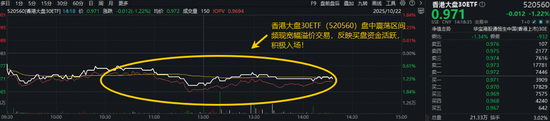
Core Viewpoint - The Hong Kong stock market is experiencing a pullback, with the first Hong Kong large-cap 30 ETF (520560) declining by 1.22%, primarily due to weakness in major tech stocks like Alibaba, Tencent, and Xiaomi [1] Group 1: Market Performance - The Hong Kong large-cap 30 ETF (520560) is showing signs of active buying despite the overall market weakness, indicating investor interest in picking up shares at lower prices [1] - The market is expected to see a turning point in the economic cycle as supply and demand dynamics improve, with a potential influx of southbound and foreign capital driving long-term upward trends in Hong Kong stocks [2] Group 2: Sector Analysis - The concentration of industries in the Hong Kong stock market is high, with new economy sectors such as consumption, telecommunications, healthcare, and technology gaining a larger share [2] - The current valuation of Hong Kong stocks is significantly lower than that of major global markets, characterized by low price-to-book (PB) and price-to-earnings (PE) ratios, suggesting a systemic discount compared to A-shares [2] Group 3: ETF Composition - The Hong Kong large-cap 30 ETF (520560) closely tracks the Hang Seng China (Hong Kong-listed) 30 Index, which consists of 30 constituent stocks, employing a "technology + dividend" strategy [2] - The top ten holdings in the index account for over 74% of the total weight, indicating a high concentration and strong capacity to absorb large trades with lower impact costs [2][3] - The total market capitalization of the index's constituent stocks is approximately 320,825 million [3]
港股投资周报:港股精选组合年内上涨66.58%,相对恒指超额40.72%-20251018
Guoxin Securities· 2025-10-18 07:52
========= - The "Guosen JinGong Hong Kong Stock Selection Portfolio" aims to select stocks with both fundamental support and technical resonance from an analyst-recommended stock pool[14][15] - The portfolio's backtesting period is from January 1, 2010, to June 30, 2025, with an annualized return of 19.11% and an excess return of 18.48% relative to the Hang Seng Index[15] - The portfolio construction involves selecting stocks based on analysts' upward earnings forecasts, initial coverage, and unexpected events in analyst reports[15] Portfolio Backtesting Results - Annualized return: 19.11%[15] - Excess return relative to the Hang Seng Index: 18.48%[15] - Maximum drawdown: 23.73%[20] - Information ratio (IR): 1.22[20] - Tracking error: 14.55%[20] - Return-to-drawdown ratio: 0.78[20] Stable New High Stock Screening Method - The method screens stocks that have reached a 250-day new high in the past 20 trading days based on analyst attention, relative stock strength, stock price stability, and continuity of new highs[23][24] - The formula for the 250-day new high distance is: $$ 250 \text{ day new high distance} = 1 - \frac{Closet}{ts\_max(Close, 250)} $$ where $Closet$ is the latest closing price and $ts\_max(Close, 250)$ is the maximum closing price in the past 250 trading days[23] - Stocks are selected based on the absolute value of the past 120-day price change and the sum of the absolute values of the past 120-day price changes[23] Stable New High Stock Screening Results - The sector with the most new high stocks is the cyclical sector, followed by technology, consumer, financial, manufacturing, and pharmaceutical sectors[23] - Specific stocks that have reached stable new highs include China National Building Material, Hansoh Pharmaceutical, and others[23][29] - The screening criteria include analyst attention (at least 5 buy or hold ratings in the past 6 months), relative stock strength (top 20% in the past 250 days), and stock price stability (top 50% based on price path smoothness and new high continuity)[24] Performance of Hong Kong Stock Connect and Active Funds Investing in Hong Kong Stocks - Median return of Hong Kong Stock Connect stocks this week: -3.44%[44] - Median return of active funds investing in Hong Kong stocks this week: -3.79%[44] - Median return of Hong Kong Stock Connect stocks this year: 25.14%[44] - Median return of active funds investing in Hong Kong stocks this year: 34.50%[44] Top Performing Funds - This week: Ping An Hong Kong Stock Connect Dividend Select A (2.29%), China Merchants Bank Hong Kong and Shanghai Multi-Strategy (1.90%), Ping An Hong Kong Stock Connect Dividend Select A (1.88%)[45] - This year: China Universal Hong Kong Advantage Select A (140.23%), Bank of China Hong Kong Stock Connect Medical A (104.90%), E Fund Global Pharmaceutical Industry RMB A (93.97%)[45] =========
【投资】这3个潜力赛道 千万别错过
中国建设银行· 2025-10-16 06:51
Core Viewpoint - The Hong Kong stock market has shown strong performance in 2025, with the Hang Seng Index and Hang Seng Tech Index rising by 30.40% and 38.02% respectively, reaching new highs [2][4]. Group 1: Market Performance - Since the beginning of 2025, the Hang Seng Index and Hang Seng Tech Index have both reached new highs, indicating a positive market trend [2]. - The Hang Seng Index peaked at 27,058 points and the Hang Seng Tech Index at 6,461 points on September 18, 2025, marking the highest levels since July 2021 and November 2021 respectively [2]. Group 2: Investment Opportunities - The Federal Reserve's decision to restart interest rate cuts has released global liquidity, making the Hong Kong stock market an attractive investment option due to its valuation advantages [5]. - Southbound capital has accelerated its inflow into the Hong Kong market, with a cumulative net purchase exceeding 1.1 trillion HKD in 2025, providing significant liquidity support [9]. Group 3: Policy and Regulatory Environment - The latest Hong Kong Policy Address has introduced multiple measures aimed at boosting the stock market, including the establishment of an "AI Efficiency Enhancement Group" and initiatives to assist mainland tech companies in financing [12][13]. - The government is exploring various measures to optimize the market ecosystem, such as implementing T+1 settlement rules and promoting the return of Chinese concept stocks [16]. Group 4: Sector Focus - The article highlights three key potential sectors under the "Chinese technology narrative": electronics, new materials, and healthcare, emphasizing the importance of domestic substitution and technological innovation [19][21][22]. - Specific funds focusing on these sectors have shown impressive returns, with one fund in the electronics sector achieving a return of +59.01% over the past year [20].

如何看待港股波动?FOF有何优势?北交所投资怎么做?三大基金经理最新研判来了
券商中国· 2025-10-16 06:29
Group 1: Market Overview - The current capital market is undergoing unprecedented changes and challenges, prompting investors to focus on optimizing asset allocation through professional research and analysis [1] - The Hong Kong stock market has experienced fluctuations primarily driven by short-term investor sentiment rather than long-term investment decisions [5][6] - Despite recent adjustments, the Hong Kong market remains attractive due to its valuation advantages and strong linkage with the mainland economy [6][8] Group 2: Investment Strategies - Investment decisions should focus on companies' long-term financial performance and strategic competitiveness rather than short-term market fluctuations [7] - The investment philosophy emphasizes a balanced approach between growth and value, with a focus on sustainable long-term returns [11][15] - The "FOF 2.0" era is characterized by a shift from selecting individual fund managers to a more systematic, diversified asset allocation strategy [14][15] Group 3: Sector Insights - Key sectors for investment in the Hong Kong market include high-end manufacturing, innovative pharmaceuticals, and AI-related technologies, with a particular focus on companies with global competitiveness [11][12][24] - The North Exchange market is highlighted for its unique advantages, including small market capitalization and specialization in innovative sectors, which provide high growth potential [22][24] Group 4: Performance Metrics - The North Exchange 50 Index has shown a year-to-date increase of over 45%, with certain funds achieving returns exceeding 110% [22][23] - The investment strategy in the North Exchange focuses on balancing growth and defensive positions, with a significant portion of the portfolio allocated to manufacturing [24][25] Group 5: Future Outlook - The outlook for the North Exchange remains optimistic, with expectations of continued growth and the introduction of more quality companies [26][27] - Future investment strategies will focus on innovation, consumer trends, dividend-paying stocks, and sectors poised for recovery [27]
一键配置港股龙头资产 摩根恒生港股通50ETF正在发行中
Zhong Guo Ji Jin Bao· 2025-10-15 07:41
Core Viewpoint - The Hong Kong stock market has gained significant attention this year, driven by substantial inflows of southbound capital and emerging industrial opportunities, leading to increased market activity [1] Group 1: Market Activity and Capital Inflows - As of September 30, 2025, southbound capital net purchases reached a record high of 1.17 trillion HKD, the highest since the establishment of the Hong Kong Stock Connect in 2014, indicating strong investor confidence in the market [1] - The Morgan Fund's Morgan Hang Seng Stock Connect 50 ETF was officially launched on October 13, allowing investors to subscribe through various brokerage channels [1] Group 2: Index Composition and Sector Distribution - The Hang Seng Stock Connect 50 Index, compiled by the Hang Seng Index Company, includes the top 50 stocks within the Stock Connect that have high liquidity and market capitalization, reflecting the overall performance of high-quality enterprises in the Hong Kong stock market [1] - The index covers 11 primary sectors, with the top three being Consumer Discretionary (28.51%), Financials (27.12%), and Information Technology (25.26%), balancing traditional finance and emerging growth sectors [1] - The top ten weighted stocks include leading companies from both new economy and financial sectors, collectively accounting for over 60% of the index, highlighting the potential for investors to capture growth in core Hong Kong assets [1] Group 3: Product Features and Management - The Morgan Hang Seng Stock Connect 50 ETF features a unique dividend mechanism, where if the ETF's excess return relative to the benchmark index is positive on the last trading day of each quarter, a mandatory dividend will be distributed, with at least 60% of the excess return allocated to investors [2] - As of June 30, 2025, Morgan Asset Management is the second-largest active ETF manager globally, with an ETF management scale of 276 billion USD, and ranked first in net inflows for active ETFs in 2024 [2] - The proposed fund manager, Wei Zhihao, has 11 years of experience in the securities industry and has been managing funds since February 2021, including the Morgan S&P Hong Kong Stock Connect Low Volatility Dividend ETF and the Morgan Hang Seng Technology ETF [2]
港股真香,齐刷刷上涨!港股ETF三剑客520560、513770、520880带头冲锋突围
Sou Hu Cai Jing· 2025-10-15 03:05
Group 1 - The Hong Kong stock market ETFs experienced a significant rebound on October 15, with notable increases in sectors such as innovative pharmaceuticals and internet technology [1] - The Hong Kong Internet ETF (513770) saw a peak increase of over 2.6% during the day, with a cumulative net inflow of 130 million yuan over the past five days, highlighting the appeal of AI in the Hong Kong market [1] - The Hong Kong Innovative Pharmaceuticals ETF (520880) rose by over 1.7% in early trading, accumulating nearly 700 million yuan in inflows over the last 20 trading days, indicating strong buying interest [1] Group 2 - The Hong Kong Large Cap 30 ETF (520560) experienced a significant premium, rising over 2.1% on its third trading day, with over 10 million yuan raised in the first two days [1] - The ETF tracks the Hang Seng China (Hong Kong listed) 30 Index, which includes a mix of new economy growth leaders and high dividend value stocks, reflecting a "dumbbell strategy" that combines technology and dividends [1] - The top ten constituent stocks of the Hong Kong Large Cap 30 ETF account for 74% of the total weight, enhancing the opportunity to capture leading investment prospects in the Hong Kong stock market [1] Group 3 - The Federal Reserve's recent signals from Powell suggest the possibility of a rate cut in October, reinforcing expectations for further rate reductions [2] - Analysts from Guotai Junan Securities believe that Hong Kong tech stocks will benefit from current industry trends, with foreign capital inflows potentially exceeding expectations in the fourth quarter [2] - Huatai Securities indicates that the short-term liquidity and sentiment in the Hong Kong market may have further room for release, while the medium to long-term upward trend remains intact [2]