
金融稳定

Search documents
How much money should you put in an HYSA vs. stocks?
Yahoo Finance· 2025-09-17 14:44
Core Insights - The article discusses the importance of balancing investments between high-yield savings accounts (HYSAs) and stocks to achieve financial goals [1][2] - HYSAs provide security and modest growth, suitable for short-term goals, while stocks offer higher potential returns but come with increased risk [1][5] Group 1: High-Yield Savings Accounts (HYSA) - HYSAs offer higher-than-average interest rates, with the best accounts paying upwards of 4% APY [3] - They are ideal for emergency funds and short-term savings due to their liquidity and low risk of losing money [4][5] - However, HYSAs may not significantly grow wealth over the long term, making them less suitable for long-term goals like retirement [5] Group 2: Investing in Stocks - Investing in stocks involves purchasing ownership in a company, with the potential for significant returns, historically averaging around 10% per year [6] - Stocks carry risks, including the possibility of value drops, especially in the short term, making them unsuitable for funds needed within five years [7][12] - A longer investment horizon of 5-10 years is recommended for stock investments to benefit from market fluctuations and compounding [13] Group 3: Considerations for Investment Strategy - Liquidity is crucial; individuals should have liquid cash in HYSAs before investing in stocks to avoid selling at a loss during emergencies [10] - Time horizon affects investment decisions; short-term needs should be met with HYSAs, while longer-term goals can be pursued through stocks [11][12] - Risk tolerance varies; those with stable income and emergency savings may opt for higher-risk stocks, while those prioritizing safety may prefer HYSAs [14][15][16]
工行行长中期业绩会10大核心观点
21世纪经济报道· 2025-08-31 05:39
Group 1 - Core Viewpoint on Shareholder Value: "Being a shareholder of Industrial and Commercial Bank of China (ICBC) should be a relatively happy experience" [1] - Growth Philosophy Declaration: "Constant speed may be the fastest, and balance may be the best. We have always adhered to this concept to promote ICBC's transformation and further high-quality development" [1] - Market Synchronization Positioning: "As a super-scale bank, we are always in resonance with the market and accurately reflect the growth status of the Chinese national economy" [1] Group 2 - Financial Stability Responsibility: "ICBC plays the role of a mainstay bank, a stabilizer. If the stabilizer's speed is extraordinary, its function may not perform well" [1] - Operational Logic Critique: "As a leading bank, we must advance in the same direction as the national economy... A bank of this size turning around indicates a problem in directional choice" [1] - Revenue Structure Metaphor: "Net interest income is the 'big head' of revenue; as a large commercial bank primarily engaged in indirect financing, interest income is our 'staple food'" [2] Group 3 - Investment Value Anchor: "Based on the stock price on August 28, the dividend yield for ICBC's A/H shares is around 4.2% and 5.8%, which should be higher than the long-term funding cost and comparable to some wealth management products, making it a good investment target" [2] - Domestic and International Business Positioning: "Domestic branches are our main base, providing stable momentum for group development; internationalization and diversification are our new bases, offering new growth curves and additional contributions" [2] - Response to Low Interest Margin: "Internationalization and diversification are not only indispensable components but also essential options for us to cope with the low interest margin environment and better serve the new development pattern" [3] Group 4 - National Economy Synchronization: "The national economy reflected in ICBC's balance sheet shows that ICBC is on a trajectory roughly corresponding to China's high-quality economic transformation... We hope to present a better annual report than the semi-annual one, with solid progress in serving the real economy and effectively preventing and resolving risks" [3]


工行行长刘珺中期业绩会10大核心观点!
2 1 Shi Ji Jing Ji Bao Dao· 2025-08-29 15:01
Core Insights - The commitment to shareholder value emphasizes that being a shareholder of the Industrial and Commercial Bank of China (ICBC) should be a positive experience [2] - The growth philosophy highlights a balanced approach to transformation and high-quality development, suggesting that steady growth may be the most effective strategy [2] - The bank positions itself as a major player in the market, reflecting the growth of the Chinese economy accurately [2] Financial Stability and Strategy - ICBC sees itself as a stabilizing force in the financial system, indicating that excessive speed in operations could undermine its stabilizing role [2] - The bank's operational logic suggests that it aligns closely with the national economy, adjusting strategies to ensure steady progress rather than pursuing extraordinary growth rates [2] - Interest income is identified as the primary revenue source, likening it to the bank's "staple food" [2] Investment and Business Positioning - The bank's A/H share dividend yields of approximately 4.2% and 5.8% are considered attractive compared to long-term funding costs and other investment products, making it a viable investment option [2] - Domestic branches are viewed as the main base for stability, while internationalization and diversification are seen as new growth avenues [2] - The bank's international and comprehensive strategies are essential for navigating low interest margin environments and better serving the new economic development framework [2] Economic Reflection - The bank's balance sheet is expected to reflect a trajectory aligned with China's high-quality economic transformation, aiming for solid progress in its annual performance [3]
工行行长刘珺中期业绩会10大金句!
2 1 Shi Ji Jing Ji Bao Dao· 2025-08-29 14:18
Core Insights - The core message emphasizes the commitment to shareholder value and the strategic vision for sustainable growth and international expansion [1][2][3] Group 1: Shareholder Value and Growth Philosophy - The bank aims to make being a shareholder a positive experience, indicating a strong commitment to shareholder value [1] - The growth philosophy is centered around steady and balanced growth, prioritizing high-quality development over rapid expansion [1] Group 2: Market Positioning and Economic Role - The bank positions itself as a major player in the financial sector, reflecting the growth of the national economy [1] - It serves as a stabilizing force in the financial system, emphasizing the importance of maintaining a steady operational pace [1] Group 3: Revenue Structure and Investment Appeal - Net interest income is highlighted as the primary revenue source, likening it to the bank's "staple food" [2] - The bank's dividend yield, at approximately 4.2% for A-shares and 5.8% for H-shares, is presented as an attractive investment opportunity compared to long-term funding costs [2] Group 4: Domestic and International Strategy - Domestic branches are identified as the main base for stability, while internationalization is viewed as a new growth avenue [2] - The strategy of internationalization and diversification is essential for navigating low interest rate environments and supporting the new economic development framework [2] Group 5: Economic Alignment and Performance Goals - The bank's performance is aligned with the trajectory of China's high-quality economic transformation, aiming for tangible improvements in annual results [3]
澳洲联储拉响警报:私人信贷扩张增加金融系统监控难度
智通财经网· 2025-08-29 06:53
Group 1 - The Reserve Bank of Australia (RBA) warns that global financing is shifting from regulated banks to private markets, complicating the ability of authorities to monitor and address potential financial stability risks [1] - The RBA's responsibilities include maintaining financial stability and chairing the Financial Regulatory Agency Committee, which aims to identify and address vulnerabilities [1] - The Australian Securities and Investments Commission (ASIC) has outlined key areas of focus, including insider trading and systemic compliance failures among large financial institutions [1] Group 2 - There is a growing allocation of funds, particularly from pension funds, towards private equity, credit, and physical assets, reshaping capital formation in Australia [1] - Regulatory concerns are particularly heightened regarding risks in the real estate sector, where private credit companies have expanded significantly [1] - The ASIC commissioner highlighted that unchecked private credit involvement in real estate could lead to systemic shocks [1] Group 3 - The RBA emphasizes that trade policy settings and geopolitical tensions may impact global and domestic growth and inflation outcomes [2] - These factors create uncertainty that could dampen business and consumer sentiment, prompting adjustments in trade patterns and supply chains [2] - In extreme cases, these factors may pose risks to financial stability [2]
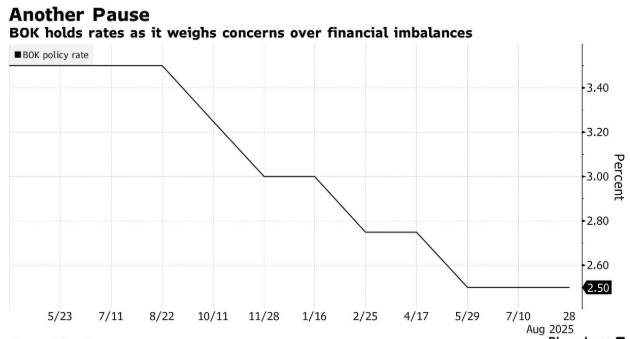
韩国央行如期维持利率不变 上调今年经济增长与通胀预测
智通财经网· 2025-08-28 03:44
Group 1 - The Bank of Korea has decided to maintain its current interest rate policy at 2.5% and will not restart the easing cycle until there are clear signs of improvement in the real estate, credit, and foreign exchange markets [1][3] - The central bank has revised its economic growth forecast for this year from 0.8% to 0.9% and increased its inflation forecast from 1.9% to 2% [1] - The Korean won appreciated by approximately 0.4% following the central bank's decision, with the exchange rate at about 1,389.45 won per US dollar [1] Group 2 - Economists expect that the Bank of Korea may lower interest rates in October, particularly after the government introduces housing supply measures [3] - The central bank's decision to maintain rates reflects the need to ensure financial stability and balance the interest rates set by the Bank of Korea and the Federal Reserve [3] - The real estate market in Seoul continues to be a constraint on rate cuts, with apartment prices rising despite government measures to limit mortgage lending [3][4] Group 3 - The South Korean government is planning to implement new measures to increase housing supply to prevent the real estate market from overheating [4]
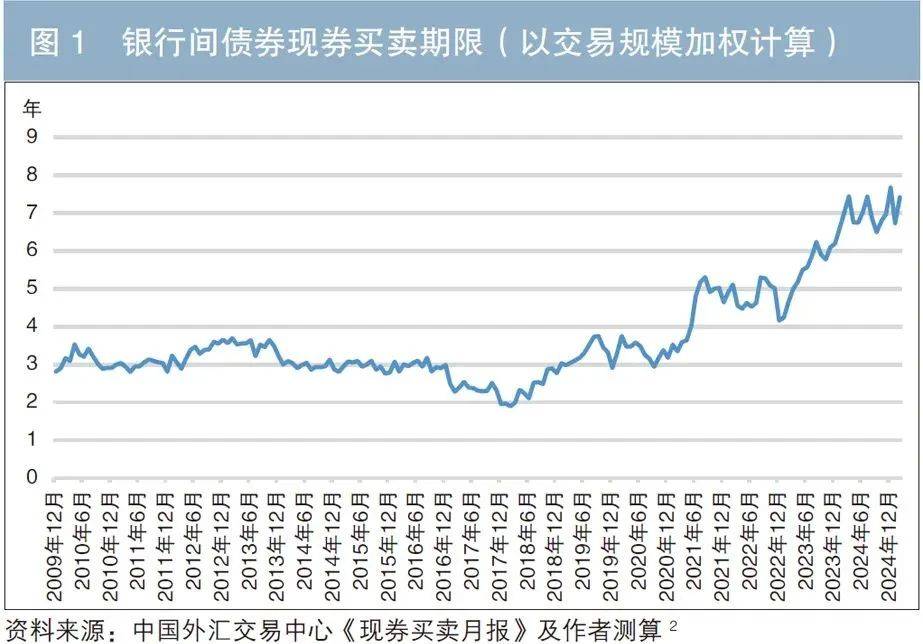
我国债券市场流动性风险分析——基于多级交易网络的视角
Sou Hu Cai Jing· 2025-08-22 15:58
Group 1 - The bond market is becoming a core area for financial stability in China, driven by the evolution of the economic development stage and structural changes in financing models [1][2][5] - As of March 2025, the proportion of government and corporate bonds in the total social financing scale has steadily increased, nearing 30% [2] - The bond market has expanded significantly, with the total issuance in 2024 reaching 79.6 trillion yuan, a 7.3-fold increase over the past decade [3] Group 2 - Liquidity is a key element for financial stability, and the stability of the bond market heavily relies on the stability of funding sources from various investors [6][11] - The relationship between liquidity and financial stability is highlighted, with liquidity risk being a significant source of financial instability [9][11] - The bond market's unique trading characteristics necessitate a new analytical framework for assessing vulnerability and risk transmission mechanisms [1][27] Group 3 - A multi-level network structure for bond trading has been proposed, illustrating the interconnections between different market participants and the liquidity transmission paths [12][16] - The structure includes large banks, small banks, and non-bank institutions, emphasizing the importance of short-term funding sources like repurchase agreements [16][17] - The self-evolving characteristics of this network structure demonstrate procyclical behavior, where rising bond prices lead to increased risk appetite and further investment [19][20] Group 4 - Various case studies illustrate the impact of policy adjustments on liquidity risk transmission within the bond market, highlighting the interconnectedness of different financial institutions [21][26] - The transmission paths show that large banks play a crucial intermediary role in liquidity provision, while non-bank institutions represent a potential weak link [26] - The analysis emphasizes the need for coordinated monetary and fiscal policies to maintain stability in the bond market [27]
宽松继续,落实落细 ——2025年二季度货币政策报告解读
Sou Hu Cai Jing· 2025-08-17 05:51
Group 1 - The central bank has adopted a more positive tone regarding the domestic economic situation, indicating that positive factors for prices are increasing, while external environmental fluctuations remain [1][3] - The macroeconomic policy is described as "more proactive and effective," leading to stable economic operation with good performance in major economic indicators, supported by regulatory measures against low-price disorderly competition [1][3] - The external environment continues to show volatility, with weakened global economic growth momentum and increased trade barriers, necessitating a focus on domestic strategic tasks for modernization [1][3] Group 2 - The policy framework emphasizes continuity and predictability, focusing on "stability in employment, enterprises, markets, and expectations," which enhances support for the capital market [2][4] - The monetary policy remains accommodative, providing protection for the real economy and capital markets, with a focus on guiding social expectations amid uncertainties [2][5] - The emphasis is on implementing existing policies in detail, optimizing the credit structure, and maintaining reasonable growth in financial totals rather than merely increasing credit scale [2][5] Group 3 - Interest rate policies stress execution and regulation, reflecting reforms in the interest rate system and transmission mechanisms, aimed at reducing social financing costs [3][7] - The report indicates a more relaxed stance on exchange rates, suggesting stability at a reasonable equilibrium level, with monetary policy execution being "self-directed" [3][7] Group 4 - The report outlines eight major tasks for the next phase of monetary policy, including enhancing macro credit policy guidance, developing green financial products, and supporting small and micro enterprises [8] - The focus is on promoting financial support for consumption, stabilizing the real estate market, and ensuring the effective implementation of various financial policies [8]
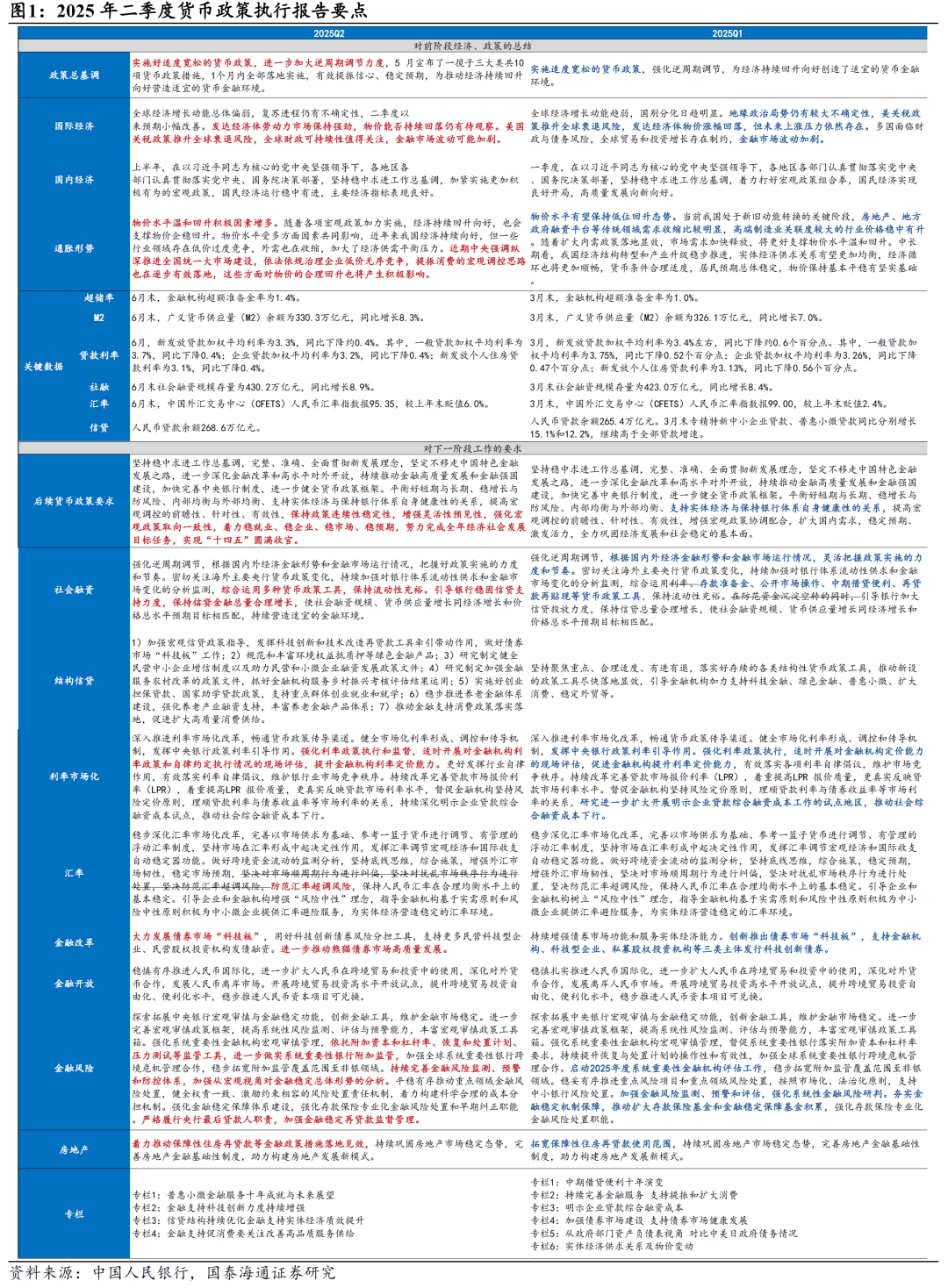
央行发布二季度货币政策报告,透露哪些关键信号?
Sou Hu Cai Jing· 2025-08-15 11:35
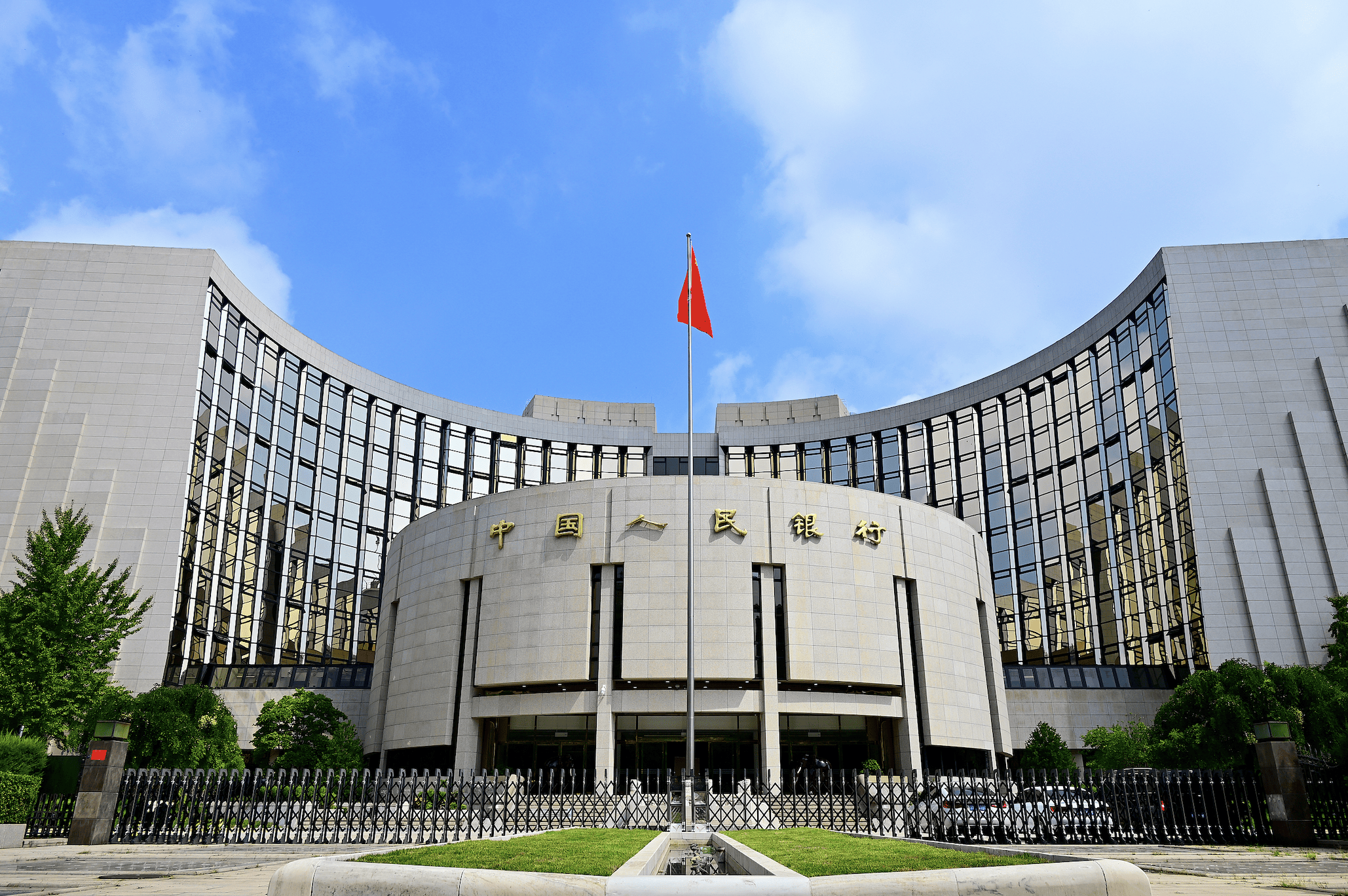
Core Viewpoint - The People's Bank of China emphasizes the implementation of a moderately accommodative monetary policy to align social financing scale and money supply growth with economic growth and price level expectations. Group 1: Monetary Policy Implementation - The report highlights the importance of promoting reasonable price recovery as a key consideration in monetary policy, aiming to keep prices at a reasonable level [2] - The central bank aims to enhance the interest rate adjustment framework, strengthen policy interest rate guidance, and improve the market-based interest rate formation transmission mechanism [2] - The report stresses the need to ensure effective transmission of monetary policy, improve fund utilization efficiency, and balance financial support for the real economy with maintaining financial health [2] Group 2: Structural Policies and Support - In May, the People's Bank of China introduced a series of financial policy measures, including structural policy tools, with a focus on supporting service consumption and the elderly care industry with a loan quota of 500 billion yuan [4] - The central bank plans to maintain a supportive monetary policy stance in the second half of the year, focusing on reducing financing costs for businesses and increasing credit accessibility to stimulate domestic demand [4] - Various monetary policy tools, such as reverse repos and medium-term lending facilities, will be utilized to enhance liquidity management in the short to medium term [4] Group 3: Exchange Rate and Financial Stability - The report advocates for a managed floating exchange rate system based on market supply and demand, aiming to stabilize the yuan at a reasonable and balanced level [5] - The central bank will explore expanding its macro-prudential and financial stability functions to maintain market stability and prevent systemic financial risks [5]
下半年债市有哪些政策机会值得关注?
Mei Ri Jing Ji Xin Wen· 2025-08-15 01:36
Fiscal Policy - The government's net financing from bonds has reached 9.5 trillion, surpassing any year except 2023 and 2024, with an additional 4-5 trillion expected to be issued this year [1] - The issuance of government bonds is expected to accelerate, while special bonds will maintain a steady issuance pace similar to previous years [1] - There is a likelihood of additional government bond issuance in the second half of the year to support economic resilience, potentially through special treasury bonds or increased deficits [1] Monetary Policy - A prediction of stock liquidity easing in the second half of the year, but the overall impact may not be as significant as previously anticipated due to financial stability constraints [1] - The central bank is expected to restart bond purchases in the third quarter, primarily due to a lack of long-term liquidity tools [2] - The bank's net interest margin is a significant factor limiting the extent of interest rate reductions, with a focus on the sustainability of banks' profitability [2] Bond Market Outlook - The bond market is currently in a state of oscillation, with strategies suggested for gradually increasing long-term bond holdings at high yield points and reducing them at low yield points [3] - The yield curve is at a relatively high level compared to the year, indicating a neutral to low historical position, with financial stability being a key constraint on monetary policy [2][3]