
AI泡沫

Search documents
陶冬:特朗普绑架马杜罗与泄密非农数据,市场为何无动于衷
Di Yi Cai Jing· 2026-01-12 04:38
Group 1 - Global stock markets are performing well, driven by strong liquidity, with the exception of Hong Kong's Hang Seng Index [1] - The U.S. non-farm payroll data for December 2025 showed an increase of 50,000 jobs, below the market expectation of 70,000, indicating a trend of "jobless growth" [2][3] - The consumer confidence index from the University of Michigan indicates deteriorating consumer expectations, primarily due to rising living costs [2] Group 2 - The U.S. economy is experiencing a K-shaped recovery, where strong sectors continue to thrive while weaker sectors lag behind, influenced by political factors and upcoming elections [4] - The Federal Reserve's monetary policy is expected to become more aggressive, potentially abandoning the 2% inflation target, which could lead to a return to quantitative easing [5] - The stock market may continue to rise in 2026 due to excess liquidity, but concerns are growing regarding the sustainability of AI investments and potential market corrections [5]
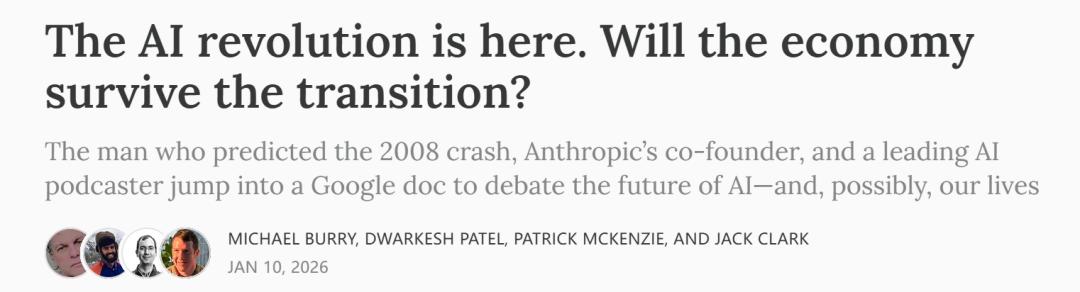
硅谷大空头杀回来了,做空甲骨文,英伟达万亿AI泡沫要崩?
3 6 Ke· 2026-01-12 00:33
Group 1 - The AI industry is facing a significant contradiction with a massive gap between capital expenditure and actual revenue, despite advancements in technology like Claude Code and Gemini [2][9] - Global AI computing power has reached 15 million H100 GPU equivalents, but there is a severe energy crisis behind this growth, with chip operation consuming 10GW of power, equivalent to the average electricity usage of two New York City [4][9] - Michael Burry has publicly shorted Oracle, criticizing its aggressive expansion into AI, which has led to a staggering debt of approximately $95 billion, and he is skeptical about the sustainability of such strategies [7][29] Group 2 - Burry expresses concerns that the current economic boom differs from past cycles due to the short duration of capital expenditures, with many investments depreciating within two to three years [10][12] - The private credit market plays a significant role in financing this boom, with mismatched durations leading to potential asset stagnation [13][14] - Burry believes that if no party in the AI supply chain can achieve substantial profits, the value will ultimately flow to customers, similar to the escalator wars of the past [21][22] Group 3 - Burry argues that Nvidia's competitive advantage is not sustainable, suggesting that most AI applications will face similar challenges as past industries that invested heavily without clear returns [18][21] - He also critiques Palantir's CEO for lacking confidence, indicating that the company is likely to decline [20] - The current AI landscape is characterized by a rapid increase in computing power, doubling approximately every seven months, which raises questions about sustainability and profitability [42][44] Group 4 - The AI chip market is dominated by Nvidia, but competitors like Google and Amazon are attempting to carve out market share with their own chips [51] - There is a critical bottleneck in the availability of infrastructure to support the growing demand for AI computing power, leading to potential idle assets [53][56] - The ongoing debate in Silicon Valley reflects a tension between the promise of AI and the reality of financial and physical constraints, with companies like Oracle experiencing significant stock volatility due to these pressures [28][57]


境外权益(港美股)周度策略报告-20260111
Guo Tai Jun An Qi Huo· 2026-01-11 11:55
Report Overview - The report is a weekly strategy report on overseas equity (Hong Kong and US stocks) by Guotai Junan Futures, dated January 11, 2026 [1][2] 1. Investment Ratings - No specific industry investment ratings are provided in the report 2. Core Views - For US stocks, maintain an optimistic outlook, continue with the technology + cyclical allocation strategy, and expect a more balanced market style in 2026 with a "shrinking circle" structure in the technology sector [3] - For Chinese stocks, in the short term, A-shares have better profit - making effects than Hong Kong stocks, and attention should be paid to the subsequent catch - up opportunities in Hong Kong stocks. In the medium term, Hong Kong stocks maintain a barbell strategy [4][7] 3. Summary by Sections US Stocks - **Market Performance and Outlook**: This week, cyclical sectors led the rise in US stocks, and the technology sector continued its "shrinking circle" structure. Next week, the US stock market will face earnings season and inflation data. The outlook remains optimistic, and the technology + cyclical allocation strategy continues [3] - **2026 Allocation Ideas**: The market style will be more balanced, and the K - shaped divergence between technology and non - technology, large - cap and small - cap stocks is expected to converge. Focus on AI technology, healthcare, utilities, finance, materials, and consumer sectors. Prioritize upstream infrastructure in AI technology over downstream software, and pay attention to theme investment opportunities in physical AI [3] - **Valuation**: US stock valuations are still relatively high overall [14] - **AI Bubble**: It is a local rather than a systematic bubble. The market is punishing individual companies with aggressive capital expenditures. Currently, it may be close to the 1997 position from the perspective of the technology industry's ROIC. Monitor the "ROIC - WACC" convergence trend and the divergence between "financing growth" and "profit growth" [20][22] Chinese Stocks - **Market Performance and Outlook**: This week, A - shares outperformed Hong Kong stocks. A - shares' performance was strong in some sectors with high performance certainty and theme - concept sectors. Southbound funds' entry momentum increased, and the pattern may be A - shares leading and Hong Kong stocks catching up. February is the month with the highest winning rate for A - shares historically [4][6][7] - **Short - term Allocation**: Defensively allocate sectors with high performance certainty (AI hardware, new energy leaders, and non - ferrous metals), and offensively allocate valuation - driven sectors (Hang Seng Technology, Hong Kong innovative drugs, commercial aerospace, and robotics) [7] - **Medium - term Allocation for Hong Kong Stocks**: Adopt a barbell strategy, focusing on technology assets with clear industrial trends supported by policies, some new energy sectors with supply - side clearance and demand - side improvement, and non - ferrous sectors benefiting from supply shortages, strong structural demand, and interest rate cuts [7] Odds Analysis - **Hong Kong Stocks**: The forward PE of the Hang Seng Index is 11.8 times, approaching the mean + 1STD since 2015. The forward PE of the Hang Seng Tech Index is 21.4 times, approaching the mean of the past 5 years. The Hang Seng Index ERP is 4.9%, and the Hang Seng Tech Index ERP is 1.1% [9][10]
2026最大的交易主题:输不起的特朗普 国际秩序的终结
智通财经网· 2026-01-11 11:21
进入2026年,全球宏观市场正在经历一场深刻的范式转变。资深分析师David Woo认为,面对中期选举 的巨大压力,特朗普政府正展现出不惜一切代价扭转局面的决心,这将重塑从能源到黄金的全球资产定 价逻辑。 David Woo表示,为弥补严重的民调劣势并避免在国会失去多数席位,特朗普政府的政策重心已全面转 向赢得"可负担性"辩论。这意味着2026年的终极交易主题将从单纯的再通胀转向激进的通缩手段——尤 其是通过强力掌控能源资源来大幅压低油价,目标是在大选前将汽油价格降至关键心理防线。这一战略 不仅意在平抑通胀,更意在通过改善中产阶级生活成本来稳固选票。 而特朗普此前对委内瑞拉的动作标志着战后建立的基于规则的国际秩序实质性终结。这一举措并非出于 意识形态考量,而是为了直接掌控能源资源,以期通过大幅增加供应来赢得国内的"可负担性论证"。特 朗普的目标是在秋季前将汽油价格压低至每加仑2.25美元,这将对原油市场造成剧烈冲击,预计油价将 下探至40至50美元区间。 Woo警告,随着美国放弃作为国际体系的传统担保人角色,全球地缘不安全感将急剧上升,这为黄金提 供了强劲支撑,并利好国防工业。相反,新兴市场股票将面临估值重估 ...
2026最大的交易主题:输不起的特朗普,国际秩序的终结
Hua Er Jie Jian Wen· 2026-01-11 08:49
进入2026年,全球宏观市场正在经历一场深刻的范式转变。资深分析师David Woo认为,面对中期选举 的巨大压力,特朗普政府正展现出不惜一切代价扭转局面的决心,这将重塑从能源到黄金的全球资产定 价逻辑。 David Woo表示,为弥补严重的民调劣势并避免在国会失去多数席位,特朗普政府的政策重心已全面转 向赢得"可负担性"辩论。这意味着2026年的终极交易主题将从单纯的再通胀转向激进的通缩手段——尤 其是通过强力掌控能源资源来大幅压低油价,目标是在大选前将汽油价格降至关键心理防线。这一战略 不仅意在平抑通胀,更意在通过改善中产阶级生活成本来稳固选票。 而特朗普此前对委内瑞拉的动作标志着战后建立的基于规则的国际秩序实质性终结。这一举措并非出于 意识形态考量,而是为了直接掌控能源资源,以期通过大幅增加供应来赢得国内的"可负担性论证"。特 朗普的目标是在秋季前将汽油价格压低至每加仑2.25美元,这将对原油市场造成剧烈冲击,预计油价将 下探至40至50美元区间。 Woo警告,随着美国放弃作为国际体系的传统担保人角色,全球地缘不安全感将急剧上升,这为黄金提 供了强劲支撑,并利好国防工业。相反,新兴市场股票将面临估值重估 ...
喝点VC|YC 内部内部复盘:AI 正在进入稳定期,并逐渐形成一套可复用的AI原生公司构建路径
Z Potentials· 2026-01-11 02:00
Core Insights - The AI economy is stabilizing, with clear differentiation between model, application, and infrastructure layers, leading to a more mature path for building AI-native companies [32][20][17] - Anthropic has surpassed OpenAI as the most preferred API among YC founders, with a usage rate exceeding 52% in the latest Winter26 batch, marking a significant shift in the competitive landscape [7][5][6] - The emergence of various models, including Gemini, is reshaping preferences, with Gemini gaining traction and accounting for approximately 23% of usage in the Winter26 batch [8][10] Group 1: AI Model Preferences - Anthropic's rapid growth is attributed to its performance in coding tools and the emergence of vibe coding, which has created significant value [7][6] - The competitive landscape is shifting from model capabilities to productization, as models become commoditized and computational power becomes cheaper [7][8] - Founders are increasingly using multiple models for specific tasks, indicating a trend towards model orchestration in AI applications [15][16] Group 2: AI Bubble Discussion - Concerns about an AI bubble are likened to the telecom bubble of the 1990s, where excess infrastructure investment ultimately led to the emergence of successful applications like YouTube [17][18] - The current phase is seen as an installation stage, with heavy capital investment in infrastructure, which will eventually lead to a deployment phase where applications flourish [20][21] - The competitive dynamics among AI labs and model companies are expected to benefit startups entering the application layer, similar to the opportunities seen during the internet boom [19][18] Group 3: Trends in AI Startups - There is a growing interest in establishing smaller models and niche applications, reminiscent of the early days of SaaS startups [26][27] - The ability to fine-tune models for specific domains, such as healthcare, is becoming more prevalent, with some startups outperforming larger models like OpenAI in specific benchmarks [28][29] - The expectation is that as more models become available, there will be an increase in AI applications tailored for various tasks, driven by advancements in open-source models and reinforcement learning [28][27] Group 4: Workforce and Efficiency - AI has improved efficiency for startups, but the expectation for higher performance has led to continued hiring rather than a reduction in workforce [36][35] - The trend indicates that while AI can enhance productivity, the demand for skilled personnel remains high to meet growing customer expectations [39][36] - The narrative around AI's impact on employment is evolving, with some believing it will lead to fewer employees needed, while others argue it will necessitate more hiring to maintain service quality [39][36]

未来走向何方?Agent 创企 2025 生存现状一览
机器之心· 2026-01-11 01:30
Core Insights - The article discusses the rising prominence of Agent companies in the AI sector, highlighting their challenges and opportunities as they navigate the market landscape leading up to 2025 [6]. Group 1: Agent Companies and Market Trends - The acquisition of Manus by Meta for over $2 billion is seen as a milestone event in the Agent space, sparking diverse interpretations within the industry [7]. - The concept of "Situated Agency" is introduced, emphasizing that an Agent's capabilities are deeply intertwined with its environment, tools, and memory [7]. - The market acceptance of Agents has surged, with 52% of companies using generative AI deploying Agents in production environments [8]. Group 2: Investment and Capital Flow - Over 20 U.S. Agent startups raised over $100 million in funding in the past year, covering various sectors such as programming, B2B customer service, healthcare, and legal [11]. - Harvey, a legal-focused Agent company, completed a $160 million Series E funding round, achieving a valuation of $48 billion [11]. - ElevenLabs raised $100 million to transition towards a conversational Agent platform, indicating a shift in focus towards dialogue-driven applications [12]. Group 3: Sector-Specific Developments - In the legal sector, EvenUp raised $150 million to automate routine legal tasks, showcasing the growing interest in legal technology [11]. - In the search domain, Parallel and You.com both secured over $100 million in funding, reflecting the demand for Agent capabilities in search infrastructure [12]. - The healthcare sector is also seeing significant investment, with companies like Abridge raising $300 million to develop clinical dialogue Agents [15].

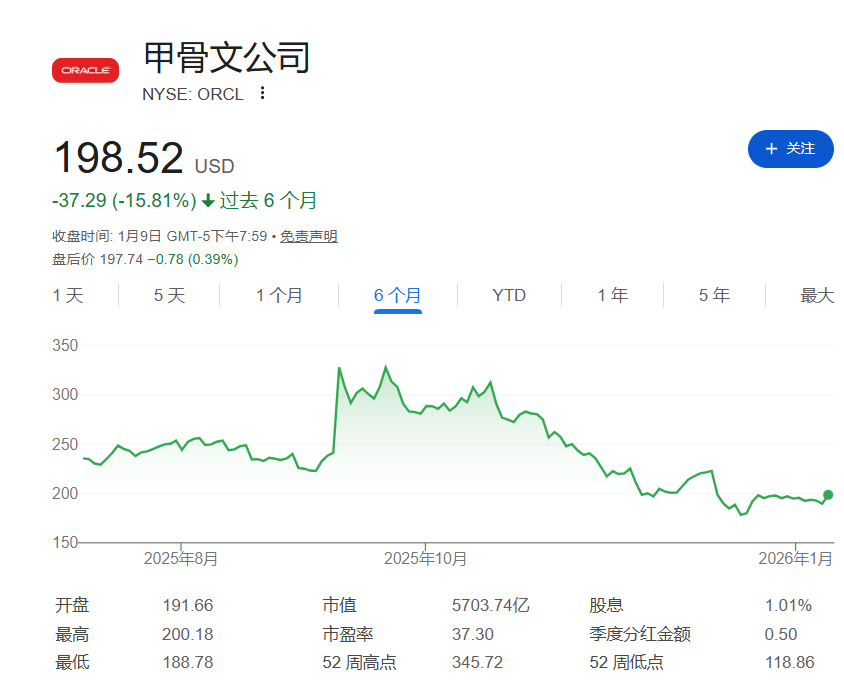
大空头Burry做空甲骨文:不喜欢其定位和融资
Hua Er Jie Jian Wen· 2026-01-10 05:00
Core Viewpoint - Michael Burry, a well-known investor and the inspiration behind the movie "The Big Short," has disclosed his short position on Oracle through a Substack post, reinforcing his belief that the current AI market is overvalued and in a bubble [1]. Group 1: Short Position and Criticism of Oracle - Burry has directly shorted Oracle in the past six months, criticizing the company's strategic positioning and aggressive investments in AI, suggesting that Oracle is unnecessarily expanding its capital expenditures to compete with cloud giants like Amazon and Microsoft [1]. - He expressed skepticism about Oracle's current investments, questioning their necessity and implying they may be driven by ego rather than sound business strategy [1]. Group 2: Comparison with Other Tech Giants - Burry's rationale for shorting Oracle instead of other tech giants like Microsoft, Alphabet, and Meta is based on the latter's strong core business moats, which provide them with a safety net even if their AI investments fail [2][3]. - In contrast, Oracle's stock price is heavily reliant on a single narrative of surging AI cloud service demand, making it more vulnerable to market fluctuations [3]. Group 3: Financial Concerns and Debt Issues - Oracle's aggressive capital expenditures and deteriorating balance sheet are key factors in Burry's bearish outlook, as the company has incurred approximately $95 billion in outstanding debt, making it one of the largest corporate bond issuers outside the financial sector [6]. - The shift from a "light asset" to a "heavy asset" model has led to significant debt burdens, raising concerns about Oracle's ability to sustain its growth strategy, especially in a high-interest-rate environment [6]. Group 4: Broader Skepticism Towards AI Industry - Burry's short position on Oracle reflects a broader skepticism towards the AI industry, as he questions the sustainability of the current AI hype and pricing models [7]. - He has indicated a willingness to short other AI-related companies, including OpenAI, if their valuations reach unsustainable levels, highlighting his overall bearish sentiment towards the AI sector [7]. Group 5: Market Reaction - Oracle's stock has experienced significant volatility, with a 36% surge last September due to optimistic forecasts for cloud services, followed by a 40% decline from its peak as investor concerns about rising capital expenditures and debt levels grew [6]. - Burry's entry into the short position has intensified market worries regarding Oracle's high-leverage strategy and its long-term viability [6]. Group 6: Oracle's Response - As of the time of reporting, Oracle has not responded to Burry's comments or his short-selling actions [8].
YC 年终座谈会:AI 泡沫反而是创业者助力?
机器之心· 2026-01-10 02:30
Group 1: AI Market Dynamics - The AI economy has established a stable structure with parallel layers of models, applications, and infrastructure, each with considerable profit potential [1] - Investment in AI infrastructure and energy, perceived as a bubble, actually provides affordable computing power and "excess dividends" for the application layer [1] Group 2: LLM Power Shift - By 2025, Anthropic's Claude has surpassed OpenAI's ChatGPT as the most popular large language model (LLM) among Y Combinator projects, indicating a significant shift in market preference [5][6] - The structural change in technology stack and model selection is evident, with OpenAI's market share declining from over 90% [5] Group 3: Developer Relations and Product Philosophy - Anthropic is characterized by a "golden retriever energy," emphasizing a friendly and cooperative approach towards developers, contrasting with OpenAI's more aloof stance [6][7] - This developer-centric design has translated into competitive advantages, particularly in programming assistance, making Anthropic the preferred choice for many founders [8] Group 4: Spillover Effects and Programming Paradigms - Founders' preference for Claude in personal programming contexts leads to a spillover effect, influencing their choice of models for unrelated applications [9] - The concept of "Vibe Coding" has evolved from a qualitative observation to a significant technical domain, demonstrating commercial viability through successful companies like Replit and Emergent [10] Group 5: Team Structure and Efficiency - The measure of company success is shifting from team size to per capita output efficiency, with examples like Gamma achieving $100 million in annual recurring revenue (ARR) with a streamlined team of 50 [12] - The rise of AI has increased productivity but also heightened customer expectations, making talent execution the new bottleneck in a competitive landscape [11] Group 6: Trust Crisis and Specialized Applications - To address complex tasks and build user trust, AI development is shifting focus from general large models to specialized applications capable of executing specific logic [13]

港股七巨头三年总市值累计上涨101%!银河证券:当前 AI 投资非泡沫化
Ge Long Hui· 2026-01-09 02:15
从市场角度来看,当前中美 AI 相关板块并未处于典型的泡沫狂热期,不必过度担忧。同时,技术创新 与产业落地的本质是非线性演进过程,绝非一蹴而就的短期行为。与商业周期相似,科技投资也存在明 显的周期特征。资产的泡沫不会阻断核心技术发展的大趋势,而寻找那些无惧市场泡沫、能够穿越周期 的企业和资产才是关键。 从产业路径来看,中国AI发展路径与美国形成明显分化,根源在于所处的资源约束条件不同。中国所 面临的硬约束在于尖端训练芯片进口受限以及高端 GPU 供给阶段性稀缺,因此建立大规模算力集群在 经济性与可持续性上显然难以与美国比肩。在此情形下,单纯复制美国的算力堆叠模式,并不具备现实 可行性。与其追随美国进行算力军备竞赛,不如选择一条更具中国特色、符合国情的发展道路,即在有 限算力条件下挖掘最优效果,产业界的高性价比模型和开源模型就是这一思路下的产物。例如, DeepSeek 等产品不靠算力堆叠,而是在工程体系优化和精准建模中持续降低成本并提升性能,体现出 用工程能力弥补算力限制的方法论选择。得益于相对较低的 token 使用价格,中国大语言模型如 DeepSeek、通义千问等在全球范围内广受欢迎,过去一年的使用量位 ...