AI芯片

Search documents
赛道Hyper | 英特尔Q1成绩单:亏损额翻倍
Hua Er Jie Jian Wen· 2025-04-26 10:07
Core Viewpoint - Intel has reported a net loss of $821 million for Q1 2025, marking its fifth consecutive quarterly loss, the longest streak since 1990, indicating significant structural issues within the company [2][3][9] Financial Performance - Intel's Q1 2025 revenue was $12.7 billion, flat year-over-year, exceeding analyst expectations of $12.3 billion [2] - The net loss of $821 million represents a 115% increase compared to the previous year's loss of $381 million [2] - Non-GAAP adjusted net income for the quarter was $600 million, down 24% from $800 million year-over-year [2] - GAAP gross margin was 36.9%, down 4.1 percentage points year-over-year, while non-GAAP gross margin was 39.2%, down 5.9 percentage points [3] Business Segment Performance - Client Computing Group (CCG) revenue was $7.629 billion, down 8% year-over-year, primarily due to structural changes in the global PC market [3][5] - Data Center and AI (DCAI) revenue reached $4.126 billion, up 8% year-over-year, driven by demand from large cloud service providers [6][8] - Intel Foundry Services (IFS) generated $4.767 billion in revenue, a 7% increase, but faced an operational loss of $2.32 billion due to high production preparation costs [7] - Other businesses reported $943 million in revenue, up 47%, mainly from Mobileye and NAND storage [7] Strategic Changes and Challenges - CEO Pat Gelsinger announced a workforce reduction of approximately 20%, or about 20,000 employees, to streamline operations and improve efficiency [2][4] - Gelsinger emphasized the need to simplify processes and reduce management layers to enhance productivity [5] - Intel's market share in the global PC market dropped from 66.3% to 56.3% year-over-year, while AMD's share increased to 43.7% [6][8] - Despite a 4.9% increase in global PC shipments, Intel's performance lagged behind competitors, highlighting issues with product iteration speed [6][8] Future Outlook - Intel's Q2 2025 revenue guidance is between $11.2 billion and $12.4 billion, with a midpoint of $11.8 billion, falling short of analyst expectations [8] - The company anticipates further gross margin decline to 34.3% due to ongoing challenges in client demand and foundry losses [8][9] - While Intel's strategic investments in advanced process nodes and foundry services may offer long-term potential, short-term performance pressures remain significant [9]

【太平洋科技-每日观点&资讯】(2025-04-24)
远峰电子· 2025-04-23 11:42
Market Overview - The main board saw significant gains with stocks like Zhuhai Intelligent (+10.06%), Hezhong Sijuan (+10.05%), and Chaoyang Technology (+10.02%) leading the rise [1] - The ChiNext board also performed well, with Li'an Technology (+20.01%) and Xincheng Technology (+19.99%) showing notable increases [1] - The Sci-Tech Innovation board was led by Fuxin Technology (+7.89%) and Weide Information (+7.59%) [1] - Active sub-industries included SW Other Communication Equipment (+4.40%) and SW Communication Network Equipment and Devices (+3.79%) [1] Domestic News - China Unicom launched the "Unicom Satellite" service, allowing users to access emergency communication via Tiantong satellites in areas with unstable or no ground network coverage [1] - Jiangsu Luxin Semiconductor's mask project is set to deliver samples for 90-100nm process nodes in the first half of 2025, with trial production for 40nm nodes expected in the second half of 2025 [1] - IDC reported that China's smartphone market is projected to grow by 3.3% year-on-year in Q1 2025, reaching 71.6 million units, driven by national subsidies and the Spring Festival sales season [1] - Huawei introduced its QianKun ADS 4 high-speed L3 commercial solution and unveiled its future autonomous driving technology architecture at the QianKun Intelligent Technology Conference [1] Company Announcements - Shenzhen South Circuit released its Q1 2025 report, showing total revenue of 4.783 billion yuan, a year-on-year increase of 20.75%, and a net profit of 491 million yuan, up 29.47% [3] - Unisoc reported a total revenue of 5.511 billion yuan for 2024, a decrease of 27.26%, with a net profit of 1.179 billion yuan, down 53.43% [3] - Dingxin Communications announced a total revenue of 3.086 billion yuan for 2024, a decrease of 15.04%, with a net loss of 258 million yuan [3] - Zhaoxun Media reported a revenue of 670 million yuan for 2024, an increase of 12.26%, primarily due to investments in digital outdoor media [3] International News - Intel announced its second-generation AI-enhanced software-defined vehicle SoC and established partnerships with companies like Black Sesame Intelligence to tackle technological challenges in automotive intelligence [4] - Japan's Electric Glass Company plans to develop larger high-performance glass substrates for semiconductor equipment, aiming to meet the growing demand for advanced materials in AI chip manufacturing [4] - SK Hynix successfully completed customer validation for its CMM-DDR5 96GB product, based on the CXL 2.0 standard [4] - Intel's 1.8nm process details revealed that the Intel 18A offers significant performance improvements, achieving a 25% speed increase and a 36% reduction in power consumption at 1.1V [4]


营收暴涨40倍!国产芯片要逆袭了?丨芯片战场
2 1 Shi Ji Jing Ji Bao Dao· 2025-04-21 16:03
Group 1 - The core viewpoint is that domestic AI chip companies, particularly Cambricon, are experiencing significant growth due to improved technology and increasing demand for chips driven by large models [1][2]. - Cambricon's revenue surged by 40 times in the first quarter, achieving a profit of 355 million yuan, which is more than double year-on-year [2]. - The company has seen a substantial increase in accounts receivable by 25.7% and inventory by 55%, indicating a sustainable growth trajectory [2]. Group 2 - The U.S. plans to tighten export controls on Nvidia's H20 chips to China, which could reshape the Chinese AI chip market, potentially benefiting domestic companies like Huawei, Cambricon, and Kunlun [3]. - Cambricon's main competitor, Haiguang Information, also reported strong performance with a 52.4% increase in revenue and a 52.87% rise in net profit [4]. - The Chinese AI industry is rapidly expanding, with an annual demand for one million GPUs, supported by favorable policies that exclude certain foreign products [4].

湖北省打造工业母机产业高地推介会在京举行 全球首台具备自主学习能力的“华中10型”智能数控系统正式发布
Zheng Quan Ri Bao Wang· 2025-04-21 13:34
华中10型智能数控系统创新构建了"一个智能底座,两条数字主线,三个功能子系统"技术架构,创造了 智能制造高级阶段的新范式。全局贯通的智能底座通过硬件平台集成AI芯片,研制智能传感模块,软 件平台支持在AI芯片上部署DeepSeek、智谱清言等大语言模型,形成了机床的"神经网络"和"超级大 脑"。 华中10型的技术亮点聚焦于融合建模方法、指令域大数据的自主学习机制、AI大模型垂直应用三大创 新。 据介绍,华中数控与武汉重型机床集团有限公司、秦川机床(000837)工具集团股份公司等18家中国机 床企业共同研制了配载华中10型的世界首批20台智能数控机床。与创世纪(300083)联合研制的智能立 式钻攻中心,汽车电机壳体和手机中框粗加工效率提升约10%;与江西佳时特联合研制的智能立式五轴 加工中心,涡旋盘轮廓精度提升75%。 本报讯(记者李万晨曦)4月21日,湖北省打造工业母机产业高地推介会在北京第十九届中国国际机床展 览会上举行。全球首台集成AI芯片与AI大模型的新一代智能数控系统——华中10型智能数控系统推介 会上正式发布。这是世界首台具备自主学习能力的智能数控系统,其发布标志着我国在高端数控系统领 域取得重 ...

特朗普“敲诈”黄仁勋,为华为昇腾910C献上“助攻”
Guan Cha Zhe Wang· 2025-04-21 08:39
Core Viewpoint - The U.S. government has imposed new export controls on AI chips, specifically targeting Nvidia's H20 chip, marking a significant escalation in restrictions on technology exports to China [1][2][8]. Group 1: Export Controls and Market Impact - Nvidia announced that its H20 chip requires a license for export to China, a first for a special version of AI chips [1]. - Intel has informed Chinese customers that starting April 2025, chips meeting certain performance criteria will also require U.S. government approval for export [1]. - The restrictions primarily affect Nvidia's H20 and AMD's MI308 chips, with Nvidia's H20 being particularly critical due to its market presence in China [1][8]. - Following the announcement, Nvidia's stock price dropped nearly 7%, resulting in a market value loss of over $148 billion, while AMD warned of an $800 million loss due to the new restrictions [11]. Group 2: Competitive Landscape - The H20 chip's performance exceeds that of other AI chips, making it highly sought after by Chinese cloud computing providers [8][9]. - Huawei's Ascend 910C AI accelerator is expected to fill the market gap left by Nvidia, with performance metrics approaching Nvidia's latest offerings [13][15]. - The competitive dynamics are shifting, with domestic Chinese manufacturers poised to accelerate their development in response to U.S. export controls [11][13]. Group 3: Strategic Implications - The U.S. export controls reflect a broader strategy to maintain technological dominance while balancing commercial interests [16]. - Nvidia's decision to maintain high performance in its products, even under export restrictions, indicates a strategic intent to retain market share in China [10]. - The ongoing policy fluctuations highlight the challenges faced by the U.S. in navigating the intersection of technology control and economic interests [16].

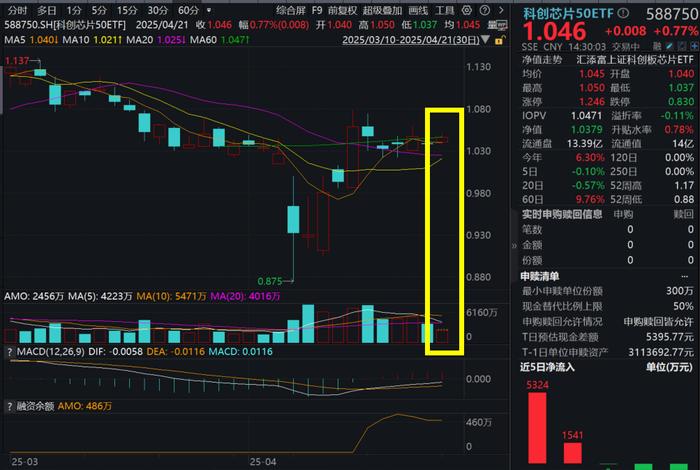
营收大增42倍,寒武纪涨超3%!科创芯片50ETF(588750)红盘震荡,全球首个人形机器人半马落幕,关注AI芯片!
Xin Lang Cai Jing· 2025-04-21 07:09
Core Viewpoint - The A-share market is experiencing fluctuations, with the Sci-Tech Chip 50 ETF (588750) showing a slight increase of 0.77% as of April 21 [1] Company Performance - Cambrian Technology reported a revenue of 1.174 billion yuan for 2024, a year-on-year increase of 65.56%, and a net profit of -0.452 billion yuan, up 46.69% [3] - For Q1 2025, Cambrian achieved a revenue of 1.111 billion yuan, a staggering year-on-year growth of 4230.22%, with a net profit of 0.355 billion yuan, up 256.82% [3][4] - Longjiang Securities highlighted Cambrian as a leading AI chip company in China, entering a new phase of business expansion due to significant demand for computing power driven by AI development [4] Industry Trends - The AI chip market is projected to exceed $150 billion by 2025 and reach $400 billion by 2027, indicating a second growth curve for the chip industry [5] - The trend of domestic substitution in the semiconductor industry is accelerating, driven by changes in global trade dynamics and increased policy support for domestic production [5] - The development of domestic computing power is seen as an irreversible trend, with companies like Cambrian and Haiguang showing strong commercial viability and entering large-scale application phases [6] Market Sentiment - The Sci-Tech Chip 50 ETF (588750) is viewed as a promising investment opportunity, benefiting from both domestic substitution and increasing demand, as the sector is currently in an upward cycle [4][6] - The AI terminal market is expanding, with multiple manufacturers launching new products that enhance user experience and performance, further driving demand for chips [6]
第一创业晨会纪要-20250421
First Capital Securities· 2025-04-21 03:27
Group 1: Robotics Industry - The first humanoid robot half marathon was held in Beijing, with only 35% of the 20 participating teams completing the 13km race, indicating significant challenges in endurance, active cooling, and operational balance for current robots [2] - The report suggests that while there are many domestic humanoid robot development teams making progress, the market expectations for mass production in the next two years may be overly optimistic, indicating a need for caution regarding stock performance in the robotics sector [2] Group 2: Semiconductor Industry - Cambrian Technology reported a revenue of 1.174 billion yuan for 2024, a year-on-year increase of 65.6%, with a gross margin of 56.7%, down 12.45 percentage points from the previous year [2] - The net profit attributable to shareholders for 2024 was -0.452 billion yuan, a 46.7% reduction in losses compared to the previous year [2] - In Q4 2024, Cambrian's revenue reached 989 million yuan, a 75.5% year-on-year increase, primarily driven by a one-time order from a major client, contributing 84.2% of total revenue for the year [2] - For Q1 2025, Cambrian's revenue was 1.11 billion yuan, a 42-fold increase year-on-year, with a net profit of 355 million yuan, marking the first two consecutive quarters of profitability [2] - The report anticipates continued strong performance in Q2 2025 due to significant increases in inventory and prepayments, alongside a shift in demand towards domestic AI chips following U.S. restrictions on certain foreign chips [2] Group 3: Consumer Sector - Weiwei Co. reported a revenue of 3.66 billion yuan for 2024, a decline of 9.4%, but a net profit of 410 million yuan, reflecting a 96.3% increase year-on-year [5] - The company experienced significant improvement in Q4 2024, with a revenue increase of 36% year-on-year and a 395% increase in net profit [5] - Wanchen Group achieved a revenue of 32.33 billion yuan in 2024, a 248% increase, and turned a profit of 290 million yuan, compared to a loss of 83 million yuan in 2023 [5] - In Q4 2024, Wanchen's revenue was 11.72 billion yuan, a 167% year-on-year increase, with a net profit of 210 million yuan [5] - The company expanded its store count significantly, reaching 14,196 stores by the end of 2024, with a net increase of 9,470 stores, and maintained a stable gross margin around 11% [5]
传华为昇腾920下半年发布 实现对英伟达H20的国产替代
智通财经网· 2025-04-21 02:49
Core Viewpoint - Huawei is set to launch its next-generation AI semiconductor, Ascend 920, in the second half of 2025, with mass production starting in the second half of this year, aiming to fill the gap left by NVIDIA's H20 chip due to recent U.S. export restrictions [1][2] Group 1: Market Context - The U.S. Department of Commerce has announced new export licensing requirements for NVIDIA H20, AMD MI308, and similar chips to China, making the export restrictions indefinite [1] - China is a key market for the H20 chip, and the restrictions are expected to impact the availability of these AI chips in the region [1] Group 2: Product Specifications - The Ascend 920 chip will be manufactured using SMIC's 6nm (N+3 node) process technology [2] - It is expected to deliver 900 TFLOPS of BF16 computing power and 4000 GB/s memory bandwidth, leveraging HBM3 memory modules [2] - The architecture continues from the Ascend 910C, with a training efficiency improvement of 30%-40%, potentially surpassing NVIDIA's H20 performance [2] - The chip supports PCIe 5.0 and next-generation high-throughput interconnect protocols, optimizing resource scheduling and cross-node collaboration [2] - Enhanced tensor operation accelerators are included, optimized for Transformer and MoE models to meet the demands of larger and more complex model training [2]
Nvidia Stock Crash: Why This Time Is Different
The Motley Fool· 2025-04-18 11:15
Nvidia's strategic position may be threatened by the trade war with China.Nvidia (NVDA -3.01%) announced a $5.5 billion hit to first-quarter results from restrictions on the company's chip sales to China. But the story is bigger than that. If China becomes self-reliant for AI chips, it could hurt Nvidia's position in the industry.*Stock prices used were end-of-day prices of April 16, 2025. The video was published on April 17, 2025. ...

英伟达CEO黄仁勋突然访华,都不穿皮衣了,还见了梁文锋
Sou Hu Cai Jing· 2025-04-18 06:14
老黄为何突然访华? 除了贸促会的邀请,黄仁勋自己肯定也想尽快来华。还不是因为特朗普贸易战给闹得,黄仁勋真的急了。当然,也有DeepSeek的原因。 我们上周还报道过,原先在一场海湖庄园私人晚宴后,特朗普政府突然叫停对英伟达最新AI芯片H20的出口限制,令外界震惊。 据说,英伟达CEO黄仁勋参加了这场百万美元一席的筹款晚宴,承诺在美扩大AI数据中心投资,可能改变了特朗普的想法。 (左: 黄仁勋,右:中国贸促会会长任鸿斌) 除了生意,还有什么目的? 英伟达CEO黄仁勋于2025年4月17日开始访华,新闻里的画面上,老黄居然穿起了西装,可见他有多重视此次访华,也或许是因为火热的中国市场和贸易 战,让老黄不得不换装了。 官方消息显示,黄仁勋本次访华是应中国贸促会的邀请。随后有消息称,黄仁勋会见了政府高层,还会见了英伟达的客户们,包括deepseek的创始人梁文 锋。 H20芯片虽然专为中国出口已经降级性能,但仍然优于中国多数国产AI芯片,今年第一季度已经抢购了160亿美元的H20库存。 然而事情变化得太快,英伟达向美国证券交易委员会提交的文件显示,美国政府通知英伟达,向中国等国家出口 H20 需要申请许可,将 "无限 ...